
Teacher Portal:
Cellular Organization
Investigation 1 – PostLab
 ZERO-IN
 ZERO-IN
Italicized font represents information to be shared orally or physically completed with the students at this time.
The non-italicized font represents additional information included to support the teacher’s understanding of the content being introduced within the CELL.
ANALYZE IT
Instruct students to complete the Analysis Questions in their SDRs then discuss them as a class. Use the suggested responses below to guide students’ answers.
Note: Table A is included for reference.
Table A
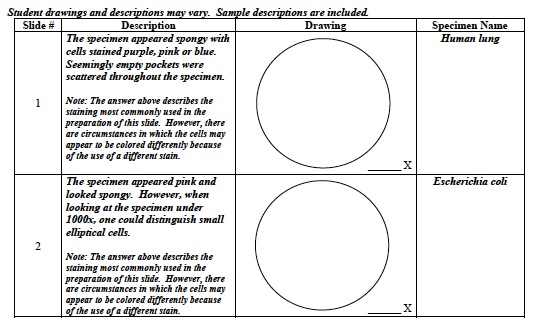
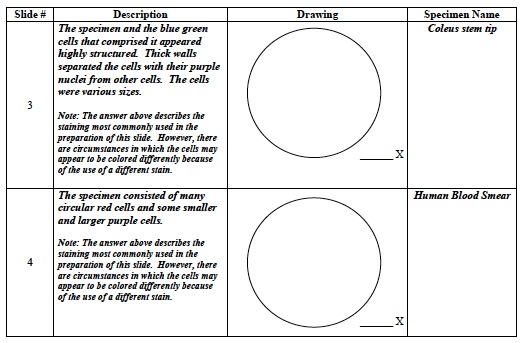
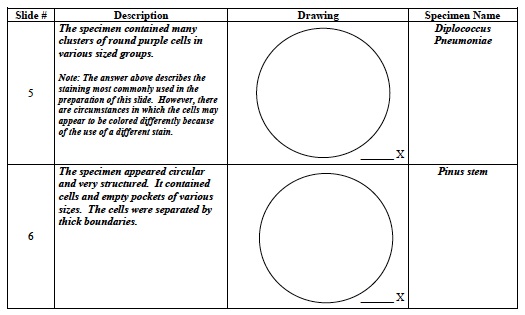
- Compare and contrast the six slides you observed. Student answers will vary. Each of the cells in the six specimens was unique. Upon initial inspection, the cells in slides 2 and 4 appeared similar, because both appeared to consist of many round cells. After observing the slides under 100X, however, one could see that slide 2 consisted of small elliptical cells while slide 4 contained small and large irregularly shaped and round cells with different colored nuclei. The cells in slides 3 and 6 appeared very organized and structured, although the shape of the specimens was quite different.
- Make a prediction. Based on the drawings and descriptions of the slides in Table A, did any of the specimens come from the same organism? Explain your answer. Student answers will vary. Students may conclude that it may be difficult to draw conclusions concerning cells and the organisms they come from simply by observing the specimens under a microscope.
Tell students that they may now uncover the identities of the slides and write the identity in the correct column of Table A of their Investigation One Data Record. Allow students to discuss the characteristics of each slide, and if there is time, observe each slide under the microscope again.
- Was your prediction correct? Student answers will vary.
- What conclusions about cells can you draw after your observations today? Student answers will vary. Students may conclude that cells have different appearances. They are different colors and are organized differently.
Note: If preparing for another class of students, instruct students to place the appropriate sleeve on the slide to once again cover the labels. Remind students to put the #1 label on the human lung slide, #2 on the Escherichia coli, and so forth, according to Table A of their Investigation One Data Record. Students may then return their materials to the distribution center.
Note: Questions marked with a triangle (∆) are included to enrich students’ understanding. These questions do not appear in students’ SDRs but should be used as additional discussion points during the PostLab.
- ∆ Why did you need to use a microscope? Cells are so small, they are impossible to see without powerful magnification.
- ∆ At what magnification were you able to view cells? At a total magnification of 100X, we were able to view cells. Students may need to be reminded of how to calculate total magnification in a microscope. When students look through a microscope, they look through two lenses, one in the eyepiece and one in the objective. In order to calculate total magnification, the magnification of the eyepiece must be multiplied by the magnification of the objective. For example, when using the 10X objective on a microscope with a 10X eyepiece, the total magnification is 100X.
- ∆ At what total magnification were you able to view cells with the greatest detail? Our microscopes were able to enlarge the image of the cells to a magnification of 1000X, enabling us to view the cells with the greatest detail.
- ∆ How did your view of the cells differ when different objectives were used? Each objective offered a different field of view and resolution. The field of view is the total area observed when viewing the specimen. The resolution is the ability to see fine details in the specimen. As the objectives increased in their refractive power (4X, 10X, 40X, 100X) the field of view decreased, but the resolution of the specimens increased.
- As a class, discuss this question: ∆ How are cells from one organism different from or similar to the cells of another?
- ∆ Based on your observations during this investigation, do you feel that you can answer this question? If so, how would you answer? Student answers will vary. Some students may feel that they do not have enough knowledge to determine how cells from one organism differ from those in another. Other students may recall that some cells are a certain color or that some cells are larger than others. Encourage varied responses.
- ∆ Based on your observations, do you feel that you can make generalizations about the characteristics of plant cells or of animal cells? For instance, can you determine that all plant cells are a certain size or that all animal cells are arranged in a specific manner? Student answers will vary. Without significant prior knowledge of cells, students may be unable to make generalizations about plant cells and animal cells. However, students may observe that the blood slide contained a non-specific arrangement of cells, whereas the Pinus stem slide contained cells in a specific arrangement. Students also may notice that the arrangement of cells in the Coleus stem slide looked much different from the arrangement of cells in the Pinus stem slide. Students may feel that the Pinus stem slide and the Human lung slide were similar in that they both contained a variety of specifically organized cells.
- ∆ What further information or observations do you need to form a scientific conclusion about the differences or similarities between cells of different organisms? What other variables or factors should you investigate? Student answers will vary. Students may feel that they need to look at more slides before they can make reliable conclusions. Students also may feel that they need to learn more about the way slides are prepared to find whether the differences or similarities they observe are due to the properties of the cells or the way the slides were prepared. Students may also wish to research the structures of cells so that they can properly identify and understand the cells they observe.
- ∆ Before you discovered the identity of each of your slides, were you able to identify whether cells were from multicellular organisms or unicellular organisms? Student answers will vary. In some cases, students may have been unable to identify whether the cells came from multicellular organisms or unicellular organisms. For instance, the cells on the blood slide may have appeared similar to the cells on the E. coli slide or the pneumoniae slide. Each bacterium on the E. coli slide is a unicellular organism, but each blood cell comes from a multicellular organism. Since the sample of E. coli was likely taken from a culture or colony, we are able to observe many E. coli rather than just one. The blood sample was taken from a sample of blood, and therefore also contains more than one cell.
Note: Students should begin to realize that while a practiced scientist like a pathologist, histologist, or microbiologist may be able to tell the difference between blood cells, E. coli, and pneumoniae, not everyone is able to draw such a conclusion without sufficient background. Sometimes it is vital that an observer knows some background about the specimen before trying to identify it. Information such as the location from which the specimen was obtained may provide valuable information necessary for identification. In the example of the blood cells, E. coli, and pneumoniae, the size and shape of the specimens may enable an observer to identify the cells. For instance, red blood cells are much larger than E. coli or pneumoniae. While E. coli and pneumoniae are of similar size, E. coli has an oblong shape while pneumoniae is spherical. In this case, an observer with minimal knowledge of each specimen may be able to properly identify each. However, some types of cells are so similar that even experts need some context before able to properly identify the specimen.
GET FOCUSED
Instruct students to complete the Focus Question in their SDRs then discuss it as a class. Use the suggested response below to guide students’ answers.
- Can you identify the type of organism a cell comes from through observation? Explain your answer. Student answers will vary. Students will likely find that they are unable to identify what type of organism a cell comes from through observation. Without a significant amount of prior knowledge, a person may have difficulty drawing conclusions based on what cell structures can or cannot be viewed under a microscope. Students likely were not able to differentiate between unicellular and multicellular organisms.