
Teacher Portal:
Cell Cycle and Cancer
Investigation 3 – PostLab

ZERO-IN
Italicized font represents information to be shared orally or physically completed with the students at this time.
The non-italicized font represents additional information included to support the teacher’s understanding of the content being introduced within the CELL.
ANALYZE IT
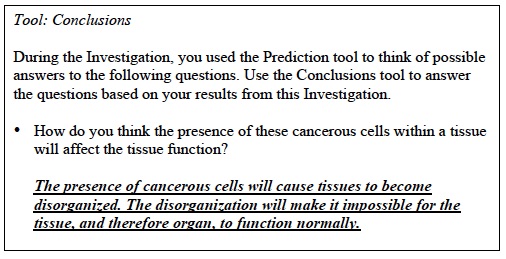
Instruct students to complete the Conclusion question in their SDRs then discuss it as a class. Use the suggested response below to guide students’ answers.
GET FOCUSED
Instruct students to complete the Focus Questions in their SDRs then discuss them as a class. Use the suggested responses below to guide students’ answers
- What is the relationship between the control of the cell cycle and cancer? Normally the cell cycle is regulated so that cells only progress through the cycle and divide when necessary. In cancer, the regulation of the cell cycle is lost and the cell divides constantly. The constant cell proliferation leads to a tumor and cancer.
COMPREHENSION CHECK
The Comprehension Check is designed to summarize the Core Experience Learning Lab and provide the teacher with an informal way to assess students’ understanding of the big ideas.
If time permits, ask your students to answer each Focus Question below. Use the suggested responses below to guide students’ answers.
- How does the organization of cells within an organ relate to an organ’s function? The cells are organized into tissues. Each tissue provides a function that contributes to the function of the organ. In the skin, the epidermal tissue is composed of closely packed cells that serve as a protective barrier between the external environment and the body. The dermis serves to contain connective tissue and blood vessels needed to maintain the integrity of the epidermis. The subcutaneous layer contains fat cells important in keeping us warm. The lung has alveoli that are lined with a single layer of alveolar (epithelial) cells. This thin layer allows the lung to function by permitting easy oxygen and carbon dioxide exchange to occur between inhaled air and the blood. Finally, in the breast tissue, you could see the organization of the glandular tissue cells to form the lobes and ducts needed to store and transport milk.
- How do cells in an organism replenish themselves after normal wear and tear to the tissue? Students may answer by discussing that cells replenish themselves by a process of cell division. Cell division is regulated by the cell cycle.
- How do tissues replenish the cells contained within them? Tissues replenish cells through cell division. Cell division has four phases, G1, S, G2, and M phase. During the S phase DNA is replicated and during the M phase mitosis occurs and cytokinesis (cell division occurs). Mitosis can be broken down into four stages including prophase, metaphase, anaphase, and telophase.
- What controls the process of cell division? The cell cycle is regulated by different proteins. The time it takes for a cell to complete the cycle is dependent on which regulatory proteins are present in that cell at any given time.
- What is the relationship between the control of the cell cycle and cancer? Normally the cell cycle is regulated so that cells only progress through the cycle and divide when necessary. In cancer, the regulation of the cell cycle is lost and the cell divides constantly. The constant cell proliferation leads to a tumor and cancer.