
Teacher Portal:
Cell Cycle and Cancer
Investigation 2 – PostLab

ZERO-IN
Italicized font represents information to be shared orally or physically completed with the students at this time.
The non-italicized font represents additional information included to support the teacher’s understanding of the content being introduced within the CELL.
ANALYZE IT
Note: Questions marked with a triangle (∆) are included to enrich students’ understanding. These questions do not appear in students’ SDRs but should be used as additional discussion points during the PostLab.
As a class, discuss the process of cell cycle regulation as the reason why different cells divide at different rates.
- ∆ What phase of the cell cycle was the model of the inactive breast cell most of the time? The inactive breast tissue cell was most likely in the G1 phase most of the time. However, students may suggest that it was in G2. It is not likely that a cell would be in the S or M phase for one year.
- ∆ Why do the embryonic and inactive breast tissue cells divide at different rates? The cells are serving different functions. Explain that the cells have different amounts of regulatory proteins (pins in the model).
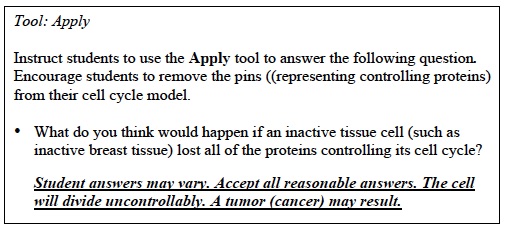
Instruct students to complete the Apply question in their SDRs then discuss it as a class. Use the suggested response below to guide students’ answers.
GET FOCUSED
Instruct students to complete the Focus Questions in their SDRs then discuss them as a class. Use the suggested responses below to guide students’ answers.
- How do tissues replenish the cells contained within them? Tissues replenish cells through cell division. Cell division has four phases, G1, S, G2, and M phase. During the S phase DNA is replicated and during the M phase mitosis occurs and cytokinesis (cell division occurs). Mitosis can be broken down into four stages including prophase, metaphase, anaphase, and telophase.
- What controls the process of cell division? The cell cycle is regulated by different proteins. The time it takes for a cell to complete the cycle is dependent on which regulatory proteins are present in that cell at any given time.