
Teacher Portal:
Atomic Structure
Investigation 2 – PostLab
ZERO-IN
Italicized font represents information to be shared orally or physically completed with the students at this time.
The non-italicized font represents additional information included to support the teacher’s understanding of the content being introduced within the CELL.
ANALYZE IT
-
Direct students to compare their results from Table A with the other members of their group then discuss the results as a class.
Instruct students to complete the Analysis Questions in their SDRs then discuss them as a class. Use the suggested responses below to guide students’ answers.
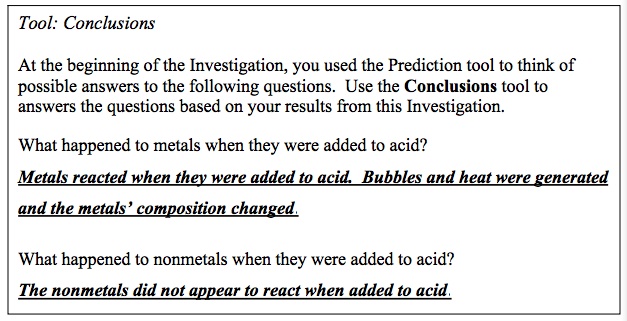
- Which elements had a chemical reaction when they were added to the HCl? Iron (Fe) and magnesium (Mg) had a chemical reaction.
- Which elements did not react when they were added to the HCl? Sulfur (S) and carbon (C) did not have a chemical reaction.
- Did the group that an element belonged to on the Periodic Table affect the likelihood that it would react to the hydrochloric acid (HCl)? The group did affect the likelihood that an element would react. Elements with a larger group number (nonmetals) were less likely to react to the hydrochloric acid (HCl) than the metals.
Note: In Investigation 1, students studied other metals in addition to the two they explored in this Investigation.
- Ask students what they would have expected if the metals from Investigation 1 were added to an acid?
Note: Students should conclude that the other metals will react just as iron and magnesium reacted when added to acid.
GET FOCUSED
Instruct students to complete the Focus Questions in their SDRs then discuss them as a class. Use the suggested responses below to guide students’ answers.
- How do the elements from the metal and nonmetal groups differ? Metals and nonmetals have different chemical properties from each other. For example, they react differently when combined with other substances. In our example, when we added metals to hydrochloric acid (HCl) the metals generated bubbles and heat as they reacted. Alternatively, when nonmetals were added to hydrochloric acid (HCl), no visible chemical reaction took place.
- What are atoms? What components make up an atom? An atom is the smallest particle of an element that still has all the properties of that element. Atoms are composed of three different types of subatomic particles. In the nucleus of the atom are the protons and the neutrons. Protons have a positive electrical charge while the neutrons have no electrical charge. Orbiting the nucleus are the atom’s electrons. They are small subatomic particles that carry a negative electrical charge.
- What information about an element can be determined by using the Periodic Table of the Elements? An element’s atomic mass is equivalent to the number of protons in its atoms’ nucleus and the number of electrons normally orbiting the nucleus. In addition, the number of neutrons likely to be found in its nucleus is equal to the element’s atomic mass minus its atomic number.