
Teacher Portal:
Atomic Structure
Investigation 3 – PostLab
ZERO-IN
Italicized font represents information to be shared orally or physically completed with the students at this time.
The non-italicized font represents additional information included to support the teacher’s understanding of the content being introduced within the CELL.
ANALYZE IT
Instruct students to complete the Analysis Questions in their SDRs then discuss them as a class. Use the suggested responses below to guide students’ answers.
- Which elements were able to transmit a current? Copper (Cu), magnesium (Mg), iron (Fe), zinc (Zn) and aluminum (Al) were able to transmit a current.
- Which elements were not able to transmit a current? Sulfur (S) and carbon (C) were not able to transmit a current.
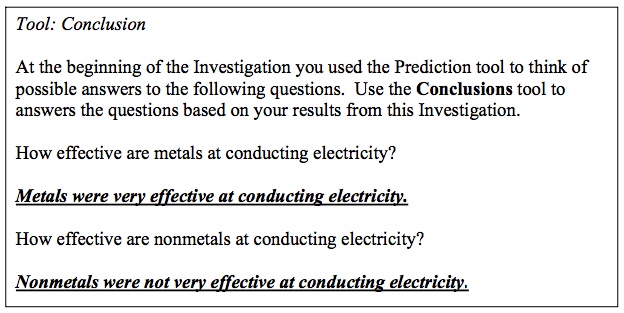
- Based on your data, which types of elements have the ability to conduct, or transmit, electricity? Metals have the ability to conduct electricity.
- Based on its position in the Periodic Table, should the element iodine (I) be able to conduct electricity? No. Iodine (I) is in the nonmetal section of the Periodic Table. Nonmetals are not good at conducting electricity.
- Is it possible to have both metals and nonmetals in a group on the Periodic Table? Yes. Groups 1, 13, 14, and 15 have both metals and nonmetals.
GET FOCUSED
Instruct students to complete the Focus Questions in their SDRs then discuss them as a class. Use the suggested responses below to guide students’ answers.
- How do elements from the metal and nonmetal groups differ? Elements from the metal and nonmetal groups have different physical and chemical properties. One difference in physical properties is the ability to conduct electricity. Elements that are metals have the ability to conduct electricity while elements that are nonmetals do not.