
Teacher Portal:
Atomic Structure
Investigation 2 – Concept Day
ZERO-IN
Italicized font represents information to be shared orally or physically completed with the students at this time.
The non-italicized font represents additional information included to support the teacher’s understanding of the content being introduced within the CELL.
ASK WHY
Remind students that it is important to know about atoms because atoms are the building blocks of matter. We use our knowledge of atoms to explain the properties of matter, understand and manipulate matter and, ultimately, the world around us.
BRANCH OUT
Explain to students that scientists at IBM made a short film using atoms. The technology that the scientists used to make the film is the same technology used to compress data for storage. In the future, this technology will allow people to carry around an archive of all the movies ever made!
PRINT IT
Use your browser to download a printable PDF as a help during the slide presentation and to make additional notes. In your browser, go to File > Print and then choose to save as PDF.
NAVIGATE IT
Once the slide presentation is launched
- use your left and right arrows to advance or go back in the slide presentation, and
- hover your mouse over the left edge of the presentation to get a view of the thumbnails for all the slides so that you can quickly move anywhere in the presentation.
- Click HERE to launch the slide presentation for the CELL.
SHARE IT
SLIDE ATOM-2-1
- Inform students that the slide presentation
- begins with a discussion of one of the most fascinating and important topics in science – the origin of matter, and
- also introduces them to the Big Bang Theory.
Note: We introduce the Big Bang Theory at this point because students are preoccupied with matter, elements and atoms throughout the entire Atomic Structure CELL, so they may well wonder where matter comes from.
Note: We only introduce the Big Bang in very simple terms. Nonetheless, very interesting discussions may occur both in and out of the classroom regarding the beginning of the Universe and time! Students needn’t have all the details at this point.
Note: Atoms and subatomic particles are discussed in the context of the Periodic Table of the Elements.
______________________________________
SLIDE ATOM-2-2
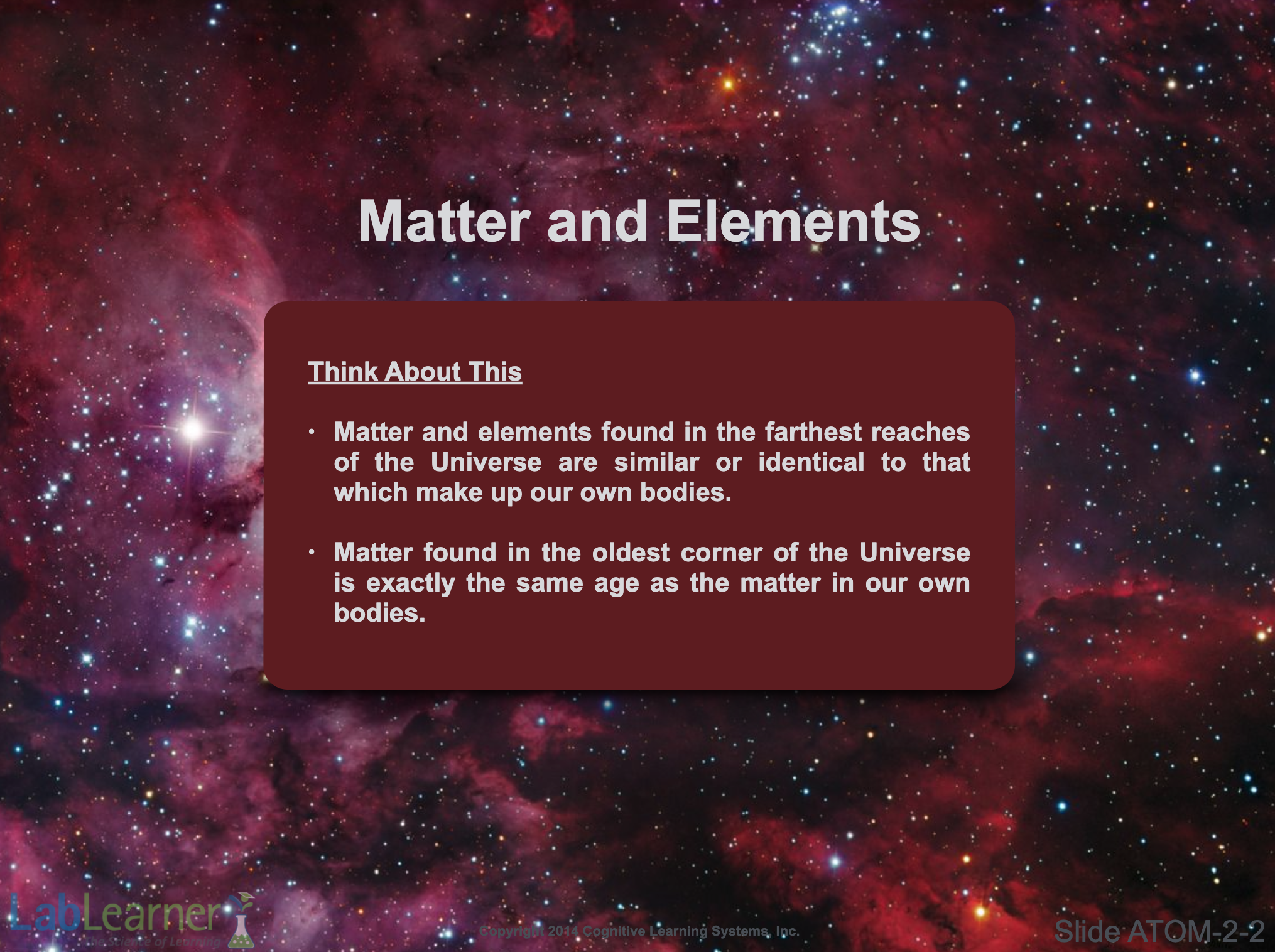
- In preparation for the introduction of the Big Bang Theory, ask students to think about the similarities between the composition and age of the matter in their own bodies compared to that of the Universe as a whole.
- Read the slide for the students.
- Ask students the following questions:
- Why do you think scientists believe these points are true?
- Where did the matter in your body come from? Where was it prior to that? And before that?
______________________________________
SLIDE ATOM-2-3
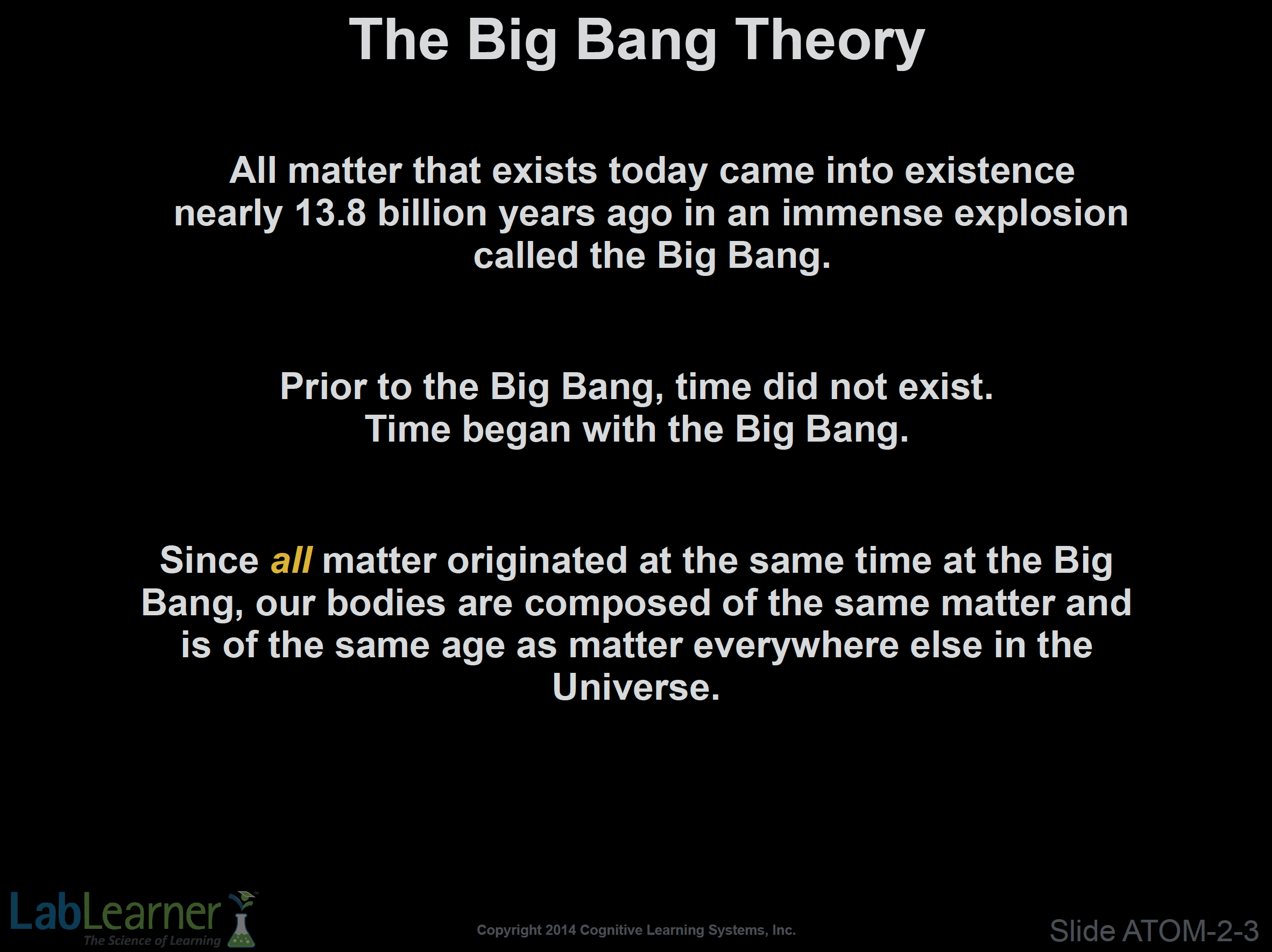
- Read the initial text segment for the students. (Click the right arrow once.)
- Read the next text segment for the students. (Click the right arrow once.)
- Read the last text segment for the students.
Note: At the time of the Big Bang (about 13.8 billion years ago), all matter and energy sprang into existence. Here we omit mention of energy to simplify the concept at this first introduction. We mention that time itself came into existence at the Big Bang as well.
Note: While the Big Bang is perhaps the most significant of all scientific topics, we necessarily leave this brief introduction superficial and move on. Students should nonetheless be stimulated by this brief discourse and may also bring up the popular television show The Big Bang Theory.
______________________________________
SLIDE ATOM-2-4
- Read the slide for the students.
-
Note: This slide is presented simply to bring thoughts back to the Periodic Table of the Elements and to remind students that all matter is composed of the elements in the Table (and any new elements that may be discovered over time).
Note: The slide also reminds students that the smallest unit of an element is the atom. By definition, an atom is the smallest particle of an element that still has all the properties of that element.
Note: We wish to maintain the connection between matter, elements, and atoms as we move into thinking about atomic and subatomic structure on the next slide.
______________________________________
SLIDE ATOM-2-5
- After the initial text appears, click the right arrow once.
-
- Tell students that
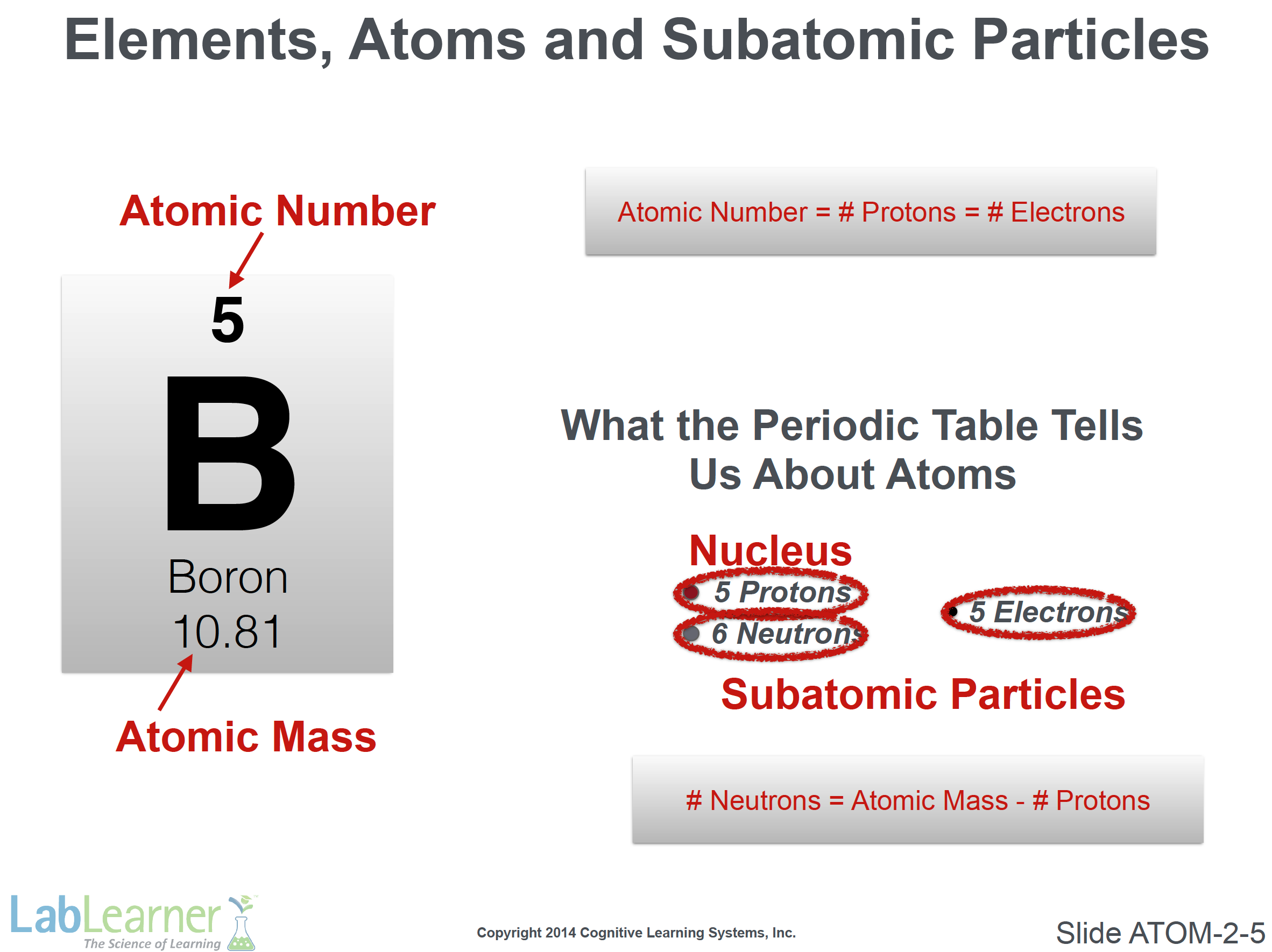
- in this slide, we use the element Boron to illustrate how information on the Periodic Table can tell us a lot about atoms and how they are constructed. (Click the right arrow two times.)
- an atom of Boron, just like an atom of any element, can be broken into subatomic particles called protons, neutrons, and electrons (Click the right arrow one time.),
- the Atomic Number gives us the number of positively charged protons in the nucleus as well as the number of the negatively charged electrons that surround the nucleus,
- the number of positive charges from the protons is exactly matched by the negatively charged electrons so that the atom has no net charge (Click the right arrow once.),
- we can use the Atomic Mass to figure out the number of uncharged neutrons in the nucleus of the Boron atom by simply subtracting the number of protons from the atomic mass then rounding the answer to the nearest resulting whole number.
______________________________________
SLIDE ATOM-2-7
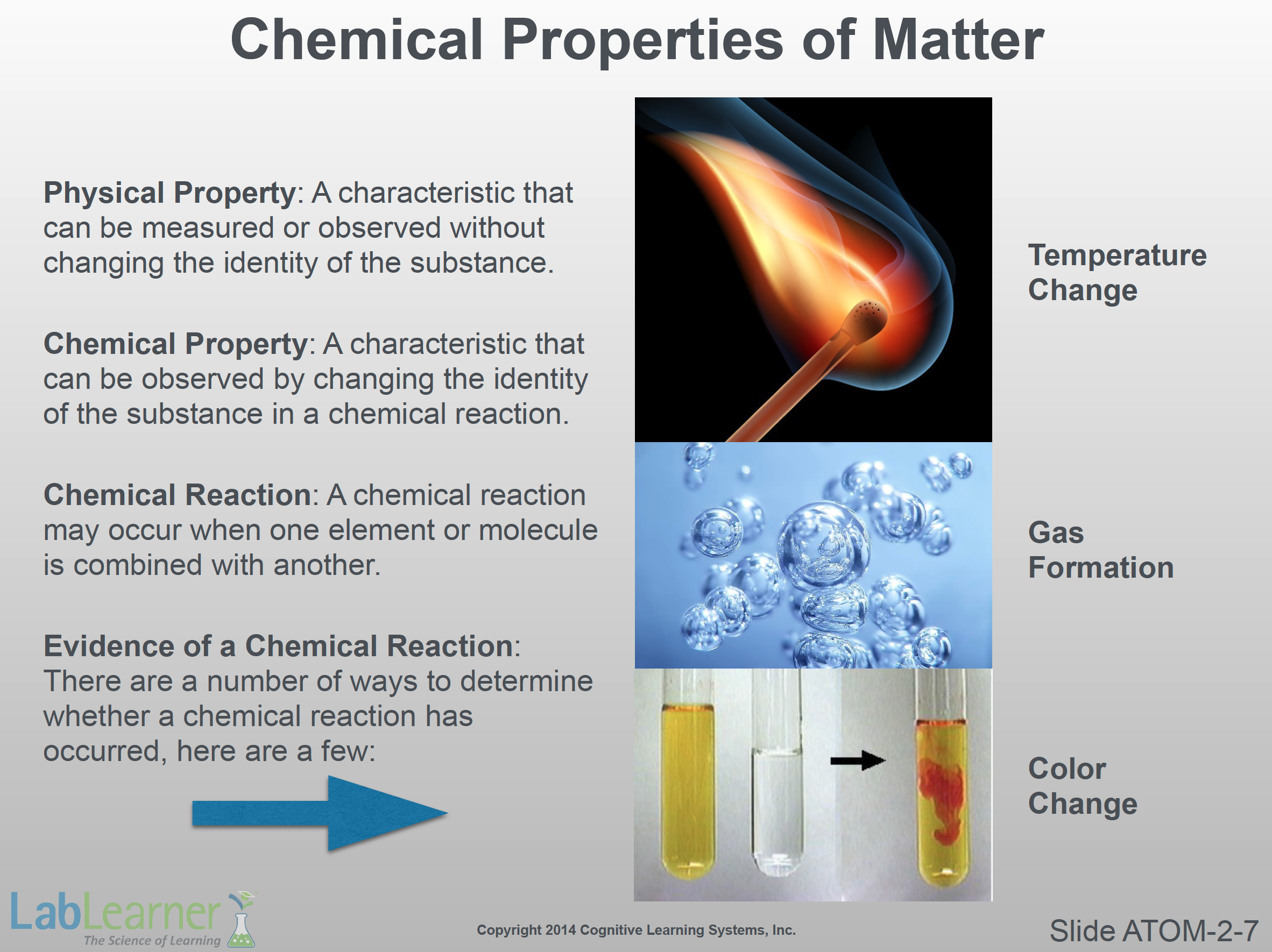
- Read the slide for the students.
- Tell students that signs of a chemical reaction include
- temperature change,
- gas formation, and
- color change.
- Tell students that signs of a chemical reaction include
- Explain to students that they may experience each of these changes in the Investigation 2 Lab.
-
Note: This slide offers a quick review of the physical and chemical properties of matter in preparation for the Investigation 2 Lab.
______________________________________
SLIDE ATOM-2-8
- Read the slide for the students.
-
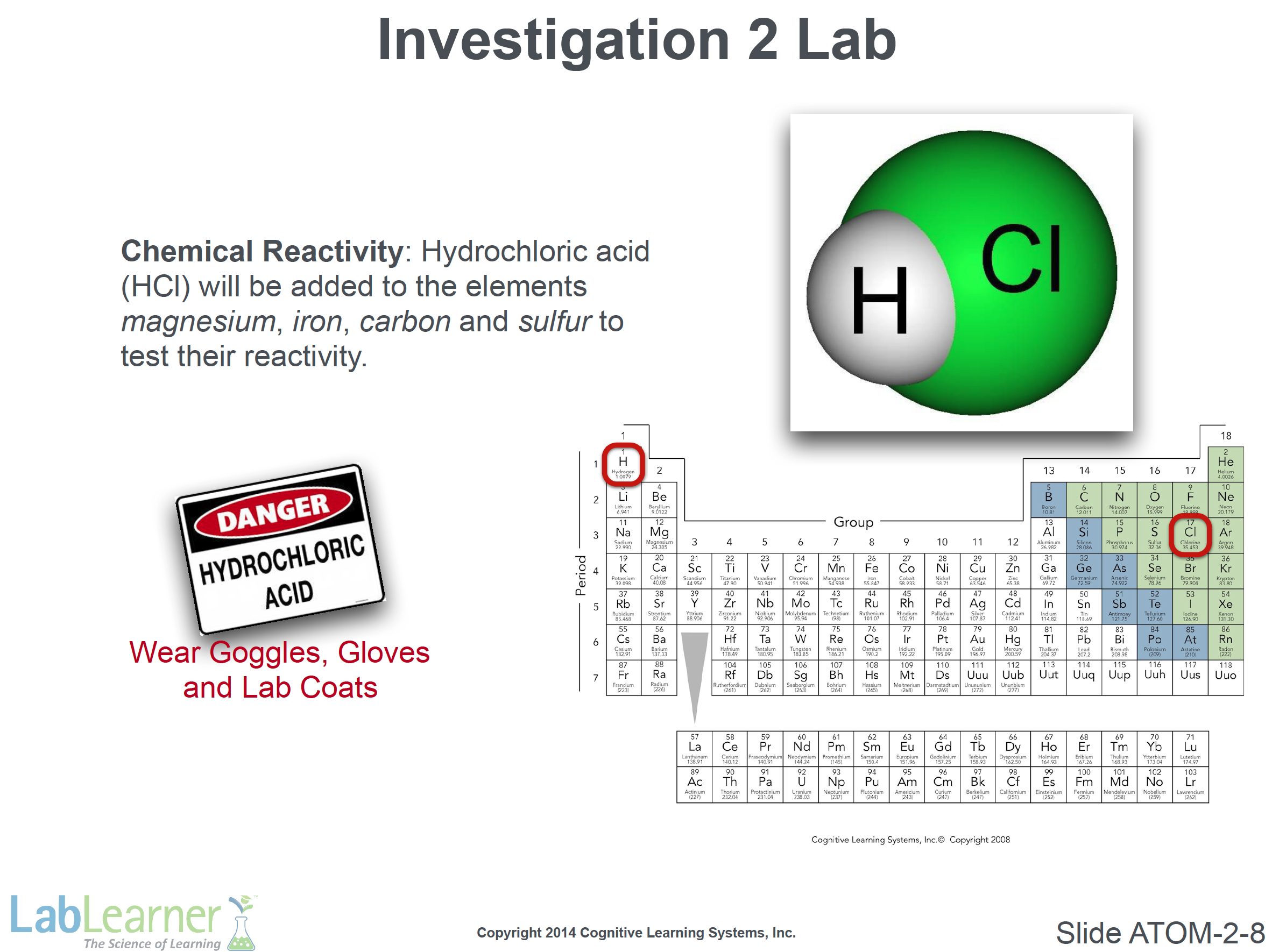
- Explain to students that they will be using hydrochloric acid in the Investigation 2 Lab.
- Explain to students that the structure of hydrochloric acid is shown (hydrogen is white and chlorine is green, one atom of each in the molecule) as well as the location of both hydrogen (H) and chlorine (Cl) on the Periodic Table of the Elements.
- Emphasize safety in the Lab. Explain to students that they will be handling various elements and chemicals and must wear goggles, gloves, and lab coats for protection.
Note: A safety reminder is given for handling hydrochloric acid. As is the case with many caustic acids and bases, HCl is virtually indistinguishable from water by simple visual inspection. Students must be taught to be consistently safe in the Lab.