
Teacher Portal
Atmosphere
Investigation 3 – PreLab

ZERO-IN
Italicized font represents information to be shared orally or physically completed with the students at this time.
The non-italicized font represents additional information included to support the teacher’s understanding of the content being introduced within the CELL.
ASK WHY
Remind students that Earth’s atmosphere is critical for life on our planet. It protects us from dangerous radiation from the sun and other objects coming at us from outer space, holds in surface heat and prevents it from radiating out into space, provides weather, makes flight possible, and, ultimately, allows us to talk with each other.
BRANCH OUT
Remind students that astronomers determine the composition of a planet, its atmosphere, and its moons. Interestingly, astronomers continually contend with Earth’s atmosphere. It is a notoriously unpredictable and limiting factor in obtaining fine views of the planets and stars.
GET FOCUSED
Inform students that the Investigation is designed to help them to answer the following Focus Questions:
- What factors are necessary for precipitation to form along fronts? Three of the factors necessary for precipitation to occur include a difference in density between the warm and cold air masses, an upper atmosphere that has temperatures lower than the air in the rising warm air mass, and a significant amount of water vapor in the rising warm air mass.
- What changes in atmospheric pressure occur with the passing of a cold or warm front? In both cold and warm fronts, the rising of the warmer air mass is accompanied by a decrease in the atmospheric pressure.
Note: These questions are located in students’ SDRs at the beginning and end of the Investigation.
Note: These are succinct responses to the Focus Questions and are placed here for your reference at this time. Fully developed responses to the Focus Questions can be found on the PostLab page.
GO DEEPER
As a class, read the Background(s) in the Investigation. Have students read the information aloud or silently to themselves. When students have finished, discuss the following concepts as a class:
- Air masses are large bodies of air that develop over areas of the Earth where the air is relatively calm and there are few winds.
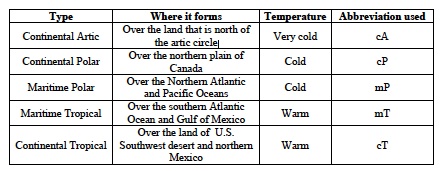
- Air masses tend to form in the polar and tropical regions of the Earth and take on the temperature and humidity characteristics of the surface over which they develop.
- The air masses that form over water usually contain more water or moisture than the air masses that form over land.
- Meteorologists tend to classify the major air masses according to the following labels:
- Air masses are moved around the Earth by upper atmosphere winds such as the jet stream as well as winds surrounding low and high-pressure systems.
- When air masses of different temperatures collide, a front is formed.
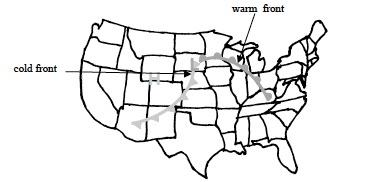
- Fronts represent the boundaries between warm and cold air masses. In a cold front, a cold air mass moves in behind a warmer air mass. In a warm air front, a warm air mass moves in behind a colder air mass.
- Cold and warm front are represented by different symbols on a weather map.
- A cold front is represented by a solid line with triangles. The triangles point in the direction of the warmer air and the direction in which the front is moving.
- A warm front is represented by a solid line with semi-circles pointing in the direction of the colder air and in the direction in which the front is moving.
Note: These concepts are integrated into the Background(s) and are used to deepen students’ comprehension of the big ideas.
LEARN THE LabLearner LINGO
The following list includes Key Terms that are introduced in the Investigation Background(s). They should be used, as appropriate, by teachers and students during everyday classroom discourse.
- air mass
- front
- cold front
- warm front
- evaporation
- condensation
- precipitation
Note: Definitions of these terms can be found on the Introduction page to the CELL.
Note: Additional words may be bolded within the Background(s). These words are not Key Terms and are strictly emphasized for exposure at this time.
SET FOR SUCCESS
- Ask students to recall what they learned about atmospheric and barometric pressure from the experiments in Investigation Two, discussing the answers to the following questions. Encourage students to describe the air movements that accompany high and low-pressure systems.
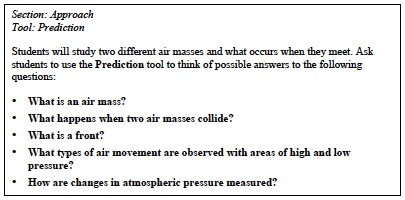
- What types of air movement are observed with areas of high and low pressure?
- How are changes in atmospheric pressure measured?
- Ask students to think about other symbols that they may see on weather maps or other terms that they may hear in weather forecasts. If necessary suggest the terms warm air mass, cold air mass, cold front, and warm front as two of these terms.
- Assess students’ prior knowledge and their understanding of the Background to predict the answers to the following questions:
- Play the video below. Stop to ask students questions or answer students’ questions when necessary. Remind students to follow along with their SDRs and make any notes that they think might be helpful.
- After the video, direct students to divide into their lab groups to discuss their strategy for the lab. For example, they may assign certain group members to perform specific functions during the lab.
Note: The purpose of the video is to allow students to anticipate the laboratory experience they will soon encounter. Students should leave this PreLab session with a firm idea of what to expect and how to perform in the lab.
Note: Homework is posted below the video.
HOMEWORK
Tell students that they should review the Investigation in preparation for the Lab.