
Teacher Portal:
Atmosphere
Investigation 3 – PostLab

ZERO-IN
Italicized font represents information to be shared orally or physically completed with the students at this time.
The non-italicized font represents additional information included to support the teacher’s understanding of the content being introduced within the CELL.
ANALYZE IT
Instruct students to complete the Analysis Questions in their SDRs then discuss them as a class. Use the suggested responses below to guide students’ answers.
Encourage students to share their answers to the questions that follow Trial 1.
- Why did water form in the tube that was placed between the sides of the ice water bag? Why did water appear in the centrifuge tube? Explain your answer in terms of the temperatures of the air in the flask and in the tube. The air that rose from the heated flask was moist and very warm. The molecules of water in this air possessed a great amount of kinetic energy. As the heated air rose, it encountered air in the tube that was surrounded by the ice water. The air in this tube was cooler than the air from the flask. As the temperature decreased the kinetic energy of the water molecules decreased. As a result there was condensation of some of the molecules of water vapor.
- In the model, the moist air mass was represented by the water vapor that rose up into the flask and the tubing. The cold upper atmosphere was represented by the tubing inside the bag with ice water. How does your experiment help explain why precipitation occurs at a front? The experiment showed that if warm moist air rises into the upper layers of the atmosphere where the temperature is colder than the temperature of the air in the warm moist air mass, the water vapor contained in the warm moist air mass will condense and precipitation can occur, falling to Earth.
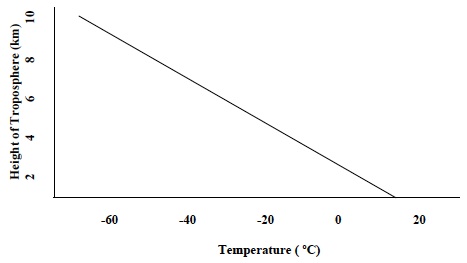
- The diagram below shows the relationship between altitude and the temperature in the troposphere. Which part of the model does the diagram resemble? In the model this is represented by the tubing that is between the sides of the bag containing ice water.
- Many of the fronts that form in the United States form over land. Why do these front produce precipitation? Explain your answer in terms of where the air masses that form the fronts may have formed.
If students completed Trials 2 and 3 in the lab or if students read the Cold and Warm Front Pressure Changes Background sheet, encourage them to share their answers to the question that follows Trials 2 and 3.
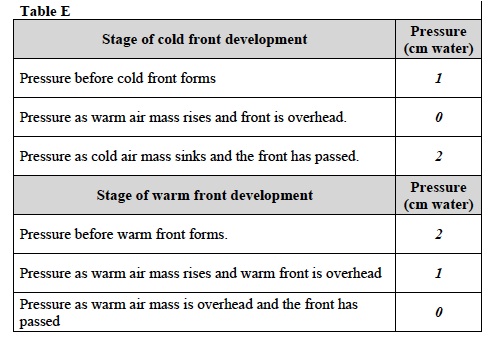
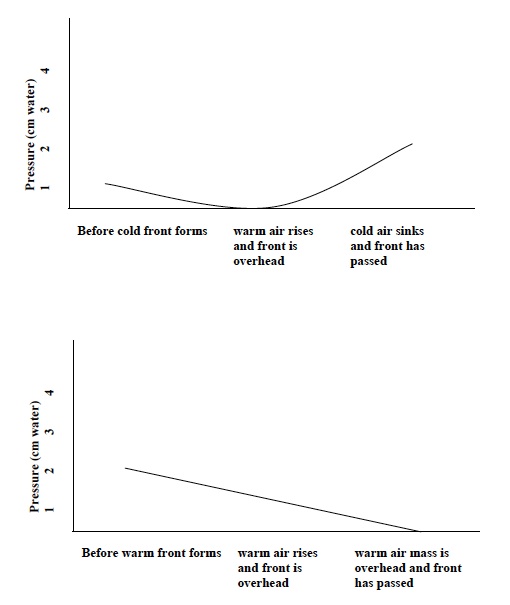
- Use the data from the experiment (Table E) to create a visual aid that shows the changes in pressure as a cold and warm front pass through an area. Create the visual aid in the form of two graphs.
Note: Questions marked with a triangle (∆) are included to enrich students’ understanding. These questions do not appear in students’ SDRs but should be used as additional discussion points during the PostLab.
Provide an opportunity for students to synthesize the information and concepts they learned from all three investigations by asking the following questions:
- ∆ How do differences in the density of air contribute to the formation of fronts? Air masses of different temperatures have different densities. Warmer air is less dense than colder air. When air masses of different temperatures collide, their differences in density result in the warmer air mass rising over the colder air mass. As the warmer air mass rises into the colder, upper levels of the atmosphere the rates of evaporation and condensation of the water and water vapor in the air mass change because of the change in temperature. As the temperature of the air decreases, the kinetic energy of the gas molecules that comprise air decrease. The result is that the rate of condensation becomes greater than the rate of evaporation and cloud formation and precipitation can occur. The amount of condensation and precipitation that occur then depends upon the humidity or amount of water vapor contained in the air mass.
- ∆ How does the unequal heating of the Earth set up the atmospheric events that result in the formation of fronts? Because the Earth is tilted 23.5 degrees on its axis, the equator receives more direct light than the poles. Surfaces at the equator therefore absorb and then conduct or radiate more heat to the atmosphere directly overhead than the surfaces at the poles. Air masses that form over the equator and near the equator therefore are warmer than air masses that develop over or near the poles. As winds move these air masses around the Earth, air masses of different temperatures collide forming fronts. Differences in the densities of these air masses result in warmer air masses rising and cooler air masses sinking leading to condensation, cloud formation and precipitation as well as other more severe atmospheric events.
- ∆ Why do changes in pressure accompany the formation and passing of a front? Fronts form as air masses of different temperatures collide. When this happens the differences in densities of the air masses results in warmer air masses rising over the colder air masses. Atmospheric pressure is a measure of the downward force per area exerted by the atmosphere on the Earth. Cool air sinking increases the downward force of air on the Earth and thus increases atmospheric pressure at that area on the Earth. Warm air rising decreases the downward force of air on the Earth and thus decreases the atmospheric pressure at that area on the Earth. The pressure changes that accompany the formation and passing of a front result from the movement of different masses of air.
GET FOCUSED
Instruct students to complete the Focus Questions in their SDRs then discuss them as a class. Use the suggested responses below to guide students’ answers.
- What factors are necessary for precipitation to form along fronts? Three of the factors necessary for precipitation to occur include a difference in density between the warm and cold air masses, an upper atmosphere that has temperatures lower than the air in the rising warm air mass, and a significant amount of water vapor in the rising warm air mass. The temperature of the atmosphere decreases with the height of the atmosphere. When cold fronts form, air from the cold and warm air masses move as a result of a difference in densities. The more dense cold air pushes under the less dense warm air ahead of it. The air in the warm air mass rises. As the warm air rises, it encounters cooler temperatures, and the rate of evaporation decreases. As the rate of evaporation becomes slower than the rate of condensation, and water vapor in the warmer air can condense and forms clouds and precipitation. When warm fronts form, air from the cold and warm air masses move as a result of their densities. The less-dense warm air behind the colder air masses rises and slides over and above the cold air mass. As the warm air rises, it encounters cooler temperatures, and the rate of evaporation decreases. As the rate of evaporation becomes slower than the rate of condensation, water vapor in the warmer air can condense and form clouds and precipitation. The more water vapor the rising warm air mass contains, the more likely it is that there will be a greater amount of precipitation that occurs with both a warm and cold front.
- What changes in atmospheric pressure occur with the passing of a cold or warm front? In both cold and warm fronts, the rising of the warmer air mass is accompanied by a decrease in the atmospheric pressure. In a cold front, there is a decrease in pressure as the front forms because the cool air mass slides under the warmer air mass and pushes it upwards. The rising warm air results in a decrease in atmospheric pressure. This decrease is followed by an increase in pressure once the front has passed because of the cooler sinking air that moves in behind the warmer rising air. In a warm front, there is a decline in the atmospheric pressure as the front moves into an area because a warm air mass moves in behind a cooler air mass. As the warm air mass slides over the cooler air mass there is a decrease in pressure. The pressure continues to drop as the front passes because of the warmer, rising air that moves in behind the cooler air mass.
COMPREHENSION CHECK
The Comprehension Check is designed to summarize the Core Experience Learning Lab and provide the teacher with an informal way to assess students’ understanding of the big ideas.
If time permits, ask your students to answer each Focus Question below. Use the suggested responses below to guide students’ answers.
- What happens to air as it is heated and cooled? The volume and density of air change with changes in temperature. As the temperature of air increases, its volume increases, and its density decreases. As the temperature of air decreases, its volume decreases, and its density increases.
- How do changes in the temperature of air affect its density? As air is heated its density decreases because its mass remains constant but its volume increases. As air is cooled, its density increases because its mass remains constant but its volume decreases.
- Why do changes in density cause air movement? Air is a fluid. Fluids that are more dense sink below those that are less dense. The decrease in density as air is heated causes it to rise above cooler, more dense air. The increase in density as air is cooled causes it to sink below warmer, less dense air.
- How do differences in the temperature of the Earth’s atmosphere affect the movement of air? The warmer air in the atmosphere rises and cooler air in the atmosphere sinks. This causes convection currents in the atmosphere.
- What types of air movements cause areas of high and low pressure? Air that moves from the upper levels of the atmosphere downward towards Earth creates an area of high pressure beneath the falling air. Air that rises or moves upward from the Earth or from lower levels of the atmosphere toward the upper atmosphere creates an area of low pressure beneath the rising air. Cold air sinking would increase the pressure in an area while warm air rising would decrease the pressure in an area.
- Why do differences in pressure cause wind? When there are pressure differences in the atmosphere air moves from areas of high pressure to areas of low pressure. This movement of air creates wind.
- How are differences in pressure measured? Changes in pressure are measured with a barometer. One type of barometer is the mercury barometer. As the pressure of an area increases the increased downward force of air pushes the mercury in a barometer up into the barometer. As the pressure of an area decreases, the level of mercury in a barometer falls because the downward force of air on the liquid in the barometer has decreased.
- What changes in temperature are necessary for precipitation to form along fronts? The temperature of the atmosphere decreases with the height of the atmosphere. Areas of the atmosphere closer to the ground have a higher temperature than areas higher in the atmosphere. When cold fronts form, air from the cold and warm air masses move as a result of their densities. The more dense cold air pushes under the less dense warm air ahead of it. The air in the warm air mass rises. As the warm air rises, it encounters cooler temperatures, and the rate of evaporation decreases. As the rate of evaporation becomes slower than the rate of condensation, water vapor in the warmer air condenses and forms clouds and precipitation. When warm fronts form, air from the cold and warm air masses move as a result of their densities. The less-dense warm air behind the colder air masses rises and slides over and above the cold air mass. As the warm air rises, it encounters cooler temperatures, and the rate of evaporation decreases. As the rate of evaporation becomes slower than the rate of condensation, water vapor in the warmer air condenses and forms clouds and precipitation.
- What changes in atmospheric pressure occur with the passing of a cold or warm front? In both cold and warm fronts, the rising of the warmer air mass is accompanied by a decrease in the atmospheric pressure. In a cold front, there is a decrease in pressure as the front forms because the cool air mass slides under the warmer air mass and pushes it upwards. The rising warm air results in a decrease in atmospheric pressure. This decrease is followed by an increase in pressure once the front has passed because of the cooler sinking air that moved in behind the warmer rising air. In a warm front, there is a decline in the atmospheric pressure as the front moves into an area because a warm air mass moves in behind a cooler air mass. As the warm air mass slides over the cooler air mass there is a decrease in pressure. The pressure continues to drop as the front passes because of the warmer, rising air that moves in behind the cooler air mass.