
Teacher Portal:
Atmosphere
Investigation 2 – PostLab

ZERO-IN
Italicized font represents information to be shared orally or physically completed with the students at this time.
The non-italicized font represents additional information included to support the teacher’s understanding of the content being introduced within the CELL.
ANALYZE IT
Instruct students to complete the Analysis Questions in their SDRs then discuss them as a class. Use the suggested responses below to guide students’ answers.
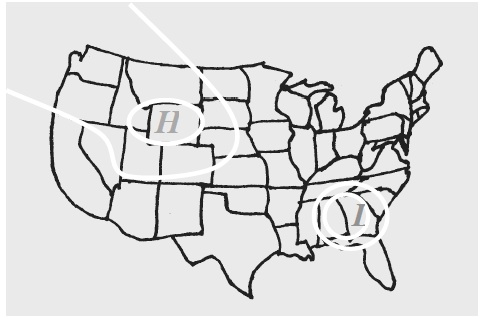
- The weather map below shows areas of high and low pressure. Describe what is happening to the air at each of these locations. There is a high-pressure area over Oregon and a low-pressure area over Georgia. Air from the upper levels of the atmosphere over Oregon moves toward the surface of the Earth. As result, the pressure below the downward moving air is higher than the surrounding areas. Air from the lower levels of the atmosphere over Georgia is rising. As a result, the pressure below the rising air is lower than the surrounding areas.
- In Investigation One you learned that cold air sinks and warm air rises. What type of pressure center would develop in an area in which a large amount of warm air is rising? Why? Low-pressure centers occur when the upward force of moving air and air molecules is greater than the downward force of moving air and air molecules. Therefore, a low-pressure center develops directly below rising air. The warm air that is rising would cause a low-pressure center to develop.
- What type of pressure center would develop in an area in which a large amount of cold air is sinking? Why? High-pressure centers occur when the downward force of moving air and air molecules is greater than the upward force of moving air and air molecules. Therefore, a high-pressure center develops directly below sinking air. Cold air that is sinking would cause a high-pressure center to develop.
- In which direction did the aluminum foil pieces move when the high-pressure center was surrounded by areas of lower pressure? Explain your answer in terms of differences in pressure. The aluminum foil pieces moved from the area of high pressure outward toward the areas of lower pressure.
- In which direction did the aluminum foil pieces move when the low-pressure center was surrounded by areas of higher pressure? Explain your answer in terms of differences in pressure. The aluminum foil pieces moved from the areas of high pressure to the area of low pressure.
- Wind is the horizontal movement of air between areas of different pressure. In which direction does the wind blow? Explain your answer in terms of differences in pressure using data from your experiment. When a high-pressure center was created by lowering the stack of paper and pushing air in a downward direction, the air moved from the area of higher pressure outward toward the surrounding areas that were lower in pressure. This was observed as the aluminum foil pieces moved outward from the “high-pressure center.” When a low-pressure center was created by lifting the stack of paper and pulling air in an upward direction, the air moved from the surrounding areas of higher pressure toward the area of lower pressure. This was observed as the aluminum foil pieces moved inward toward the “low-pressure center.”
- How did the strength of wind change as the distance between two areas of pressure increased? The aluminum foil piece move 17.6 cm when the distance between the 1020 mb area and 1000 mb area was 20 km. As the distance between the 1020 mb high-pressure center and 1000 mb low areas increased to 140 km and 260 km, the foil pieces did not move as far: 8.8 cm at the 140 km isobar and 0.7 cm at the 260 km isobar. A similar result was observed when the distance between the 1020 mb high-pressure areas and the 1000 mb low-pressure center was increased. The foil piece moved 18.6 cm when the distance between the 1000 mb and 1010 mb areas was 20 km but only 2.7 cm and 0 cm when the distance was increased to 80 km and 140 km. Therefore, the strength of the wind decreased as the distance between the areas of high and low pressure increased.
- Calculate the PGF (pressure gradient force) for the winds produced in Trial 2.
PGF = [higher pressure(mb) – lower pressure (mb)] ÷ distance (km)
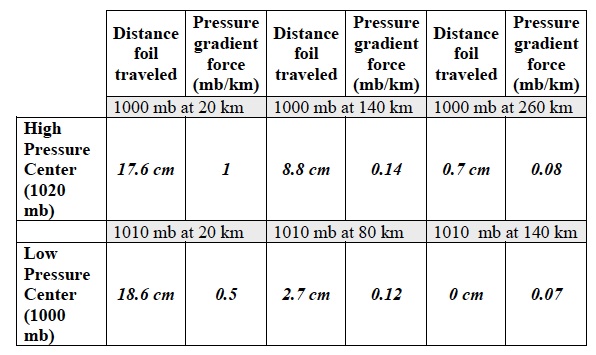
- How did the pressure gradient force a change as the distance between either the high or low-pressure center and other areas of pressure increase? As the distance between the high and low-pressure areas increased the pressure gradient force decreased. 10.
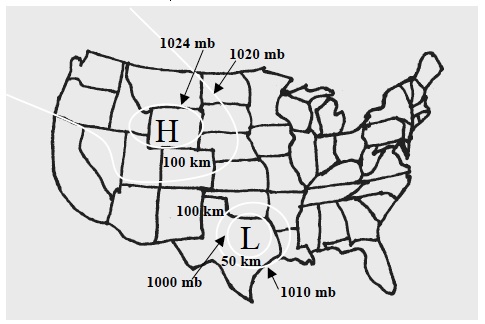
- The map below shows different isobars of pressure across the United States. Determine the pressure gradient force for the winds that will occur. Use the pressure gradient force to describe the strength and directions of the winds that will occur. Winds will blow from the 1024mb center of the high-pressure center toward the 1020mb area. The pressure gradient force will be 4mb/100km. Winds will blow from the 1020 mb area towards the 1010 mb area. The pressure gradient force will be 10mb/100km. Winds will blow from the 1010 mb area toward the center of the low-pressure center (1000mb). The pressure gradient force will be 10 mb/50 km. The strongest wind will be towards the low-pressure center (10 mb/km). The weakest wind will be outward from the high-pressure center (4 mb/100 km.
- In which direction did the water in the barometer move when an area of high pressure was modeled? The water moved up into the test tube.
- In which direction did the water in the barometer move when an area of low pressure was modeled? The water moved from higher up in the test tube to lower in the test tube.
- “The barometer is falling” is one phrase used to forecast changes in weather. What does this phrase indicate about the change in pressure that will occur over an area? This would indicate that an area of low pressure is developing over an area. The observations made in this experiment showed that the level of water in the barometer fell when an area of low pressure was modeled.
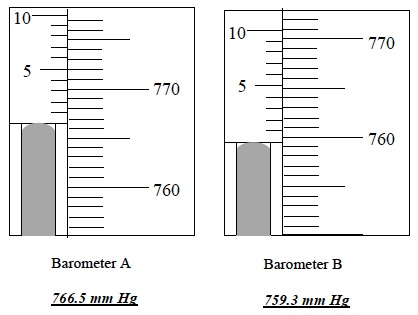
- Two barometers are shown below. What is the barometric pressure of each? Which shows a higher atmospheric pressure? Barometer A shows the higher atmospheric pressure.
GET FOCUSED
Instruct students to complete the Focus Questions in their SDRs then discuss them as a class. Use the suggested responses below to guide students’ answers.
- What types of air movements cause areas of high and low pressure? Air that moves from the upper levels of the atmosphere downward towards Earth creates an area of high pressure beneath the falling air. Air that rises or moves upward from the Earth or from lower levels of the atmosphere toward the upper atmosphere creates an area of low pressure beneath the rising air. Cold air sinking would increase the pressure in an area while warm air rising would decrease the pressure in an area.
- Why do differences in pressure cause wind? When there are pressure differences in the atmosphere air moves from areas of high pressure to areas of low pressure. This movement of air creates wind.
- How are differences in pressure measured? Changes in pressure are measured with a barometer. One type of barometer is the mercury barometer. As the pressure of an area increased the increased downward force of air pushes the mercury in a barometer up into the barometer. As the pressure of an area decreases, the level of mercury in a barometer falls because the downward force of air on the liquid in the barometer has decreased.
EXTEND IT
Figure 1 shows places on the Earth the temperature of different areas of the Earth. It also shows what meteorologists call semi-permanent high and low-pressure systems.
Figure 2 shows the movement of warm and cold air between the Earth and the atmosphere.
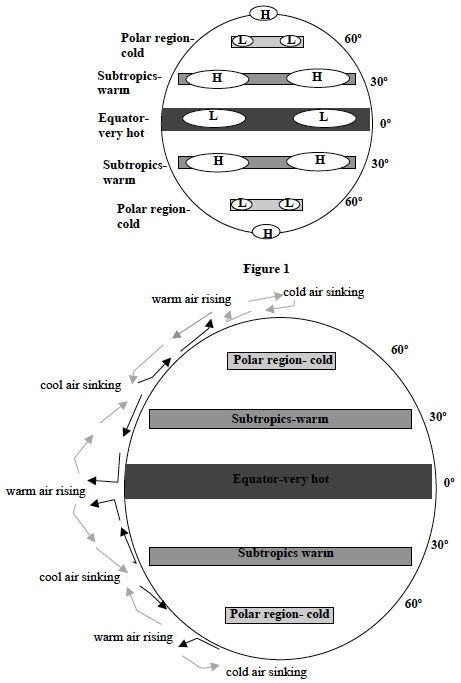
- Why do you think that the semi-permanent high-pressure systems develop at 30 degrees and 90 degrees latitude? Why do you think semi-permanent low-pressure systems develop at 0 degrees and 60 degrees latitude? The differences in temperatures on the Earth result in areas in which warm air rises and cool air sinks. Warm air rises at 0 and 60 degrees latitude and cool air sinks at 30 and 90 degrees latitude. Low-pressure systems are created when there is a decrease in the downward force of air on the Earth. Rising, warm air therefore creates areas of low pressure. High-pressure systems are created when there is an increase in the downward force of air on the Earth. Sinking, cool air therefore creates areas of high pressure. Thus, semi-permanent high-pressure systems are found at 90 degrees and 30 degrees latitude because these are areas in which cold air sinks. Semi-permanent low-pressure systems are found at 0 degrees and 60 degrees latitude because there are areas in which warm air rises.