
Teacher Portal:
Atmosphere
Investigation 1 – PostLab

ZERO-IN
Italicized font represents information to be shared orally or physically completed with the students at this time.
The non-italicized font represents additional information included to support the teacher’s understanding of the content being introduced within the CELL.
ANALYZE IT
Instruct students to complete the Analysis Questions in their SDRs then discuss them as a class. Use the suggested responses below to guide students’ answers.
- Think about the changes in density observed as the air in the flask was heated and cooled. How could the changes in density be used to explain why the colder air was found below the warmer air in the experiments with the ice cube and metal cube? As the temperature of air increases (air is heated) it expands and the volume it occupies increases. However its mass does not change. The result is a decrease in its density. As the temperature of air decreases, (air is cooled) it contracts and the volume it occupies decreases. However its mass does not change. The result is an increase in its density. Air is a fluid. Fluids of lesser densities float or are found above fluids of greater densities. Therefore, cooler air that is more dense would be found below warmer air that is less dense.
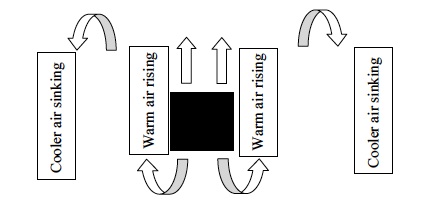
- How did the air move around the metal cube? The air around the metal cube was heated by heat transfer from the metal cube, it became less dense and began to rise above the cooler, more dense air around it. The warmer air rose above the metal cube. As the warmer air rose, a vacuum was created and cooler, less dense moved to fill the area. As the cooler, less dense air moved below the metal cube, it was heated and rose. The result was a continuing convection current. As a result, the air became warmer above the metal cube and cooler beneath the metal cube.
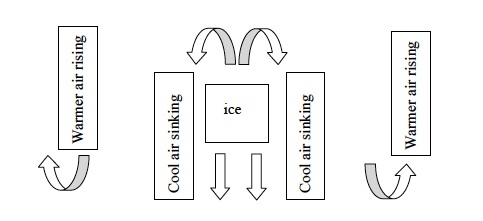
- How did the air move around the ice pack? The air around the ice pack was cooled as heat was transferred from the air surrounding the ice cube to the ice pack. As heat was transferred from the surrounding air the air was cooled and it became more dense. The less dense air began to sink below the warmer air next to it. As the cooler air sank, warmer air moved to fill the area. As the warmer air moved above the ice pack it was cooled and began to sink. The result was a continuing convection current. As a result the air became cooler below the ice pack and warmer above it.
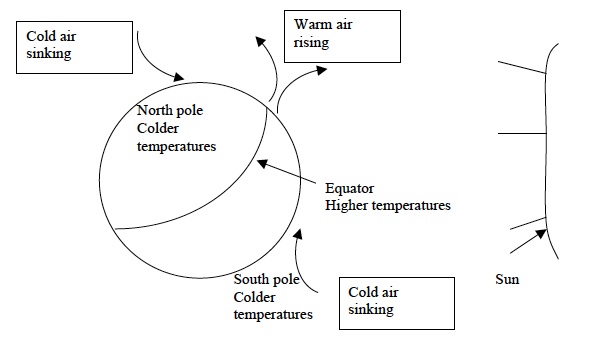
- Imagine that the metal cube was a model of the land found at the Equator and the ice pack was a model of the land found around the north and south poles. Look at the picture of the Earth below. How would the air move around the Earth?Students should suggest that the warm air from the equator would rise toward the poles and that the cold air from the poles would sink towards the equator.
GET FOCUSED
Instruct students to complete the Focus Questions in their SDRs then discuss them as a class. Use the suggested responses below to guide students’ answers.
- What happens to air as it is heated and cooled? The volume and density of air change with changes in temperature. As the temperature of air increases, its volume increases, and its density decreases. As the temperature of air decreases, its volume decreases, and its density increases.
- How do changes in the temperature of air affect its density? As air is heated its density decreases because its mass remains constant but its volume increases. As air is cooled, its density increases because its mass remains constant but its volume decreases.
- Why do changes in density cause air movement? Air is a fluid. Fluids that are more dense sink below those that are less dense. The decrease in density as air is heated causes it to rise above cooler, more dense air. The increase in density as air is cooled causes it to sink below warmer, less dense air.
- How do differences in the temperature of the Earth’s atmosphere affect the movement of air? The warmer air in the atmosphere rises and cooler air in the atmosphere sinks. This causes convection currents in the atmosphere.