
Teacher Portal:
Atmosphere
Investigation 1 – Concept Day
ZERO-IN
Italicized font represents information to be shared orally or physically completed with the students at this time.
The non-italicized font represents additional information included to support the teacher’s understanding of the content being introduced within the CELL.
ASK WHY
Explain to students that Earth’s atmosphere is critical for life on our planet. It protects us from dangerous radiation from the sun and other objects coming at us from outer space, holds in surface heat and prevents it from radiating out into space, provides weather, makes flight possible, and, ultimately, allows us to talk with each other.
BRANCH OUT
Explain to students that meteorologists track hurricanes to alert people about its path, which could save thousands of lives.
PRINT IT
Use your browser to download a printable PDF as a help during the slide presentation and to make additional notes. In your browser, go to File > Print and then choose to save as PDF.
NAVIGATE IT
Once the slide presentation is launched
- use your left and right arrows to advance or go back in the slide presentation, and
- hover your mouse over the left edge of the presentation to get a view of the thumbnails for all the slides so that you can quickly move anywhere in the presentation.
- Click HERE to launch the slide presentation for the CELL.
SHARE IT

SLIDE ATMOS-1-1
Note: In this Investigation, we wish to introduce students to the concept of the atmosphere. Many students think of the atmosphere as everything above the Earth’s solid surface. They may not realize that the atmosphere ends. From space, the atmosphere can be seen to form a relatively thin skin surrounding the Earth. It is a finite amount of gas with a very specific composition. This is an important concept for students to comprehend. If the atmosphere extended into limitless space, the impact of pollutants would be insignificant, as they would be infinitely diluted. On the other hand, given that the atmosphere is limited, the impact of releasing pollutants into it can be very significant indeed! Ample evidence is available to prove that human activity, particularly the burning of fossil fuels, has changed the chemical composition of the atmosphere.
We therefore begin with a discussion of the chemical composition and limits of the atmosphere in Investigation 1. We will also begin a discussion of how differential heating of the Earth’s surface by solar energy initiates air movement and convection currents. This will be developed further in terms of weather formation in Investigation 2.
______________________________________________

SLIDE ATMOS-1-2
- This slide shows the chemical composition of the Earth’s atmosphere.
- Nitrogen gas, not oxygen, is the major component of the atmosphere. Oxygen represents approximately 21% of the atmosphere land animals breathe. Most oxygen is produced through plant photosynthesis and its abundance has varied considerably over geologic time.
- Interestingly, the gas that plants require for photosynthesis, carbon dioxide (CO2) is present at well under a single percentage of the total atmosphere.
- Carbon dioxide is one of the major topics of discussion regarding global warming, as its abundance may be increased through the burning of fossil fuels. We will discuss this further in Slide ATMOS-1-5.
- Finally, notice that the gas ozone (O3) is present at a very low concentration. It is found condensed into a defined layer in the stratosphere as shown on the next slide. This important layer of the Earth’s atmosphere is thought to protect the surface of the Earth from excessive UV irradiation.
______________________________________________

SLIDE ATMOS-1-3
- This slide shows the layers of the Earth’s atmosphere. The ozone layer is shown at the lower altitudes of the stratosphere.
- Troposphere: The troposphere is the layer of atmosphere extending from the Earth’s surface to about 10 kilometer out. The troposphere is where essentially all of the events related to the planet’s weather occurs. It contains about 80% by mass of all the molecules found in the entire atmosphere. Most of the nitrogen and oxygen gas are found closest to the Earth’s surface. In fact, the oxygen gas concentration in high mountains on the Earth’s surface is noticeably lower than at sea level. Nearly all aviation occurs in the troposphere, with few commercial aircraft entering the stratosphere.
- Stratosphere: While in the troposphere temperatures drop with increasing altitude, the stratosphere is characterized by increasing temperatures at higher altitudes. The stratosphere contains the ozone layer that helps reduce harmful UV irradiation from reaching the Earth’s surface.
- Mesosphere: The mesosphere, like the troposphere, decreases in temperature with increasing altitude. No jet-powered aircraft can reach the mesosphere. It is in the mesosphere that most meteors that enter the Earth’s atmosphere burn out and are rendered harmless.
- Thermosphere: The temperature of the thermosphere increase with altitude. However, even though the thermosphere can reach a temperature exceeding 2,700oF (1,500oC), it would seem cold to a human. This is because the molecular vibration of molecules with high levels of kinetic energy transfers heat. Even though individual thermosphere molecules may have high levels of kinetic energy and move very rapidly, there are far too few of them to have much of a heating effect on the human body. An interesting estimate is that an individual thermosphere molecule needs to travel about a kilometer to collide with another molecule! Not surprisingly then, the thermosphere blends into the complete void of outer space where no trace of our atmosphere is present.
- Finally, the inset at the right is a photograph of the Earth’s atmosphere taken from the International Space Station (also pictured here), some 230 miles (370 km) above the Earth’s surface. At sunset and sunrise, the layers of the atmosphere can sometimes be seen. The Earth’s thin atmosphere is all that separates the life-friendly surface of our planet from the cold, dark, lifeless void of outer space.
Note: Students should appreciate the importance of the atmosphere as it will likely be an important aspect of scientific expenditure and study for much of their careers.
______________________________________________

SLIDE ATMOS-1-4
- This slide is the first of a series of two that explains the greenhouse effect and the concept of global warming.
- In this first of the two slides, the Earth’s atmosphere is grossly over-represented simply for illustrative purposes. Most solar radiation, with its associated energy and heat, penetrates into the Earth’s atmosphere. However, some 30% is reflected from the atmosphere and back into space.
- Solar radiation that enters our atmosphere acts to heat the Earth’s surface through the transfer of kinetic (thermal) energy. The heated landmasses radiate much of this absorbed energy back through the atmosphere into outer space. Moist, warm air that is heated by solar radiation in the oceans evaporates as water vapor. Much of its associated energy and heat diffuses back out of the atmosphere as well.
______________________________________________

SLIDE ATMOS-1-5
- A “greenhouse effect” is thought to be caused by excessive amounts of carbon dioxide and other gasses (such as methane, water vapor, nitrous oxide, and ozone) released into the atmosphere. These gasses act to trap heat rising from the Earth’s surface and increase the average temperature of the atmosphere, including the troposphere at the Earth’s surface.
- Extensive research and discussion is currently centered on the ramifications of atmospheric warming. Potential problems that we may encounter or have already encountered include:
- decreases in glaciers, snow cover, and sea ice
- increases in ocean and land temperatures
- increases in atmospheric humidity
- increases in troposphere temperature
- Many peripheral impacts of global warming have also been investigated including its impact on various animal species, weather patterns, droughts, flooding, and severe weather occurrences.
______________________________________________

SLIDE ATMOS-1-6
- Putting aside the discussion of greenhouse effects and global warming, this slide indicates that the Earth is heated unevenly by the Sun. Near the equator, the Sun’s rays strike the Earth’s surface most directly. As suggested in a previous slide, while some of this energy is reflected back into space, the majority reaches the Earth’s surface. This acts to heat these areas.
- On the other hand, at the poles, the Sun’s rays strike the Earth’s surface at a much more glancing angle and far less energy and heat is absorbed. This is not totally unlike the reasons explaining the seasons of the year, where during summer months in the northern hemisphere that hemisphere is tilted more toward the Sun and is thus subject to more direct bombardment by solar radiation than in winter months when it is tilted away from the Sun and receives sunlight at less direct angle. However, regardless of time of year, the equator receives much more direct solar energy than do the North or South Poles.
- Uneven solar radiation leads directly to uneven heat distribution. The equatorial regions of the planet maintain higher air and surface temperatures than do either polar region.
______________________________________________

SLIDE ATMOS-1-7
- The model of convection currents shown at the upper left of this slide (near the smaller globe) indicates a very simplified situation in which hot air at the equator rises into the atmosphere, where it cools and returns to Earth at some distance northerly and southerly.
- However, this simple situation, which could be predicted by considering only the information from the previous slide (Slide ATMOS-1-6) is complicated by the fact that the Earth spins on its axis at different speeds that are related to the distance from the Equator. Any given point at the circumference of a spinning sphere must travel the distances of the entire circumference with each rotation. As one moves toward either pole, the distance traveled by any point per rotation is greatly diminished. This, of course, means that different areas of the Earth’s surface are moving at different speeds. Movement is fastest at the Equator at about 1,700 km/hr. and only about half that speed, or 850 km/hr., at 60oN (or 60o South).
- The difference in surface velocity causes what is known as the Coriolis Effect. The net impact of the Coriolis Effect in this context is to break up a single convection current system in the troposphere into six smaller, somewhat evenly spaced convection systems. As shown on this slide by the globe at the lower right, each individual convection cell has its own associated cycle of air mass rising, cooling, and sinking. All this resolves into a relatively stable pattern of temperature distribution across the planet, roughly at 30o intervals of latitude. These areas of temperature are the very hot Equatorial region, warm Subtropical regions at 30o North and South and cold Polar regions beginning at 60o North and South.
______________________________________________

SLIDE ATMOS-1-8
Note: On the previous slide we introduced the concept of air mass convection currents. We will discuss this important concept further in Investigation 2 in terms of atmospheric pressure and fronts.
- To fully understand the basic physics of convection currents, you must first understand why warm air rises and cold are sinks.
- In the first part of the Lab for Investigation 1, you will do an experiment to demonstrate that warm air is less dense than cooler air. Density is the amount of mass in a given volume of a substance, or d = m/v.
- For gasses, Charles’s Law expresses the relationship between temperature and volume. Charles’s Law states that the volume of a given amount of gas is directly proportional to the temperature and is expressed mathematically as:

- From this equation, we can easily conclude that if you increase the temperature (from T1 to T2) of a gas of a given volume (V1), you must increase the volume of the heated gas (V2) by an amount
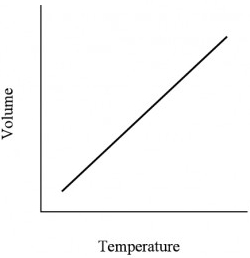 proportional to the increase in temperature. On the other hand, if you decrease the temperature (from T1 to T2) of a gas of a given volume (V1), you must decrease the volume of the cooled gas (V2) by an amount proportional to the decrease in temperature. This rather simple relationship (ie: an increase in gas temperature causes an increase in its volume and a decrease in gas temperature causes a decrease in its volume), is shown in the graph here.
- In Lab, you will directly demonstrate Charles’s Law by affixing a latex balloon to the mouth of a 1-liter Erlenmeyer flask. The volume of the gas (air) will be determined both before and after heating.
Note: Since the volume of the flask itself will not change significantly under these conditions, any increase in gas volume will be observable by an increase (blowing up) of the balloon. An estimation of the diameter of the balloon will give students a rough idea of how much the gas expands upon heating.
- You will also determine the mass of the flask/balloon apparatus at both temperatures.
- If the mass doesn’t change, but the volume does, a change in the density of the air will necessarily have taken place. That is, since no air molecules are added or taken away from the system during the experiment, the same number of molecules of the same mass will be present throughout. Therefore, if the same mass of air is found in two different volumes, the density of the air will have changed.
Note: If the volume of the air goes up, then its density goes down – there is a decrease in air density with increasing temperature. Through this experiment, students should be able to demonstrate and conclude that warmer air is less dense than cooler air.
Note: Most students will be able to appreciate this concept from their own previous experiences. Hot air balloons sail into the air because the hot air is less dense and therefore lighter than the surrounding, unheated air. In the summer, basements are typically cooler than the rest of the house because cooler air is denser and sinks to the lowest level in the house. We will see that air masses do the exact same thing in creating weather. That is, warm air masses rise and cold air masses sink. This is what is responsible for convection currents.
______________________________________________

SLIDE ATMOS-1-9
- This last slide illustrates the experimental setup for the second part of Investigation 1 Lab. In this part of the experiment, you will place either a cold-pack or a heated metal cube on wire gauze affixed to a ring stand. A thermometer is secured above and below the sample and you look for and record temperature changes.
- The point of this very simple experiment is to directly demonstrate that warm air rises and cold air sinks.
Note: In this experiment, it is essential to minimize air movement around the thermometers. Excessive air movement will cause the mixing of the air and the warming or cooling effect of the samples will be minimized or completely masked.
- Finally, as noted on this slide, remind students to be exceedingly careful not to burn themselves. They should always handle heated items with either hot hands or thongs.