
Teacher Portal:
Adaptation
Investigation 1 – Lab
ZERO-IN
Italicized font represents information to be shared orally or physically completed with the students at this time.
The non-italicized font represents additional information included supporting the teacher’s understanding of the content being introduced within the CELL.
MINDSET
This Investigation is designed to:
- illustrate to students that the variation in the individuals of a species is due to genetic variation,
- allow students to conclude that genetic variation leads to adaptation to environmental change, and
- allow students to investigate how genetic variation becomes a common trait of a species if it allows the survival of the members of a species.
BE PREPARED
Teacher Preparation for the Investigation includes the following. This preparation should be done prior to students arriving in the lab.
- Place the materials at the distribution center.
- Divide the class into five cooperative groups.
Note: Each student lab group will need the materials listed below.
Student Preparation for the Investigation includes having students gather the following materials. This preparation takes place on lab day after student lab groups have settled at their assigned lab tables.
Note: The materials are listed in students’ SDRs. They are also listed below for your reference.
- (1) clear plastic container
- (12) dark-colored gram cubes of the same color
- (12) light-colored gram cubes of the same color
- (2) 15 ml centrifuge tubes
- (1) triple beam balance
- (1) metric ruler
- (40) toothpicks
- (3) sticks of clay
- (1) Light Meter
- (1) flashlight
- (1) marker pen
- (1) calculator
- (1) roll of masking tape
Direct one student from each lab group to collect the materials listed in their SDRs.
INVESTIGATE
- Encourage students to reflect on the PreLab video as they move through the procedural steps.
- Explain to students that during the Experiment, every procedural step is important. If one step is skipped, data can become invalid. To help students keep on track, direct them to read each step thoroughly, complete the step, then check it off (Read it – Do it – Check it off).
- Direct students to complete the procedural steps in their SDRs.
Note: The procedural steps are listed below for your reference. Teacher “Notes” are inserted, as needed, to help facilitate the lab.
Trial 1:
- In this Trial, you will model three individual cactus plants: one with no spines, one with few spines, and one with many spines.
- Use a stick of clay to create a model cactus with no spines.
- Place the stick of clay on the table so that the long end is pointing upwards.
- Prepare to use the Light Meter to take measurements for the experiment. Refer to the Procedure Light Meter Use and Operation for help.
- Measure the amount of light that would fall on a cactus if it had no spines. To do this, complete the following steps.
A. Place the Light Meter’s light sensor directly beneath one of the sides of the clay that has no spines, or toothpicks.
B. Place a flashlight 5 cm directly above the top of the cactus.
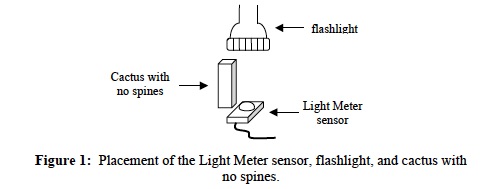
C. Shine the flashlight directly onto the light sensor so that the brightest part of the beam of light falls on the light sensor. Hold the flashlight steady for 5 seconds.
D. Find the number of light units (Lux) measured.
E. Record: How much light falls on the cactus when there are no spines? Record the amount of light in Table A.
6. Use a stick of clay to create a model cactus that has only a few spines.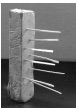
A. On one of the long sides of the stick, place 8 toothpicks in a random pattern. These represent the spines of a cactus. Make sure there is still room at the bottom for the light meter.
7. Measure the amount of light that falls on a cactus that has only a few spines. To do this, complete the following steps.
A. Place the Light Meter’s light sensor directly beneath the side with 8 toothpicks. Remember, this side represents a cactus with only a few spines.
B. Hold the flashlight 5 cm directly above the side of the cactus with the 8 toothpicks.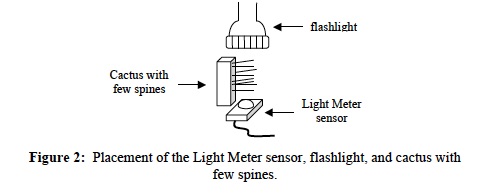
C. Shine the flashlight directly onto the light sensor so that the brightest part of the beam of light falls on the light sensor.
D. Hold the flashlight steady for 5 seconds.
E. Find the number of light units (Lux) measured.
F. Record: How much light falls on the cactus when there are few spines? Record the amount of light in Table A.
8. Use a stick of clay to create a model cactus that has many spines.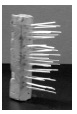
A. On one of the long sides of the stick, place 30 toothpicks in a random pattern making sure there is still room at the bottom for the light meter. This represents a cactus with many spines.
9. Measure the amount of light that falls on a cactus that has many spines. To do this, complete the following steps.
A. Place the Light Meter’s light sensor directly beneath the side with 30 toothpicks. Remember, this side represents a cactus with many spines.
B. Hold the flashlight 5 cm directly above the side of the cactus with the 30 toothpicks.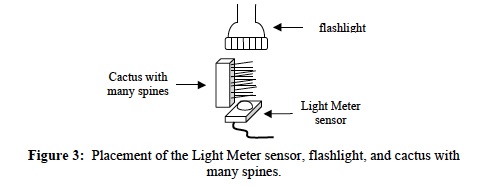
C. Shine the flashlight directly onto the light sensor so that the brightest part of the beam of light falls on the light sensor.
D. Hold the flashlight steady for 5 seconds.
E. Find the number of light units (Lux) measured.
F. Record: How much light falls on the cactus when there are more spines? Record the amount of light in Table A.
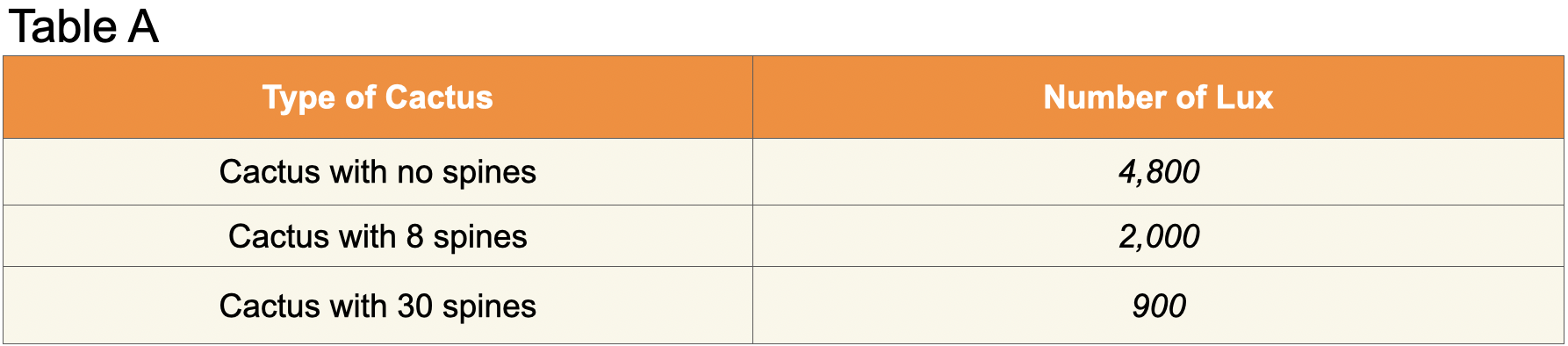
- Compare the two cacti with spines. Which received the most light? The cactus with 8 spines received the most light.
- Compare the two cacti with spines. Which was more shaded? The cactus with 30 spines was more shaded.
- Were the two cacti with spines shaded from the Sun compared to the cactus with no spines? How do you know? Yes. Both cacti with spines were shaded from the Sun because the amount of light that fell on the cacti with spines was less than the amount of light that fell on the cactus with no spines.
- In the current climate, if a cactus receives more than 2500 Lux it will not survive. Would the cactus with no spines survive? No, the cactus with no spines would not survive.
- Consider the two cacti with spines. How will the variation in the number of spines affect the survival of the two cacti? Can both cacti survive in the current climate? Both cacti will survive in the current climate. In the current population, there is variation in the number of spines, but each variety can survive since they receive no more than 2500 Lux. If the climate becomes hotter, drier, or if the amount of sunlight would increase, the cacti with many spines would have an advantage and be more likely to survive.
- If the temperature and intensity of the sun were to increase, would the variation in the number of spines give one type of cactus an advantage over the other cactus? Why? If the climate changed, the cactus with many spines would be better adapted for survival than the cactus with fewer spines because the increased number of spines provides more shade to the cactus. The surviving cactus would then be able to pass its genes on to the next generation.
Trial 2:
- In this Trial, you will investigate variation in the trait of bone density in penguins.
- Create a model ocean. Fill a clear plastic container with water until the water is 3-4 cm from the top of the container.
- In this experiment, Falcon tubes will represent penguins with different bone densities.
- Use an empty centrifuge tube to represent one model penguin. Label the tube “Penguin A.”
- Use the other centrifuge tube to represent the second model penguin. Fill the tube with water until the water reaches the top line. Close the tube and label it “Penguin B.”
- Determine the density of each model penguin by completing the following steps.
A. Record: Using the triple beam balance, determine the mass of the empty centrifuge tube. Record the mass in Table B.
B. Record: Using the triple beam balance, determine the mass of the filled centrifuge tube. Record the mass in Table B.
C. The volume of the tube is 15 ml.
D. Calculate: Determine the density of each tube using the formula for density: Density = Mass ÷Volume
E. Record: Write the density of each penguin in Table B.
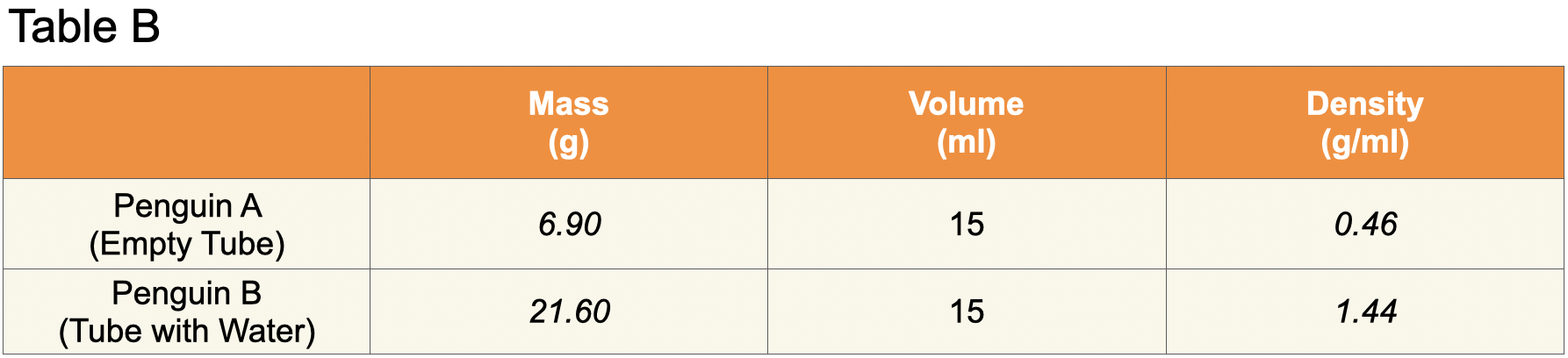
- Which tube is denser? Which penguin has denser bones? The falcon tube filled with water is denser. Penguin B has denser bones.

- Make a prediction. Which model penguin do you think will be able to dive deeper into the ocean where there is more food? Why? Student answers may vary. Since Penguin B, the falcon tube filled with water, has denser bones, it will dive deeper than Penguin A. A more dense substance is more likely to sink than float in water.
- To model how Penguin A dives, use the following steps.
A. Hold Penguin A (the empty tube) so that the cap end  rests on the top edge of the container. One student should hold the tube on the edge of the container.
B. Another student should sit or crouch beside the container so that they are able to watch the penguin through the side of the plastic container.
C. Allow Penguin A, the empty falcon tube, to fall into the water.
10. To model how Penguin B dives, use the following steps.
A. Hold Penguin B (the tube filled with water) so that the cap end rests on the top edge of the container. One student should hold the tube on the edge of the container.
B. Another student should sit or crouch beside the container so that they are able to watch the penguin through the side of the plastic container.
C. Allow Penguin B, the falcon tube filled with water, to fall into the water.
11. Remove the tubes from the water and dry them with a paper towel.
12. Which penguin floated lower in the water? The falcon tube filled with water, Penguin B.

- How does bone density relate to the depth of dive? Penguin B had the greater bone density and floated lower in the water than Penguin A. Penguin A had bones that were less dense than Penguin B. Therefore, greater bone density allows a penguin to achieve a greater depth of dive.
- In the current environment, there is food at all levels of the water and on land. How does the variation in the density of bones affect the survival of both penguins? Can both penguins survive in the current environment? Student answers may vary. Since there is food at all levels of the current environment, both penguins can survive. There is genetic variation in the population and consequently, there are different types of penguins existing at one time in this population. Although Penguin B has the unique ability to dive deeper, this trait currently does not provide an advantage because the food is so abundant. This trait would not be naturally selected for at this point.
- If there was little food at the surface of the water and on the land, but plenty of food at lower depths of the ocean, would the variation in the density of bones of one penguin provide it with an advantage over the other penguin? Why? If the location of food were to change, the penguin with denser bones would be better adapted for survival than the penguin with less dense bones. The increased density of bones would allow for greater depths of a dive and therefore increase the amount of food that the penguin with denser bones could retrieve.
- How do the traits or adaptations that animals and plants have help them survive in their environments? Adaptations are the characteristics that plants or animals possess that allow them to survive in their harsh environment. Cacti have many spines that provide protection from predators as well as shading the plant from the sun and preventing the plant from overheating. Unlike many birds, penguins have dense bones that allow them to dive deep into the water and float at a deeper level. They spend much of their life in the water and this further enables them to swim and catch fish in the ocean.
- Are all members of a species exactly alike? No. Each member of a species has a slightly different genetic makeup. In other words, there is a great deal of genetic variation in the population of a species. This variation was demonstrated in the cacti and the penguins. Some penguins have more dense bones than other penguins. Some cacti have more spines than other cacti.
- Can individuals of a species with different variations of a trait survive in a particular environment? Yes. In every population, there is a tremendous amount of genetic variation. Quite frequently there are many different varieties of traits that coexist in the population. However, sometimes the environment can change and an individual with a specific trait will have an advantage and will be more likely to pass on their genes.
Trial 3:
- In this Trial, you will analyze the genetics of bone density.
- Separate the gram cubes into one pile of dark color and one pile of light-colored cubes.
- Place the dark-colored cubes beside Penguin A, the empty centrifuge tube. Each dark-colored gram cube represents the allele that determines less-dense bones. This is the dominant allele.
- Place the light-colored gram cubes beside Penguin B,
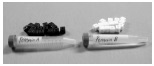 the centrifuge tube filled with water. Each light-colored gram cube represents the allele that determines more dense bones. This is the recessive allele.
 - Refer to the key in Table C.
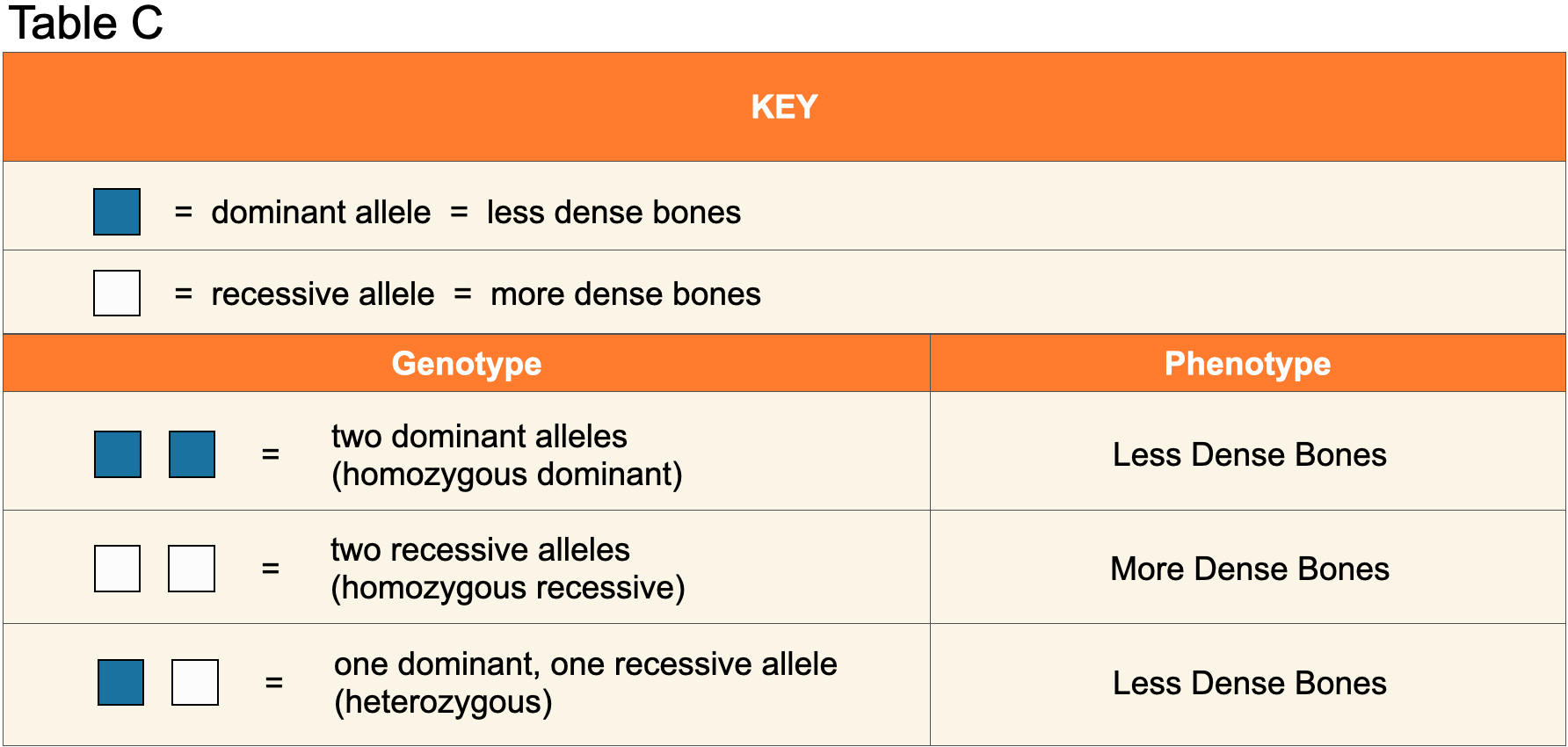
Note: Ensure that students understand the key in Table C. Students should work collaboratively to complete Trial 3 questions 6A to 6F.
- Create genotypes for penguins with different variations of the bone trait by combining two alleles.
A. Connect two dark-colored gram cubes.
B. Use the key to answer the following question. Will the penguin you just created have the phenotype of more dense or less dense bones? Less dense bones.
C. Connect two light-colored gram cubes.
D. Will this penguin have the phenotype of more dense or less dense bones? More dense bones.
E. Connect a dark-colored gram cube and a light-colored gram cube.
F. Will this penguin have the phenotype of more dense or less dense bones? Less dense bones.
7. Use the Punnett square in Table D to help find the possible combinations of alleles if two penguins mate.
A. Locate the penguin that was made with two dominant alleles (dark-colored gram cubes). This is a penguin with less dense bones.
B. Disconnect the cubes and place each cube over a dark square in the left column of the Punnett square.
C. Find the penguin that was made with two recessive alleles (light-colored gram cubes). This is a penguin with more dense bones.
D. Disconnect the cubes and place each cube over a light square in the top row of the Punnett square.
E. Locate the extra gram cubes. The alleles from the left will combine with the alleles from the top. As an example, in Box 1, you would connect one dominant allele with one recessive allele. Box 2 has been filled in as an example.
F. Connect pairs of cubes in the correct combinations and place them in the correct boxes in the Punnett square to represent the remaining two genotypes.
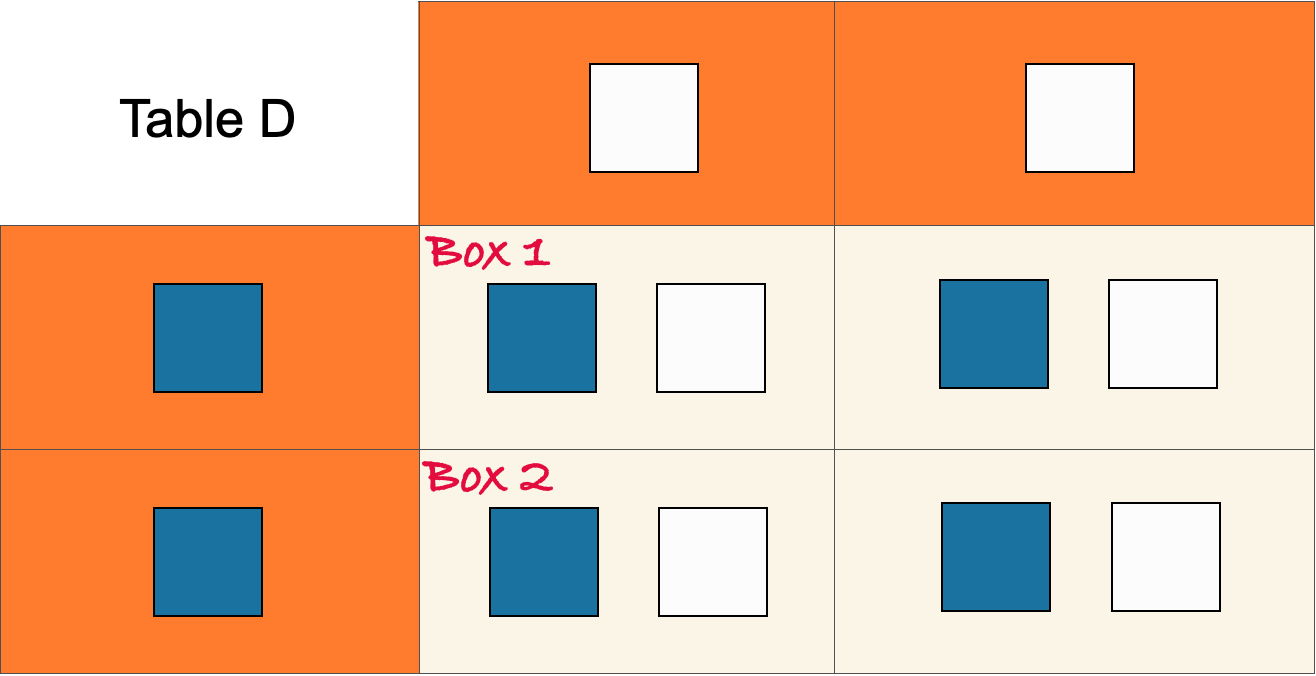
- Notice that all the possible combinations included one dominant allele and one recessive allele. Based on the key in Table C, will these penguins have the phenotype of more dense bones or light bones? Less dense bones.
- Use the Punnett square in Table E to help find the possible combinations of alleles if two heterozygous penguins mate. Use the key in Table C for help.
A. Create a penguin that has one dominant allele and one recessive allele. This is a penguin with less dense bones.
B. Place the alleles on the dark and light squares to the left of Table E.
C. Create another penguin that has one dominant allele and one recessive allele.
D. Place the alleles on the dark and light squares above Table E.
E. Locate the extra gram cubes. Connect pairs of cubes in the correct combinations and place them in the correct boxes in the Punnett square to represent the four genotypes.
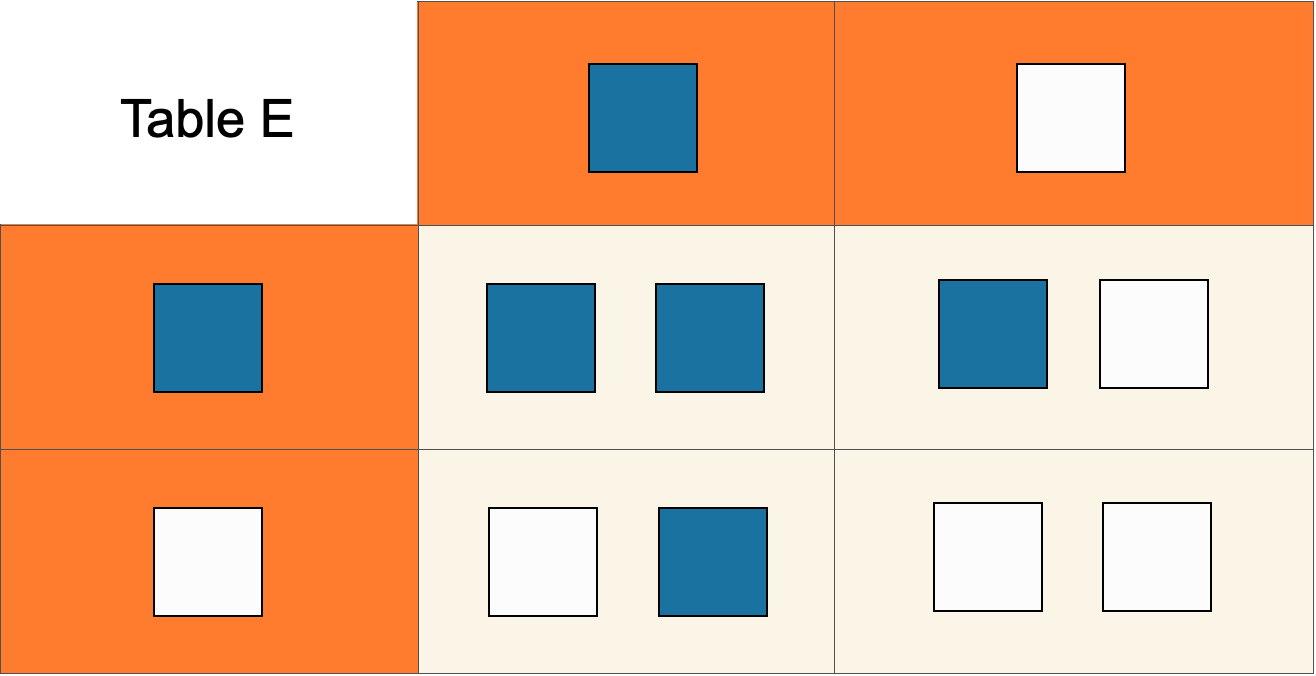
- What are the possible genotypes (combinations of alleles)? The possible genotypes are: one homozygous dominant, one homozygous recessive, and two heterozygous dominant genotypes.
- Which phenotypes of the bone density trait do the different genotype combinations represent?
- Two dominant alleles = less dense bones
- Two recessive alleles = more dense bones
- One dominant and one recessive allele = less dense bones
- Use the Punnett square in Table F below to help find the possible combinations of alleles if a penguin with two dominant alleles and a penguin with one dominant and one recessive allele mated. Use the key in Table C for help.
A. Create a penguin that has two dominant alleles. This is a penguin with less dense bones.
B. Place the alleles on the dark squares on the left of Table F.
C. Create another penguin that has one dominant allele and one recessive allele.
D. Place the alleles on the dark and light squares on the top of Table F.
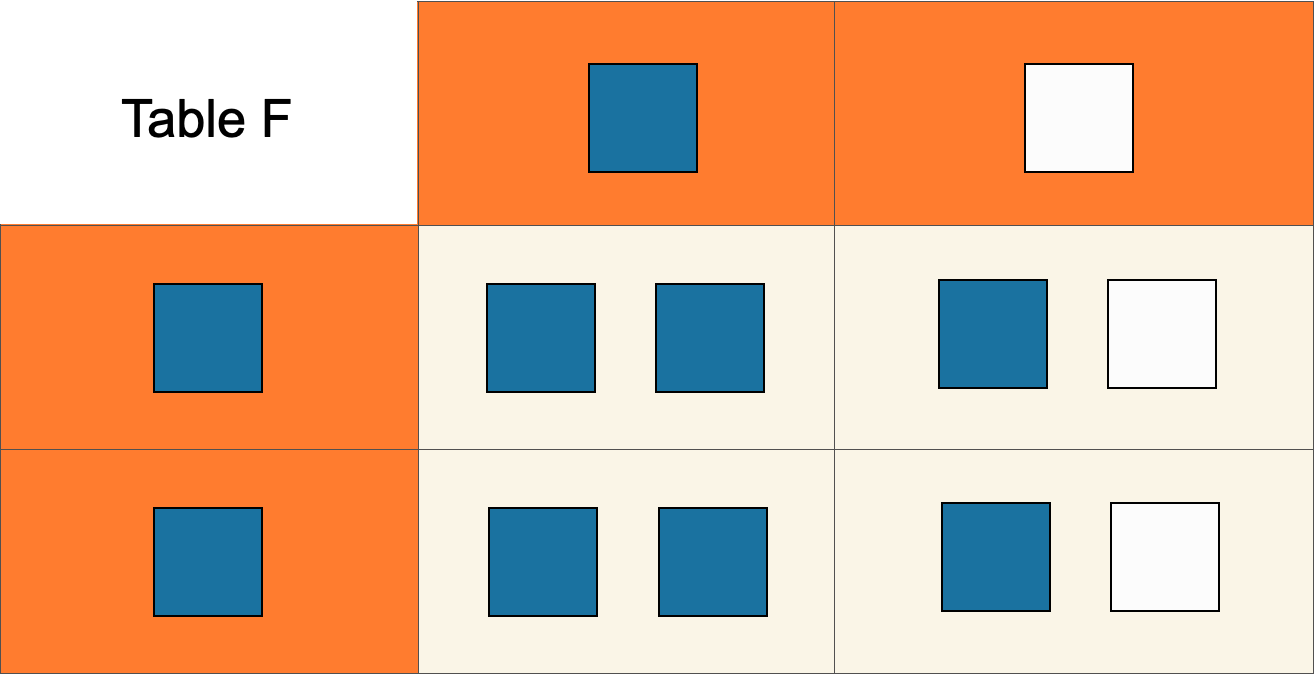
- What are the possible genotype combinations if a penguin with two dominant alleles and a penguin with one dominant and one recessive allele mated? The possible genotypes are: two homozygous dominant and two heterozygous recessive genotypes.
CLEAN UP
Let students know your expectations for clean up. Ask them to clean up.