
Teacher Portal:
Solutes and Solubility
Investigation 3 – PostLab

ZERO-IN
Italicized font represents information to be shared orally or physically completed with the students at this time.
The non-italicized font represents additional information included to support the teacher’s understanding of the content being introduced within the CELL.
ANALYZE IT
Instruct students to complete the Analysis Questions in their SDRs then discuss them as a class. Use the suggested responses below to guide students’ answers.
- Combine your data with the data from the other groups by completing Table G.
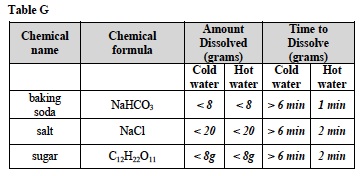
- Did each of the compounds dissolve in cold water? None of the compounds dissolved in cold water.
- Did each of the compounds dissolve in hot water? All of the compounds dissolved in hot water.
- How does temperature affect the solubility of solutes? Use data from the experiment to support your answer. Increased water temperature increases the solubility of solutes. The temperature of the hot water was 45°C compared to cold water which was 6°C. None of the compounds dissolved in cold water in 6 minutes. All of the compounds dissolved in the hot water in 1 or 2 minutes. More of each compound dissolved in hot water as compared to cold water.
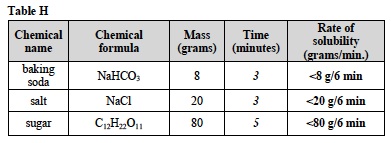
- Calculate: What was the rate of solubility for each compound in cold water? Use the class data to complete Table H.
- Calculate: What was the rate of solubility for each compound in hot water? Use the class data to complete Table I.
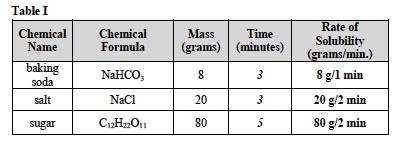
- How does temperature affect the rate of solubility of solutes? Use data from Tables H and I to support your answer. A greater amount of each solute dissolved in a shorter amount of time in the hot water as compared to the cold water. Increasing the temperature increased the rate of solubility of all of the compounds.
- Why did using hot water increase the solubility and rate of solubility of the solutes? Hot water increased both the solubility and the rate of solubility by causing the particles of solute to move more quickly so the particles of solvent could more easily surround the solute particles.
- Compare the chemical formulas of the three compounds in Tables H and I. Does increasing the temperature of the solvent increase the solubility and rate of solubility of compounds made of the same elements? Increasing the temperature increased the rate of solubility of all the compounds. Compounds composed of similar elements all experienced an increase in solubility and rate of solubility as the temperature of the solvent increased.
- Compare the chemical formulas of the three compounds in Tables H and I. Does increasing the temperature of the solvent increase the solubility and rate of solubility of compounds made of different elements? Increasing the temperature increased the rate of solubility of all the compounds even though each compound was composed of some elements that were different.
GET FOCUSED
Instruct students to complete the Focus Questions in their SDRs then discuss them as a class. Use the suggested responses below to guide students’ answers.
- What affects the solubility of a solute? Changing the temperature of the solvent affects the solubility of a solute. More solute can dissolve in a higher temperature solvent than in a lower temperature solvent.
- Can you change the rate of solubility of a solute? Yes, the rate of solubility of a solute can be changed by using a solvent of a different temperature. The rate of solubility increases as the temperature of the solvent increases and decreases as the temperature of the solvent decreases.