
Teacher Portal:
Simple Machines
Investigation 1 – Lab

ZERO-IN
Italicized font represents information to be shared orally or physically completed with the students at this time.
The non-italicized font represents additional information included to support the teacher’s understanding of the content being introduced within the CELL.
MINDSET
This Investigation is designed to:
- illustrate to students that work is force applied over a distance,
- allow students to discover that a simple machine makes work seem easier by changing the direction in which the effort force is applied,
- demonstrate to students that mechanical advantage is the ratio of load force to effort force,
- illustrate to students that mechanical advantage can also be measured as the ratio of effort arm length to load arm length,
- allow students to discover that increasing the number of pulleys in a system increases mechanical advantage by decreasing the amount of effort force to needed to move the load, and
- allow students to discover that increasing the number of pulleys increases the distance over which a force is applied, thereby increasing mechanical advantage.
BE PREPARED
Teacher Preparation for the Investigation includes the following. This preparation should be done prior to students arriving in the lab.
- Place all materials at the distribution center.
- Divide students into five cooperative groups.
Note: Each student lab group will need the materials listed below.
Student Preparation for the Investigation includes having students gather the following materials. This preparation takes place on lab day after student lab groups have settled at their assigned lab tables.
Note: The materials are listed in students’ SDRs. They are also listed below for your reference.
- (1) fixed pulley
- (1) moveable pulley
- (3) 3m pieces of string
- (1) ring stand
- (1) pair of scissors
- (1) meter stick
- (1) metric ruler
- (3) 100-gram masses
- (1) white bucket
- (1) calculator
- (1) triple beam balance
- (1) spring scale (5N)
Direct one student from each lab group to collect the materials listed in their SDRs.
INVESTIGATE
- Tell students that in this Investigation they will use pulleys to determine the answers to the focus questions.
- Encourage students to reflect on the PreLab video as they move through the procedural steps.
- Explain to students that during the Experiment, every procedural step is important. If one step is skipped, data can become invalid. To help students keep on track, direct them to read each step thoroughly, complete the step, then check it off (Read it – Do it – Check it off).
- Direct students to complete the procedural steps in their SDRs.
Note: The procedural steps are listed below for your reference. Teacher “Notes” are inserted, as needed, to help facilitate the lab.
Trial 1:
- In this Trial, you will investigate the mechanical advantage of a one pulley system.
- Measure the force of gravity on each load that will be used in the experiment. This is called the load force.
A. Place the 100-gram mass in the bucket.
B. Place the bucket with the mass on the triple beam balance.
C. Record: Write the mass of the bucket with the 100-gram mass below. 162 g
D. Calculate: Convert the mass of the load from grams to kilograms. Use this formula: Mass of the load x 1kg/1000g = kg Use the space provided. 162 grams x 1 kg/ 1000 g= 0.16 kg
E. Add another 100-gram mass to the bucket and repeat the procedure. 262 grams x 1 kg/ 1000 g= 0.26 kg
F. Add another 100 gram mass and repeat the procedure. 362 grams x 1 kg/ 1000 g= 0.36 kg
G. Use the following formula to calculate the load force. Record the load force in the column in Table A labeled “Load Force.”
Load force = mass (kg) x g g = 9.8 m/s2
0.16 kg x 9.8 m/s2= 1.56 N = 1.6 N
0.26 kg x 9.8 m/s2=2.54 N= 2.6 N
0.36 kg x 9.8 m/s2=3.53 N= 3.6 N
- Construct a one-pulley system:
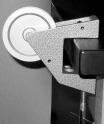
A. Attach the fixed pulley to the edge of the lab table.
B. Cut a piece of string that is one meter in length.
C. Attach the string to the bucket by threading one end of the string through the hole in the center of the handle and tying two knots to secure it.
D. Feed the free end of the string over the top of the fixed pulley.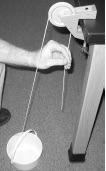
4. Calibrate the spring scale.
A. Hold it by the handle with the “0” graduation directly at eye level.
B. Turn the adjustment nut at the top until the indicator platform is at the “0” graduation.
5. Record: Measure the force of gravity on the spring scale using the following steps:
A. Hold the spring scale upside down by the hook. Without adjusting the nut, observe the force on the spring scale.
B. Measure the force of the upside-down spring scale. Record the force above Tables A and B.
6. Calibrate the spring scale for use in an upside-down position as follows: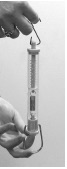
A. Hold the spring scale by the metal hook.
B. Turn the adjustment nut until the platform is even with the “0 N” mark on the Newton scale.
7. Attach the spring scale to the free end of the string 10 cm from the pulley by tying a knot to the hook end of the spring scale.
8. Place a meter stick beside the spring scale so that the zero meter line is on the ground and the meter stick is standing straight up.
9. Place a 100-gram mass into the bucket.
10. Place a metric ruler next to the bucket.
11. Lift the bucket by following the steps below: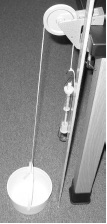
A. Begin with the bottom of the bucket even with the 1 cm mark on the metric ruler.
B. Raise the bucket so that the bottom of the bucket is at the 6 cm mark by pulling on the loop at the bottom of the spring scale. Do NOT pull on the hook.
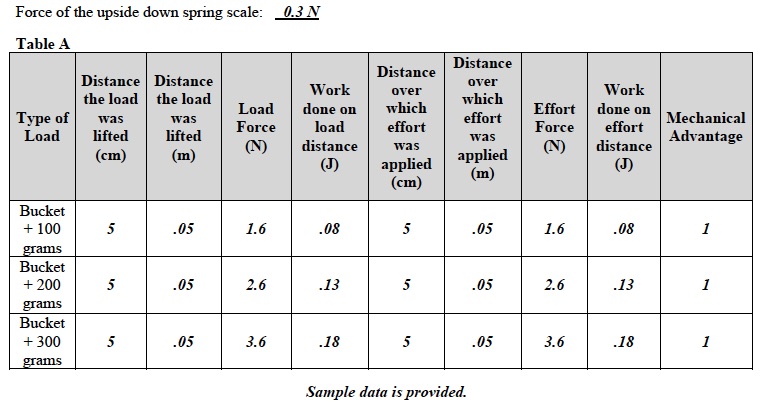
12. Record: Read the amount of force required to lift the bucket from the spring scale and add to it the force of the upside-down spring scale recorded above Table A. Write the sum in the column of Table A labeled “Effort Force (N)”. Table A is located on the last page of the Investigation One Student Data Record.
13. Determine the distance over which the effort was applied:
A. Measure the points at which the top edge of the spring scale hook starts and stops.
B. Calculate: Determine the difference between the two points and record it in Table A.
14. Add a second 100 gram mass to the bucket and repeat the procedure. Read the amount of force from the spring scale and add to it the force of the upside-down spring scale recorded above Table A. Record the sum in the column of Table A labeled “Effort Force (N)”.
15. Add a third 100 gram mass into the bucket so that there is a total of 300 grams in the bucket and repeat the procedure. Read the amount of force from the spring scale and add to it the force of the upside-down spring scale recorded above Table A. Record the sum in the column of Table A labeled “Effort Force (N)”.
Note: The Analysis Questions for Trial 1 are located on the PostLab page for Investigation 1.
Trial 2:
- Construct a two-pulley system:
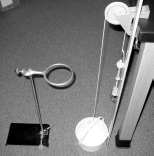
A. Place the ring stand so that the rod is 20 cm from the bucket and the bench. The base of the ring stand should face away from the table.
B. Adjust the ring so that it is placed at the top of the rod.
C. Remove the spring scale from the string.
D. Detach the bucket from the string by untying the knot or cutting the knot with a pair of scissors.
E. Cut a new piece of string that is 150 centimeters in length.
F. Tie one end of the string to the ring stand.
G. Feed the free end of the string through the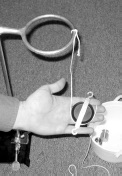 moveable pulley by threading it underneath the pulley.
H. Attach the bucket to the moveable pulley by inserting the bottom hook into the hole in the center of the handle.
I. One person should hold the bucket and the moveable pulley in place.
J. Feed the free end of the string over the bench pulley.
K. Make sure that the ring stand and pulley are in line.
2. Attach the spring scale to the free end of the string by tying a knot to the 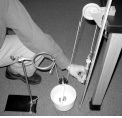 hook end of the spring scale. Tie the spring scale 10 cm from the pulley.
3. Place a meter stick beside the spring scale and pulley so that the zero meter line is on the ground and the meter stick is standing straight up.
4. Place a 100-gram mass into the bucket.
5. Place a metric ruler next to the bucket.
6. Lift the bucket by following the steps below:
A. Begin with the bottom of the bucket even with the 1 cm mark on the metric ruler.
B. Raise the bucket so that the bottom of the bucket is at the 6 cm mark by pulling on the loop at the bottom of the spring scale. Do NOT pull on the hook.
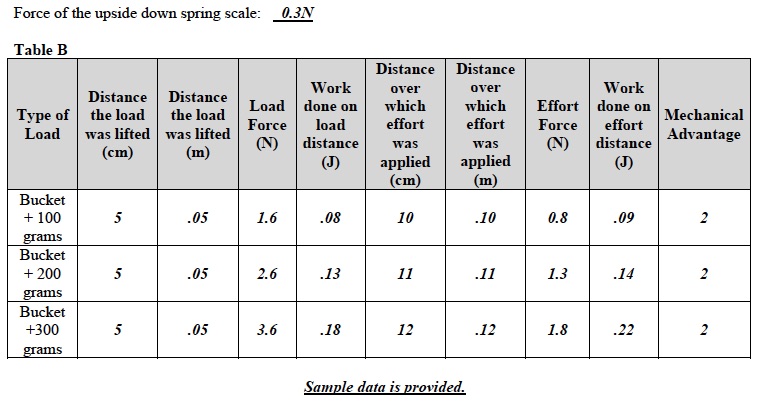
C. Look at the spring scale. Read the amount of force from the spring scale and add to it the force of the upside-down spring scale recorded above Table B. Record the sum in the column of Table B labeled “Effort Force (N)”.
-Determine the distance over which the effort was applied: Measure the points at which the top edge of the spring scale hook starts and stops.
-Calculate the difference between the two points and record it in Table B.
7. Repeat the procedure using the 200-gram and 300-gram loads. Read the amount of force from the spring scale and add to it the force of the upside-down spring scale recorded above Table B. Record the sum in the column of Table B labeled “Effort Force (N)”.
8. Calculate: Determine the work done on the load distance of the pulley for each load and record your results in Table B. Use the formula:
Work (J) = load force (N) x distance load was lifted (m)
Bucket + 100 grams = 1.6 N x.05 m = .08 J
Bucket + 200 grams = 2.6 N x .05 m = .13 J
Bucket + 300 grams = 3.6 N x .05 m = .18 J
- Calculate: Determine the work done on the effort distance of the pulley when lifting each load and record your results in Table B. Use the formula:
Work (J) = effort (N) x distance effort was applied (m)
Bucket + 100 grams = 1.6 N x .05 m = .09 J
Bucket + 200 grams = 2.6 N x .054 m = .14 J
Bucket + 300 grams = 3.6 N x .061 m = .22 J
- Describe what happened to the load force, effort force, and work as the mass of the load increased. The load force, effort force, and work increased as the mass of the load increased.
Note: The Analysis Questions for Trial 2 are located on the PostLab page for Investigation 1.
CLEAN UP
Let students know your expectations for clean up. Ask them to clean up.