
Teacher Portal:
Photosynthesis
Investigation 3 – PostLab
ZERO-IN
Italicized font represents information to be shared orally or physically completed with the students at this time.
The non-italicized font represents additional information included to support the teacher’s understanding of the content being introduced within the CELL.
ANALYZE IT
Instruct students to complete the Analysis Questions in their SDRs then discuss them as a class. Use the suggested responses below to guide students’ answers.
- According to your observations of the Elodea stem and the Elodea leaf, where does photosynthesis take place in the Elodea plant? How do you know? Both the Elodea stem and the Elodea leaf contain chloroplasts. Chloroplasts contain the pigment chlorophyll which is vital for photosynthesis. Based on this information, students can conclude that in the Elodea plant, photosynthesis occurs in both the stem and the leaf of the plant. Although students observed chloroplasts in both the stem and leaf, they likely observed a greater abundance of chloroplasts in the leaf. From these observations, students should suggest that more photosynthesis occurs in the leaf as compared to the stem. Students may also suggest that the majority of photosynthesis that occurs in the stem, occurs in the periphery of the stem as the majority of the chloroplasts are located in the outer layers of the stem.
Note: Questions marked with a triangle (∆) are included to enrich students’ understanding. These questions do not appear in students’ SDRs but should be used as additional discussion points during the PostLab.
- ∆ What did the data show concerning oxygen in the beaker containing the Elodea in Investigation Two? The amount of dissolved oxygen in the beaker containing Elodea increased significantly over time.
- ∆ How did your experiment today vary from that experiment? What variable did you manipulate today? Students manipulated the amount of light received by the Elodea. By covering the beaker with aluminum foil, students blocked out most of the light in the room. In today’s experiment, the beaker of Elodea exposed to light served as a control. Students were able to evaluate the effect of light on photosynthesis because both the “Light” and “No Light” conditions were investigated.
- Graph: Use the grids below to make two graphs. One graph should compare time to oxygen level in a beaker of water and Elodea without light. One graph should compare time to oxygen level in a beaker of water and Elodea exposed to light. Draw a best fit line through your data points. If you need help, refer to the procedure, Drawing of a Best Fit Line.
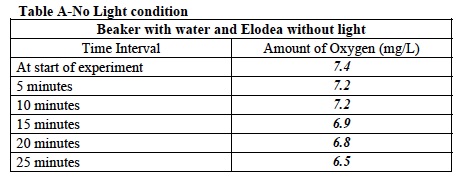
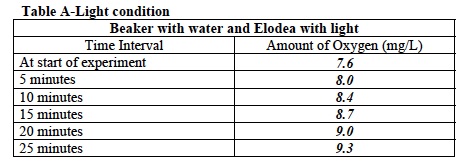
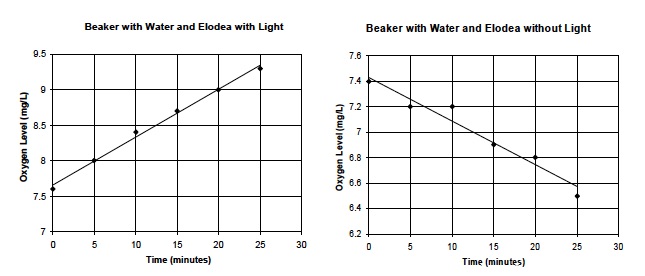
- How did the level of oxygen in the beaker not exposed to light compare to the level of oxygen in the beaker with Elodea exposed to light? The level of oxygen in the beaker without light did not increase like the oxygen in the beaker with Elodea in light increased. Looking at the change between the first measurement of oxygen (start of the experiment) and the last measurement of oxygen (after 25 minutes), some students may observe that the amounts of dissolved oxygen remained the same. Other students may observe that the amounts of dissolved oxygen decreased. However, the line and the slope of the line are distinctly different than that of the graph illustrating dissolved oxygen concentration over time in a beaker of Elodea exposed to light. The slope of the line from the beaker not exposed to light was either zero or a negative slope as compared to the positive slope seen when Elodea was exposed to light. Instruct students to record their answers in a similar question that follows their graphs in their Investigation Three Data Record.
- Based on this observation, how does light affect photosynthesis? An increase in oxygen represents photosynthetic activity. Because the Elodea leaf in water next to the bulb and socket produced oxygen, we know photosynthesis was occurring. The Elodea leaf in water in the dark did not produce oxygen, therefore we know that photosynthesis was not occurring. Instruct students to answer a similar question that follows their graphs in their Investigation Three Data Record.
- ∆ If some students’ data showed a decrease in the amount of dissolved oxygen in the water with the Elodea in the dark, what may have caused such a decrease?. Student answers will vary. Encourage students to think of any reactions that occur in plants that use oxygen. Tell students that cellular respiration is a reaction that does not require light and that takes place in plants. Since light was not present, photosynthesis could not occur, but cellular respiration could occur. The Elodea placed in the dark stilled performed cellular respiration during the time it was deprived of light, using oxygen in the process.
GET FOCUSED
Instruct students to complete the Focus Questions in their SDRs then discuss them as a class. Use the suggested responses below to guide students’ answers.
- What is the importance of light in photosynthesis? Light is necessary for photosynthesis to take place. Without light, oxygen and sugar are not produced.
- In which parts of the plant does photosynthesis occur? Both the Elodea stem and the Elodea leaf contain chloroplasts; therefore, photosynthesis occurs in both stem and leaf. However, although both stem and leaf have chloroplasts, students likely observed a greater abundance of chloroplasts in the leaf. From these observations, students should suggest that more photosynthesis occurs in the leaf as compared to the stem.