
Teacher Portal:
Genes and Proteins
Investigation 1 – Lab
ZERO-IN
Italicized font represents information to be shared orally or physically completed with the students at this time.
The non-italicized font represents additional information included to support the teacher’s understanding of the content being introduced within the CELL.
MINDSET
This Investigation is designed to:
- promote student understanding of the process by which information in genes is translated into proteins,
- build student proficiency in using complementary base-pairing rules to determine RNA sequences that are complementary to DNA sequences,
- prompt students to analyze how the DNA sequence is directly related to protein structure, and
- promote student discovery of the different types of mutations and the effects that they may have on the proteins produced by the cell.
BE PREPARED
Teacher Preparation for the Investigation includes the following. This preparation should be done prior to students arriving in the lab.
- Place all materials at the distribution center.
Note: To facilitate classroom management, you may want to count and divide the colored gram cubes for each group before the class begins. Gram cubes can be placed in separate weigh dishes for each color at each group’s table.
- Divide students into five cooperative groups.
Note: Each student lab group will need the materials listed below.
Student Preparation for the Investigation includes having students gather the following materials. This preparation takes place on lab day after student lab groups have settled at their assigned lab tables.
Note: The materials are listed in students’ SDRs. They are also listed below for your reference.
- (42) green gram cubes
- (30) yellow gram cubes
- (27) white gram cubes
- (21) red gram cubes
- (4) weigh dishes
- (2) acrylic cylinders
- (4) 2.5 oz. plastic cups
- (2) 15 ml centrifuge tubes
- (2) caps from 50 ml centrifuge tubes
- (1) cap from 15 ml centrifuge tube
- (2) wood blocks
- (3) ping pong balls
- (1) moon ball,
- (1) binder clip
- (2) large gram bears
- (1) small gram bear
- (2) glass marbles
- (2) 40 cm pieces of string
- (1) roll of masking tape
Direct one student from each lab group to collect the materials listed in their SDRs.
INVESTIGATE
- Briefly review DNA and its structure with students. Discuss how the four nucleotide bases – adenine, thymine, guanine, and cytosine – combine in different sequences to make genes. Each unique gene codes for a unique protein.
- Describe RNA to the students. RNA has many roles in the cell, but in this Investigation, students will focus on the role of RNA as a messenger (mRNA). RNA carries the genetic information from DNA in the cell’s nucleus to the cell’s cytoplasm where proteins are made on structures called ribosomes. The structure of RNA is similar to that of DNA, but RNA is single-stranded. In addition, RNA has uracil instead of thymine as one of its bases. If necessary, demonstrate how to use complementary base-pairing rules to create an RNA message from the DNA.
- Explain that within the Investigation, students will model the transfer of genetic information in DNA to RNA and explore how the message in the RNA gets translated into a protein.
- Encourage students to reflect on the PreLab video as they move through the procedural steps.
- Explain to students that during the Experiment, every procedural step is important. If one step is skipped, data can become invalid. To help students keep on track, direct them to read each step thoroughly, complete the step, then check it off (Read it – Do it – Check it off).
- Direct students to complete the procedural steps in their SDRs.
Note: The procedural steps are listed below for your reference. Teacher “Notes” are inserted, as needed, to help facilitate the lab.
- The following DNA sequence is from part of a gene that codes for a protein.
GTATCACAAGCTCGACTATTTTGC
- In the boxes below, write the base sequence of the RNA molecule that corresponds to the DNA. Use the following rules:
A in DNA = U in RNA
G in DNA = C in RNA
C in DNA = G in RNA
T in DNA = A in RNA

- How does the RNA sequence compare to the DNA sequence? The RNA sequence contains the same number of bases as the DNA sequence. However, the sequence of the bases in the RNA is different than the bases in the DNA. In addition, there are no T’s in the RNA. Instead, there are U’s.
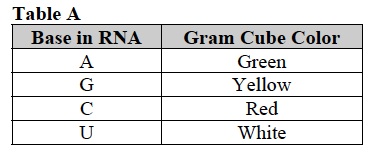
- Use gram cubes to build the RNA message. Use Table A to find the color that represents each base in RNA.
- Starting from the beginning of the RNA sequence, separate the gram cubes into groups of three. Each group of three is one codon. Be sure to keep the gram cubes in the same order.
- Use Table B to find which amino acids correspond to each codon.
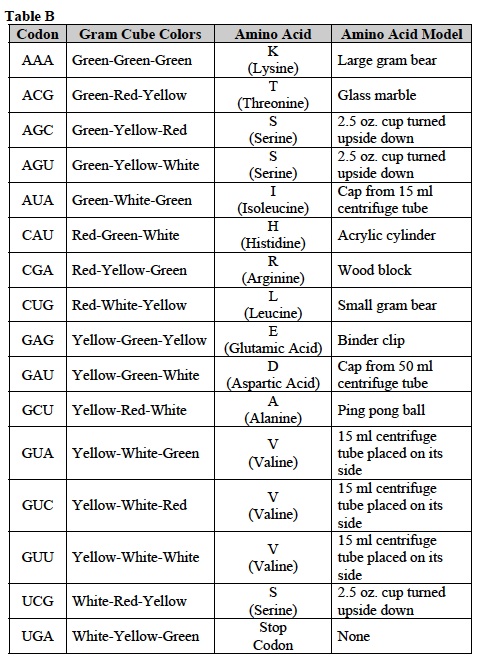
- Write the letters of each codon on the top line. Write the letter for the amino acid the codon codes for on the line below each codon. The first one is done for you as an example.

- Build a model of the protein.
- Find the materials listed in Table B that represent each amino acid.
- Line the “amino acids” up in order. The amino acids should be touching each other.
- Connect the amino acids together by placing a string along the top of the amino acids.
- Tape the amino acids to the string, be sure that the edges of the amino acids are still touching. If the amino acid is long, tape each end to the string.
- How many bases are in the RNA model? 24
- How many amino acids are in the protein model? 8
- How many bases does it take to code for each amino acid? It takes three bases (a codon) to code for each amino acid.
- How are proteins different from DNA and RNA? Proteins are made up of building blocks called amino acids. DNA and RNA are made up of building blocks called nucleotides (bases).
- Put the RNA sequence back together in a single piece. Place it and your protein model to the side.
- Table C shows four different DNA sequences. Each sequence is a mutation of the original sequence. How is each mutation different from the original sequence? Write your answers in the first two columns of Table C.
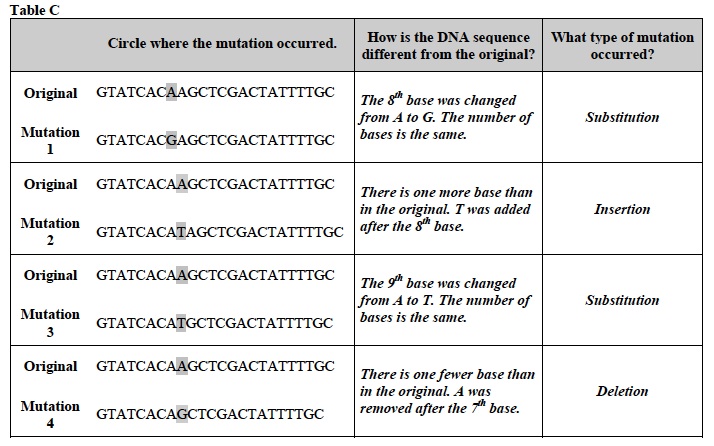
- What type of mutation has occurred to form each of the new DNA sequences? Write your answers in the third column of Table C.
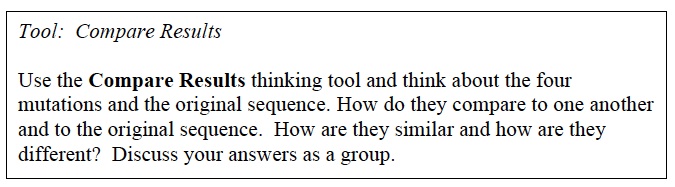
- In the boxes below, write the base sequence of the RNA molecule that corresponds to each mutation. Remember to use the rules to convert DNA sequences to RNA sequences.
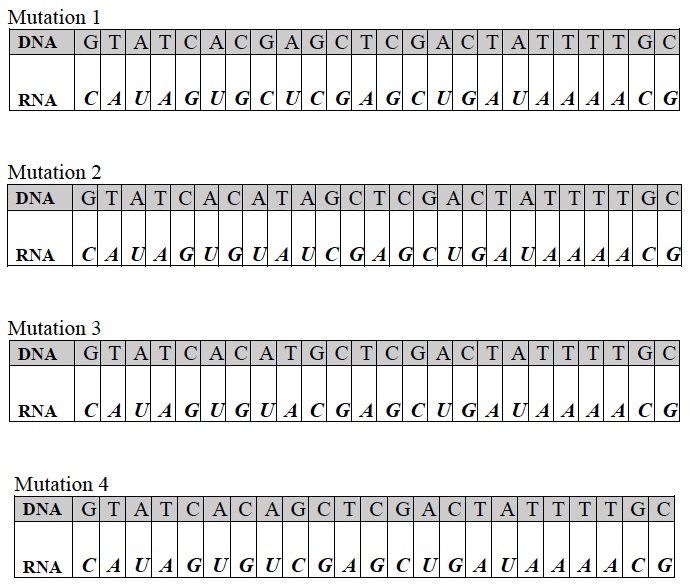
- Your teacher will assign your group one of the mutations. Build an RNA model using gram cubes that correspond to your mutation. Use Table A to find the color that represents each base in RNA.
- Write the letters of each codon on the top line. Use Table B to find the amino acid each codon codes for. Write the letter for the amino acid on the line below each codon. The first one is done for you. Mutation _____

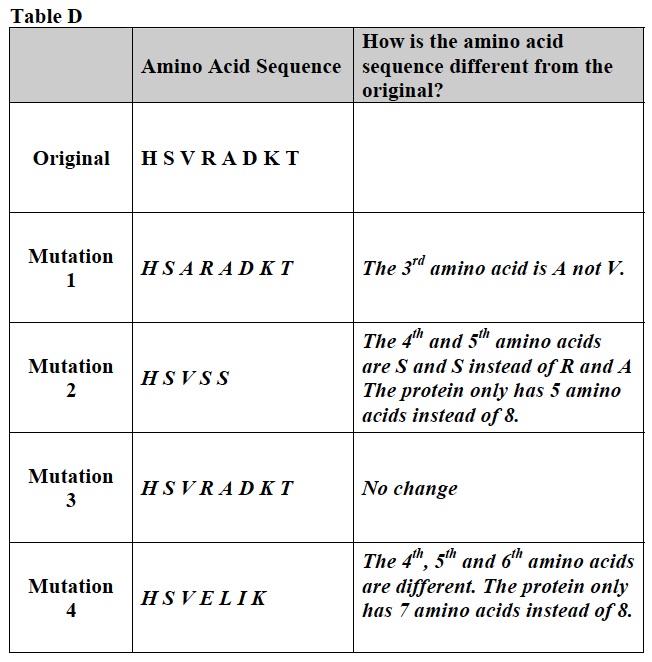
Note: Student answers will vary based on the mutation assigned. Codons can be found above. Amino acid sequences for each mutation can be found in Table D.
- Use the codon code in Table B to build the protein model that corresponds to the RNA for this mutation.
- How does the sequence of amino acids in the mutant protein compare to the original protein? Student answers will vary depending on the mutation assigned. Mutation 3 will show no change in amino acid sequence. The rest of the mutations will show changes as detailed in Table D. Mutation 2 has a stop codon.
- Record: Compare the mutant protein you created with those of the rest of the class. How did the amino acid sequence corresponding to each mutation differ from the original amino acid sequence? Record the answers in Table D.
- Make a prediction. Can a change in amino acid sequence change the function of the protein? Explain your answer. Student answers will vary. Some students may suggest that a change in amino acid sequence will always change the function of a protein. Others may suggest that sometimes no change will be seen – based on Mutation 2 which did not have an amino acid sequence different from the original.
- Fold the original model protein by placing amino acid 7 on top of amino acid 2. Place a moon ball in the center of the circle formed by these amino acids. The moon ball represents a molecule being bound by the protein.
- Fold your mutant protein by placing amino acid 7 on top of amino acid 2.
- Will the moon ball fit in the circle formed by the mutant protein as well as it fit in the original protein? Student answers will vary depending on the mutation assigned. The moon ball will be able to fit in the protein formed by Mutation 3. In all other cases, the moon ball will not fit. Mutation 2 only has 5 amino acids, so it is unable to fold and has no “binding site.”
- The function of the original protein is to bind the moon ball molecule and transport it to another part of the cell. Has the mutation in the original gene affected the function of the protein produced? Explain your answer. Student answers will vary depending on the mutation assigned. Mutation 3 is the only mutation that does not lead to a change in protein function. All others cannot bind the moon ball and will therefore have a protein function that is affected.
- Compare the results of your mutant protein with the results of your classmates. Did all of the mutant proteins look and function in the same way? Explain your answer. No. The mutant proteins all had a different structure from each other. Only the protein formed by mutation 3 showed the same function as the original wild type protein. None of the other proteins functioned properly.
- Can a change in the amino acid sequence of a protein change the function of the protein? Explain your answer. Yes. In this Investigation, all changes in the amino acid sequence led to a change in the function of the protein. Note: This is not always the case, as will be demonstrated in the next Investigation.
CLEAN UP
Let students know your expectations for clean up. Ask them to clean up.