
Teacher Portal
Friction: Investigation 4 –
Concept Day
ZERO-IN
Italicized font represents information to be shared orally or physically completed with the students at this time.
The non-italicized font represents additional information included to support the teacher’s understanding of the content being introduced within the CELL.
ASK WHY
Remind students that friction plays the role of both hero and villain in our world. Activities like walking and eating would be impossible without it. Nails would slip from boards, knots would come untied, and hair clips would fall out if it weren’t for friction On the other hand, skinned knees, scuff marks on floors, and wear and tear of moving parts are caused by friction. Learn about this force then decide if you think friction is a hero or villain.
BRANCH OUT
Explain to students that mechanical engineers design and develop Olympic luge sleds to be aerodynamic. Minimal friction and top speed are of utmost importance. Even the luge racing suit is designed to minimize fluid friction!
PRINT IT
Use your browser to download a printable PDF as a help during the slide presentation and to make additional notes. In your browser, go to File > Print and then choose to save as PDF.
NAVIGATE IT
Once the slide presentation is launched
- use your left and right arrows to advance or go back in the slide presentation, and
- hover your mouse over the left edge of the presentation to get a view of the thumbnails for all the slides so that you can quickly move anywhere in the presentation.
- Click HERE to launch the slide presentation for the CELL.
SHARE IT

FRICTION-4-1
- Inform students that the main goal of this final Investigation of Friction is to introduce the concept of the Coefficient of Friction (μ, mu, pronounced like “you” but with an m).
Note: Mu takes into account that different surfaces cause a different amount of friction. This is fairly intuitive to most students. For example, a hockey puck sliding across the ice experiences nowhere near the friction as a brick on a sidewalk.
- Tell students that, in addition to defining the coefficient of friction, we will look at some common examples and at how friction comes into play in various sports.
_______________________________________________

FRICTION-4-2
Note: This slide contains a lot of information that has been covered to this point and introduces the concept of the Coefficient of Friction.
- Explain that the green box is being pushed to the right (Force). Frictional Force (Ff) opposes this motion.
- Explain that the weight of the box is opposed by the Normal Reaction Force (R), which pushes up on the box as forcefully as the weight of the box pushes down.
Note: There are two very simple equations presented on this slide through which μ is introduced:
- Ff = μR That is, the Frictional Force (Ff) is effected by both the Normal Reaction Force (R) and the properties of the surfaces of the box and floor (μ).
- μ = Ff/R That is, the Coefficient of Friction (μ) is related to both the Frictional Force (Ff) and the Normal Reaction Force (R) such that the higher the Frictional Force is in relation to the Normal Reaction Force, the higher the value of μ.
- Explain that, in simple terms, this tells us that the larger the value of the Coefficient of Friction of two surfaces, the greater will be the opposing effect of friction. That is, more force will need to be applied to move an object that has a higher coefficient of friction.
Note: The math here is very simple, but it will be best to give students a “feel” for the coefficient of friction by considering many different examples in real life that they are familiar with.
Note: Once the concept is established over the remaining slides, the teacher may wish to return to the two equations and discuss them once again.
_______________________________________________

FRICTION-4-3
- Inform students that this slide provides a graphic representation of the microscopic surfaces affected by friction and how they are related to the Coefficient of Friction (μ).
- Explain that, in general, rougher surfaces with sharp ridges and valleys will have a higher μ than smoother surfaces.
Note: This slide also assures that students know how to accurately pronounce mu.
_______________________________________________

FRICTION-4-4
- Inform students that this slide provides the Coefficient of Friction (μ) for a number of common substances.
- Remind students that a lower μ indicates that the two surfaces will cause a lower amount of friction as they move against each other.
- Discuss the following points of interest with students:
- Notice the very low μ between Teflon on Teflon.
- Rubber on concrete is important as this is essentially the interaction between motor vehicle tires and the pavement. This μ is important for stopping, holding the road on curves, and quick starts from a dead stop.
- Notice the difference in μ between wood on wood and wood on snow. This is good news for someone taking a wooden toboggan down a snowy hill!
- Notice the very low μ for ice on ice. Also, notice that Teflon comes very close in μ value.
- Finally, notice the difference in μ values for steel on steel with and without lubrication. This is the reason for adding oil to cars and for oiling metal machinery.
_______________________________________________

FRICTION-4-5
- Inform students that this is the first of four slides stressing the importance of friction in sports.
- Explain that friction can be both an advantage and a disadvantage in sports.
- In general, stopping, starting, and gripping are all facilitated by greater friction between surfaces.
- On the other hand, speed is often improved by reducing the amount of friction between surfaces.
- Tell students that, in the lacrosse examples shown in this slide, we are accentuating the importance of increasing μ between surfaces, in particular, between the glove and the stick.
- Emphasize the microscopic close-up of the friction tape. One would predict a high μ value for this surface.
_______________________________________________

FRICTION-4-6
- Explain that, in baseball, one wants to increase μ between surfaces for the most part.
- Explain that pitchers rely on a good grip on the ball to make it break and curve as it speeds towards the plate. In fact, even the path of the curve ball is dependent on the friction of the air on the surface of the spinning baseball.
- Explain that pitchers sometimes use a rosin bag to get a better grip on the ball. Rosin is a very fine powder from dried sap from pine trees. It is particularly good at removing sweat from a pitcher’s hand on a hot day. Sweat on the hand would act as a lubricant and drastically reduce μ. As a result, the pitcher’s grip on the ball would not be very good and his control would drastically suffer.
- Tell students that pine tar gives batters a better grip on the bat in a similar fashion that rosin gives pitchers a better grip on the ball.
- Finally, since a player is easily tagger out if they run past a base, runners often slide into bags, using the friction of their bodies on the dirt to stop at the base.
_______________________________________________
FRICTION-4-7
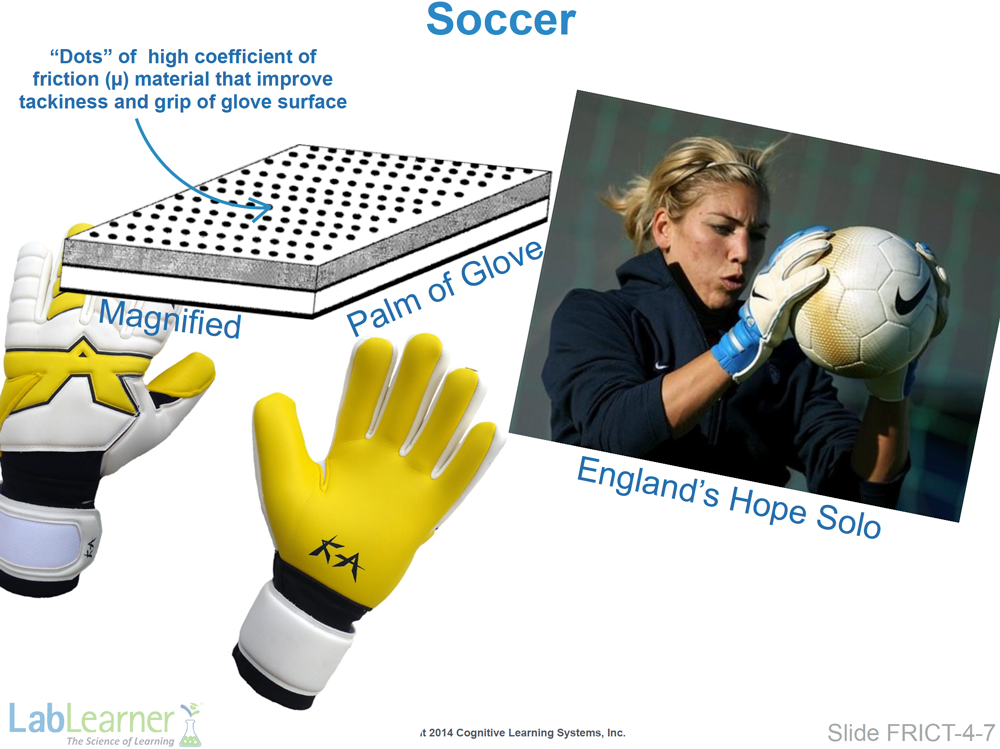
- Explain that a soccer ball shot at the goalkeeper may travel between 27 to 36 meters/second (60 to 80 miles per hour)!
- To help grip the ball, keepers depend on some pretty hi-tech gloves. As shown on the upper left of this slide, goalkeeper gloves are often supplemented with dots of very high coefficient of friction materials to help them grab and hold onto the ball.
- Tell students that goalkeeper jerseys are also sometimes treated with high μ substances to increase the frictional forces when they trap the ball on their chest or belly.
_______________________________________________

FRICTION-4-8
- Inform students that the final slide considers friction in the sport of race swimming.
- Remind students that, in the three previous sport examples (lacrosse, baseball, and soccer), we discussed ways in which athletes strived to increase μ and friction to enhance performance.
- Explain that, in swimming, athletes try to minimize the friction between their bodies and the water as much as possible.
- Read the slide to the students.
Note: In recent years, full-body swimsuits have become popular. Among the most popular is the Speedo LZR Racer swimsuit. In the 2008 Beijing Olympics, 98% of all medals won were won by swimmers wear this swimsuit. In total 23 out of the 25 world records broken in Beijing, were achieved by swimmers competing in the LZR suit. It is estimated that the swimsuit increases a swimmer’s speed anywhere from 1.9 to 2.2 percent. In competition where the difference between winning and losing is measured in 1/100th’s of a second, some officials believe that this technology gives an unfair advantage and, as a result, many of the hi-tech bodysuits have been banned from certain competitions.