
Teacher Portal:
Cell Cycle and Cancer
Investigation 2 – Lab

ZERO-IN
Italicized font represents information to be shared orally or physically completed with the students at this time.
The non-italicized font represents additional information included to support the teacher’s understanding of the content being introduced within the CELL.
MINDSET
This Investigation is designed to:
- teach students that when cells die within a tissue they are replenished through the cell cycle,
- introduce students to the four phases of the cell cycle (G1, S, G2, and M) and their functions,
- allow students to build a model representing the cell cycle,
- assist students in reviewing the stages of mitosis within the M phase of the cell cycle,
- provide an opportunity for students to review the four stages of mitosis using microscope slides,
- investigate the consequences of loss of regulation of the cell cycle, and
- introduce the concept of a mechanism for cell cycle regulation, and allow students to represent regulation in their cell cycle model
BE PREPARED
Teacher Preparation for the Investigation includes the following. This preparation should be done prior to students arriving in the lab.
- Cut and place plastic tubing, marbles, push pins, packing tape, and permanent markers at a central distribution center.
- Place one microscope at each group station.
- Place the onion root tip slide and one bottle of immersion oil at each group station.
- Divide students into five cooperative groups.
Note: There is no Student Preparation for Investigation 2 Lab.
INVESTIGATE
- Encourage students to reflect on the PreLab video as they move through the procedural steps.
- Explain to students that during the Experiment, every procedural step is important. If one step is skipped, data can become invalid. To help students keep on track, direct them to read each step thoroughly, complete the step, then check it off (Read it – Do it – Check it off).
- Direct students to complete the procedural steps in their SDRs.
Note: The procedural steps are listed below for your reference. Teacher “Notes” are inserted, as needed, to help facilitate the lab.
Trial 1:
- Place the marble in the tubing. The marble represents a cell.
- Tape the two ends of the tubing together with packing tape to form a closed ring with the marble inside.
- Using a marker, draw 4 lines around the tubing to indicate 4 separate portions of the ring. Look at the diagram for help:
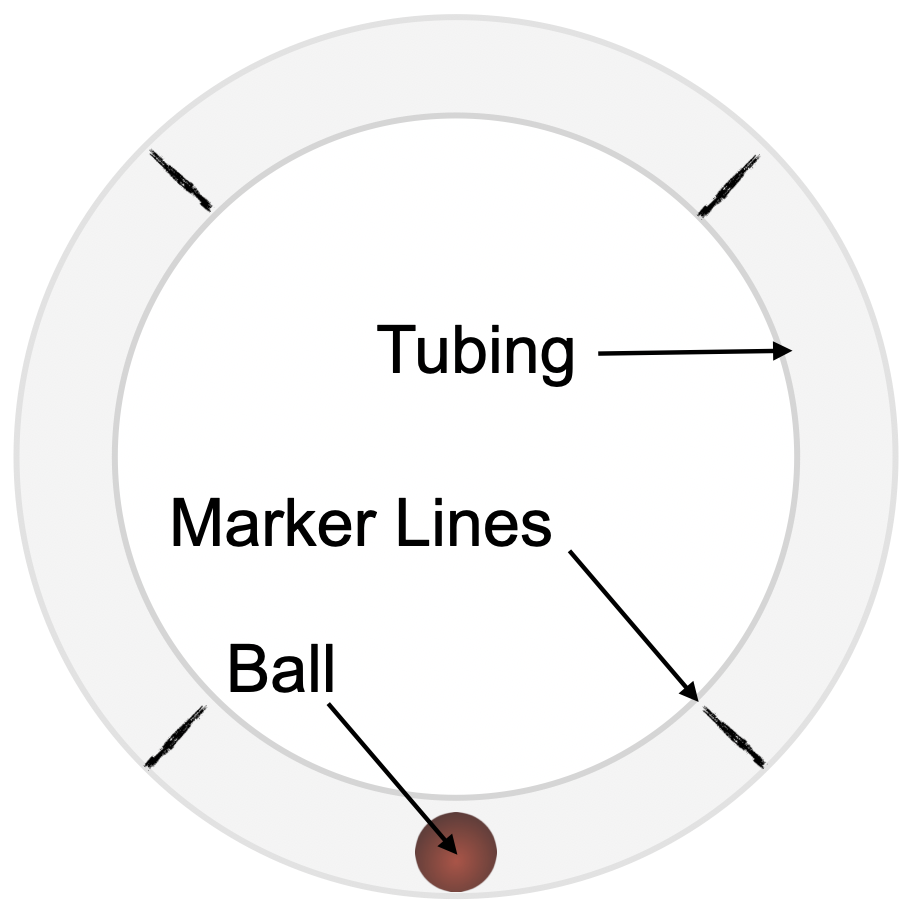
- Label each section to represent one phase of the cell cycle in the correct order on the ring: M, G1, S, or G2. Use the diagram in the Background box to help you order the phases correctly.
- Draw an arrow on the ring to represent the direction the cycle runs.
- Rotate the ring so that the marble moves through each phase of the cell cycle. The location of the marble in the ring represents the phase of the cell cycle that the cell is in.
- Use the model to determine what phase of the cell cycle a cell would be in if the cell was replicating (copying) its DNA? The cell would be in the S phase of the cell cycle.
- Use the model to determine what phase of the cell cycle a cell would be in if the mitosis is occurring? The cell would be in the M phase when mitosis is occurring.
Trial 2:
- Set up the microscope according to the Procedure, Microscope Use, and Operation.
- Place the onion root tip slide on the microscope stage. Focus first on the lowest power, and then focus using each of the higher power objectives. Finally, view the slide using the oil immersion 100X objective. Refer to the Procedure, Microscope Use, and Operation if necessary.
- Look at the different cells within the onion root tip by moving the microscope stage as needed.
- Many of the cells in your slide are going through mitosis. Are all of the cells at the same point in mitosis? Students should indicate that they see cells at all the stages of mitosis and some in interphase (not undergoing mitosis).
- Record: Using the 100 X objective, find four cells that are in different stages of mitosis. Draw each cell in the space provided.

- Can you find cells at all phases of mitosis? Label your drawings with the name of the mitosis phase (prophase, metaphase, anaphase, or telophase) that the cell appears to be in.
- What phase of the cell cycle are the cells undergoing mitosis in? Cells doing mitosis are in the M phase of the cell cycle
- What phase of the cell cycle might the cells that are NOT going through mitosis be in? The cells not going through mitosis can be in G1, S, or the G2 phase of the cell cycle. Students cannot discern which of these phases each cell is in by looking at morphology. However, cells are most likely in the G1 phase because it is the longest phase of the cell cycle.
- Is the cell cycle model you made a truly accurate representation of how cells move through the phases of the cell cycle? Why or why not? No, in the model the marble (cell) can move freely between phases. In reality, cells do not normally move directly through each phase of the cell cycle. Each phase of the cell cycle is regulated by regulatory proteins whose presence, or absence, signals the cell to move from one phase of the cell cycle to another.
Trial 3:
- Alter the cell cycle model to show how the cell stops and starts each phase.
A. Take 4 push pins of the same color. The pins represent the proteins that control the cell cycle.
B. Stick the push pins into the tubing on your model at one of the lines that mark the separation between the phases of the cell cycle.
C. Place the 4 pins evenly around the tube on this line so that there is one on the top, one on the bottom, and one on each side.
D. Test that the marble can not move past the pins.
2. Place each of the other sets of 4 pins on the other lines on your model that mark the transition between the phases. 3. Remove, 1, 2, or 3 pins at a time to move the cell (marble) from one phase of the cell cycle to another.
Note: Collect and keep the student cell cycle tube models so that they can be used in the Performance Assessment after all three investigations are complete for the Core Experience Learning Lab.
CLEAN UP
Let students know your expectations for clean up. Ask them to clean up.