
Teacher Portal
Atmosphere
Investigation 2 – PreLab
ZERO-IN
Italicized font represents information to be shared orally or physically completed with the students at this time.
The non-italicized font represents additional information included to support the teacher’s understanding of the content being introduced within the CELL.
ASK WHY
Remind students that Earth’s atmosphere is critical for life on our planet. It protects us from dangerous radiation from the sun and other objects coming at us from outer space, holds in surface heat and prevents it from radiating out into space, provides weather, makes flight possible, and, ultimately, allows us to talk with each other.
BRANCH OUT
Remind students that climate change analysts use atmospheric data to create models and to make predictions about what will happen to Earth’s climate in the future, and what impacts, if any, these changes will have on natural ecosystems and civilizations. They evaluate both economic and physical impacts.
GET FOCUSED
Inform students that the Investigation is designed to help them to answer the following Focus Questions:
- What types of air movements cause areas of high and low pressure? Cold air sinking would increase the pressure in an area while warm air rising would decrease the pressure in an area.
- Why do differences in pressure cause wind? When there are pressure differences in the atmosphere air moves from areas of high pressure to areas of low pressure. This movement of air creates wind.
- How are differences in pressure measured? Changes in pressure are measured with a barometer.
Note: These questions are located in students’ SDRs at the beginning and end of the Investigation.
Note: These are succinct responses to the Focus Questions and are placed here for your reference at this time. Fully developed responses to the Focus Questions can be found on the PostLab page.
GO DEEPER
As a class, read the Background(s) in the Investigation. Have students read the information aloud or silently to themselves. When students have finished, discuss the following concepts as a class:
- The molecules of gas that compose the atmosphere exerted a force on the surface of the Earth. Atmospheric pressure is a measure of that force per unit area.
- Pressure is calculated as
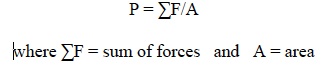
- Because atmospheric pressure is a type of pressure, the same equation can be used to determine atmospheric pressure.
- Pressure is measured by meteorologists in the units of millibars (mb). The greater the millibars, the higher the pressure.
- Anything that increases the downward force increases the pressure at that area of the Earth. Anything that decreases the downward force decreased the pressure at the area of the Earth.
- A high-pressure area or high-pressure system has a pressure that is higher than any place next to it.
- A low-pressure area means that the area has a pressure that is lower than any place next to it.
- Meteorologists indicate areas of different pressure on a map. The areas that have the same pressure are connected by a line called an isobar.
Note: These concepts are integrated into the Background(s) and are used to deepen students’ comprehension of the big ideas.
LEARN THE LabLearner LINGO
The following list includes Key Terms that are introduced in the Investigation Background(s). They should be used, as appropriate, by teachers and students during everyday classroom discourse.
- atmospheric pressure
- high-pressure system
- low-pressure system
- barometric pressure
- barometer
- pressure gradient force
- isobar
- wind
Note: Definitions of these terms can be found on the Introduction page to the CELL.
Note: Additional words may be bolded within the Background(s). These words are not Key Terms and are strictly emphasized for exposure at this time.
SET FOR SUCCESS
- Remind students that the focus of this Core Experience Learning Lab is to better understand the changes that can occur to the atmosphere and how these changes result in changes in the weather by examining temperature, pressure, and amount of precipitation received by different areas on Earth.
- Encourage students to recall and what they learned about temperature and the movement of air from the experiments conduction in Investigation One.
- Ask students whether they think whether the movement of air as a result of temperature differences can affect other areas of weather such as atmospheric pressure. Student answers will vary.
- Reinforce that the focus of Investigation Two will be an exploration of atmospheric pressure and air movement in the atmosphere. At the end of the investigation, students will have an opportunity to pull together the information from Investigations One and Two to answer this question.
- Assess students’ prior knowledge and their understanding of the Background by asking them to predict the answers to the following questions. Students will likely formulate answers to these questions after they have completed the Investigation.
- What is pressure?
- What is meant by high pressure and low pressure?
- What is wind and what causes wind?
- What does pressure have to do with the weather?
- Play the video below. Stop to ask students questions or answer students’ questions when necessary. Remind students to follow along with their SDRs and make any notes that they think might be helpful.
- After the video, direct students to divide into their lab groups to discuss their strategy for the lab. For example, they may assign certain group members to perform specific functions during the lab.
Note: The purpose of the video is to allow students to anticipate the laboratory experience they will soon encounter. Students should leave this PreLab session with a firm idea of what to expect and how to perform in the lab.
Note: Homework is posted below the video.
HOMEWORK
Tell students that they should review the Investigation in preparation for the Lab.