
Teacher Portal:
Acids and Bases
Investigation 1 – Lab
ZERO-IN
Italicized font represents information to be shared orally or physically completed with the students at this time.
The non-italicized font represents additional information included to support the teacher’s understanding of the content being introduced within the CELL.
MINDSET
This Investigation is designed to:
- allow students to recognize some acids and bases as common and familiar household chemicals,
- allow students to realize that acids and bases are not necessarily strong or dangerous,
- enable students to become proficient at measuring pH,
- allow students to measure the pH of different chemical compounds,
- promote students’ categorization of different chemical compounds as acids or bases, and
- allow students to correlate the differences among acids and bases with the differences in hydrogen ion concentration of solutions of the two classes of compounds.
BE PREPARED
Teacher Preparation for the Investigation includes the following. This preparation should be done prior to students arriving in the lab.
- Prepare the following solutions. All other solutions are the correct concentrations without the need for dilution or preparation.
 Note: The hydrochloric acid and sodium hydroxide solutions may be stored indefinitely in closed bottles. None of the acids or bases pose any significant hazard. If spills occur, simply rinse the skin, piece of clothing, or table with water. Care, however, should be exercised to prevent splashing any solution into the eyes.
Note: The concentrations of the hydrochloric acid, sulfuric acid, and sodium hydroxide solutions are the concentrations present in stomach acid, battery acid, and drain cleaner, respectively. The stipulated brands of window cleaner and liquid antacid medication contain ammonium hydroxide and magnesium hydroxide, respectively. Other brands may still exhibit the indicated pH values but should be tested before the Investigation.
- For Trial 1, each student group requires 5ml each of vinegar, 1N sulfuric acid (automobile battery acid), 0.01N hydrochloric acid (stomach acid), lemon juice, and carbonated soft drink. Place beakers containing these solutions at a central location or prior to the Investigation; prepare centrifuge tubes of each solution for each student group.
- For Trial 2, each student group requires 5ml each of 0.1N (0.1M) sodium hydroxide solution, ammonium hydroxide solution (window cleaner), and magnesium hydroxide solution (antacid medication). Place beakers of these solutions at a central location or prior to the Investigation; prepare centrifuge tubes of each solution for each student group.
- Place all materials at a central location.
- Divide students into cooperative groups of five students.
Note: Each student lab group will need the materials listed below.
Student Preparation for the Investigation includes having students gather the following materials. This preparation takes place on lab day after student lab groups have settled at their assigned lab tables.
Note: The materials are listed in students’ SDRs. They are also listed below for your reference.
- (1) pair of goggles per student
- (1) pair of gloves per student
- (1) test tube rack
- (8) 15 ml centrifuge tubes
- (8) dropper pipettes
- (1) box of pH paper strips
- (1) pair of forceps
- 5 ml acetic acid solution (vinegar)
- 5 ml sulfuric acid solution (automobile battery acid)
- 5 ml hydrochloric acid solution (stomach acid)
- 5 ml citric acid solution (lemon juice)
- 5 ml carbonic acid solution (carbonated soft drink)
- 5 ml sodium hydroxide solution (drain cleaner)
- 5 ml ammonium hydroxide solution (window cleaner)
- 5 ml magnesium hydroxide solution (liquid antacid medication)
Direct one student from each lab group to collect the materials listed in their SDRs.
INVESTIGATE
- Inform students that they will perform two Trials during this Investigation. Trial 1 introduces acids and Trial 2 introduces bases.
Note: Trial 1 should be started only after the Introduction specific for Trial 1 has been completed. Trial 2 should be started only after the Introduction specific for Trial 2 has been completed.
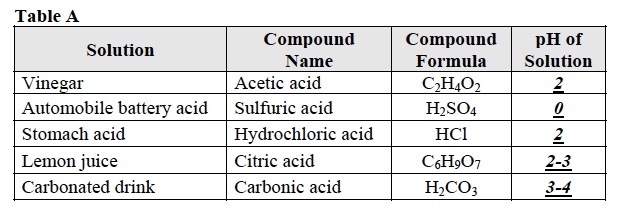
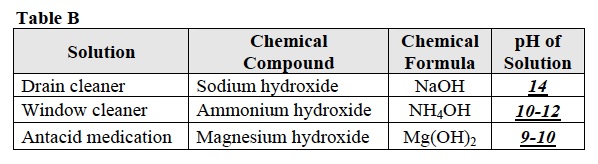
- Inform students that data for Trial 1 should be recorded in Table A and data for Trial 2 should be recorded in Table B in the Student Data Record.
- Explain that as each Trial is completed, students should answer the questions at the end of each Trial.
- Encourage students to reflect on the PreLab video as they move through the procedural steps.
- Explain to students that during the Experiment, every procedural step is important. If one step is skipped, data can become invalid. To help students keep on track, direct them to read each step thoroughly, complete the step, then check it off (Read it – Do it – Check it off).
- Direct students to complete the procedural steps in their SDRs.
Note: The procedural steps are listed below for your reference. Teacher “Notes” are inserted, as needed, to help facilitate the lab.
Trial 1:
- In this Trial, you will determine the pH of several different solutions that contain acids. Review the Procedure, Determination of pH.
- Using the lab marker and the masking tape, label a centrifuge tube with the names of each solution listed in Table A. Using a dropper pipette, add 5 ml of each solution to a centrifuge tube.
- Using forceps grasp the top of a pH paper strip and dip ¼ of the strip into the vinegar. Remove the pH paper strip.
- Match the color on the strip with the pictures of the squares on the pH chart. Estimate the pH of the vinegar that most closely corresponds to the color of the colored squares in the pictures. Estimate the pH to the nearest half of a pH unit, for example, 3.0, 3.5, or 4.0. Record the pH value in Table A.
- Repeat steps 1 through 3 for each of the other acids.
- Which of the acids that were tested are familiar to you? Student answers will vary.
- Using the data from Table A, write the names of the acids in order from lowest to highest pH. Use the pH Scale from the Background. Sulfuric acid, Hydrochloric acid, Acetic acid, Citric acid, Carbonic acid.
- What does the order of the acids tell you about the concentration of H+ ions in each solution of acid? (Hint: Use the pH scale for help). The order of the acids shows that the H+ ion concentration decreases as the pH increases.
- Which atom is present in the chemical formula of each acid? Hydrogen is present in each chemical formula.
Trial 2:
- In this Trial, you will determine the pH of several different solutions that contain bases.
- Label a centrifuge tube with the names of each solution listed in Table B. Using a dropper pipette, add 5 ml of each solution to a centrifuge tube.
- Using forceps grasp the top of a pH paper strip and dip ¼ of the strip in the drain cleaner. Remove the pH paper strip.
- Match the color on the strip with the pictures of the squares on the pH chart. Estimate the pH of the drain cleaner that most closely corresponds to the color of the colored squares in the pictures. Estimate the pH to the nearest half of a pH unit, for example, 3.0, 3.5, or 4.0. Record the pH value in Table B.
- Repeat steps 1 through 3 for each of the other bases.
- Which of the bases that were tested are familiar to you? Student answers will vary.
- Write the names of the bases in order from lowest to highest pH. Use the pH Scale from the Background. Magnesium hydroxide, Sodium hydroxide, Ammonium hydroxide.
- What does the order of the bases tell you about the concentration of H+ ions in each solution of base? The order of the bases shows that the H+ ion concentration decreases as the pH increases.
- Which two elements are present in the chemical formula of each base? Oxygen and hydrogen are present in each chemical formula.
CLEAN UP
Let students know your expectations for clean up. Ask them to clean up.