
Teacher Portal:
Weight and Volume
Weight and Volume
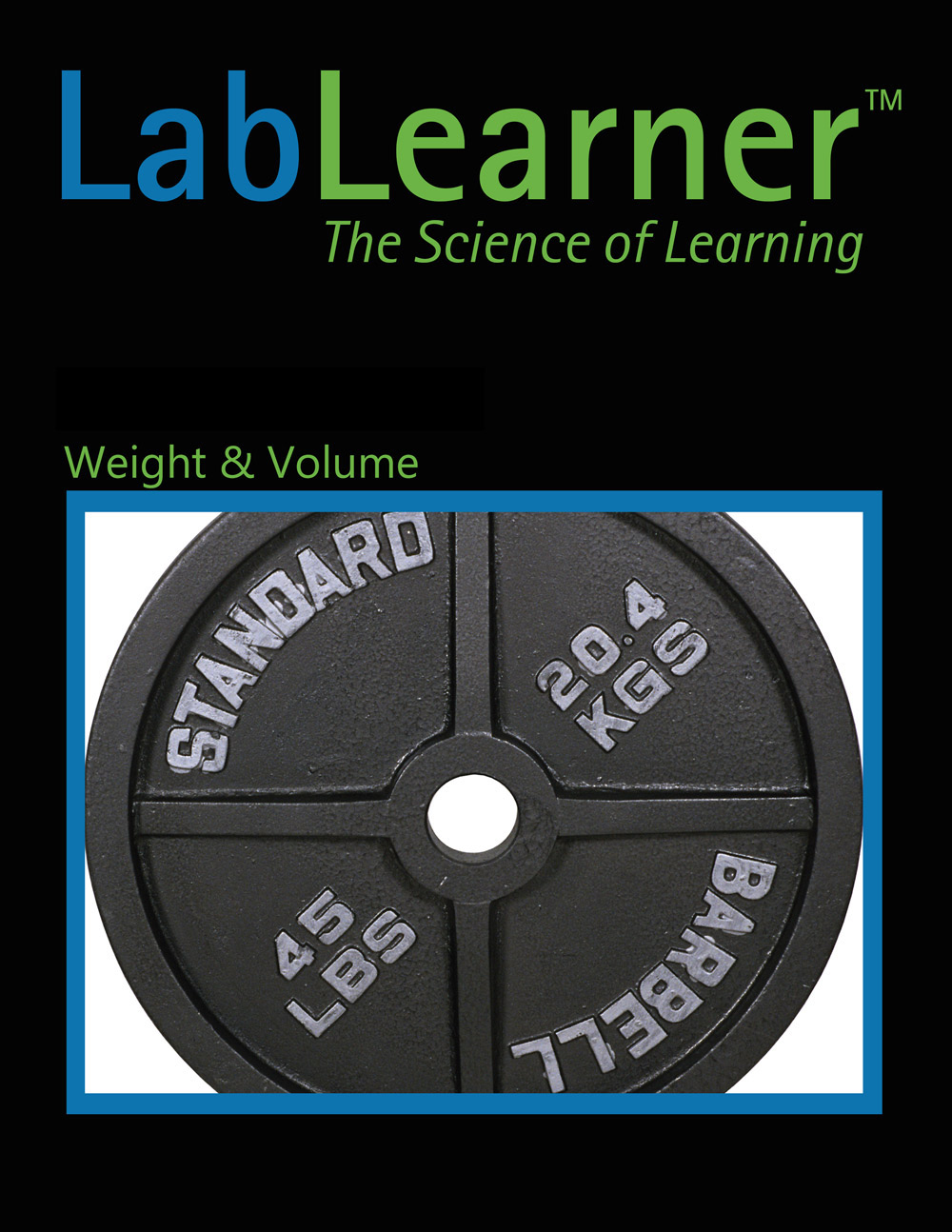 During this CELL, students will conduct several Investigations focused on the concepts of weight, balance, and volume. Through experimentation, they will explore the relationship between weight and balance and be introduced to the concept that solids and liquids possess volume. In order to conduct their investigations, they will be introduced to a beam balance, which consists of a beam and fulcrum, and a pan balance. Both of these are science tools that can be used to compare the weight of two or more items. In order to measure volume, students will be introduced to the beaker.
Through various activities and experiments, students will explore how balance is dependent on whether weight is evenly distributed. They will build a beam balance and examine how its balance is affected when its load and fulcrum are changed. They will be introduced to the concept of volume and will learn to measure volume by reading the graduation marks on a beaker. This Core Experience Learning Lab gives students the opportunity to study weight, balance, and volume by creating models, the behavior of which is governed by these concepts.
Students will investigate the physical properties of objects and will establish that the properties of weight and volume are independent of each other. Using examples of varying solids and liquids, students will learn that objects with equal weight do not necessarily possess equal volume, that objects with equal volume are not necessarily equal in weight, and that the weight or volume of a collection of objects is not related to the number of objects that are measured.
Through this CELL, students also develop their understanding of the concepts of states of matter. Students establish that matter in both solid and liquid forms possesses the physical properties of weight and volume. The systematic manipulation of first weight, then volume, and the demonstration of principles using first solids, then liquids, helps students learn to logically manipulate one variable at a time when investigating the properties of objects. It also facilitates attention to one scientific principle at a time. By conducting these investigations students will develop an appreciation for weight, volume, and measurement that will serve to deepen their understanding of the world around them.
___________________________________________________________________
Investigation 1: Exploring Weight and Balance
In Investigation One, students will begin their study of weight and balance by exploring how balance is dependent on an even distribution of weight. They will build a model of a beam balance and learn how to balance the weight of the beam on the fulcrum. Students will vary the objects placed on the beam and observe the results. Through experimentation, they will learn that balancing a beam can be accomplished by moving the objects on the beam or moving the position of the fulcrum.
Investigation 1: Teacher’s Video (1:59)
Investigation 1: Student’s Video (6:11)
___________________________________________________________________
Investigation 2: Investigating the Pan Balance
Students will continue their exploration of weight and balance in Investigation Two. They will be introduced to a pan balance, which is used to compare the weight of objects and compare it to the beam balance. They will learn to equilibrate the pan balance before using it in their experiments. Students will then use the pan balance to compare the weight of several different objects. They will determine which of the objects are greater than or less than the weight of other objects. Students will also observe that the weight of an object is not related to its size. These experiments will assist students in understanding that weight is a physical property they can use to identify an object.
Investigation 2: Teacher’s Video (3:03)
Investigation 2: Student’s Video (8:27)
___________________________________________________________________
Investigation 3: Examining the Weight and Volume of Solids
Investigation Three introduces students to another physical property of matter – volume. This investigation provides them with the opportunity to discover that the volume of an object is not dependent on the weight of that object. Students will use the pan balance to compare several foods that are equal in weight. They will determine which of the foods are greater than or less than in volume than the other foods. Through their experiments, students will observe that objects that are equal in weight may not be equal in volume.
Investigation 3: Teacher’s Video (5:58)
Investigation 3: Student’s Video (9:47)
___________________________________________________________________
Investigation 4: Comparing Weight to Volume
In Investigation Four, students will examine whether objects or substances that are of equal volume are also of equal weight. Through the use of the same three foods used in the previous investigation, students will compare equal volumes of the foods on the pan balance. Students will discover that equal volumes result in different weights. They will determine which of the foods are greater than or less than in weight than the other foods. Through experimentation, students will observe that objects of equal volumes may not be equal in weight.
Investigation 4: Teacher’s Video (2:32)
Investigation 4: Student’s Video (7:30)
___________________________________________________________________
Investigation 5: Exploring the Weight and Volume of Liquids
Investigation Five is designed to give students the opportunity to explore the properties of another state of matter – liquids. Students will observe equal volumes of three different liquids and compare how they look, feel, and smell. They will determine that although liquids have similar properties, they may be different in other properties. Students will then use the pan balance to compare the weight of the three liquids. They will determine which of the liquids are greater than or less than in volume than the other liquids. Through their experiments, students will observe that liquids have weight and that equal volumes of a liquid may not be equal in weight.
Investigation 5: Teacher’s Video (5:06)
Investigation 5: Student’s Video (10:07)
Pre-Tests and Post-Tests
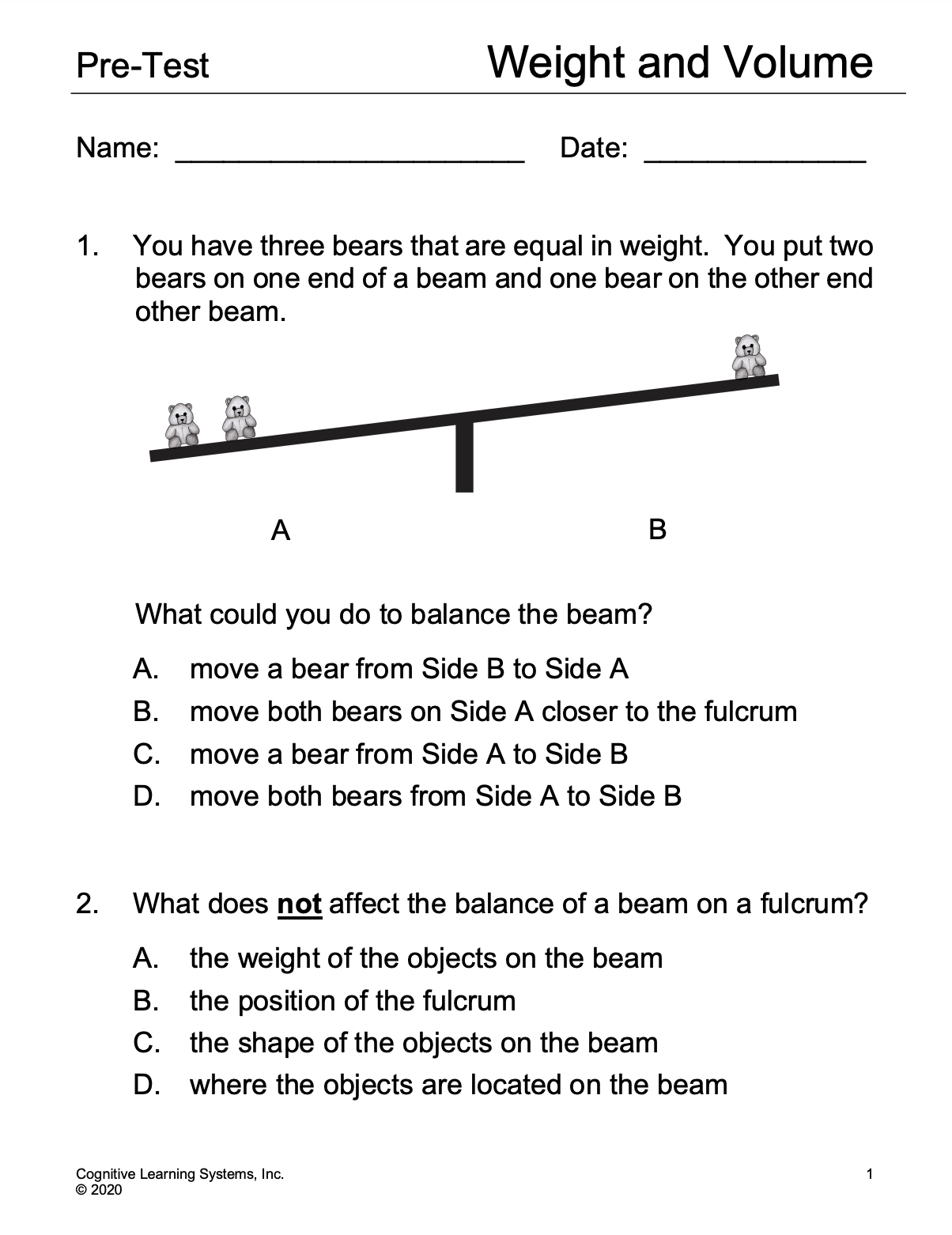
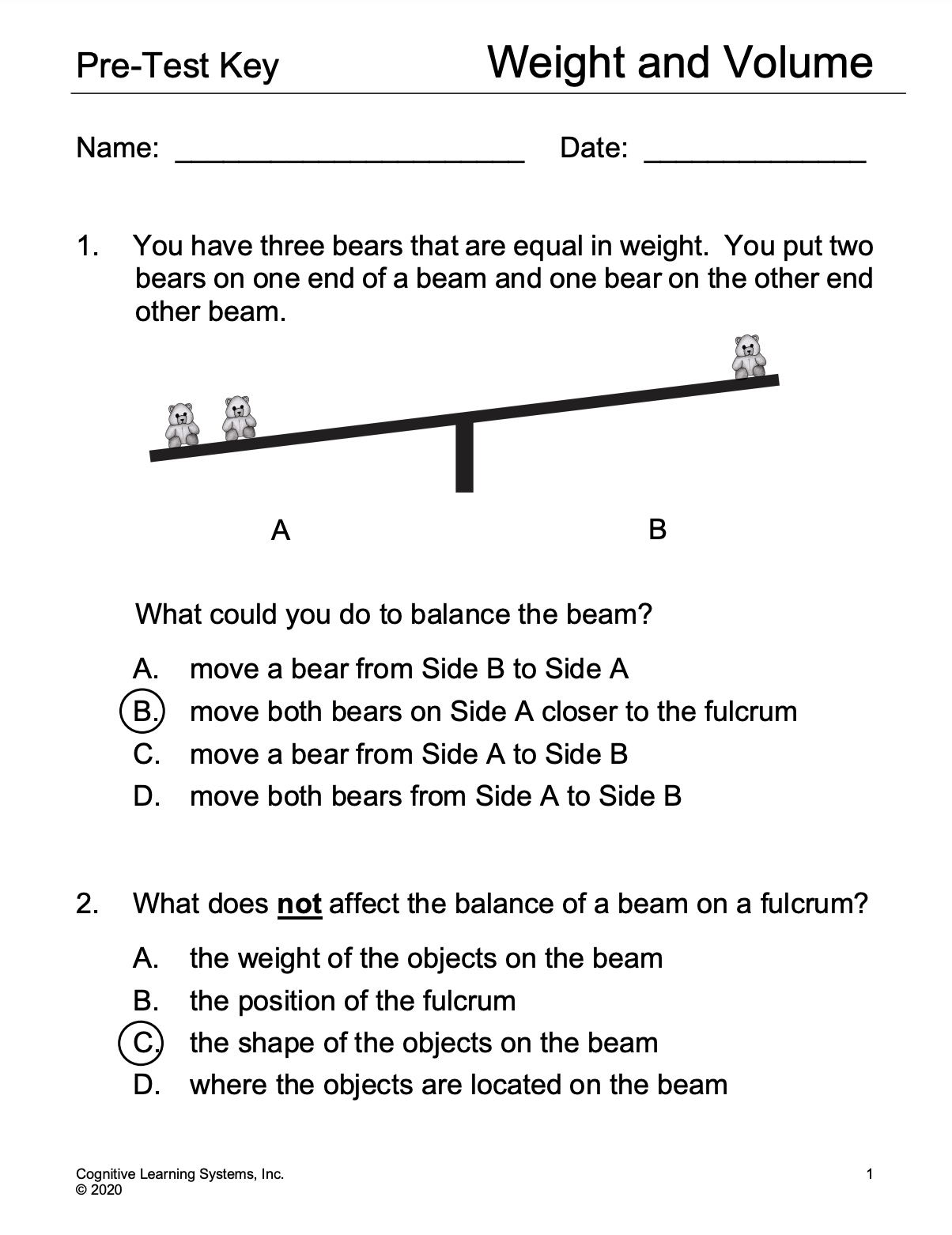
Pre-Test Key
Includes NGSS correlations
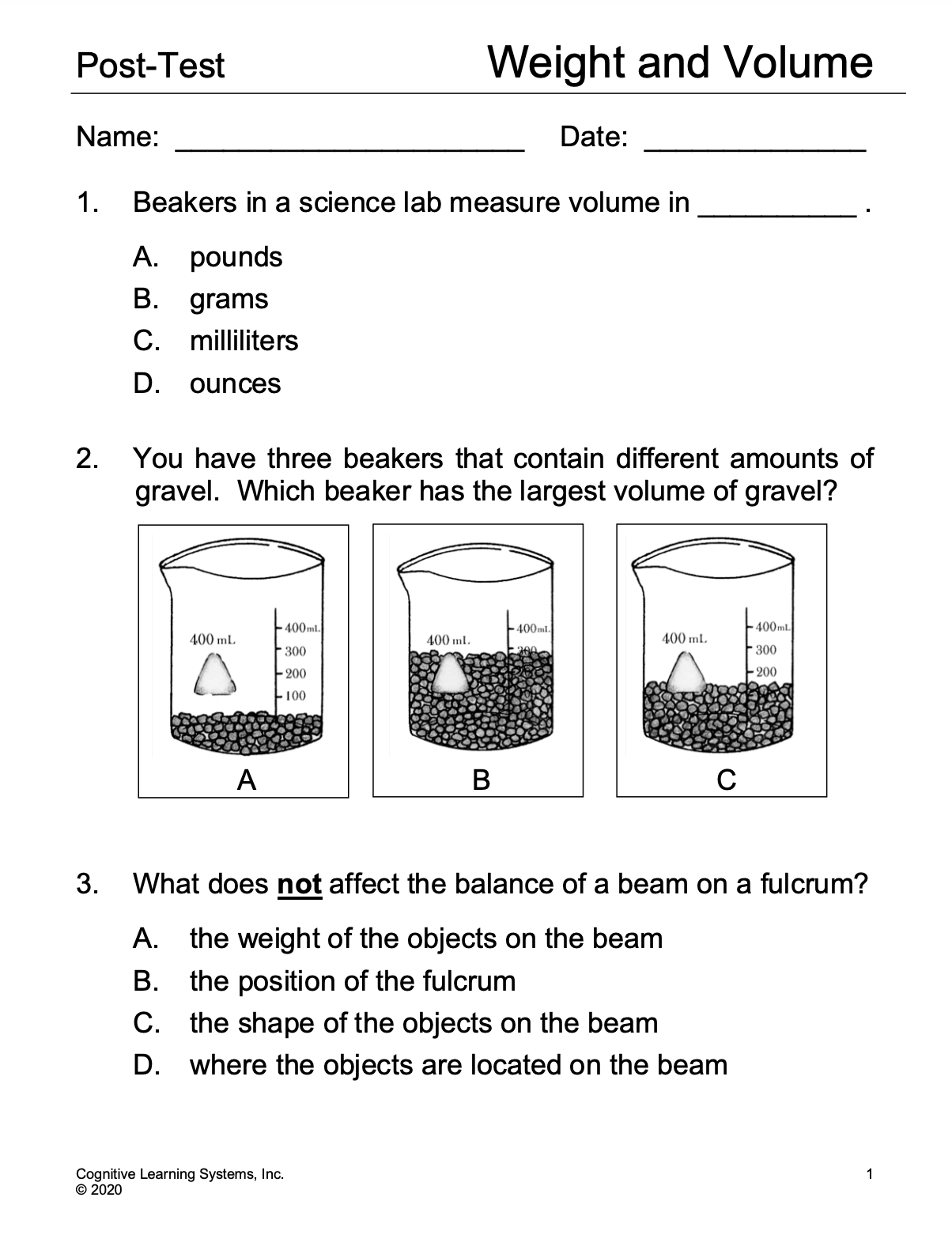
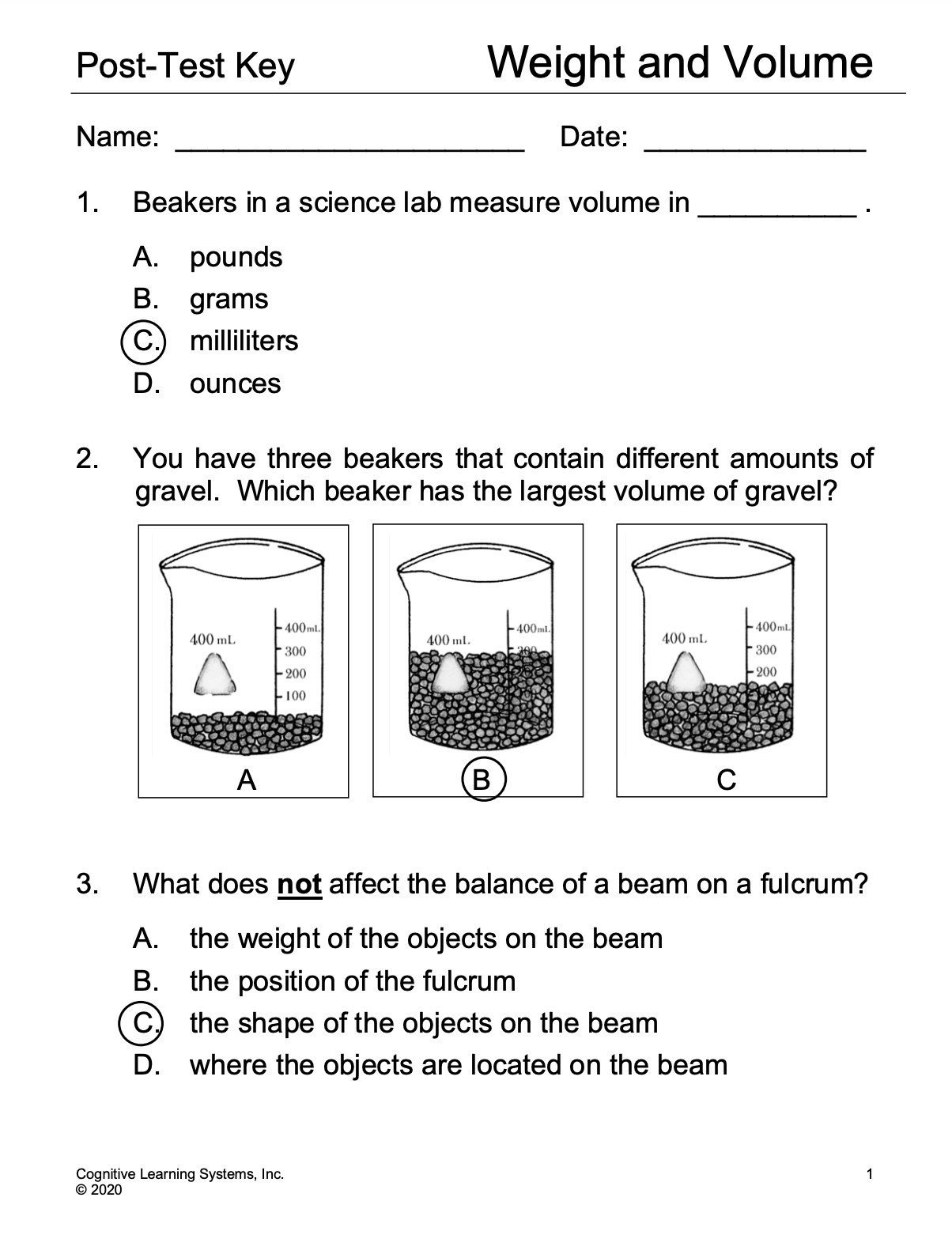
Post-Test Key
Includes NGSS correlations