
Teacher Portal:
Weather Changes
Weather Changes
 During this CELL, students will conduct several investigations focused on types of weather. By conducting experiments, investigating different variables, and utilizing scientific tools, students will begin to draw conclusions concerning the relationship between weather and temperature and conclusions about the effects that precipitation and wind have on the Earth.
Students will explore weather in a number of different ways in this CELL. They will begin their exploration of weather by determining how water and the environment are affected by the changes in temperature and sunlight that are associated with the seasonal changes of summer and winter. Through the use of a compass, they will determine the four directions found on the globe: north, south, east, and west. This facilitates students’ understanding of the direction of travel of the Sun throughout the day. Students will also conduct an Investigation that examines temperature and cloud cover. During this Investigation, students will learn how to use and operate a thermometer. In other Investigations, students will study the effect that precipitation and wind can have on the Earth and on living things. Students will also have an opportunity to use the knowledge they have gained to create a shelter that remains dry during heavy rains and remains standing during strong winds. By the conclusion of this CELL, students should realize that weather is an ever-changing part of their daily lives. They should also discern that a day’s weather is defined by temperature, cloud cover, wind, and type of precipitation. Students will also have a record of their local weather during the five Investigations, by way of a weather log completed during each Investigation.
Through performing experiments and participating in class discussions, students will develop both their observational skills and their understanding of weather. This CELL will promote students’ awareness of the types of weather that they encounter in their daily lives, building continuity between classroom Investigations and daily applications.
___________________________________________________________________
Investigation 1: Exploring Weather
Investigation One introduces students to weather and the four seasons. Through observation and experimentation, students will determine how water and the environment are affected by summer and winter. A simple experiment will show students how the amount of sunlight that reaches the Earth changes throughout the seasons. In addition, students will have an opportunity to use a compass to determine the directions of north, south, east, and west.
Investigation 1: Teacher’s Video (3:39)
Investigation 1: Student’s Video (11:46)
___________________________________________________________________
Investigation 2: Weather and Temperature
In Investigation Two, students continue their study of weather and temperature through experimentation. Students will learn how to use and read a thermometer. Students will then use the thermometer to measure the temperature of warm and cold water. They will discover that warm water has a higher temperature than cold water. Students will then observe a demonstration showing the differences in sunlight on a clear and cloudy day. Their observations will enable them to realize that more sunlight reaches the Earth on a clear day than on a cloudy day.
Investigation 2: Teacher’s Video (7:43)
Investigation 2: Student’s Video, Introduction (7:00)
Investigation 2: Student’s Video, Trials 1-4 (9:54)
Click on the image below to open Investigation 2 CAP
___________________________________________________________________
Investigation 3: Examining the Water Cycle
During Investigation Three, students will begin their exploration of precipitation through the water cycle. While performing several simple tests, students will create rain in the lab. In addition, students will examine the effect that light and heavy rain have on soil and living things. Students should discern that light rain has little or no effect on soil and on living things, while heavy rain has a significant effect on the two. Students will also begin to determine the importance of shelter for living things.
Investigation 3: Teacher’s Video (8:39)
Investigation 3: Student’s Video (15:32)
___________________________________________________________________
Investigation 4: Effects of Wind
Investigation Four introduces students to another aspect of weather: wind. Through the use of an anemometer and through experimentation, students will determine that winds blow at different speeds and from different directions. Students will also be given an opportunity to see how wind affects solids and liquids that are found on the Earth.
Investigation 4: Teacher’s Video (4:57)
Investigation 4: Student’s Video (15:57)
___________________________________________________________________
Investigation 5: Protection from Weather
During Investigation Five, students will have an opportunity to compile and analyze all of the weather data they have collected during this Core Experience Learning Lab. While in the lab, students will use the provided materials to build a shelter for a gram bear. Through simple testing, students will determine if their shelter can withstand heavy rains and strong winds. Students should discern the importance of shelter to the survival of living organisms.
Investigation 5: Teacher’s Video (4:19)
Investigation 5: Student’s Video (4:04)



Pre-Tests and Post-Tests
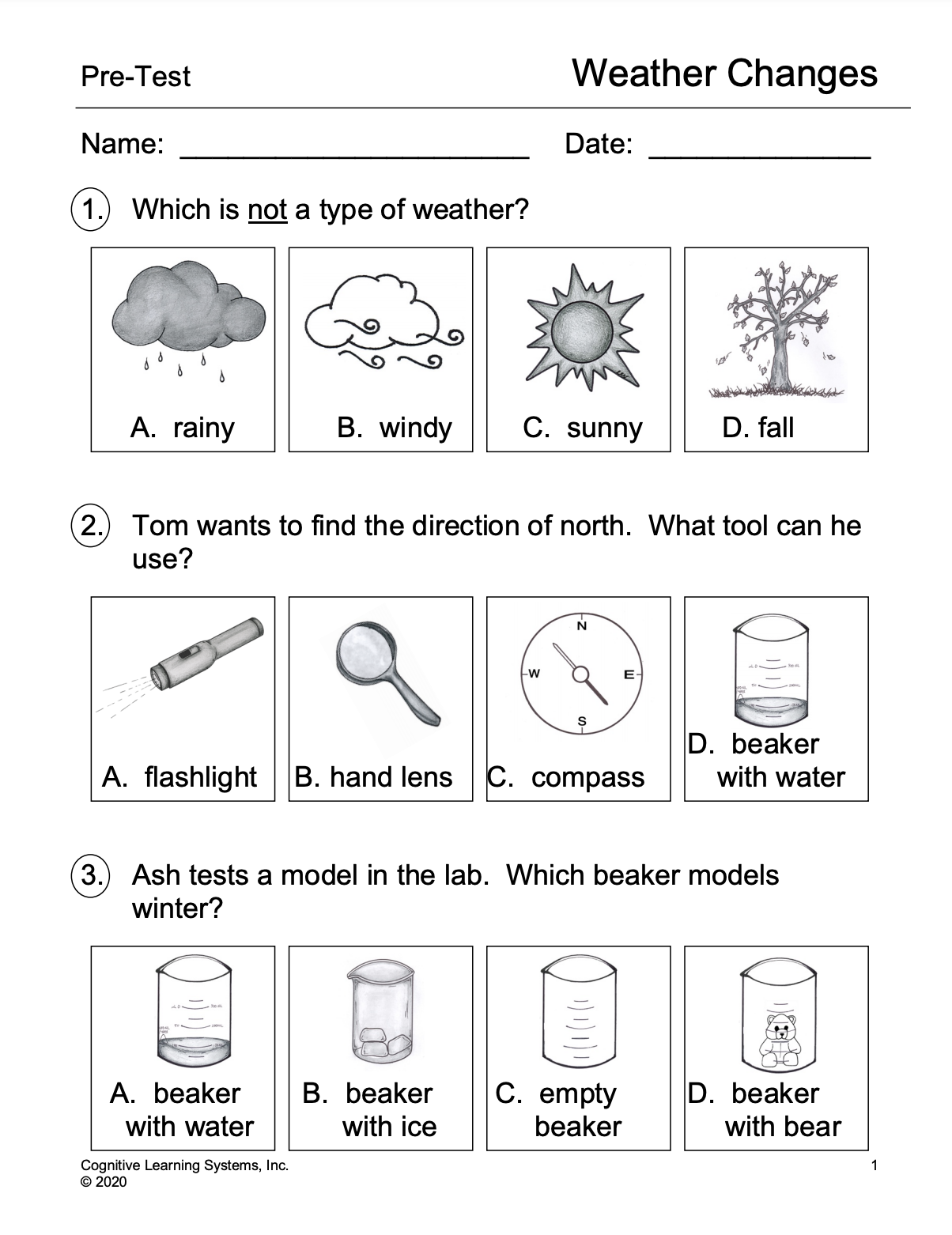
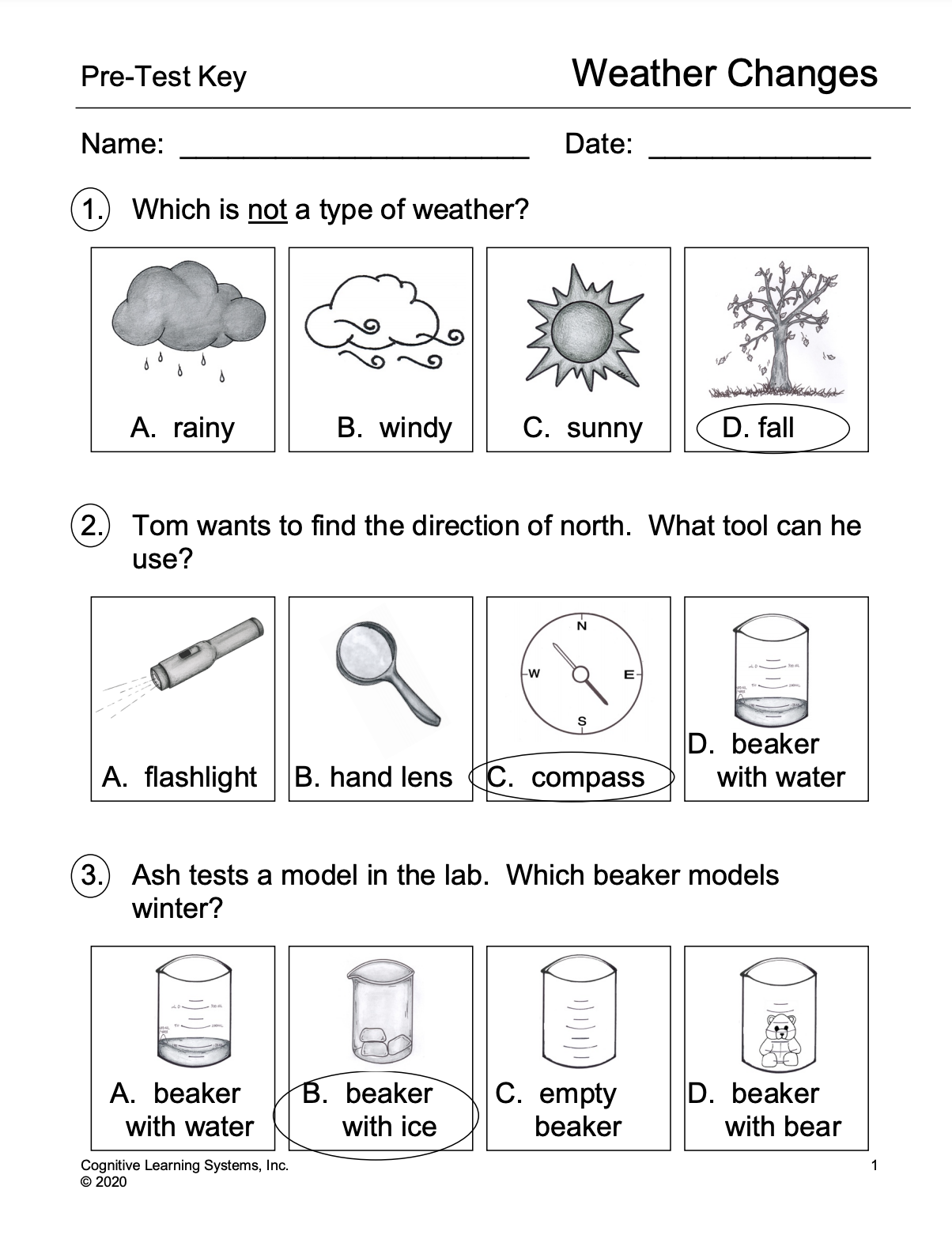
Pre-Test Key
Includes NGSS correlations

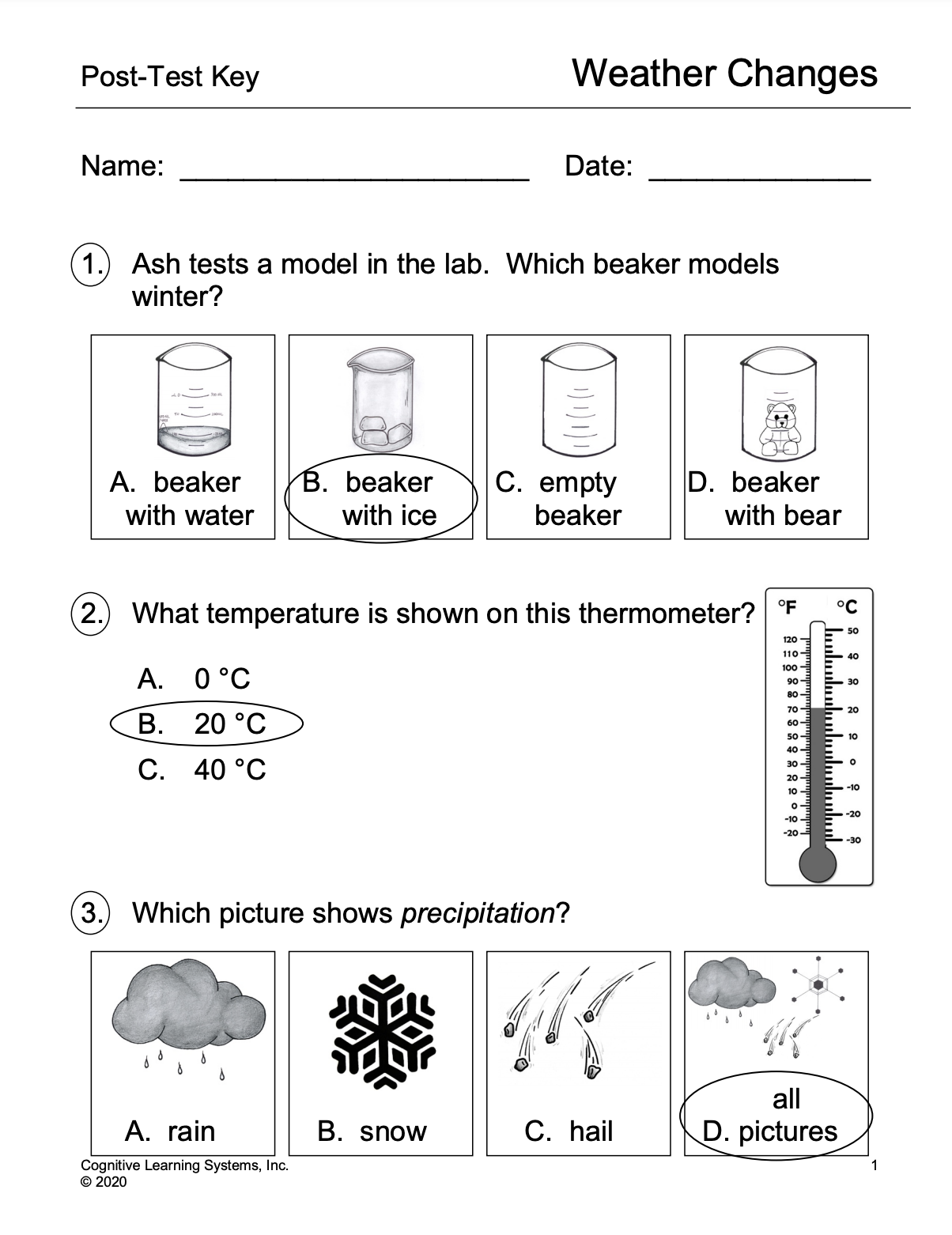
Post-Test Key
Includes NGSS correlations