
Teacher Portal:
Our Solar System
Our Solar System
 During this CELL, students will conduct several investigations focused on our Solar System. Through experimentation and observation of models, students will explore the parts of the Solar System and their relationship to one another.
By creating and using models, students will find that the Sun is a vital part of our Solar System. Students will find that the Sun, at the center of the Solar System, is surrounded by eight major planets, each rotating on its axis while revolving in an elliptical orbit around the Sun. Students will find that the Sun provides energy to the planets, shedding light and warmth with decreasing intensity as the distance from the Sun increases.
Students will also find that the Sun has specific effects on the Earth. By using models, students will observe that the Sun’s light energy interacts with objects on the Earth, causing shadows that change in size at different times of the day. Students will observe that the Sun’s heat energy to an object can be minimized by shading that object from direct sunlight. Finally, students will find that the Sun’s light energy can be converted into other forms of energy, such as mechanical energy.
Seasonal changes on the Earth are accompanied by temperature changes. Students will explore these changes by creating and using a model to illustrate the position of the Sun and the Earth in each of the four seasons, Winter, Spring, Summer, and Autumn. By using this model, students will understand that the tilt of the Earth’s axis causes parts of the Earth to be exposed to more direct sunlight while other parts are not. The parts that are exposed to direct light are warmer and experience Summer, while those that are not directly exposed at a given time are cooler and experience Winter.
By modeling the position of the Moon, Earth, and Sun as the Moon revolves around the Earth, students will observe that half of the Moon is always illuminated by the Sun. Students will also observe that the appearance of the Moon from the Earth changes due to its position relative to the Earth. In this way, students will observe the cause of the phases of the Moon.
In all of their explorations, students will focus on the parts of the Solar System and their relationship to one another. Students will also explore the movement of the planets around the Sun, concluding that forward motion and gravity cause the planets to orbit the Sun. In this way, students will find that forward motion and gravity are driving factors in creating our Solar System to be what we know today.
This CELL will broaden students’ understanding of our Solar System and the planets, the Sun, and the other bodies that comprise it. This knowledge will give students a better understanding of their own place in the vast universe which surrounds them.
___________________________________________________________________
Investigation 1: The Eight Planets Around the Sun
In Investigation One, students will begin their exploration of the Solar System by investigating the movement of the planets around the Earth. By modeling rotation and revolution, students will find that the planets move around the Sun. Students will also find that the Earth’s rotation causes us to experience night and day. Finally, students will find that the order of the planets from the Sun is important in determining the level of the Sun’s heat energy that reaches each planet.
Investigation 1: Teacher’s Video (11:29)
Investigation 1: Student’s Video (14:43)
___________________________________________________________________
Investigation 2: The Sun and the Earth
Investigation Two guides students into further exploration of the Sun’s effect on the Earth. Students will use models to investigate the Earth’s atmosphere, concluding that the atmosphere varies the amount of light that reaches the Earth’s surface. Students will explore this light by looking at various objects’ shadows. Students will find that the size of the shadows depends on the size of the object and on the time of day the shadows are observed in natural light. Students will observe the effect of the Sun’s energy on Earth and will conclude that the amount of heat energy that reaches an object can be varied by providing shade for the object. They will also find that light energy from the Sun can be converted into other types of energy. These conclusions will aid students in coming to a better understanding of the Sun and its relationship to the Earth.
Investigation 2: Teacher’s Video Introduction (15:00)
Investigation 2: Student’s Video (16:14)
___________________________________________________________________
Investigation 3:The Earth and Its Seasons
During Investigation Three, students will use a model of the Earth and the Sun to observe the direction of sunlight on the Earth during the four seasons. Students will find that the tilt of the Earth affects how directly parts of the Earth receive light during a given time of year. Students will conclude that the tilt of the Earth allows different parts of the Earth to receive greater or smaller amounts of light and heat energy, causing temperature changes, which drive seasonal changes.
Investigation 3: Teacher’s Video (14:45)
Investigation 3: Student’s Video: Set Up (9:42)
Investigation 3: Student’s Video: Trials 1-5 (10:31)
___________________________________________________________________
Investigation 4: The Phases of the Moon
Investigation Four guides students through an exploration of the phases of the Moon. By observing and manipulating a model of the Sun, Moon, and Earth, students will find that our observations of the Moon from the Earth vary based on the position of these three bodies. Students will find that although half of the Moon is always illuminated by the Sun, our observations of its appearance change as the Moon revolves around the Earth, giving us what we have termed phases of the Moon.
Investigation 4: Teacher’s Video (7:26)
Investigation 4: Student’s Video (10:53)
___________________________________________________________________
Investigation 5: Movement of the Planets
Investigation Five concludes students’ exploration of the Solar System with an investigation of the movement of the planets. Students will use models to explore the two factors which affect planetary motion, the Sun’s gravity and a planet’s forward motion. Students will conclude that these two factors combine to cause each planet to orbit the Sun in a continuous and elliptical manner
Investigation 5: Teacher’s Video (11:01)
Investigation 5: Student’s Video (9:37)
Click on the image below to open Investigation 5 CAP
___________________________________________________________________
Investigation 6: Performance Assessment – Teachers Only (3:58)
In the Performance Assessment that comprises the sixth investigation, students will demonstrate their understanding of the previous investigations in the Core Experience Learning Lab. Specifically, students will demonstrate the ability to model the relationship between components of the Solar System. Students will construct a model of the Sun, Earth, and Moon in order to demonstrate particular Moon phases, followed by a model of the Earth and the Sun that depicts a specific season in a given location on the Earth.


Pre-Tests and Post-Tests
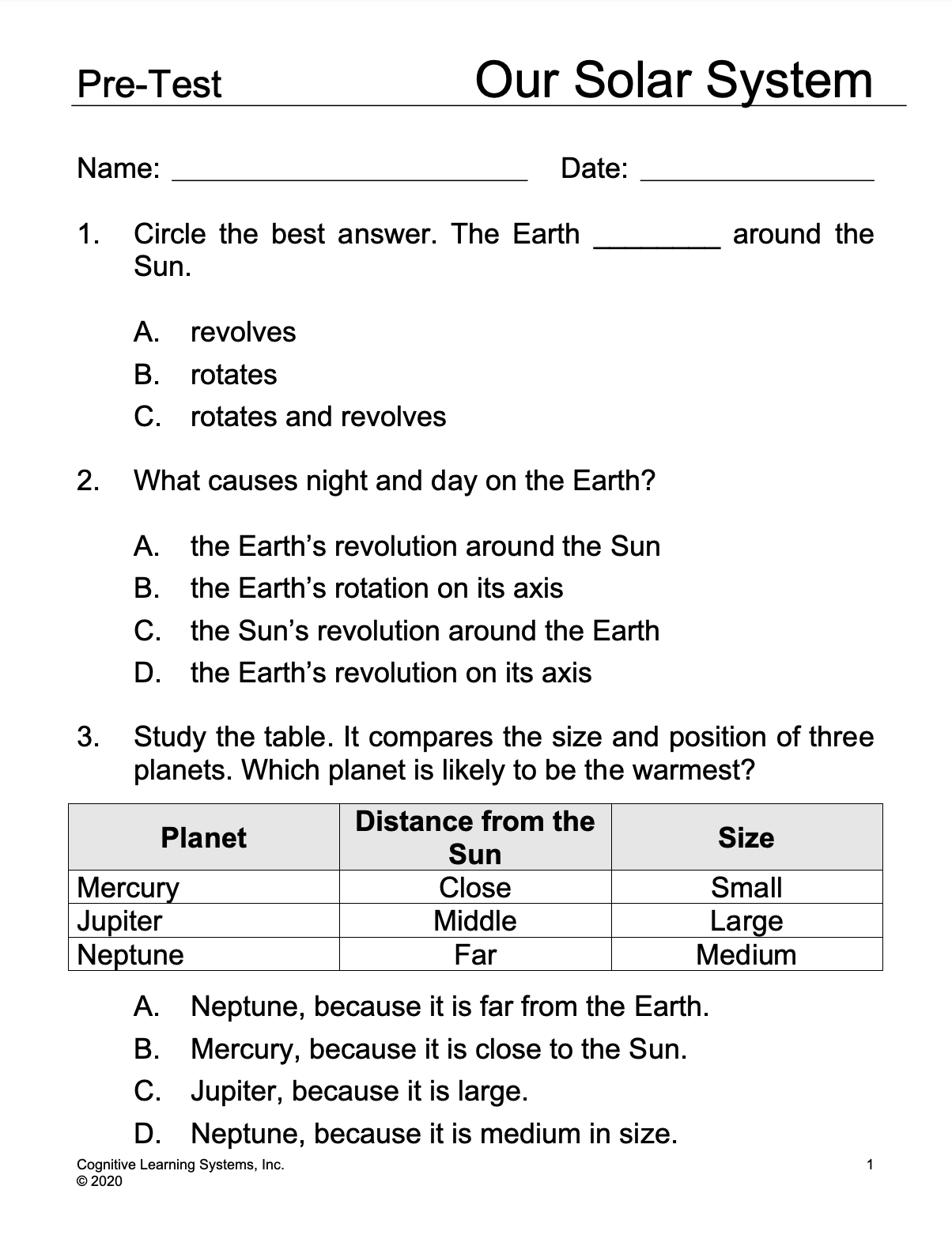
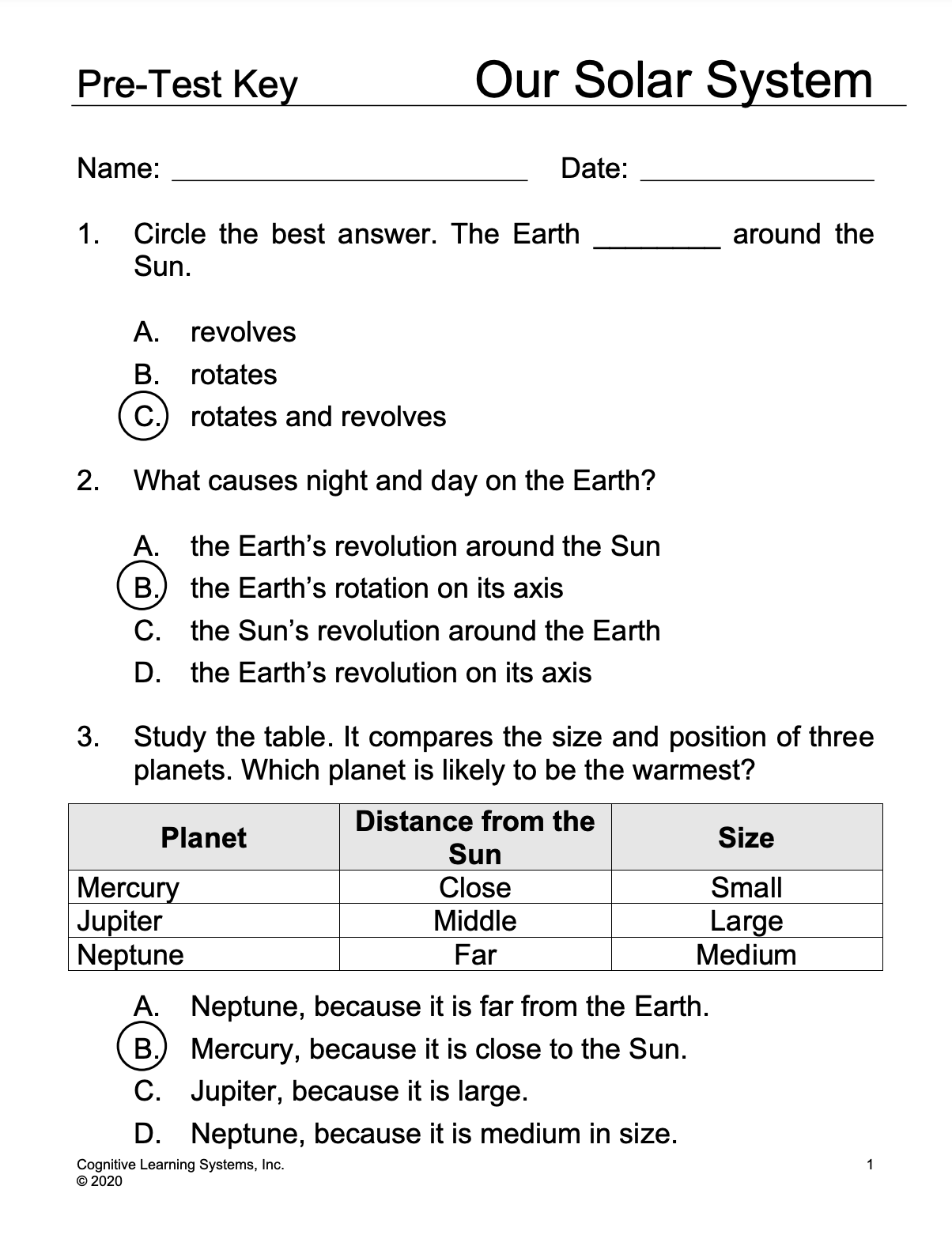
Pre-Test Key
Includes NGSS correlations
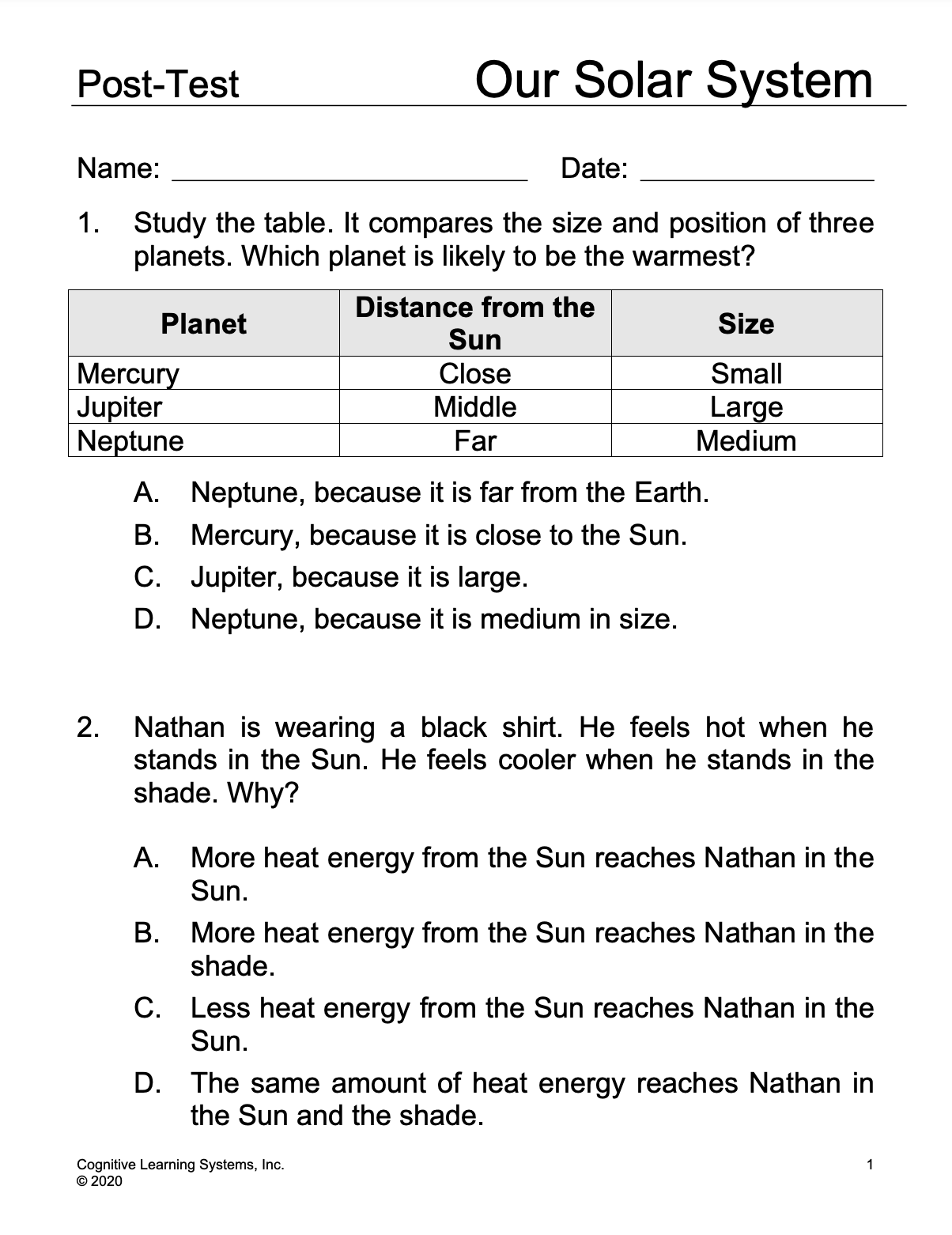
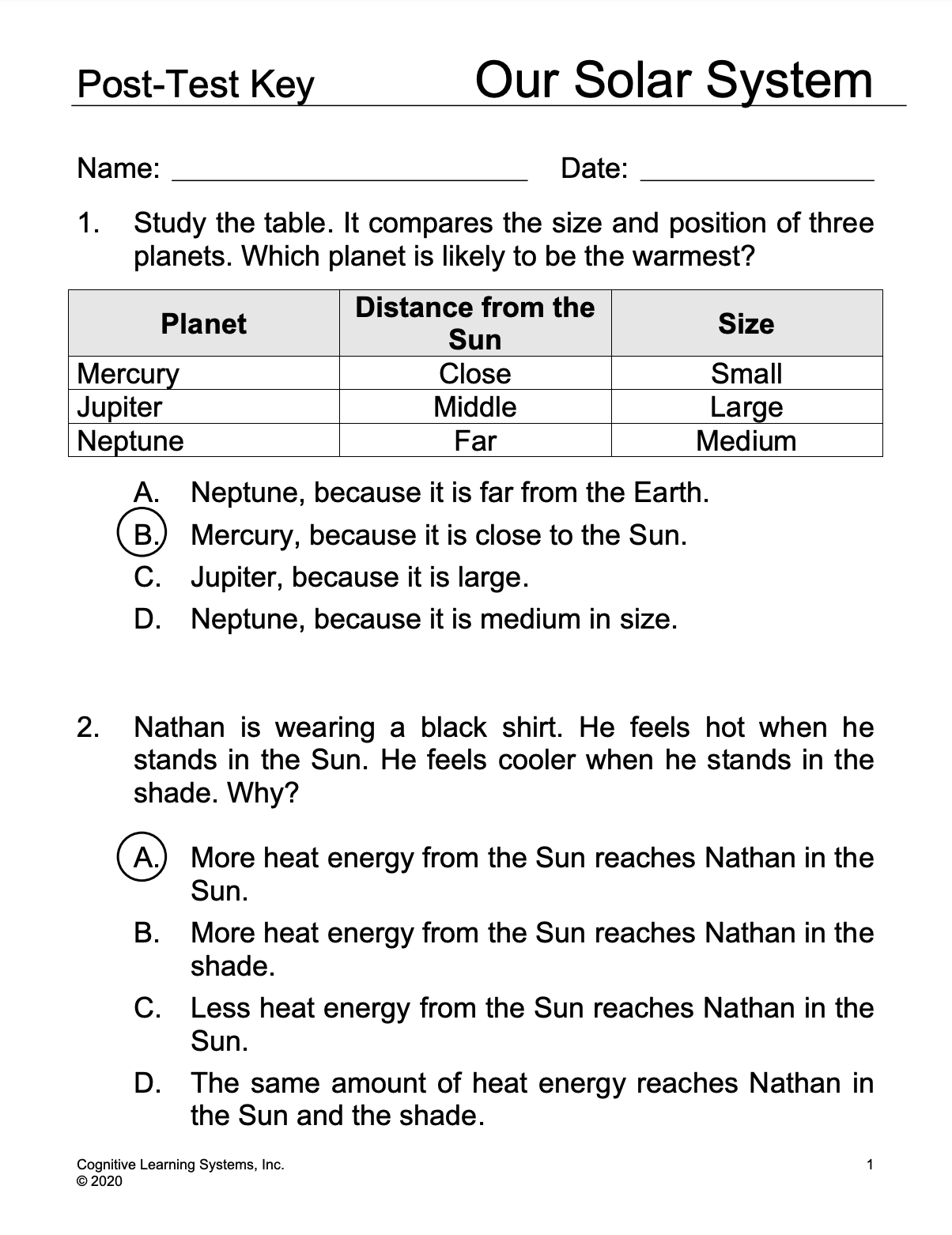
Post-Test Key
Includes NGSS correlations
LabLearner Links for
Our Solar System


