Teacher Portal:
Making Measurements
Making Measurements
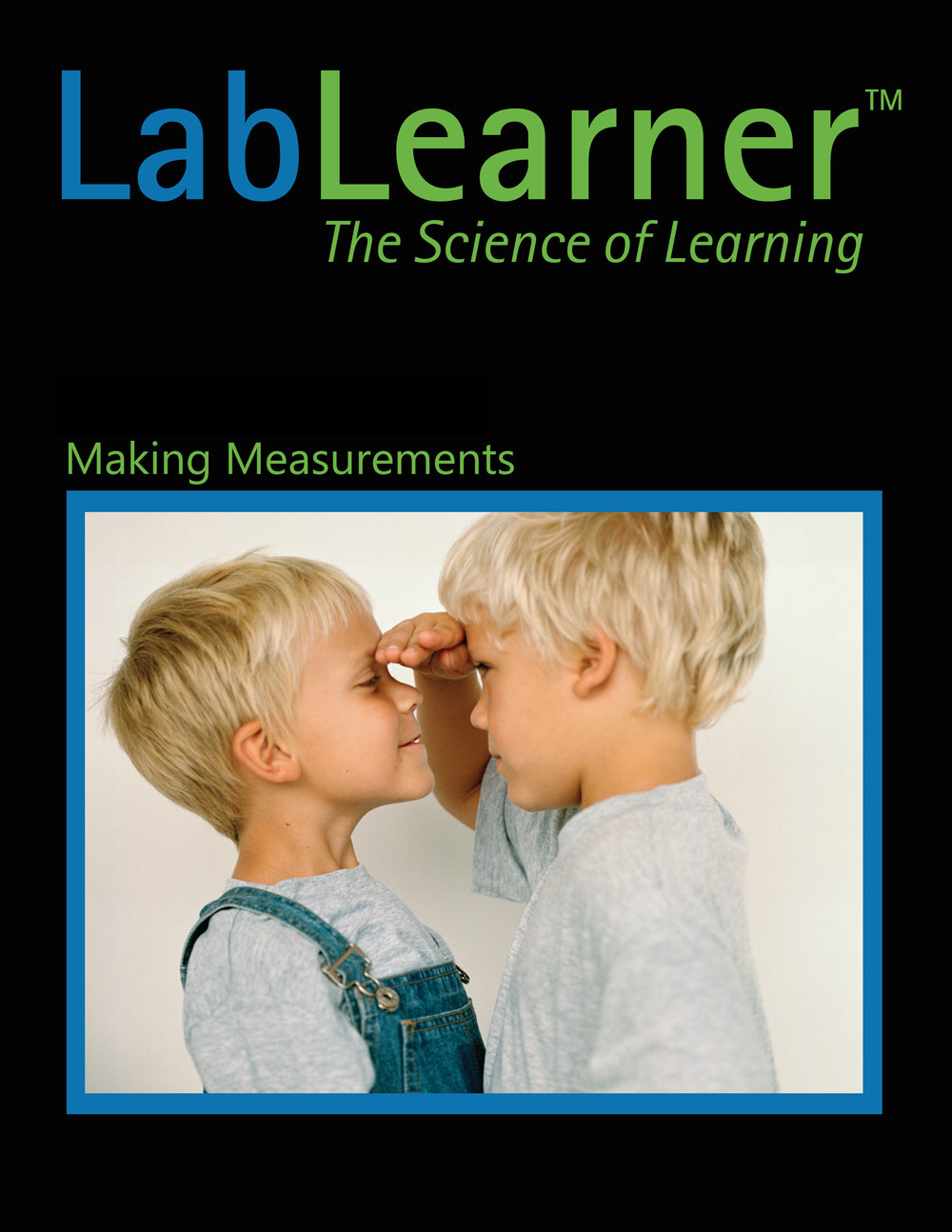
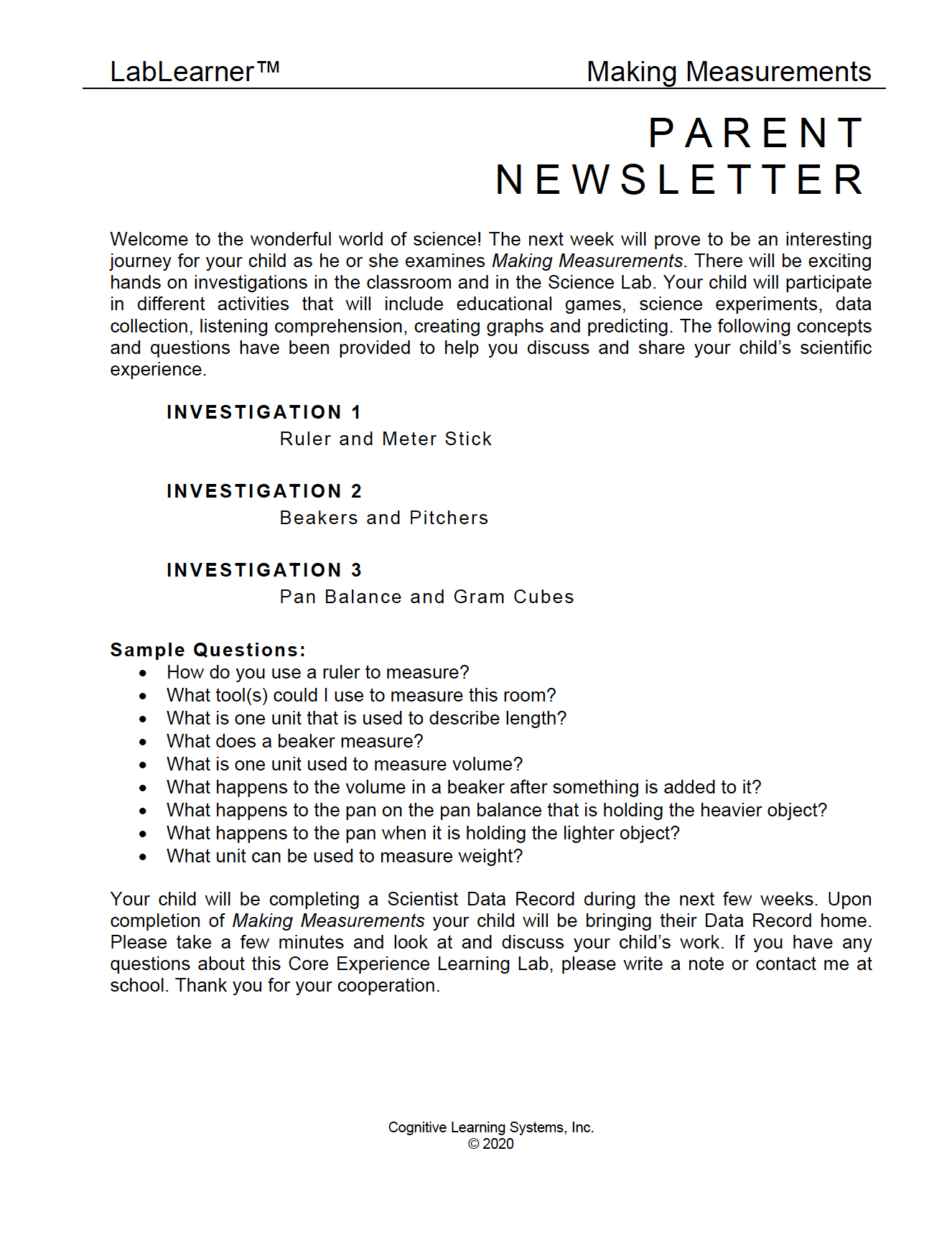
During this CELL, students will perform activities and conduct experiments focused on measuring and quantifying the properties of objects. In the past, students have spent time observing and describing their observations of properties such as color, texture, smell, and sound. This CELL guides students to expand these observations by studying the properties of height, length, width, volume, and weight.
Students begin their exploration of measurable properties by using a ruler and a meter stick. Using these tools, students find that they can measure the height, length, or width of objects. Through measuring various objects, students find that by using a ruler, they are better able to measure smaller objects, and that meter sticks allow students to more easily measure larger objects.
After being presented with a question of how to measure liquids, students are introduced to two new tools of measure: beakers and a liter pitcher. Students find that these tools can be used to hold and measure volume. Through exploration, students discover that when more of something is added to a beaker, the volume contained within the beaker increases. By experimenting with the beakers and pitchers, students begin to understand some of the basic properties of matter.
Students conclude their investigation of measurable properties by exploring the property of weight. They use a pan balance to compare the weights of objects, finding that the position of the balance indicates which object is heavier and which is lighter. Students then use the pan balance and gram cubes to measure and quantify the weight of various objects.
Through these explorations of height, length, width, volume, and weight, students learn that certain properties can be described by number and that the number is further described by a unit of measure. Students become familiar with using units such as centimeters, meters, milliliters, and grams. These experiments guide students to conclude that units of measure are vital in describing an object’s properties.
By completing this CELL, students will become familiar with some basic properties of matter. Their experiments lay the groundwork for further study and understanding of changes that matter may undergo as well as conservation of matter. Students will find that measurement is a vital way of describing the world around them, at home, at play, and at school.
___________________________________________________________________
Investigation 1: Ruler and Meter Stick
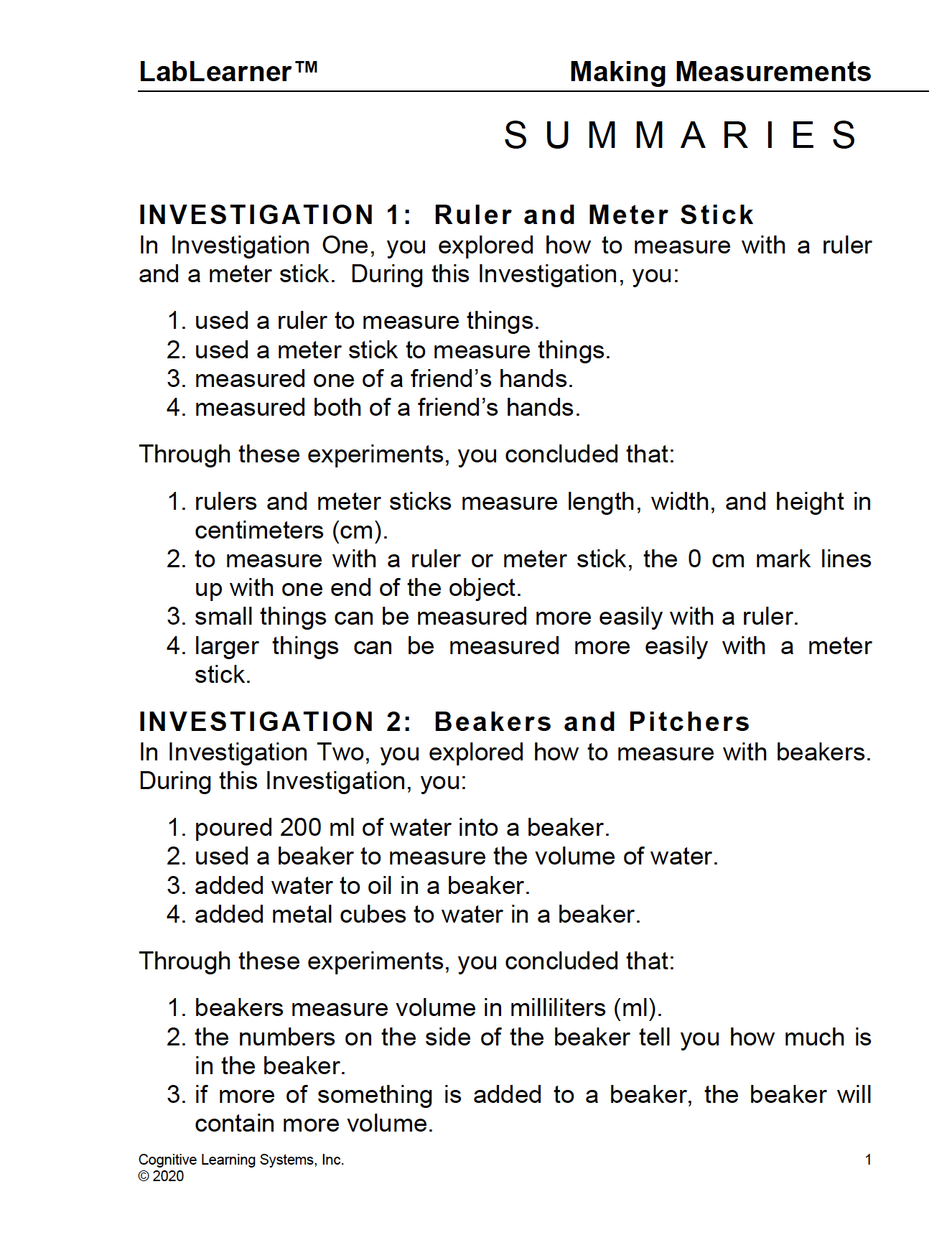
In Investigation One, students are introduced to measurable properties of objects by using a ruler and a meter stick to measure height, length, and width. Students learn that these dimensions can be assigned numerical values, and students become familiar with using the centimeter as a unit of measure. As they explore, students find that the length of an object may be increased if something additional is added to that object. Students also begin to find that certain tools are better for certain tasks, as they discover that smaller objects can be more easily measured with rulers and that larger objects can be more easily measured with meter sticks.
Investigation 1: Teacher’s Video (4:39)
Investigation 1: Student’s Video (10:55)
___________________________________________________________________
Investigation 2: Beakers and Liter Pitchers
Investigation Two guides students in an exploration of volume. Students investigate liquid volume by using beakers and a liter pitcher to hold and measure a volume of liquid. Students use beakers to obtain a specific volume of water as well as to measure the volume of a specific sample of water. Students also find that when additional liquid is added to a beaker, there is an increase in the volume contained in the beaker. Similarly, when solid objects are added to the liquid in a beaker, the volume contained in the beaker increases.
Investigation 2: Teacher’s Video (6:44)
Investigation 2: Student’s Video (14:33)
___________________________________________________________________
Investigation 3: Pan Balance and Gram Cubes
During Investigation Three, students use a pan balance to explore the property of weight. Throughout the Investigation, students use the pan balance to compare the weight of objects, finding that the pan containing the heavier object is lower than the pan with the lighter object. Students also use the pan balance and gram cubes to quantify the weight of objects. Through this exploration, students find that measuring the weight of objects in grams further helps them to compare and contrast their weight.
Investigation 3: Teacher’s Video (10:44)
Investigation 3: Student’s Video (12:00)
___________________________________________________________________