Teacher Portal:
Making and Recording Observations
 Making and Recording Observations
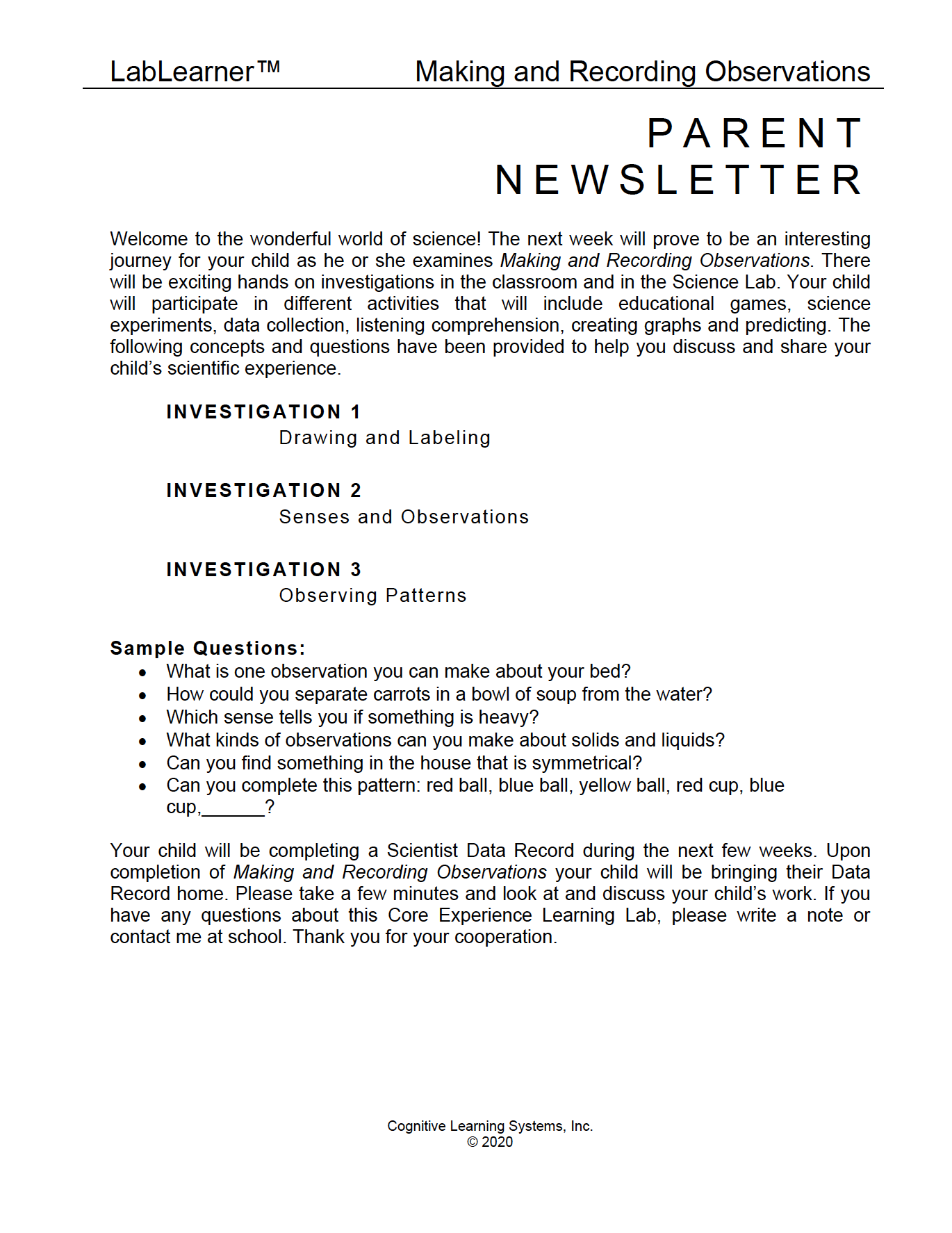
During this CELL, students will perform activities and conduct experiments designed as a formal introduction to the process of making and recording observations. Through their explorations, students will come to a better understanding of different types of observations, how to draw and label detailed observations, and how to recognize and classify various patterns in the biological and physical world. In addition, they will discover a relationship between the five senses and the types of observations made by each sense.
Students begin their investigation by discovering what happens when various objects and substances are combined with water. Students are encouraged to make observations of the color, shape, and volume of the water and substances before and after their combination. In addition, students are later challenged to test and observe whether the substances can be separated from the water. As a result of their experiments, students learn that drawing and labeling their observations is one method of recording data.
As a part of their investigations students also observe and compare the appearance, texture, weight, sound, and smell of three solids and three liquids using their senses of sight, touch, hearing, and smell. By collecting data about each of these properties students extend their understanding of what constitutes an observation and that each sense is responsible for different types of observations. In addition, by comparing their observations of the different solids and liquids, students develop an initial understanding of properties that solids and liquids may or may not share.
Students end their investigation through the study of patterns. As a part of their experiments, they learn that different types of patterns such as sequence and symmetry are present in innate objects, animals, stories, art, and music. Through experiments, observation, and participation in class discussion, students will begin to comprehend that their natural curiosity and declaration and recording of observations provide them with the procedures they need to research, conduct, and share the findings of their own experiments. This Core Experience will promote students’ awareness of the process of making and recording observations and the behaviors they perform on a daily basis, building continuity between laboratory investigations and real-world applications and encouraging independent investigation.
___________________________________________________________________
Investigation 1: Drawing and Labeling
Investigation One introduces students to the formal process of making and recording observations as they investigate whether different materials can be added to and separated from the water. As students are guided towards finding and recording the details of their observations through drawings, they discover that some of the substances can be separated using a sieve, while others cannot. In addition, students learn that labeling their drawings provides a way for their observations to be shared and discussed with others
Investigation 1: Teacher’s Video (6:07)
Investigation 1: Student’s Video (11:05)
Click on the image below to open Investigation 1 CAP
___________________________________________________________________
Investigation 2: Senses and Observation
In Investigation Two, students will build on their experience by investigating the types of observations that can be made with four of their five senses: sight, touch, hearing, and smell. Students explore the relationship between senses and observations by investigating the appearance, texture, sounds, and smell of three solids and three liquids. As a part of their analysis, students complete a data table that correlates the type of observations that can be made with each sense. In addition, through analysis of their observations, students gain an initial understanding that for both different solids and different liquids there exist properties that are both similar and different.
Investigation 2: Teacher’s Video (6:21)
Investigation 2: Student’s Video (12:40)
Click on the image below to open Investigation 2 CAP
___________________________________________________________________
Investigation 3: Observing Patterns
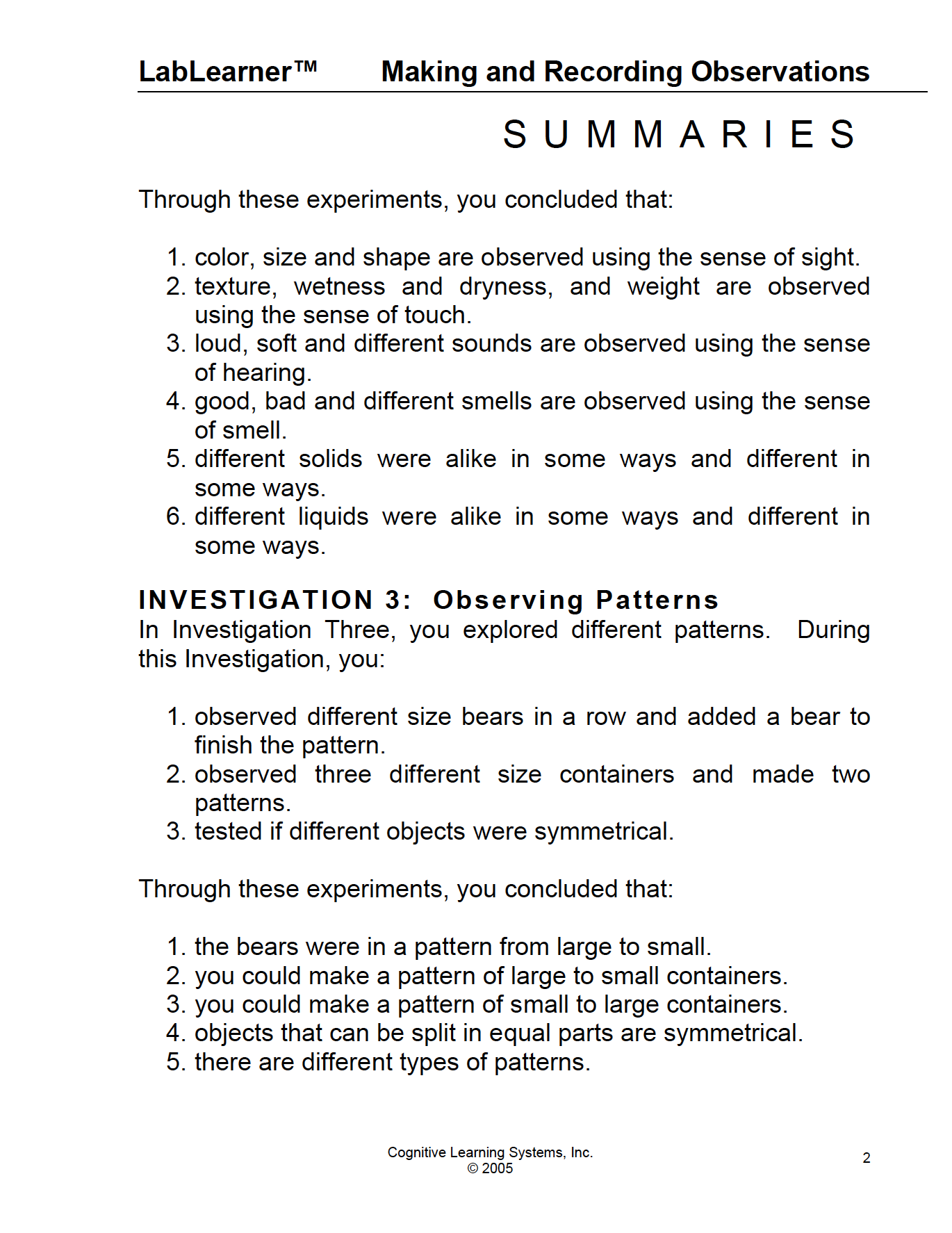
During Investigation Three, students will be introduced to the concept of patterns. By observing objects in a sequence, students will discover patterns and predict the next item in a sequence. In addition, students will explore patterns that exist in drawings, music, and speech. Through experiments, students will learn how to determine if an object or organism exhibits symmetry and that symmetrical objects can be divided into equal parts. As a result of their observations, students will learn how to recognize patterns in living and non-living things and will discover that the repeating part of a pattern differs between patterns.
Investigation 3: Teacher’s Video (4:43)
Investigation 3: Student’s Video (11:03)
Click on the image below to open Investigation 3 CAP