
Teacher Portal:
Discovering Life
Discovering Life: CAP – Investigation 5
ZERO-IN
Italicized font represents information to be shared orally or physically completed with the students at this time.
Non-italicized font represents additional information included to support the teacher’s understanding of the content being introduced within the CELL.
BRANCH OUT
Explain to students that inventors and engineers have used structures of animal bodies to design machines and products that solve human problems.
PRINT IT
Use your browser to download a printable PDF as a help during the slide presentation and to make additional notes. In your browser, go to File > Print and then choose to save as PDF.
NAVIGATE IT
Once the slide presentation is launched
- use your left and right arrows to advance or go back in the slide presentation, and
- hover your mouse over the left edge of the presentation to get a view of the thumbnails for all the slides so that you can quickly move anywhere in the presentation.
- Click on the button below to launch the slide presentation for the CELL.
SHARE IT
Slide LIFE 5-1:
In this CAP, students will consider how animal body structures have served as an inspiration for inventors and engineers over the years to invent and develop machines and products that help humans.
Slide LIFE 5-2:
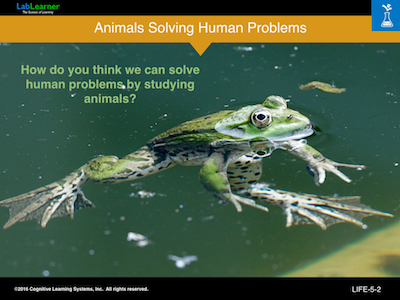
This slide simply asks students, “How do you think we can solve human problems by studying animals?”. Students have probably never thought of this question before. Hopefully, after observing a few examples of how humans have designed inventions mimicking animal structures, they will be able to think of additional examples on their own.
Slide LIFE 5-3:
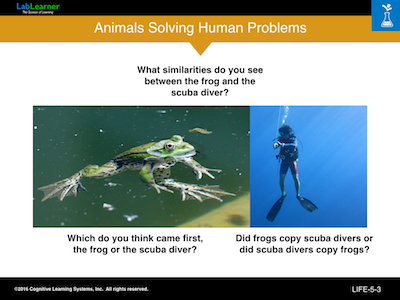
This is the first of three very similar slides in which an animal structure is compared to a human invention mimicking it. When viewing this slide, first we will ask students to identify similarities between the animal structure(s) and the human invention that mimics it. Next (lower left), we ask students which they think came first, the animal structure or the human invention. This seemingly obvious question may not initially be clear to students. However, they should begin to understand the time sequence involved with more examples. Finally, we ask students if the animal in question “copied” the human invention or if the human invention copied the animal structure. Again, the repetition of this and the next two nearly identical slides will serve to inform students of this important relationship between natural animal structures and human inventions.
Slide LIFE 5-4:
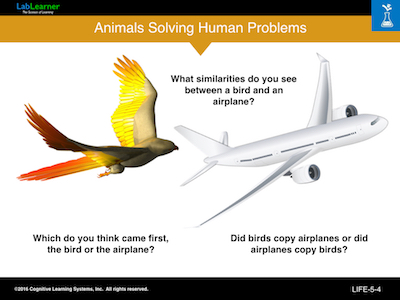
This slide depicts the second example of a human invention that mimics the natural structure of an animal body. In addition, the same three questions asked in the previous slide are asked again, this time for the bird/airplane comparison.
Slide LIFE 5-5:
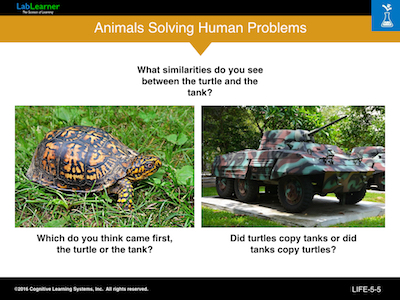
This slide depicts the third example of a human invention that mimics the natural structure of an animal body. In addition, the same three questions asked in the previous two slides are asked again, this time for the turtle/tank comparison.
Slide LIFE 5-6:
This final slide can be used to spark a class discussion about other examples of ways human inventions or products copy or mimic naturally-occurring animal structures. Notice that in all of the examples that we have used in this CAP, we are referring to analogies between animal structure and human inventions. Further discussion could involve potential examples of how plant structures have or could serve as inspiration or ideas for human inventions. For example, comparing the branches of a tree to a step ladder or the veins of a leaf to the plumbing and pipes in a house.