
Teacher Portal:
Discovering Life
Discovering Life: CAP – Investigation 3
 ZERO-IN
Italicized font represents information to be shared orally or physically completed with the students at this time.
Non-italicized font represents additional information included to support the teacher’s understanding of the content being introduced within the CELL.
BRANCH OUT
Explain to students that biologists study the behavior of animals in nature. Animal behavior is an important adaptation just as animal structure and body design are important. In humans, behavior is studied by psychologists, typically with a Ph.D. degree in psychology. Physicians who specialize in human behavior and diseases are called psychiatrists.
PRINT IT
Use your browser to download a printable PDF as a help during the slide presentation and to make additional notes. In your browser, go to File > Print and then choose to save as PDF.
NAVIGATE IT
Once the slide presentation is launched
- use your left and right arrows to advance or go back in the slide presentation, and
- hover your mouse over the left edge of the presentation to get a view of the thumbnails for all the slides so that you can quickly move anywhere in the presentation.
- Click on the button below to launch the slide presentation for the CELL.
SHARE IT
Slide LIFE 3-1:
In this CAP we will discuss the behavior that parents in the animal kingdom perform to help their offspring survive. In biology it is better to refer to the progeny of animals as their “offspring” when comparing other animals to humans. Whereas it is not uncommon to refer to very young offspring in the animal world as “babies”, older progeny are not referred to as “kids” or “children” as we refer to the progeny of humans. Therefore, in this discussion we refer to the progeny of both other animals and humans as either babies or offspring.
Slide LIFE 3-2:
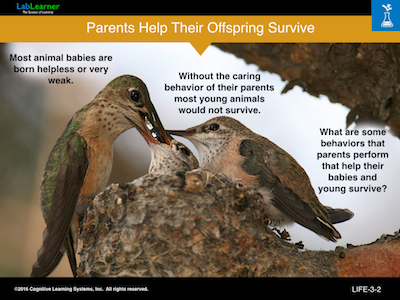
This slide introduces the students to our discussion of the behavioral adaptations of parents in the animal world (including humans) that help to assure the survival of their offspring. The slide ends by asking the question, “What are some behaviors that parents perform that help their babies and young survive?”.
An important vocabulary word here is “survive”. Students might not know the meaning of the word at the onset. The teacher might say that survive means to “live and grow to become adults”.
Slide LIFE 3-3:
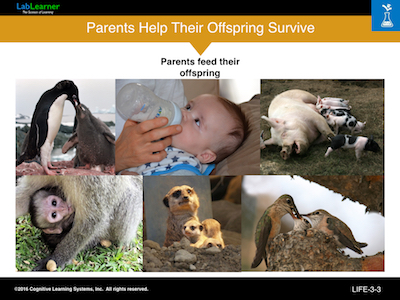
This is the first of three similar slides that compare human and animal parental behaviors that result in an increased chance that their offspring will survive. All parents must feed their offspring in order for them to survive. At the earliest stages of offspring development in mammals (humans are mammals), the mother is primarily responsible for feeding the offspring. This is because they are equipped with milk-producing mammary glands. Human infants may be given a bottle containing milk or formula. Other mammals must, of course, breastfeed. Many human infants are also breastfed so the teacher might expect questions along these lines.
Slide LIFE 3-4:
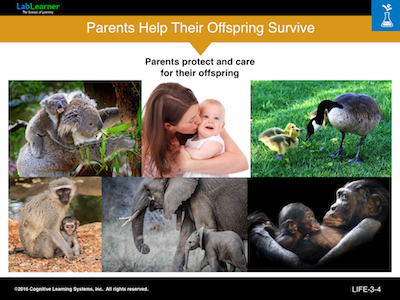
This slide shows another example of parental behavior that helps their offspring survive. Parents must protect and care for their offspring in order for them to survive. Protection behavior may range from hiding offspring from predators and preventing them from consuming poisonous foods or hurting themselves in some other way, to actively fighting a predator to save their offspring if no other solution to the danger is available. In nature, parents may ultimately sacrifice their own lives to protect their offspring.
Slide LIFE 3-5:
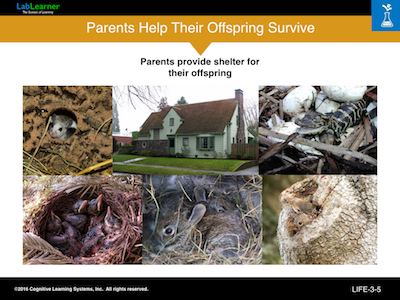
This slide depicts a third example of parental behavior that helps their offspring survive. Many animals, in addition to feeding and protecting their young, also provide them with some form of shelter from the elements. This might entail building nests or burrows or, as in the case of the squirrel family shown at the lower right, simply finding an appropriate size hole in a tree. Many students will recognize the house shown in the upper middle picture. The teacher might point out that there are many different kinds of shelter that humans provide for their offspring. For example, in the city, many parents live with their offspring in an apartment in very large buildings. It doesn’t matter what the house looks like, all houses and living accommodations provide shelter for human offspring and their parents.
Slide LIFE 3-6:
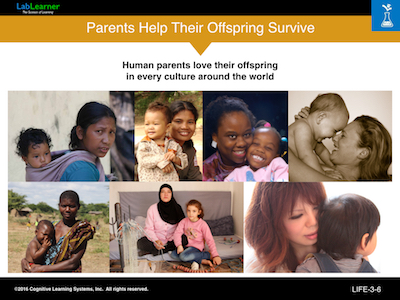
The point of the previous slides was to impress upon students that humans are animals and have many things in common with animals in terms of how parents care for, protect, feed and shelter their offspring to help them survive. This slide focuses on humans and points out that human parents all love their offspring no matter where you go in the world.
Slide LIFE 3-7:
This final slide can be used to spark a class discussion about other examples of ways in which parents help their offspring survive. The resulting discussing might include parental behaviors such as encouraging their offspring to play and exercise, teaching them, providing clothing and so forth.