
Teacher Portal:
Investigating Heat
 Investigating Heat: CAP – Investigation 3
Non-italicized font represents additional information included supporting the teacher’s understanding of the content being introduced within the CELL.
BRANCH OUT
Two of the most basic laws of physics are the conservation of energy and the conservation of matter. In this CAP, we simply consider both of these laws and see how they are related. While a chemical equation is used in this CAP, we simply wish to introduce the concept of chemical equations at this time. Students will study chemical reactions and equations more in middle school and much more in high school chemistry.
PRINT IT
Use your browser to download a printable PDF as help during the slide presentation and to make additional notes. In your browser, go to File > Print and then choose to save as PDF.
NAVIGATE IT
Once the slide presentation is launched
- use your left and right arrows to advance or go back in the slide presentation, and
- hover your mouse over the left edge of the presentation to get a view of the thumbnails for all the slides so that you can quickly move anywhere in the presentation.
- Click on the button below to launch the slide presentation for the CELL.
SHARE IT
Slide HEAT3-1:
In this short CAP, we wish to talk about both the Law of Conservation of Energy and the Law of Conservation of Matter. At this point, the thing that we would like students to appreciate is that neither energy nor matter can be destroyed or created. When energy or matter appears to disappear it is only that they have changed form, but the exact same amount of energy and matter will always exist regardless of what form transitions have taken place.
Slide HEAT3-2:
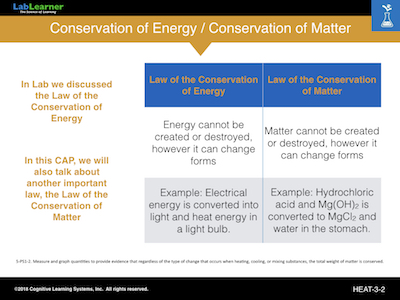
In this first slide, we simply state the two laws of conservation and give an example for each.
Slide HEAT3-3:
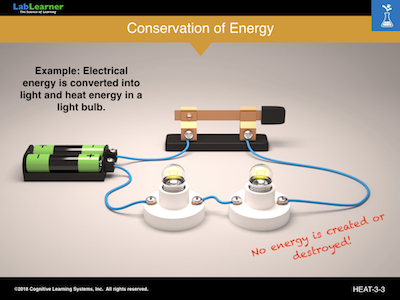
This slide deals with the Law of Conservation of Energy that states that energy cannot be created or destroyed but can change forms. In this case, electrical energy supplied by the batteries is converted into light energy by the two light bulbs. In addition to light, incandescent bulbs also produce a large amount of heat from the electrical current. So, in this example, electrical energy is converted into both light and heat energy. However, no energy is created or destroyed. If we were to determine how much light and heat were generated by the lightbulb, we would find that it was exactly the amount of electrical energy that was supplied. Thus the electrical energy was changed but there was no net gain or loss of energy.
Slide HEAT3-4:
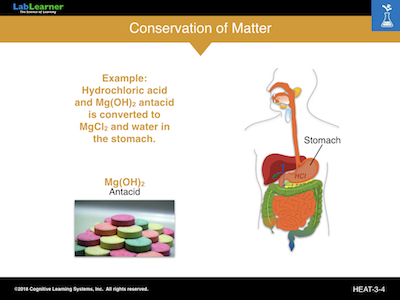
This is the first of three slides devoted to the Law of Conservation of Matter. This law states that matter cannot be created or destroyed, but can change form. The example we are using is that of an antacid tablet composed of magnesium hydroxide Mg(OH)2. Stomach acid, hydrochloric acid or HCl, is secreted by cells lining the inside of the stomach to aid in the digestion of food. Sometimes too much acid causes stomach problems. While modern drugs target the release of HCl, an antacid is used to neutralize the acid in the stomach once it is already present.
Slide HEAT3-5:
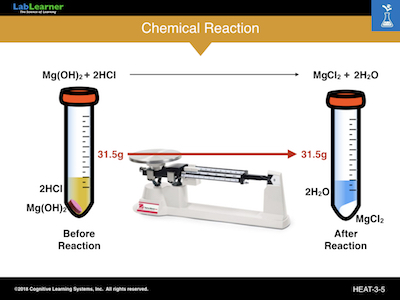
In the experiment shown in this slide an antacid tablet, composed of the chemical magnesium hydroxide Mg(OH)2, is added to a certain volume of hydrochloric acid (HCl). Hydrochloric acid is an acid secreted by the stomach lining to help break down and digest food. As seen in the slide, the total mass of the acid and antacid tablet is 31.5 grams. After the reaction is complete, the antacid and hydrochloric acid have been completely transformed into two new products magnesium chloride (MgCl2) and water (H2O). IMPORTANTLY, the mass of the two products is EXACTLY the same as the two starting materials, 31.5g. Thus, although the composition of the reaction changed completely, there was no increase or decrease in mass. Therefore, matter was neither created nor destroyed as a result of the reaction.
Slide HEAT3-6:
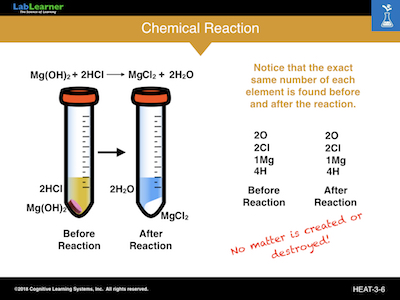
The last two slides are too advanced for students at this point but are included simply to set the stage for middle school when chemical reactions are studied in greater detail. Let’s look at the chemical reaction that takes place in this reaction:
Mg(OH)2 + 2HCl —> MgCl2 + 2H2O
On the left of the arrow, one molecule of Mg(OH)2 (magnesium hydroxide) combines with two molecules of HCl (hydrochloric acid) to form one molecule of the harmless salt MgCl2 (magnesium chloride) and two molecules of H2O (water). On the right side of the slide, we actually use the chemical formula of the reaction to count the total number of each atom before and after the reaction. As can be seen, there is an exact match between the pre and post-reaction. Note that to count the total number of each atom involved in the reaction one needs to pay attention to all numbers. Thus, the term 2H2O tells us there are a total of four hydrogens (2 x H2) and two oxygens (2 x O) present. Again, students will become very familiar with chemical notation in middle school and this slide should simply serve as an interesting glimpse of things to come!
Slide HEAT3-7:
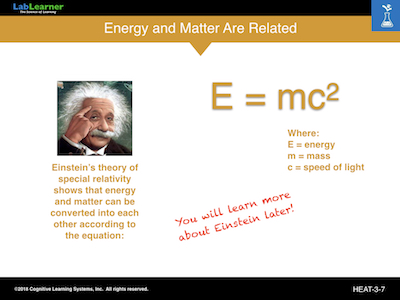
This final slide should be used simply to introduce the name Einstein and his most famous equation to students. Einstein’s brilliant idea is that matter and energy are not only related to each other (E=mc2) but can actually be converted into each other. Students will see this equation again in middle school and beyond.
Knowing that matter and energy are interconvertible helps explain how the laws of the conservation of matter and the conservation of energy are also related and sound so similar when stated. Neither matter nor energy can be created or destroyed.