
Teacher Portal:
Forms of Energy
Forms of Energy: CAP – Investigation 1
 Italicized font represents information to be shared orally or physically completed with the students at this time.
Non-italicized font represents additional information included supporting the teacher’s understanding of the content being introduced within the CELL.
BRANCH OUT
Explain to students that energy and speed are related. Auto racing engines are extremely powerful and provide a great deal of energy. This energy is converted into the high speed that the race car can attain.
PRINT IT
Use your browser to download a printable PDF as help during the slide presentation and to make additional notes. In your browser, go to File > Print and then choose to save as PDF.
NAVIGATE IT
Once the slide presentation is launched
- use your left and right arrows to advance or go back in the slide presentation, and
- hover your mouse over the left edge of the presentation to get a view of the thumbnails for all the slides so that you can quickly move anywhere in the presentation.
- Click on the button below to launch the slide presentation for the CELL.
SHARE IT
Slide ENERGY1-1:
In this CAP we will begin by discussing the relationship between energy and force involved in the lab experiment for Investigation 1. We will then consider two additional situations in which energy, force, and speed are related. In addition, we will briefly discuss potential and kinetic energy.
Slide ENERGY1-2:
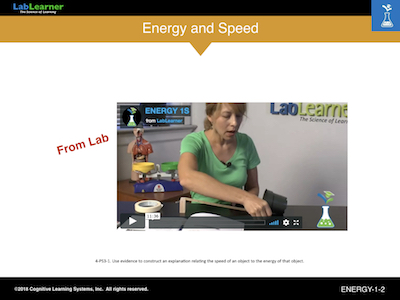
This slide can be used to refresh students’ memories of the laboratory experiment in which steel and plastic marbles were used to demonstrate how force and energy are related.
Slide ENERGY1-3:
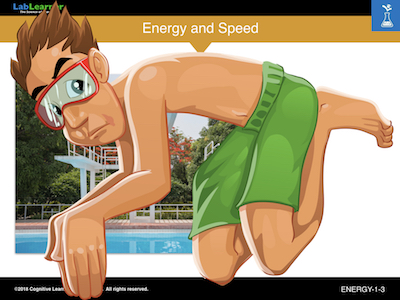
This is simply a fun introductory slide. The next several slides are going to deal with diving into a swimming pool from various heights. This is a very common and memorable experience that many or most students will have had. In particular, young students will remember hitting the water “harder” when jumping from a diving board than from the edge of a pool. We want students to translate the hardness of impact to greater energy of impact. The impact of various dives on the body and the relationship of the height of the dive to the hardness and energy of the impact will be used in the next several slides.
Slide ENERGY1-4:
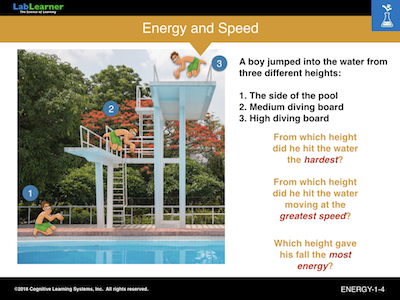
This slide shows a boy jumping into the pool from three different heights and asks, “From which height did he hit the water the “hardest?” Students will likely know from experience that the high dive will result in the hardest impact and may actually hurt! The speed of entering the water, the second question asked, will be harder for students to envision/remember than how hard one hits the pool surface. Nonetheless, most students will suspect that they will hit the water at a greater speed from the highest dive. Finally, the question, “Which height gave his fall the most energy?” relates height and energy.
Slide ENERGY1-5:
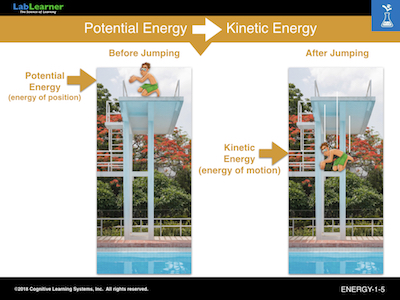
This slide refers to one of the central conceptual elements of the CELL Forms of Energy Investigation 1– that is, the difference between potential and kinetic energy.
Slide ENERGY1-6:
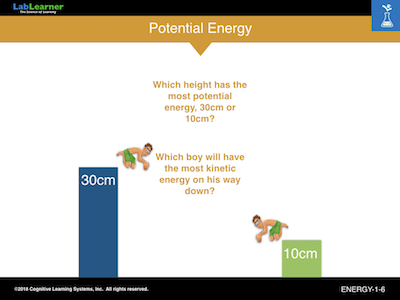
This slide is somewhat silly in that no one would dive off a 30cm or 10cm block. However, it accentuates the fact that an object at any height greater than another has more potential energy and that an object falling from that greater height has more kinetic energy.
Slide ENEREGY1-7:
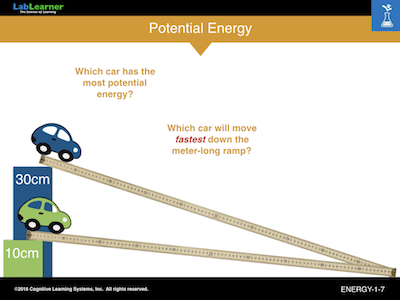
This slide replaces the boy diving from a 30cm and 10cm block with a toy car set to go down a 1-meter ramp. The car atop the 30cm high ramp has more potential energy. A prediction is then required, “Which car will move the fastest down the ramp?” Students are likely to predict that the car with the most energy will travel the fastest.
Slide ENERGY1-8:
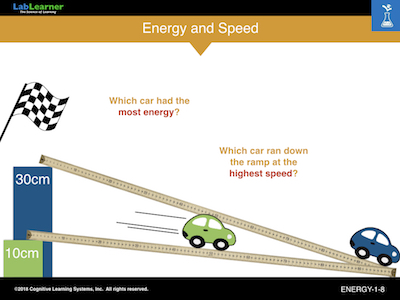
This slide shows the result of releasing the two cars and having them race down the ramp. Since the blue car has already reached the bottom of the ramp (traveled 1 meter) and has stopped while the green car is only about halfway down the ramp, the blue car must have traveled faster – it traveled down the ramp at a greater speed.
ENERGY1-9:
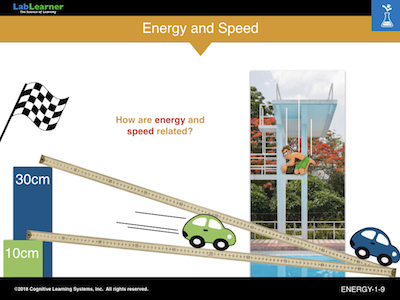
This summary slide asks the important question, “How are energy and speed-related?”. Objects with greater energy (those on the high-dive and the 30cm high ramp) can attain greater speeds! Thus, race cars with larger, higher energy engines can go faster than cars that provide less energy.