
Teacher Portal:
Earth’s Forces
Earth’s Forces
 During this CELL, students will perform several investigations designed to reveal the Earth’s forces of gravity and friction and the way that these forces affect the motion of objects on Earth. Through discussion and experimentation, students learn about the effects of balanced and unbalanced forces on stationary objects as well as objects in motion. Students realize that balanced forces mean that a stationary object remains stationary, or a moving object continues at the same speed in the same direction. Through the systematic investigation of variables, students draw conclusions about the effect of gravity on objects found on Earth. Students learn that the force of gravity is dependent on an object’s mass, but that acceleration due to gravity is a consistent 9.8 m/s2. Students also connect the concepts of weight and gravity. These facts are established through hands-on experimentation followed by an analysis that includes collation and graphing of results.
Students begin to investigate the force of friction. Through experimentation with different surface types, students learn that the force of friction that exists as an interaction between two surfaces acts in opposite direction to the direction of an object’s motion. In addition, students learn that the force of friction is not present on a stationary object, but that it is present when a force is applied to a stationary object. Students learn that just like the force of gravity, the force of friction can be measured in Newtons. Students learn that weight as well as surface type affects frictional force. In the final Investigation, students learn the Newtonian principle that the sum of forces is equal to the product of the mass and the acceleration. Students use knowledge of the force and mass present, to calculate acceleration.
The sixth Investigation takes the form of a Performance Assessment. This draws on students’ knowledge of balanced and unbalanced forces, and the force of friction. Students generate and solve a novel problem. Through these applications and explorations, students will begin to conceptualize Newtonian laws of motion and the ways that these laws impact the motion of objects on Earth. This CELL will challenge students to apply these ideas to everyday situations, building continuity between classroom investigations and daily applications.
___________________________________________________________________
Investigation 1: The Force of Gravity
In Investigation One, students will explore the concept of balanced forces. Students will hold objects stationary in the air and measure the force required to keep the object from accelerating. Students compare this force in Newtons to the mass of the object. Students discover that the force required to keep the object stationary is equal to the object’s weight and directly proportional to the mass of the object.
Investigation 1: Teacher’s Video (10:48)
Investigation 1: Student’s Video (11:18)
___________________________________________________________________
Investigation 2: Acceleration Due to Gravity
Investigation Two allows students to explore the effects of gravity in the context of unbalanced forces. Students make a small and a large object, find the mass of each object, then conduct trials to establish the time that it takes for these objects to fall to the ground. In analyzing these trials, students are introduced to the formula for calculating acceleration. Through collating and presenting their data, students come to understand that while the force of gravity is dependent on the mass of the object, acceleration due to gravity is a constant 9.8 m/s2.
Investigation 2: Teacher’s Video (14:57)
Investigation 2: Student’s Video (12:11)
___________________________________________________________________
Investigation 3: The Force of Friction
During Investigation Three, students begin to investigate the force of friction. Students first learn about normal contact forces in order to provide a context for discovering friction. Students then investigate the effect of an object interacting with three different surface types. Through multiple trials, students measure the distance an object travels on these three surfaces. Students draw conclusions regarding the type of surfaces that provide the most and the least degree of frictional force.
Investigation 3: Teacher’s Video (9:07)
Investigation 3: Student’s Video (14:14)
___________________________________________________________________
Investigation 4: Measuring the Force of Friction
Investigation Four introduces students to the fact that like gravity, friction can be measured using Newtons. Students understand this because they know that balanced forces cause a moving object to remain in motion and that unbalanced forces cause a moving object to accelerate. Students’ experiments lead them to realize that frictional force constitutes an unbalanced force on a moving object. Hence, frictional force while an object is in motion causes the object to slow down. Students also discover that the frictional force acting on an object in motion is typically less than the weight of the object.
Investigation 4: Teacher’s Video (14:07)
Investigation 4: Student’s Video (14:17)
___________________________________________________________________
Investigation 5: Force, Mass, and Acceleration
In Investigation Five, students will explore the relationship between balanced and unbalanced force, mass, motion, and acceleration. Students first explore how forces change when a stationary object held in the air begins to move either upwards or downwards. Then, by performing an experiment in which an object is pulled horizontally, students recognize that the same principles apply. Students consider the vertical and horizontal forces acting on these stationary and moving objects and realize that the same principles apply. In doing so, students are introduced formally to Newton’s law of acceleration, which states that the sum of the forces is equal to the mass multiplied by the acceleration.
Investigation 5: Teacher’s Video (14:19)
Investigation 5: Student’s Video, Trials 1-6 (10:54)
Investigation 5: Student’s Video, Trials 7-10 (4:50)
___________________________________________________________________
Investigation 6: Performance Assessment
Investigation Six consists of a performance assessment designed to evaluate students’ understanding of the science concepts addressed in the first five Investigations of the CELL. During this exploration, students will design and test their predictions regarding the force required to lift versus drag and object, and the frictional force created by different surfaces on an object.
Investigation 6: Performance Assessment – Teachers Only (4:28)



Pre-Tests and Post-Tests
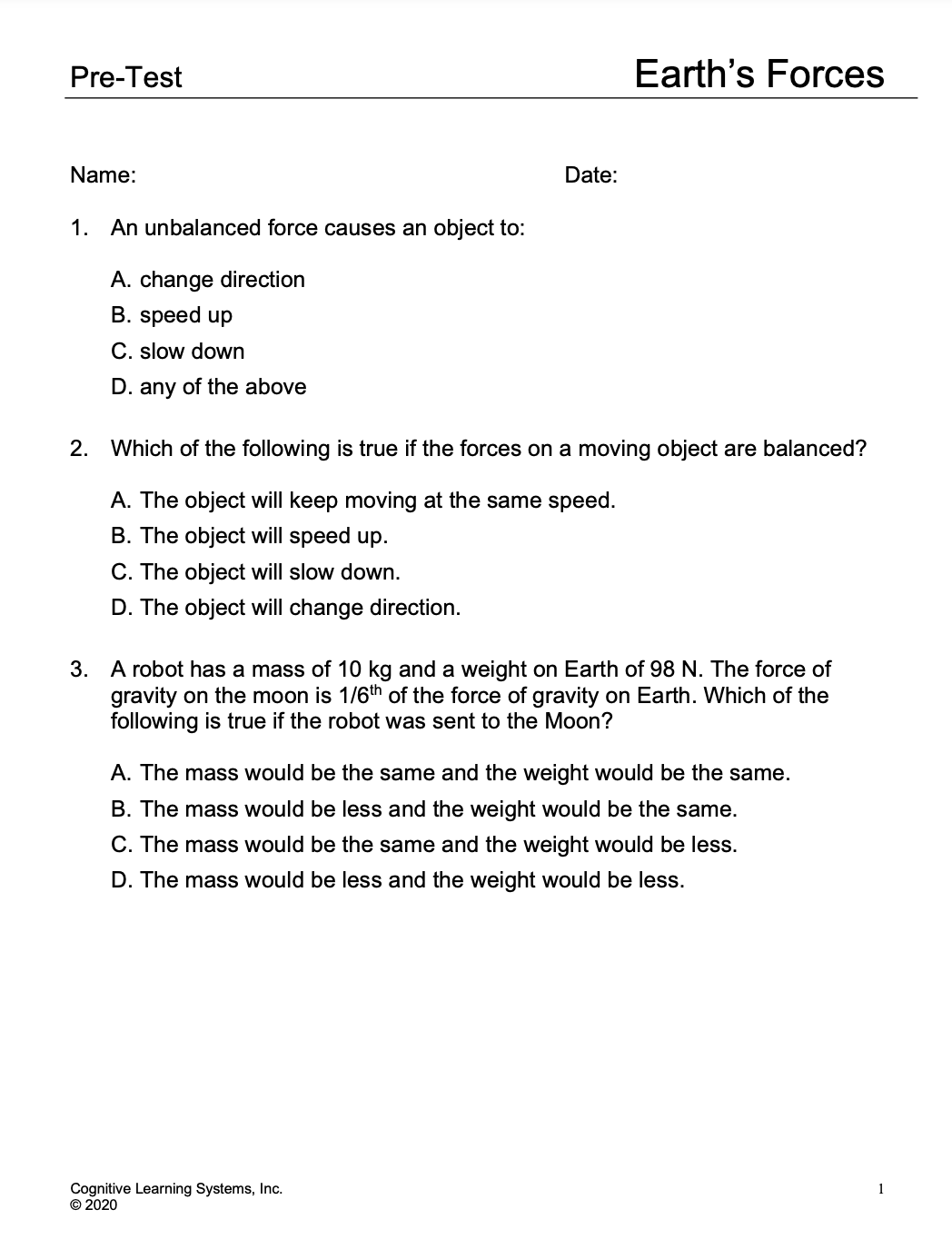
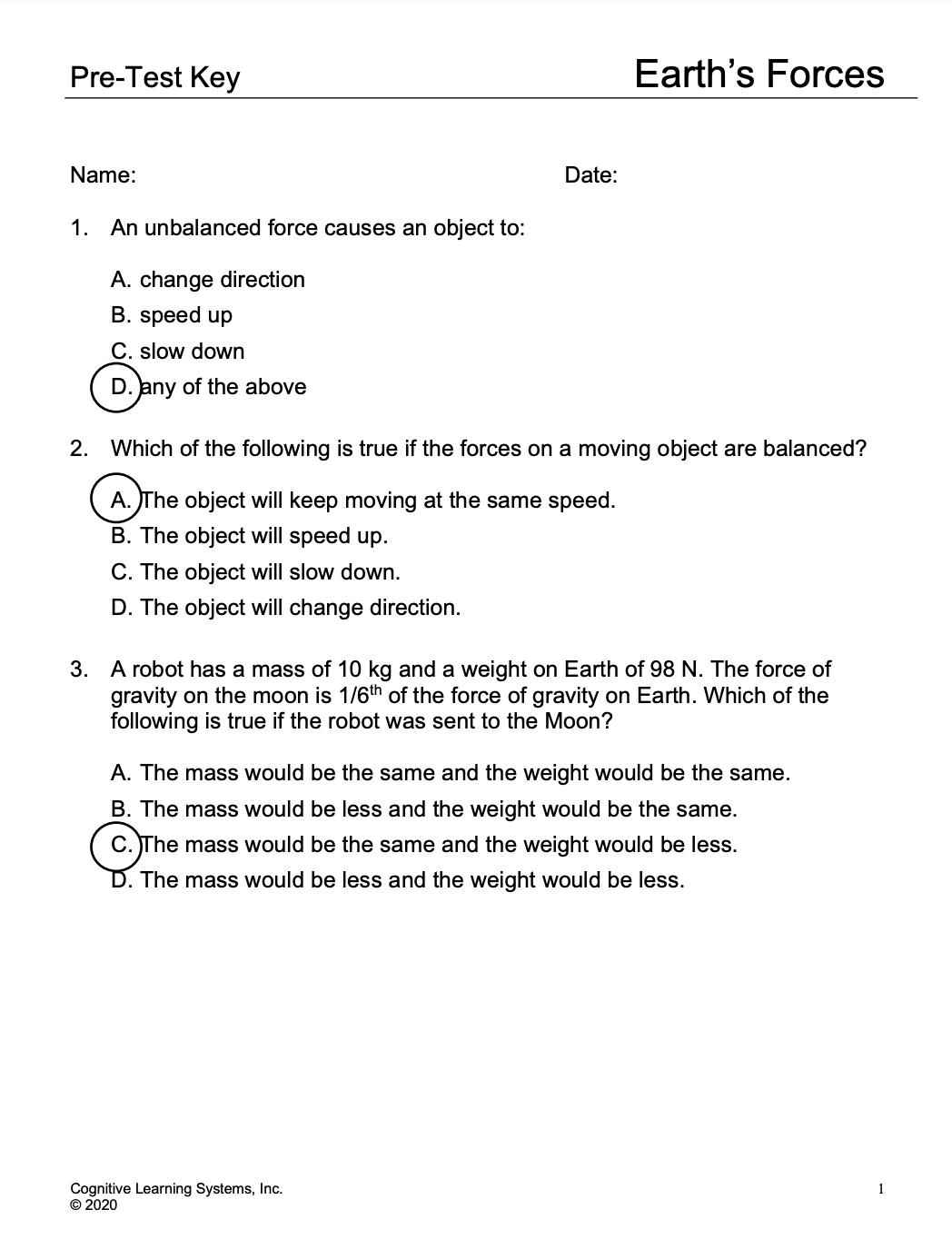
Pre-Test Key
Includes NGSS correlations
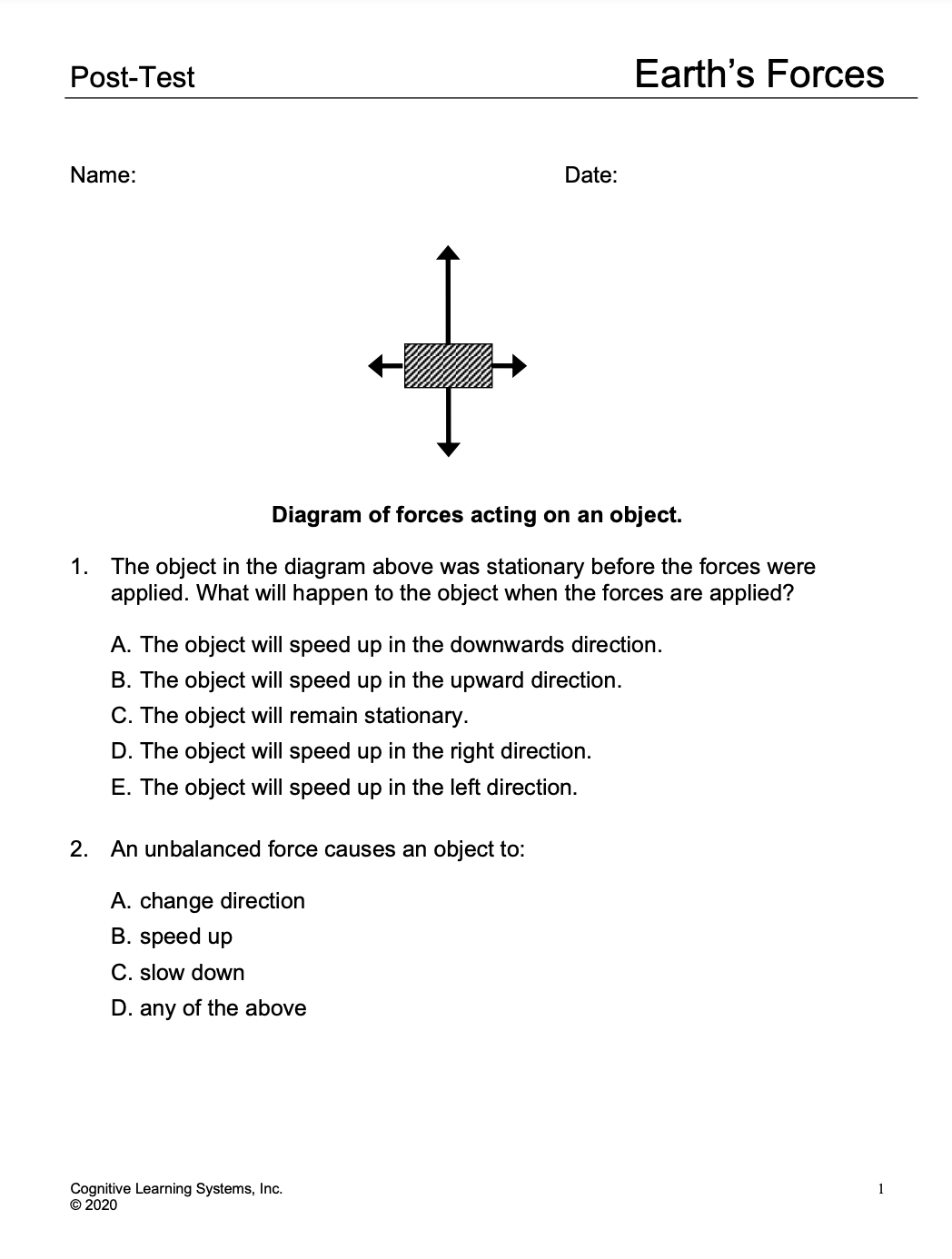
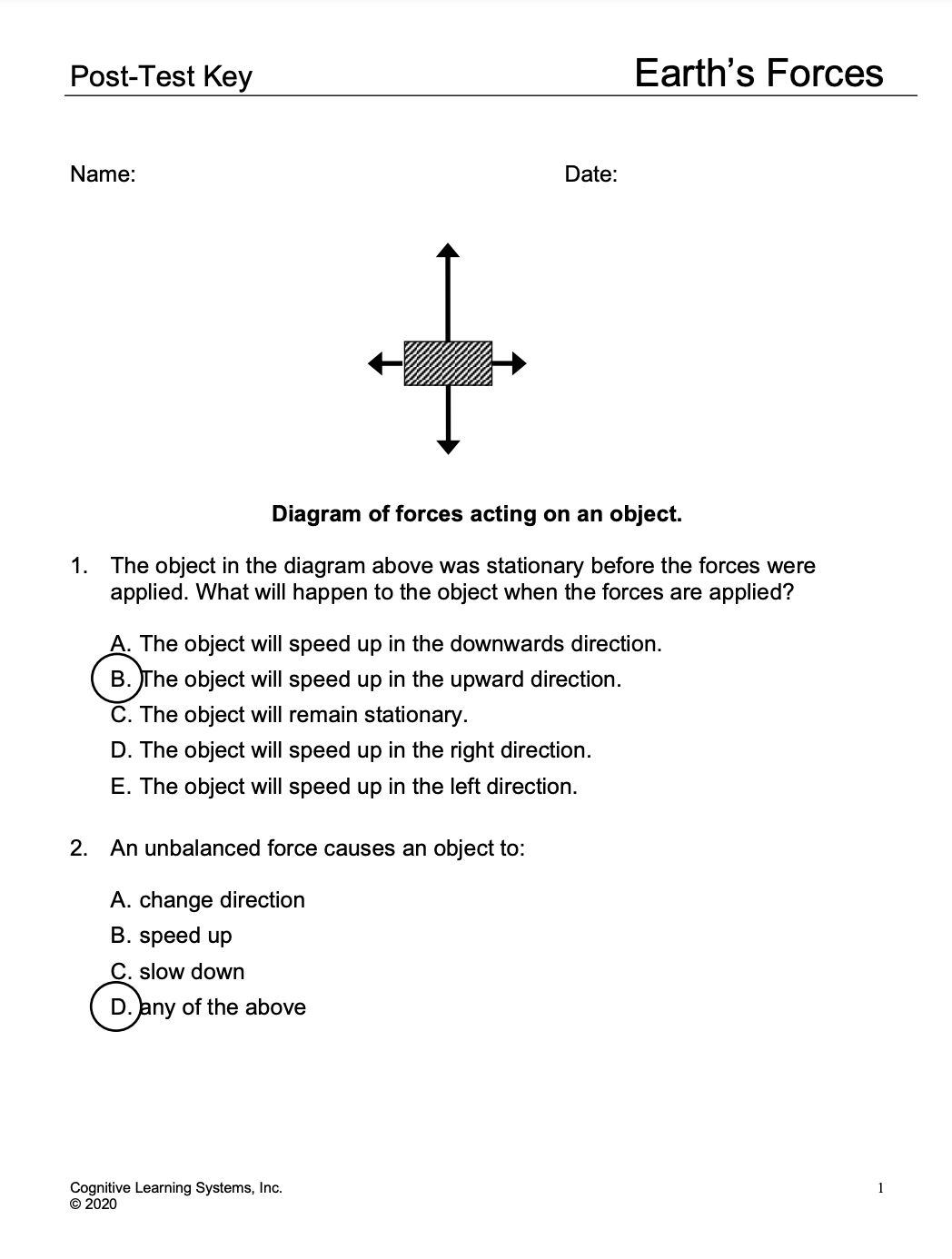
Post-Test Key
Includes NGSS correlations