
Teacher Portal
What is STEAM/STREAM?
PRINT IT
Use your browser to download a printable PDF as help during the slide presentation and to make additional notes. In your browser, go to File > Print and then choose to save as PDF.
NAVIGATE IT
Once the slide presentation is launched
- use your left and right arrows to advance or go back in the slide presentation, and
- hover your mouse over the left edge of the presentation to get a view of the thumbnails for all the slides so that you can quickly move anywhere in the presentation.
- Click HERE to launch the slide presentation for the CELL.
SHARE IT
SLIDE 2VSTEM-1
In the first Lesson in the LabLearner STEM Careers Journey, we discussed the importance of looking at each scientific concept from the different perspectives of science, technology, engineering, and mathematics. We used the example concept of heat. We came to understand the power of STEM in solving problems and producing useful innovations and inventions.
______________________________________________
SLIDE 2VSTEM-2
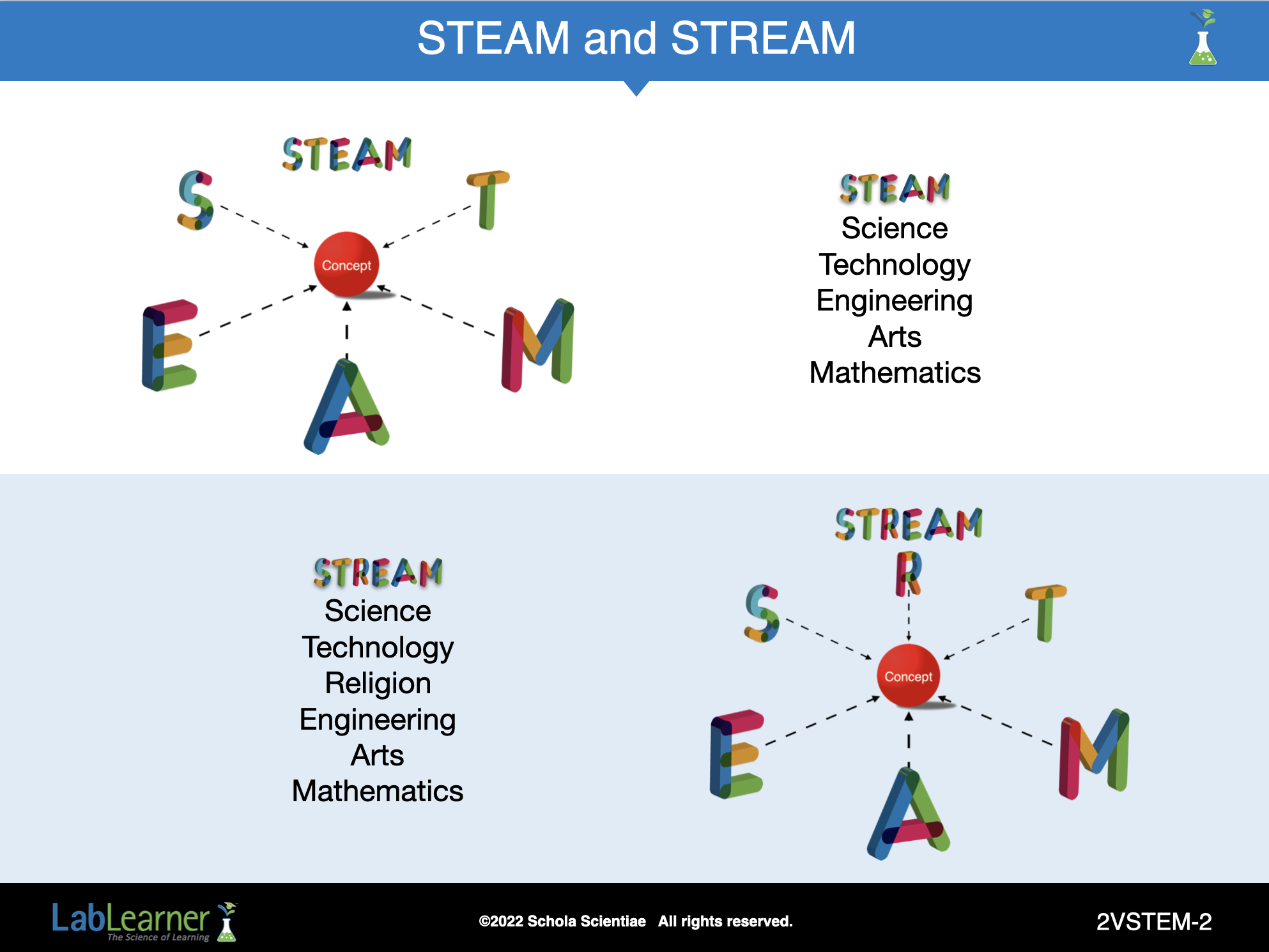
Since the introduction of the STEM approach in addressing problems and innovations in areas of science, other educators wished to include additional subjects in the multi-perspective STEM method.
In this Lesson, students will explore STEM extensions such as STEAM, which includes the arts in STEAM and STREAM, with includes both the arts and religion (sometime also reading) into the STEM approach.
______________________________________________
SLIDE 2VSTEM-3
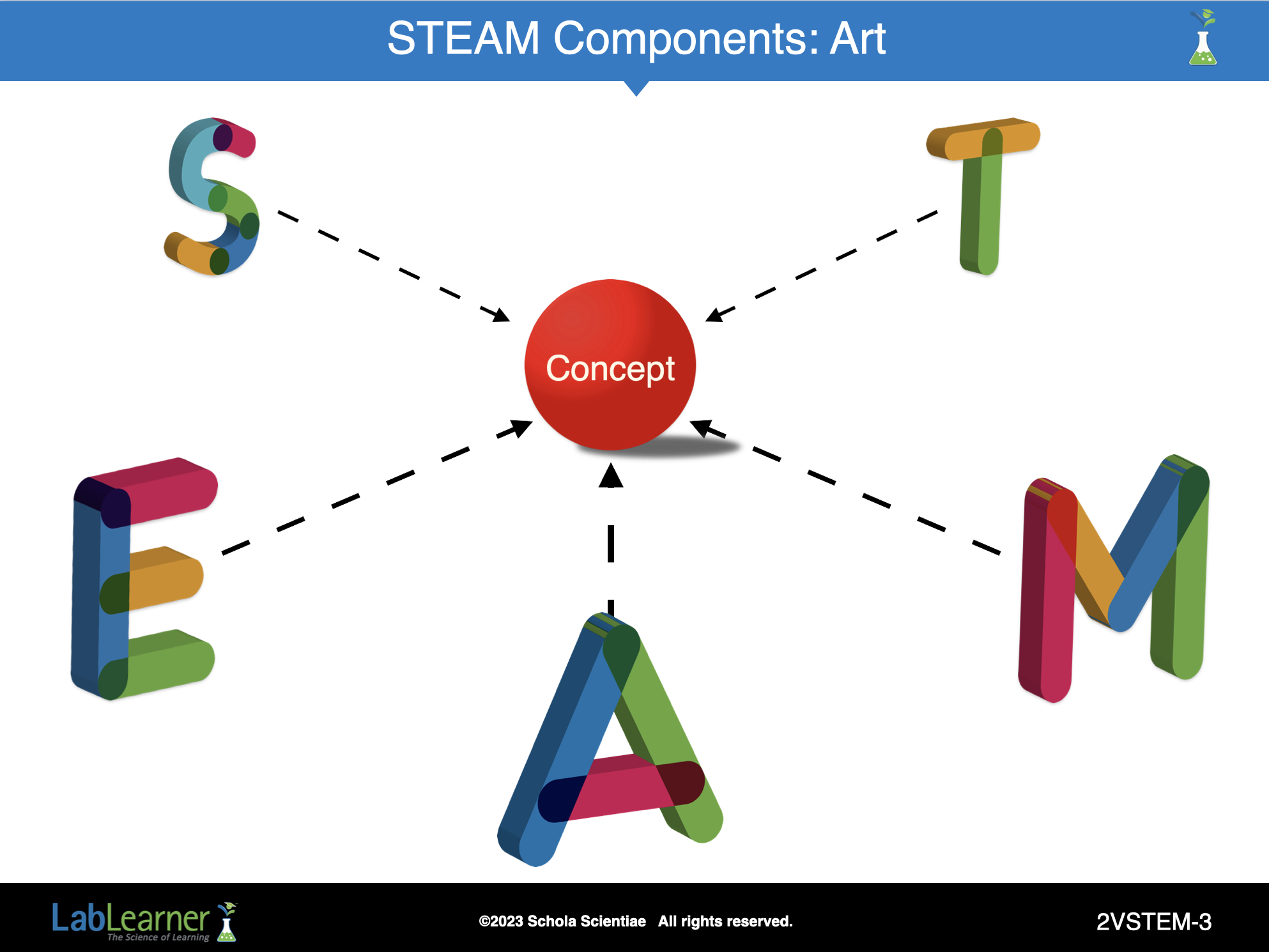
Color, shadow, symmetry, perspective, composition. Each of these aspects of visual art have STEM affiliates such as light, vision, balance, and dimension.
The performing arts such as dance exemplify force, energy, and motion while musicians control pitch, frequency, volume, and tone to produce their masterpieces.
Photography itself, with its close relative cinematography (movie making), is nothing more than the harnessing of light and chemistry to record and interpret reality. Such are just some of the overlaps between the arts and STEM.
______________________________________________
SLIDE 2VSTEM-4
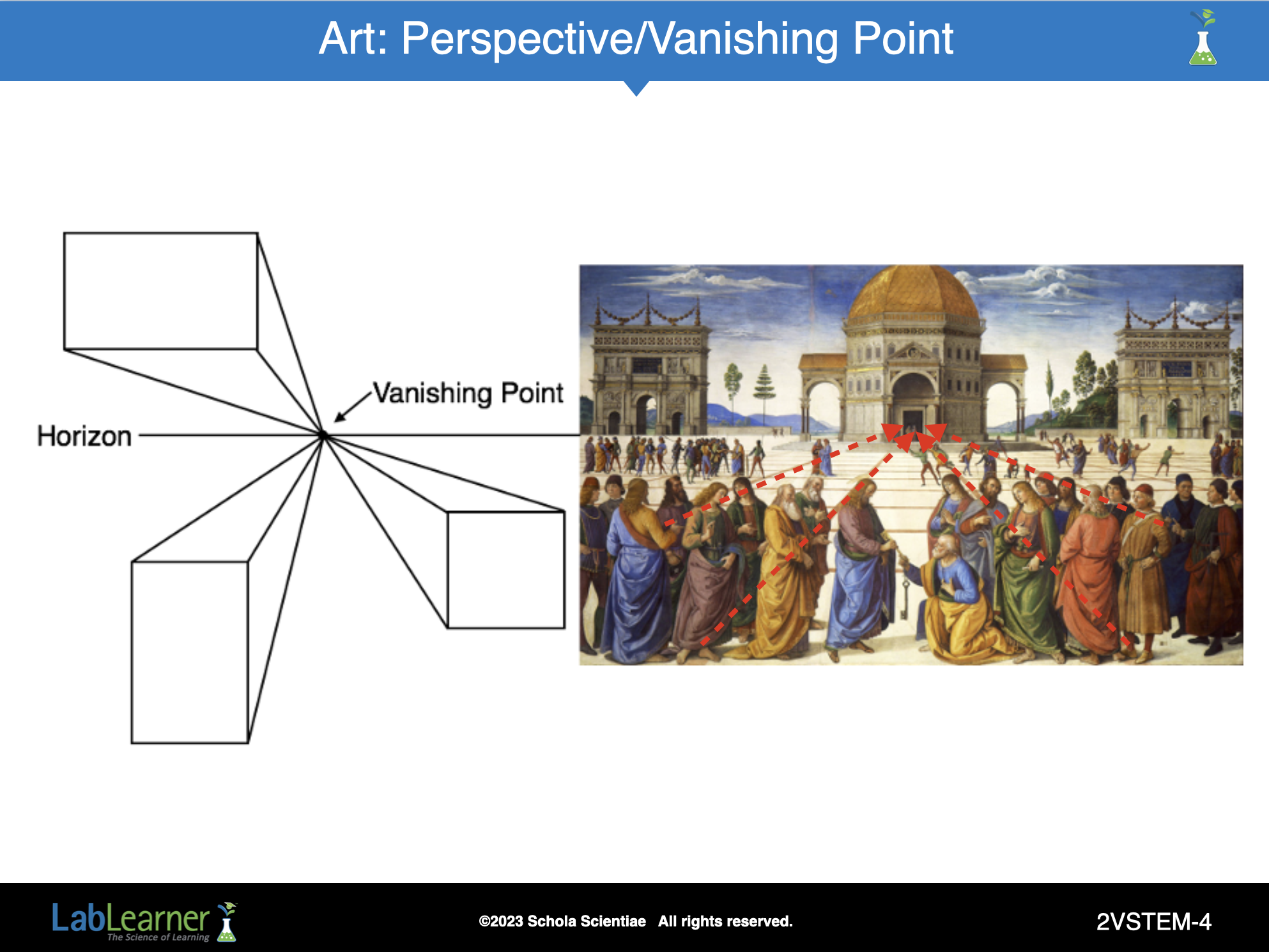
The concept of a vanishing point revolutionized the depiction of perspective in art during the Renaissance. Based on the observation that parallel lines coalesce at the horizon, vanishing points added tremendous depth and realism to European painting. Vanishing points also helped produce progress in projective geometry that is still important today in computer graphics.
Ask students: Look around the room. Can you identify any images depicting perspective and/or vanishing points? Student answers will vary.
______________________________________________
SLIDE 2VSTEM-5
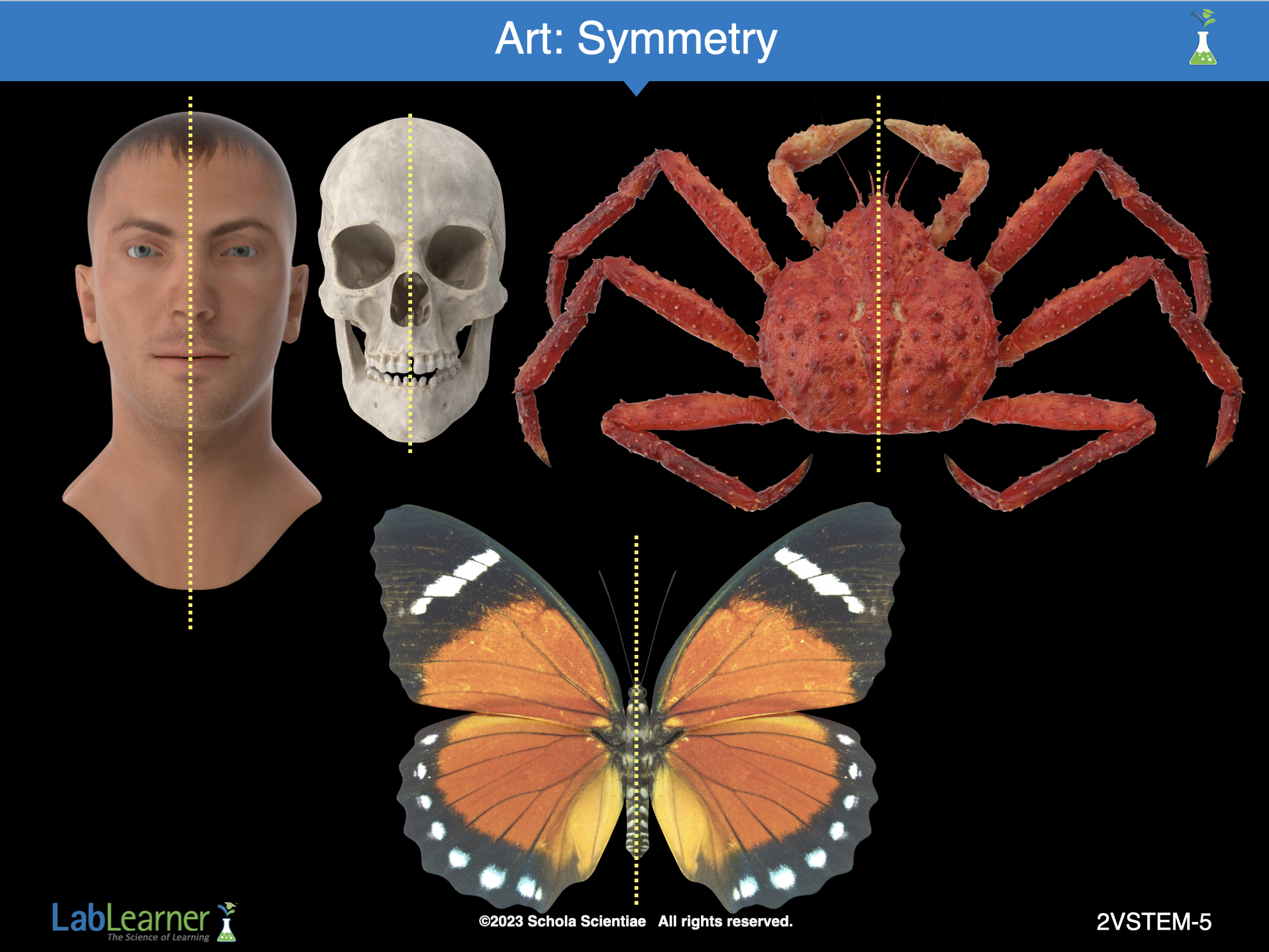
In biology, symmetry is associated with the body plan of all higher organisms. From the radial symmetry of starfish and pine trees, flowers and fruit to the bilateral symmetry of insects and humans, symmetry is pervasive in biology.
An understanding of symmetry in its various forms is also important in the visual and artistic representation of reality. The representation of bilateral symmetry is essential in depicting the human face, for example.
Ask students: Recall what you’ve learned about symmetry in the Science and Art CELL. Explain the difference between radial and bilateral symmetry. Students should indicate that objects with bilateral symmetry have one plane of symmetry. Objects with radial symmetry have similiar parts arranged around a central axis.
______________________________________________
SLIDE 2VSTEM-6
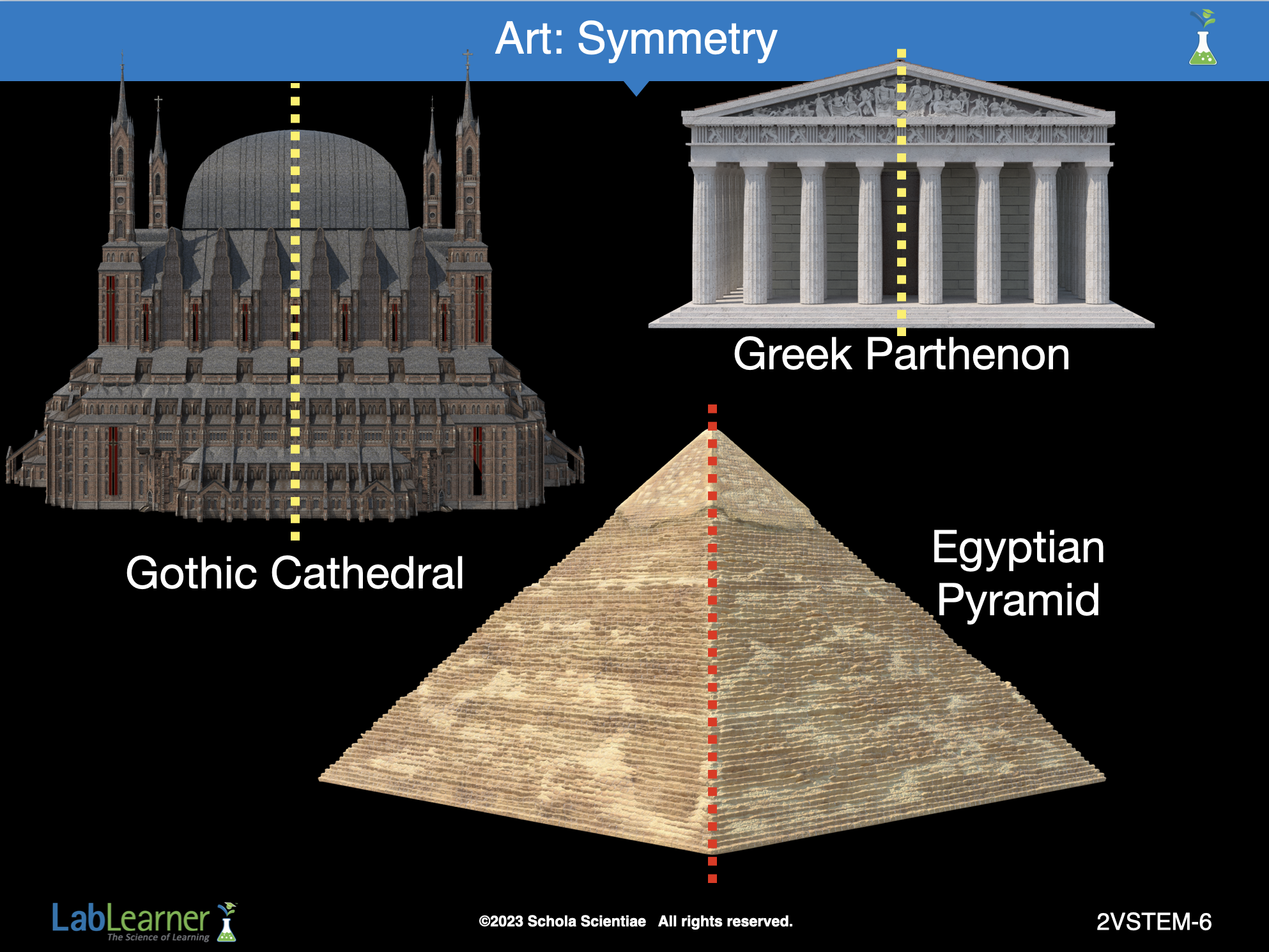
Symmetry also appears in basilica domes, arches, and other Renaissance buildings as well. In fact, symmetry in architecture dates back to ancient times in the form of the Egyptian pyramids and later in Greek structures such as the Parthenon and later still in medieval cathedrals with their rose stained glass windows, external facades, and overall cruciform floor plans.
______________________________________________
SLIDE 2VSTEM-7
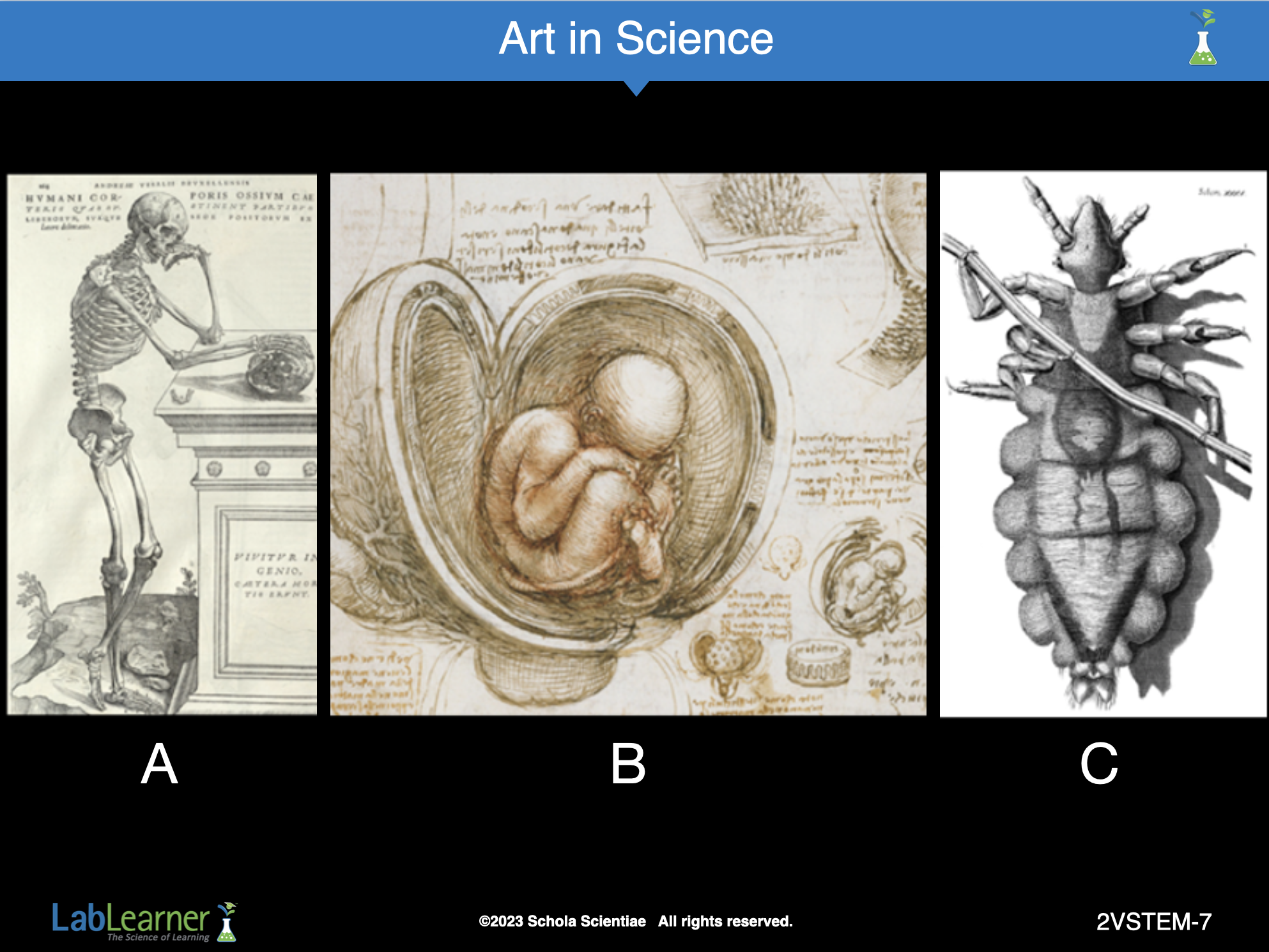
While we have been discussing the relevance and use of STEM in the development of art throughout history, science has produced some very important works of art in its own right, simply in the recording of its results and observations.
Early anatomists and cell biologist had to rely entirely on drawing skills prior to the invention of photography. Astronomers drew what they saw in their journals and astonished their benefactors with their drawings.
The examples of artwork shown in this slide are just a sample of the many wonderful drawings and illustrations of work emanating directly from scientific inquiry. Often, such scientific artwork was produced as illustrations for books. In these examples, for instance, the Vesalius (A) and Hooke (C) drawings are from published books.
The famous illustration of the skeleton thoughtfully contemplating a human skull specimen (A) appeared in Andreas Vesalius’ De humani corporis fabrica (On the Fabric of the Human Body) published in Basel Switzerland in 1543.
Finally, the Leonardo De Vinci drawing (B) shows a page from his sketchbook. Illustrations such as these were not intended to be finished illustrations for a published book. Leonardo, like many scientists before and after his time, kept illustrated notes of their thoughts and ideas. The drawing shown here illustrates Da Vinci’s interest in human anatomy and physiology. However, he had a whole range of scientific interests including mechanics, fluid dynamics, and engineering. Consequently, examples of drawing of each of these subjects can be found in Da Vinci’s voluminous work.
______________________________________________
SLIDE 2VSTEM-8
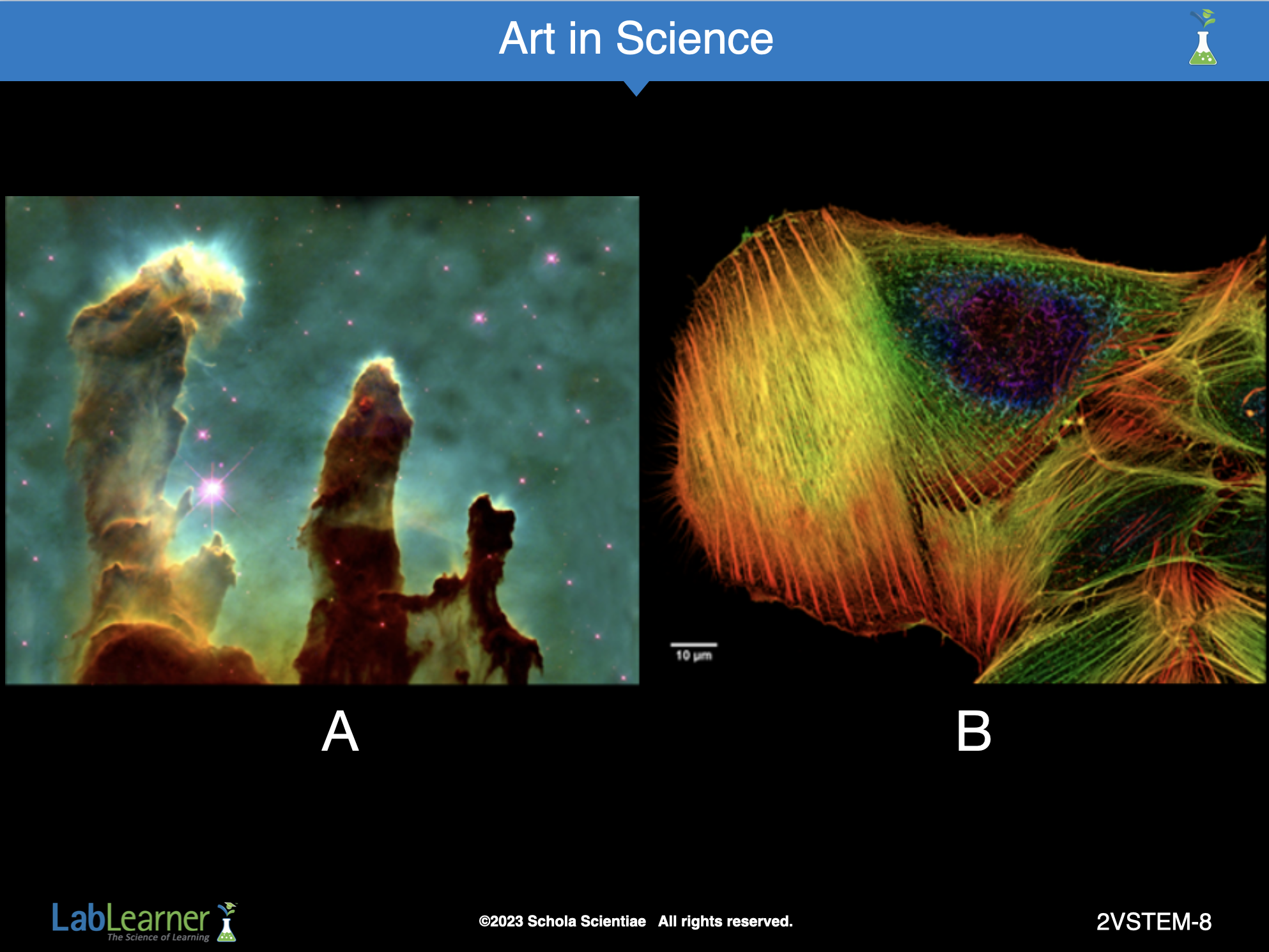
Even today, images of the Universe obtained by orbiting space telescopes like Hubble enthrall all of mankind with the wondrous beauty of the cosmos. In figure A of this slide, for example, is a section of the Eagle Nebula captured by the Hubble Space Telescope. These columns are commonly referred to as the Pillars of Creation as they are 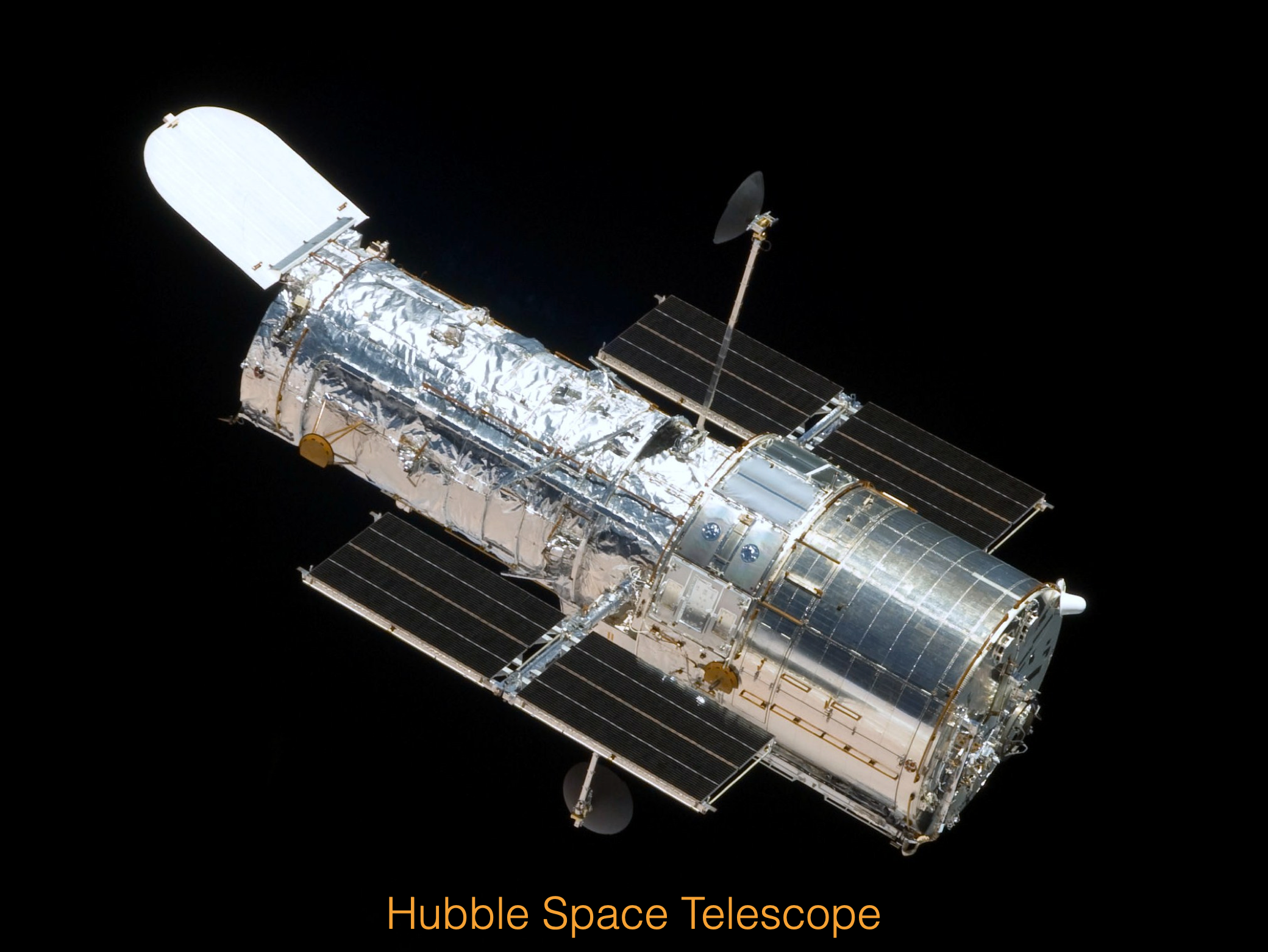 known to be the birthplace of stars. The Eagle Nebula is located about 7,000 light years from Earth. That is, it takes light from the nebula 7,000 years to reach Earth. In other words, the image we see here actually shows us what the Pillars of Creation looked like 7,000 years ago, not necessarily what they look like today.
On the other extreme, modern microscopic techniques and photography produce breathtaking new images as well. The image in figure B in this slide is an immunofluorescence micrograph of cancer cells stained to detect intracellular filaments composed of a protein called actin. The size-bar at the lower left of the micrograph indicates a length of 10 microns, that is 10 millionths of a meter, a dimension practically impossible to imagine.
On the other hand, the Pillars of Creation are approximately four light-years in length, about 40 trillion kilometers or 24.8 trillion miles! Thus, in this single figure we have the Pillars of Creation at 7,000 light years from Earth, 7,000 years in the past and 40 trillion kilometers in size alongside a cancer cell located right here on Earth, in the present and only a very small fraction of a millimeter in size. Both are impossible to see by the naked human eye and of sizes nearly impossible to imagine. Yet both serve as excellent examples of the awesome artistic beauty that science reveals to our human senses.
______________________________________________
SLIDE 2VSTEM-9
Discussions about religion and science can be difficult because of the broad range of understanding and opinions about both subjects. This is not at all surprising given that the tools and thought processes involved in understanding one of these subjects doesn’t necessarily translate well into understanding the other.
Whereas science relies entirely on measurable parameters and physical qualities, religion deals in immeasurable qualities and exists in its essence outside physical description. Science exists in the natural world, while religion is supernatural. By definition, the supernatural is attributed to forces beyond scientific understanding and the laws of nature.
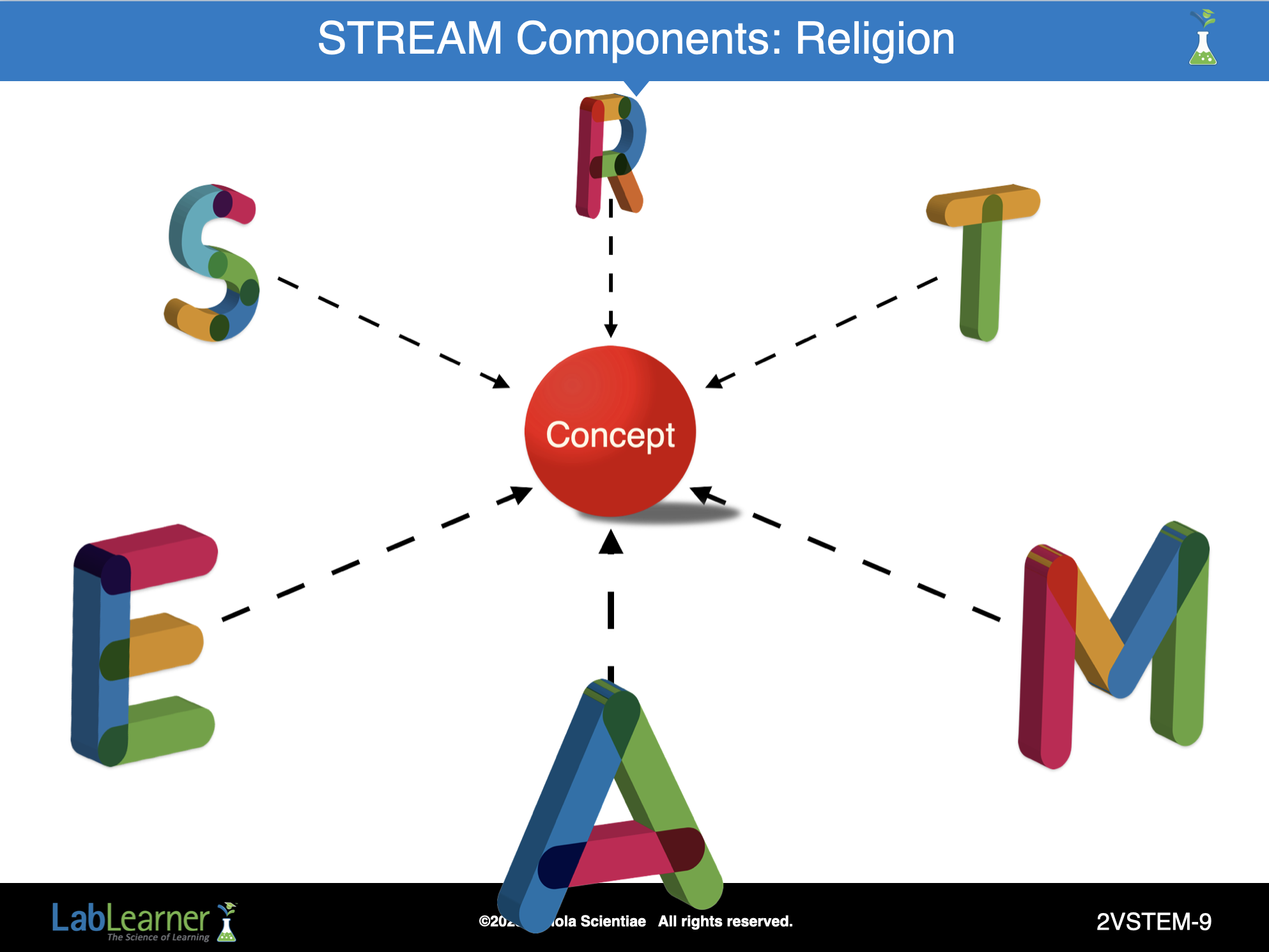
Parochial schools are tasked with teaching both science and religion. In fact, the modification of the STEM acronym to STREAM (R for religion in this case) in Catholic and other parochial systems reflects the desire to incorporate religion into STEM.
______________________________________________
SLIDE 2VSTEM-10
It should be pointed out that excellent science is not at all incompatible with religious belief. Throughout most of the history of science, key scientists where generally also religious believers. Thus, Sir Isaac Newton, Louis Pastor, Nicolaus Copernicus, Galileo Galilei, and countless other major scientists were also believers. Clearly, religious beliefs and affiliations do not preclude a brilliant scientific disposition and mind.
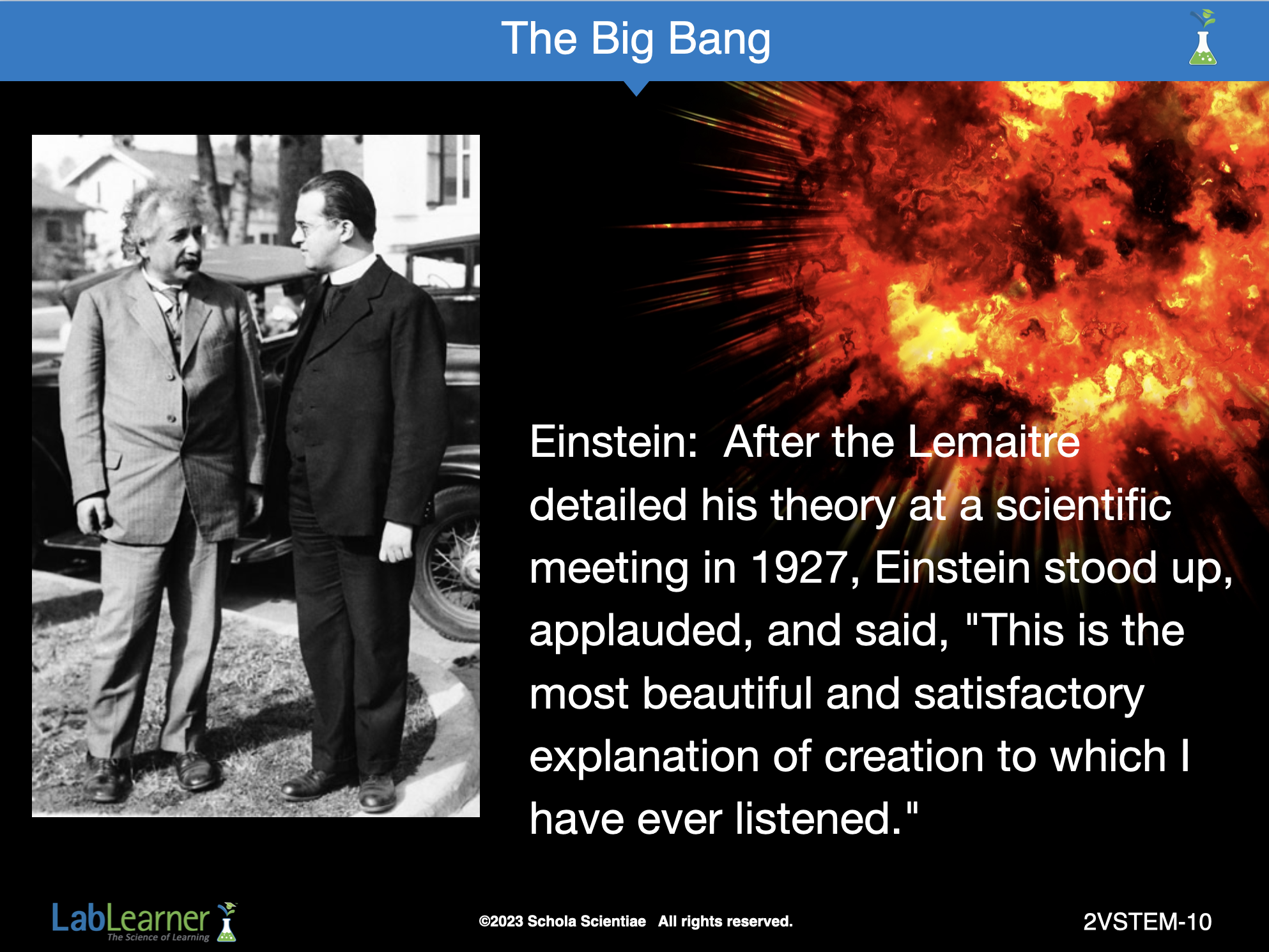
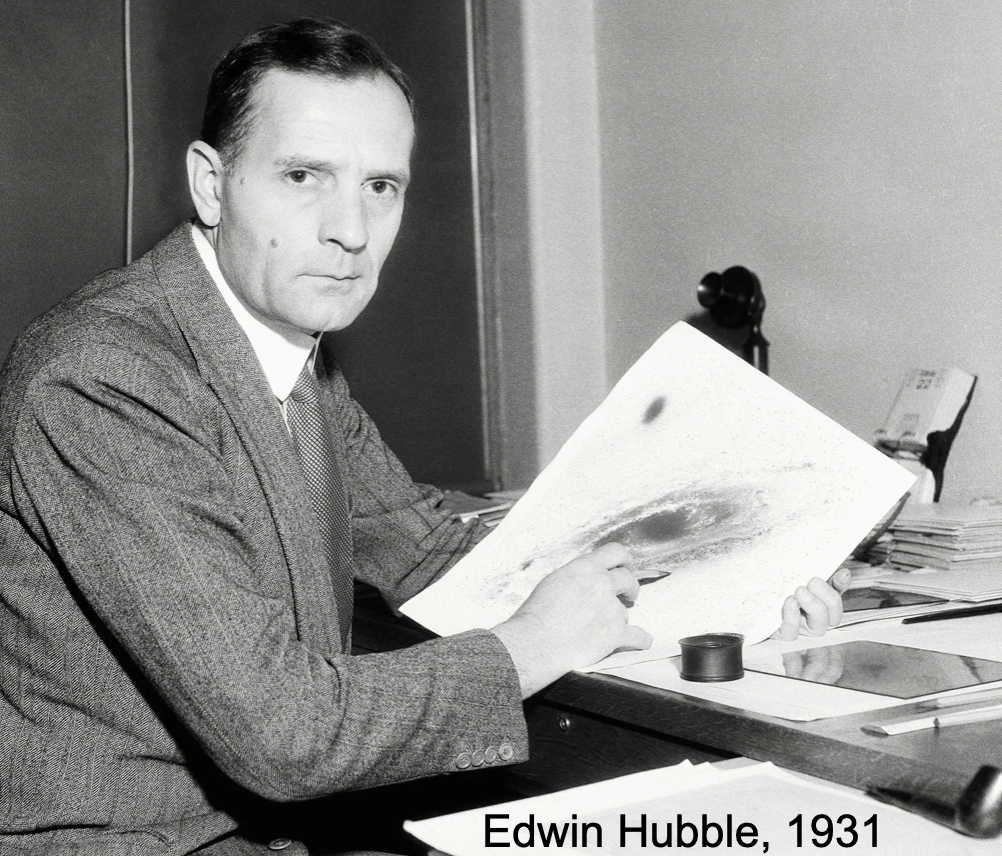 One of the great examples of a believer who was also a great scientist/mathematician in relatively recent times is Georges Lemaître (on the right with Albert Einstein in the insert above). Lemaître was Belgian physicist and Roman Catholic priest. He was one of the early proponents of and contributors to the expanding universe theory – later to be called The Big Bang Theory. Somewhat later, the American astronomer, Edwin Hubble (pictured here) produced evidence that provided further evidence to the idea of an expanding usnverse and the Big Bang Theory.
In a 1933 New York Times article entitled,“Lemaître follows two paths to the truth: The famous physicist tells why he finds no conflict between science and religion”, the writer Duncan Airman says, “His view is interesting and important not because he is a Catholic priest, not because he is one of the leading mathematical physicists of our time, but because he is both.”
Interestingly, rather than censoring or punishing Lemaître for scientific views contradicting then current Church doctrine, Lemaître’s propositions were embraced by the Church. Pope Pius XII went as far as to say that the Big Bang concept was not only congruent (in agreement) with the Catholic view of creation but also actually served as a scientific validation of the existence of God.
______________________________________________
SLIDE 2VSTEM-11
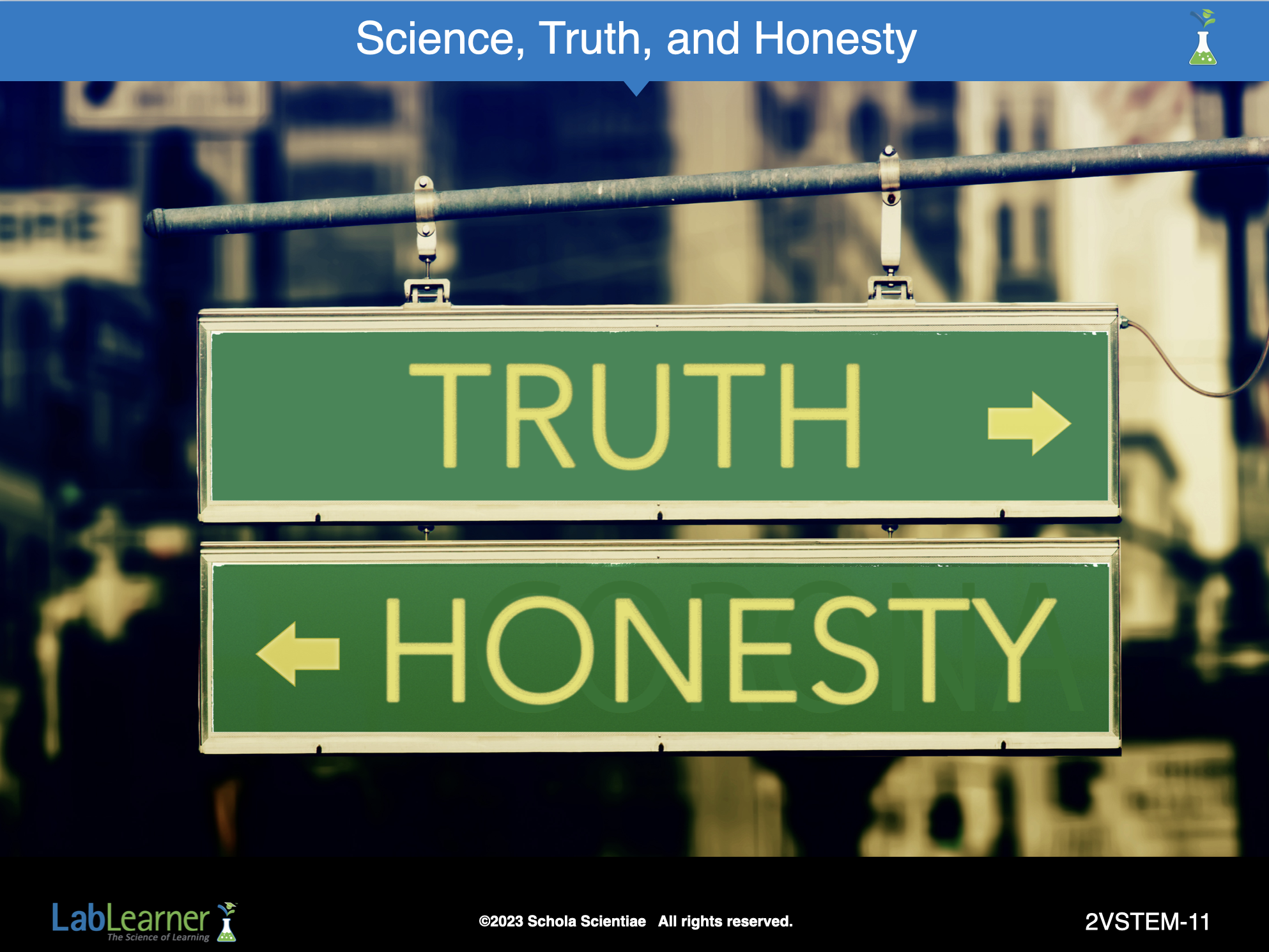
When we teach students science, the importance of honesty and truth cannot be overstated. In addition to critical thinking skills, science education can and should also instill integrity of thought and the value of using the truth to solve problems, communicate with others, and resolve disputes.
In LabLearner, students repeatedly predict and write down what they think will happen at various points in an experiment prior to a particular step. They then find out if their prediction was correct or incorrect. Either way, they are forbidden from changing their prediction.
After the experiment, the student returns to each prediction to see where they were right and wrong. If they were wrong, they must explain what they were thinking when they made the prediction and why they thought it was a reasonable prediction when they made it.
What does this teach the student? They learn to treat their initial, first thoughts with skepticism. They are wrong in their predictions too often to become over confident, and this is a sign of a very good scientist. Value is placed on being correct in the end… to learn the truth even if it takes some reevaluation or revision in their thinking.
______________________________________________
SLIDE 2VSTEM-12
The third and final Lesson of the STEM Careers Journey, will be devoted to a discussion of current and future career opportunities in the many STEM professions. As such, we will return to discussing STEM rather than STEAM or STREAM since the vast majority of career opportunities fall under this heading.
______________________________________________