
Teacher Portal
What is STEM?
PRINT IT
Use your browser to download a printable PDF as help during the slide presentation and to make additional notes. In your browser, go to File > Print and then choose to save as PDF.
NAVIGATE IT
Once the slide presentation is launched
- use your left and right arrows to advance or go back in the slide presentation, and
- hover your mouse over the left edge of the presentation to get a view of the thumbnails for all the slides so that you can quickly move anywhere in the presentation.
- Click HERE to launch the slide presentation for the CELL.
SHARE IT
SLIDE 1VSTEM-1
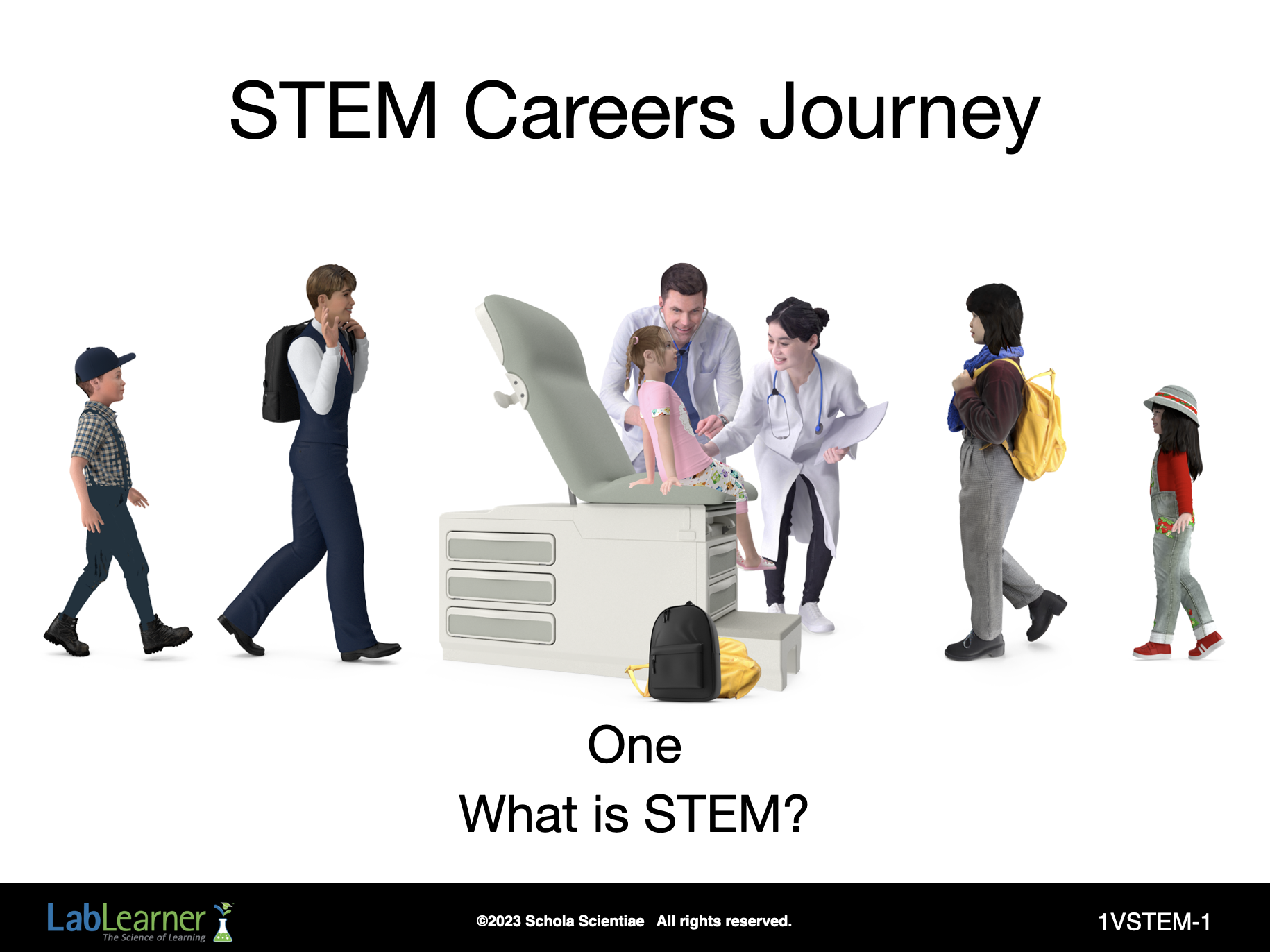
This is the first lesson in the LabLearner STEM Careers Journey. In it the concept of STEM is introduced and explained through wording with an example of the scientific concept involving heat and temperature.
Once students understand the meaning a power of STEM in solving problems and producing useful innovations and inventions, they will be introduced to a vast array of STEM fields and professions in Lesson Two.
______________________________________________

SLIDE 1VSTEM-2
STEM is not just a list of academic subjects. Instead, STEM represents a different kind of instruction. Simply including science, technology, engineering, and mathematics content in a curriculum is insufficient to achieve a STEM approach to education.
The power of STEM lies in the integration of its core curricular components, so that each subject informs and complements the others. STEM requires a new system of thought; a system of cognitive processing that is valuable to the developing mind and to society.
STEM requires a commitment on the part of the school and all of its educators at all levels to reexamine their skills and pedagogical methods. As such, a successful STEM initiative requires an overriding culture of academic subject-level rigor as its base. Then, once this base is in place, guided by the coordinated and sequenced presentation of content, the STEM approach can be implemented.
______________________________________________
SLIDE 1VSTEM-3
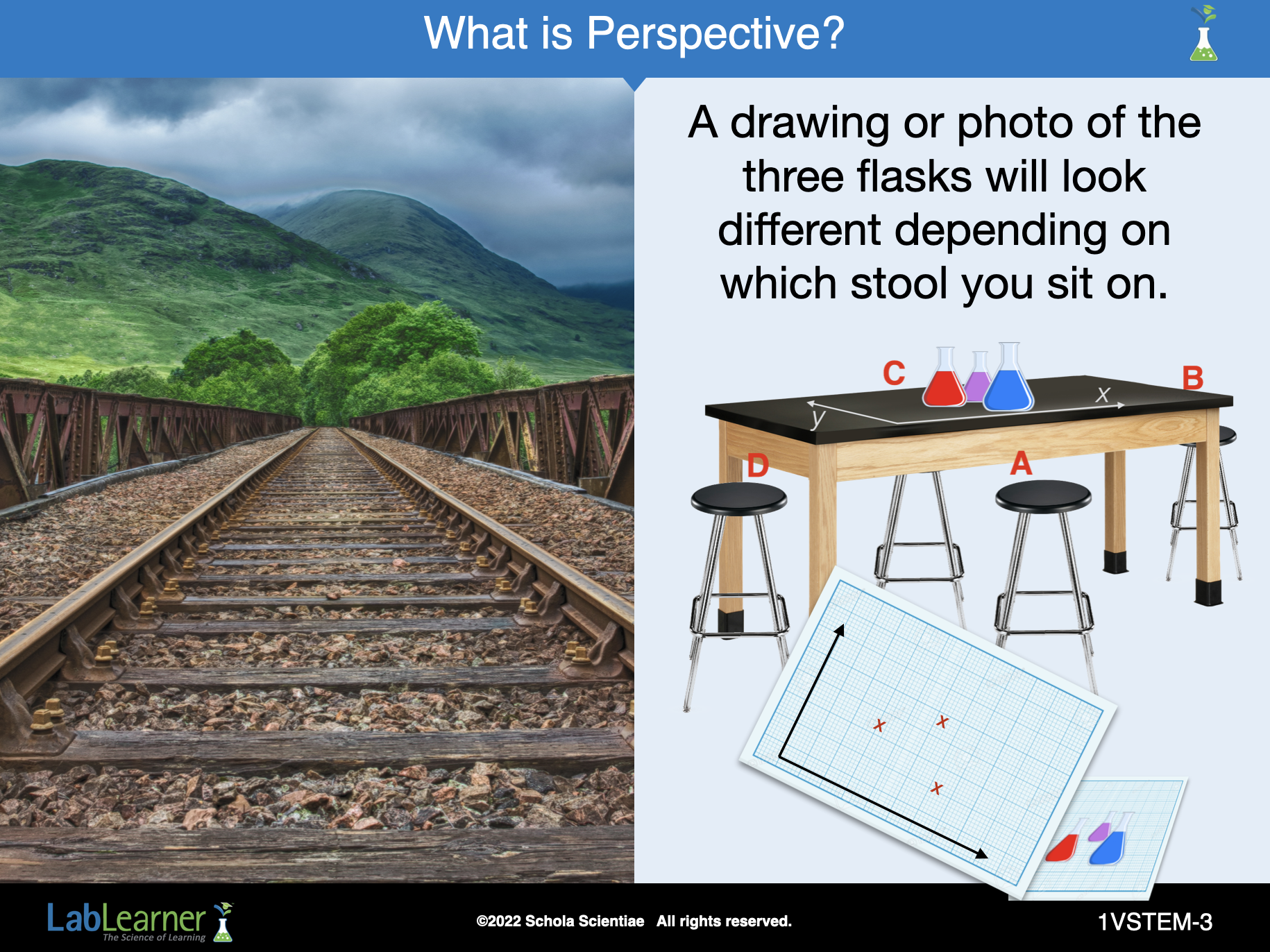
On the left of this slide shows a train track that illustrates one-point perspective as considered in art. Notice that all of the straight parallel line converge in the distance. The point at which they converge is called the vanishing point.
On the right of this slide is another type of perspective in which objects appear differently to us if we view them from different “perspectives”. Thus, a student sitting on the stool at position A will se the blue flask on the right while a student sitting in position C will see the blue flask on the left. The important point is that the more perspectives we have of a subject, the more we will know about it.
This final point is accentuated on the next slide.
______________________________________________
SLIDE 1VSTEM-4
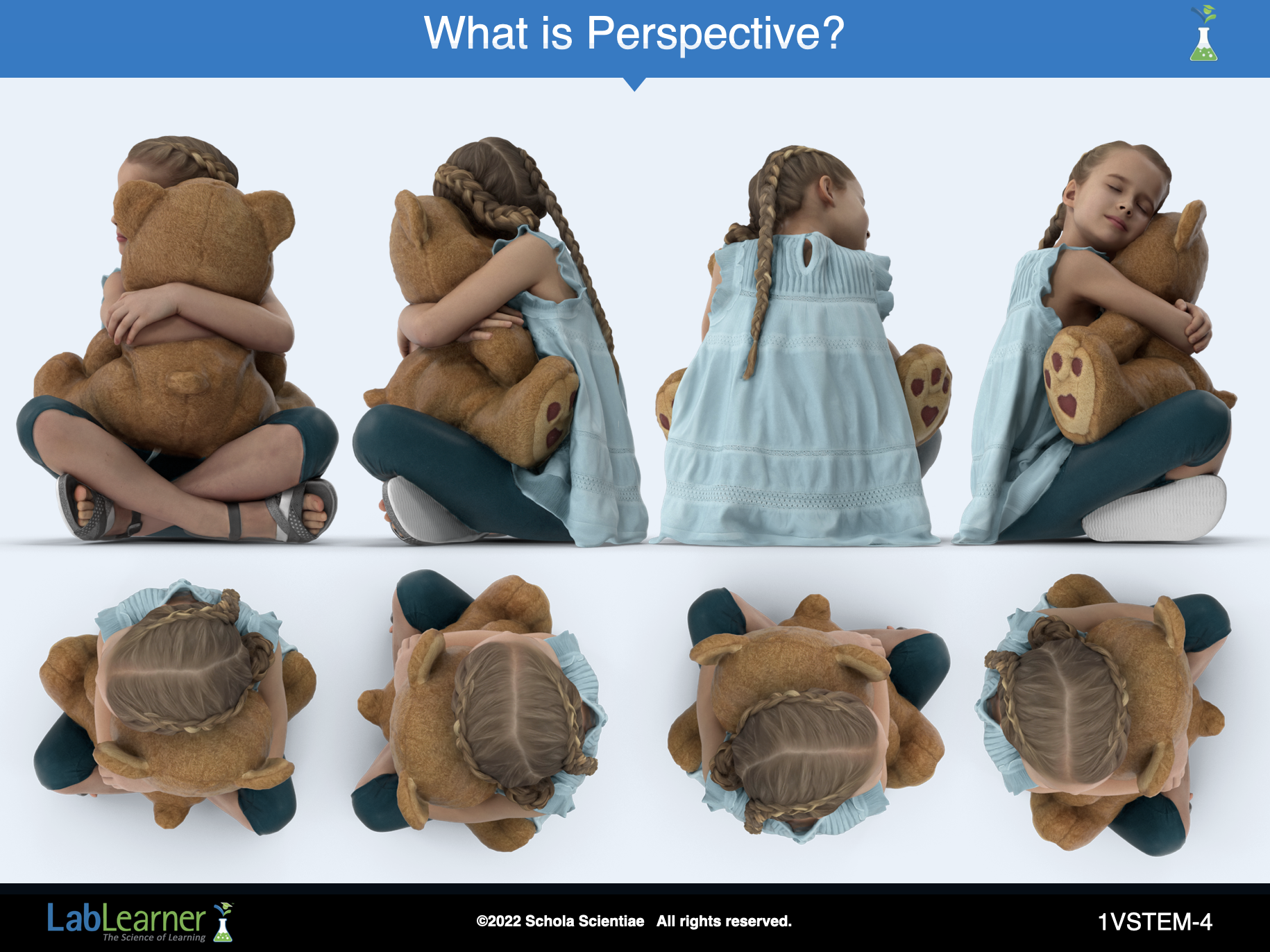
 This slide shows four different perspectives of the girl and bear when viewed from the side, as well as the various perspectives from the top. A final view, from the bottom, is shown to the right.
Notice that among all of these “perspectives”, in only one of them can we see her face. Once again, this stresses the point that the more perspectives we have of a subject, the more we learn about it.
______________________________________________
SLIDE 1VSTEM-5
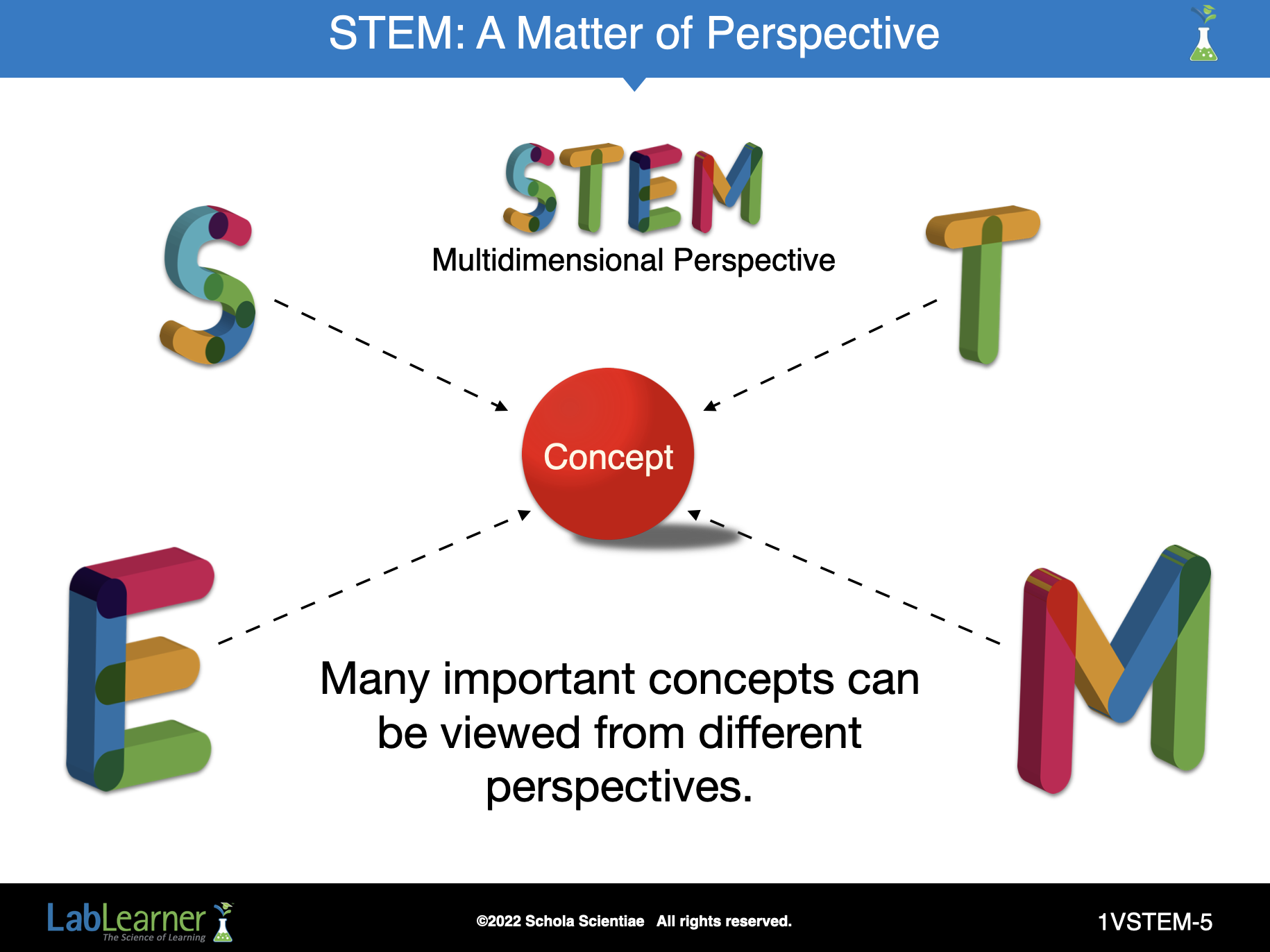
The exact same principle illustrated in the previous two slides is at work when we look at a scientific concept from different perspectives. That is the power of the STEM approach! We can learn much more about any concept such as gravity, heat, acceleration, flight, cell division, and so on, if we examine it from the perspectives of science, technology, engineering, and mathematics.
Ask students: What is perspective? Student answers may vary. A perspective is a “point of view” or “perspective” in this context.
Ask students: What is a concept? Can you give an example of a concept? Student answers may vary. Several scientific concepts were listed above (gravity, heat, etc.) so press students for additional concepts such as light, weather, sound, and so on.
Ask students: What do you think is the meaning of this slide? Student answers may vary. In general, the central concept may be viewed from the point of view of science, mathematics, technology, and engineering.
Ask students: Do you think we learn more or less about a concept by applying all four of the STEM perspectives? Students should answer that we learn more if we examine a concept from all of the STEM perspectives.
______________________________________________
SLIDE 1VSTEM-6
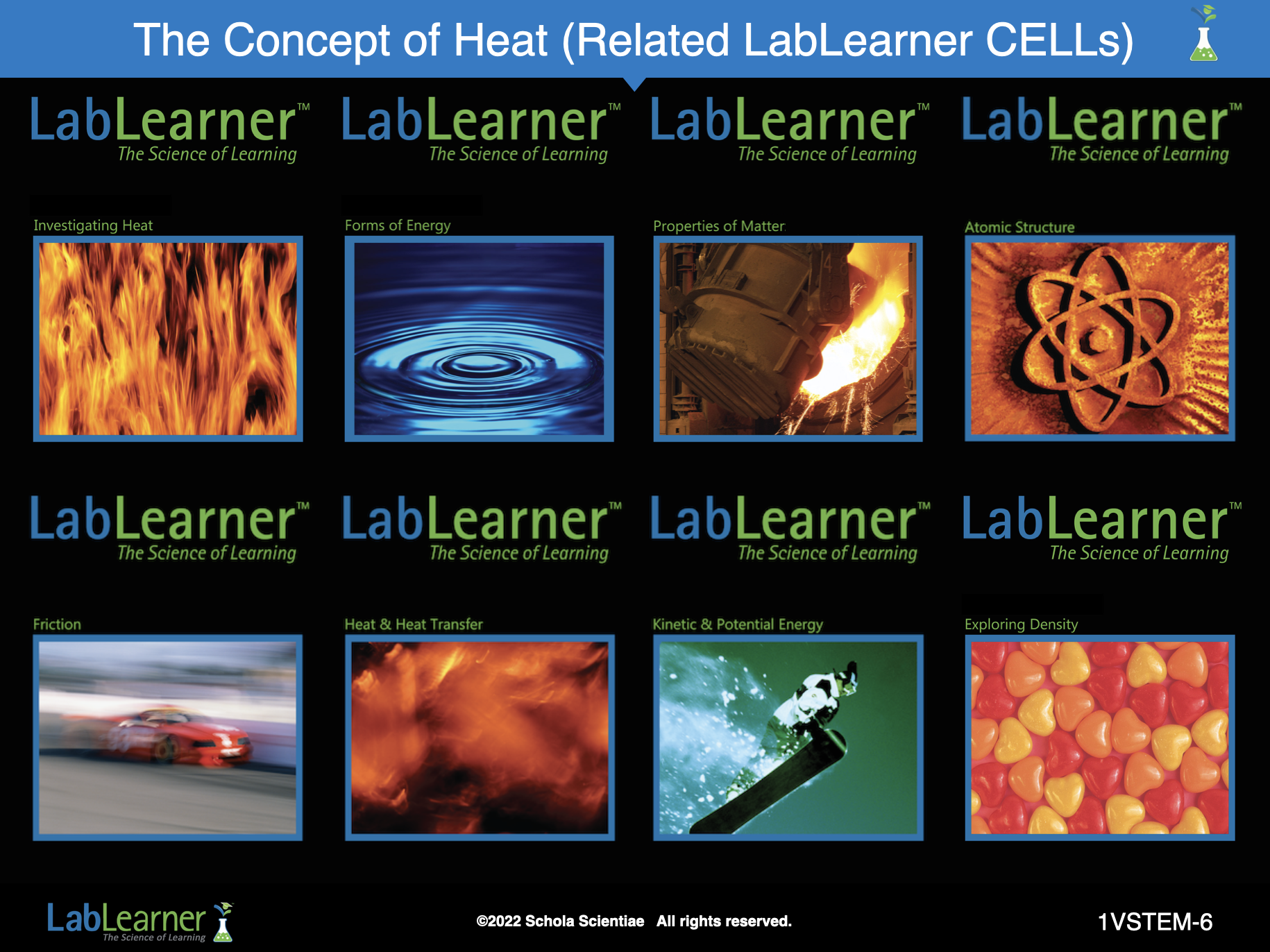
As an example of how most topics can be examined from the four corners of the STEM approach, we will use the example of heat. Students may be familiar with some aspects and information in this example of the STEM approach. The following is a list of LabLearner CELLs that covered material and concepts relevant to the example of heat (ES=elementary school CELLs, MS=middle school CELLs):
-
- Properties of Matter (ES)
- Exploring Electricity (ES)
- Forms of Energy (ES)
- Exploring Density (ES)
- Investigating Heat (ES)
- Kinetic and Potential Energy (MS)
- Atomic Structure (MS)
- Heat and Heat Transfer (MS)
- Electricity and Magnetism (MS)
Note to Teacher: To the extent that students have participated in these relevant CELLs, the teacher may make reference to the knowledge the students have already been exposed to. However, an in-depth understanding is not essential, as the heat example is simply for illustration and discussion of how a concept can be viewed from the different STEM perspectives.
______________________________________________
SLIDE 1VSTEM-7
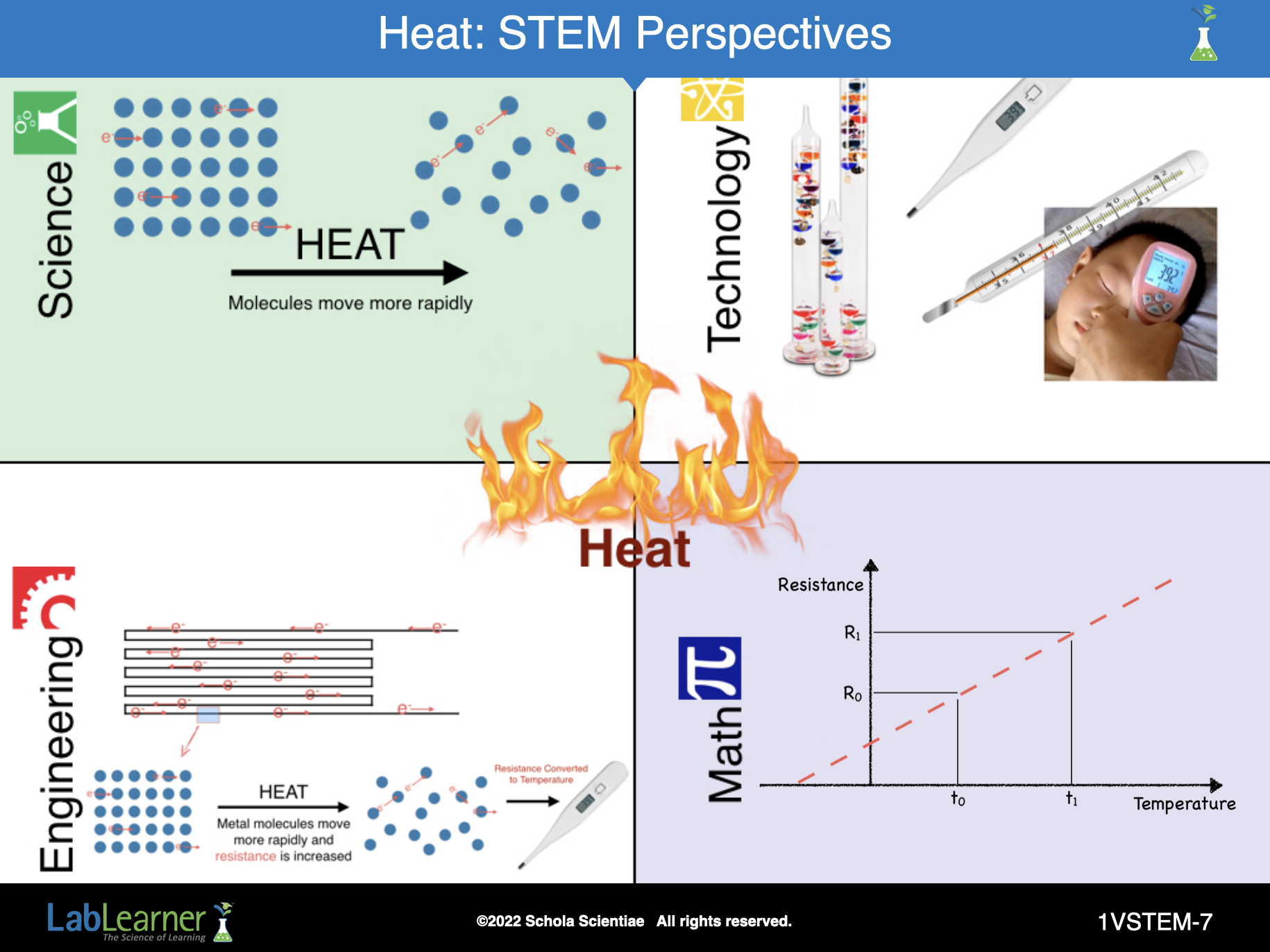
This slide simply indicates the four STEM perspectives that we will use in our overview of the example concept of heat.
______________________________________________
SLIDE 1VSTEM-8
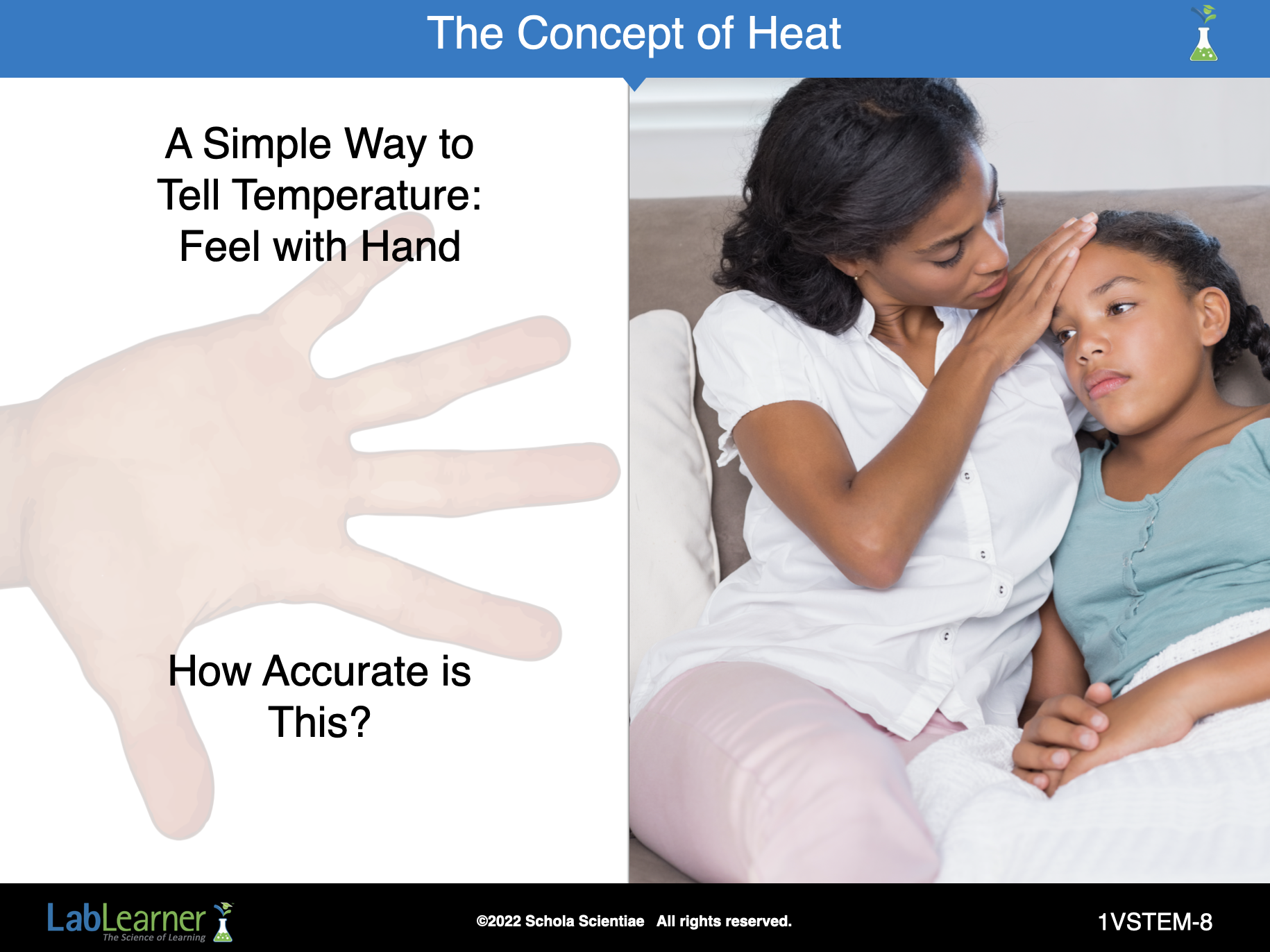
If we begin with looking at heat from a Science perspective, we will wish to understand the nature of heat and how we perceive or measure heat.
In this case we use the example of heat in terms of human body temperature.
Ask students: Is the method shown in the picture an accurate way to determine temperature? Student answers will vary.
______________________________________________
SLIDE 1VSTEM-9
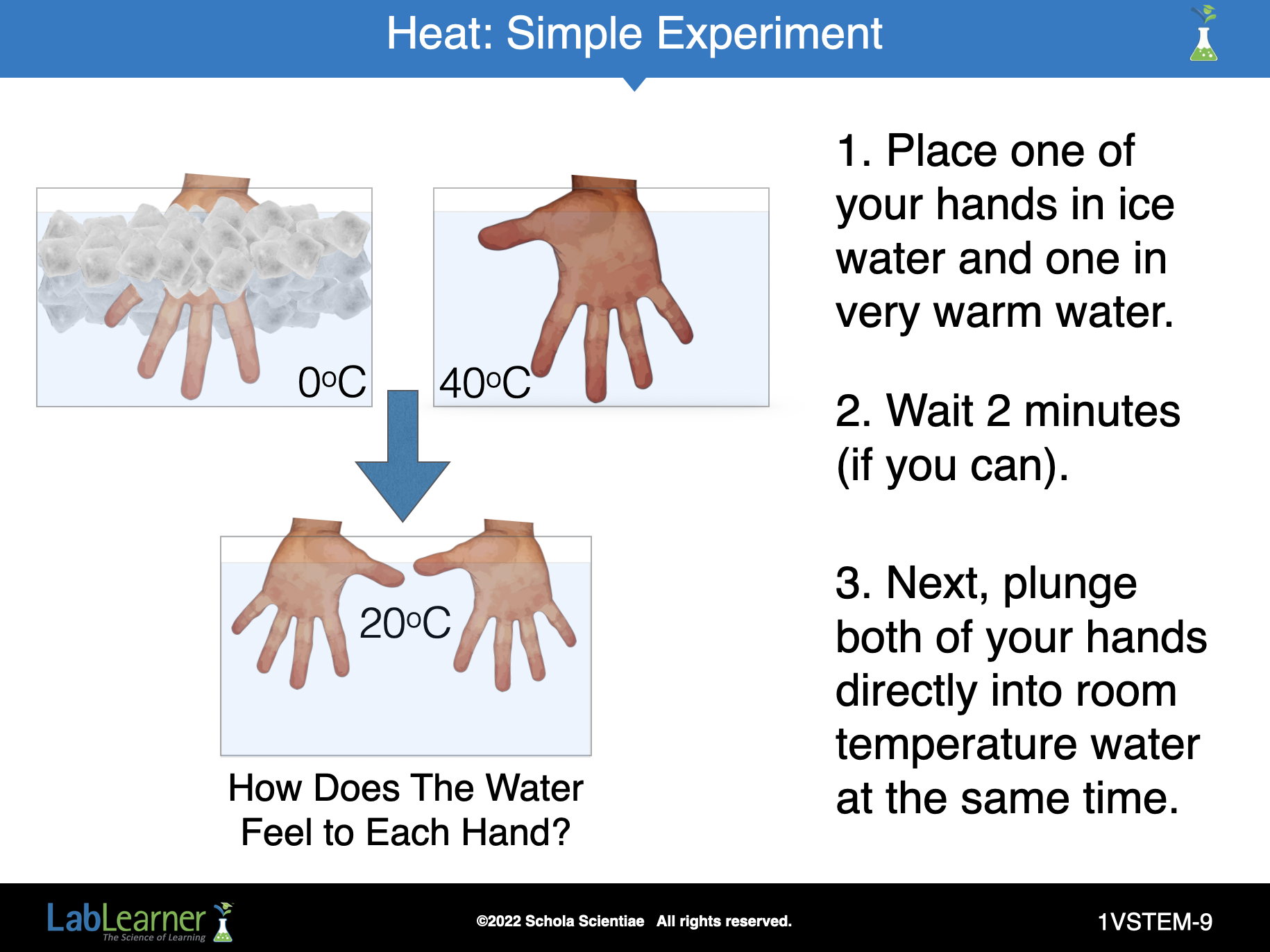
When we look at heat from a Science perspective, we can do experiments. To address if the mother feeling the girls forehead as a sign of fever is an accurate way to determine temperature, we might perform the experiment outlined on this slide.
Basically, if you perform this experiment, you will find that even though both hands are plunged into the room temperature water at the same time, the hand that was previously in the ice water will feel that the room temperature water “feels” warm. On the other hand, when moving from the very warm water directly into the room temperature water, that hand will “feel” that the room temperature water is cold.
Since both hands are plunged into the same room temperature water, but one hand feels cold while the other feels warm, this suggests that simply feeling is not a very accurate way of judging or measuring temperature.
______________________________________________
SLIDE 1VSTEM-10
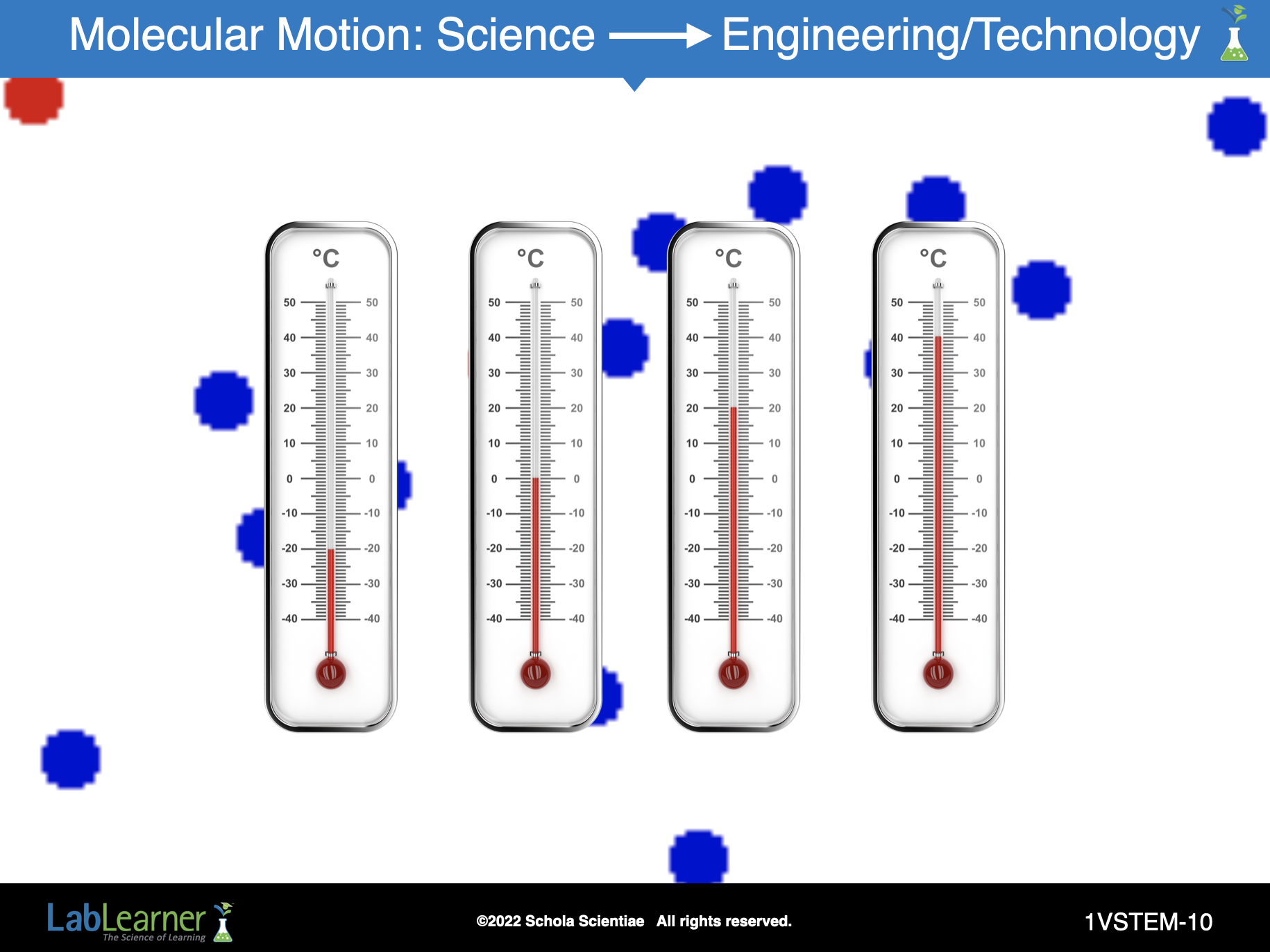
In the past, students have learned that heat is a form of kinetic energy and, as such, motion or movement is involved. In fact, the more kinetic energy is involved, the faster and more forcefully molecules will move whether speaking of gas molecules (as in hot air balloons), liquids (as when water is heated and finally boils and converts to steam), or solids (we will show an important example of molecular motion in metals in a later slide).
Ask students: Recall past CELLs in which you learned about kinetic energy, heat, and heat transfer. Can you explain how a liquid thermometer works? Student answers will vary.
In several LabLearner CELLs, we learned that as a liquid is heated, it takes up more volume. Scientists and engineers have used this scientific concept to build some of the earliest thermometers using a thin closed glass tube containing a liquid (mercury or alcohol are commonly used). As the temper increases, the liquid molecules move faster and the volume of the liquid expands. This, in turn, foresees the liquid up into the closed tube. Finally, by adding a calabrated scale along side the glass tube, researchers were able to determine temperature much more accurately and reproducibly.
This example, the liquid-filled glass thermometer, is an excellent example of how science and engineering/technology interact with each other – how looking at a problem from different STEM perspectives can solve the problem and result in an invention that is very useful to mankind.
______________________________________________
SLIDE 1VSTEM-11
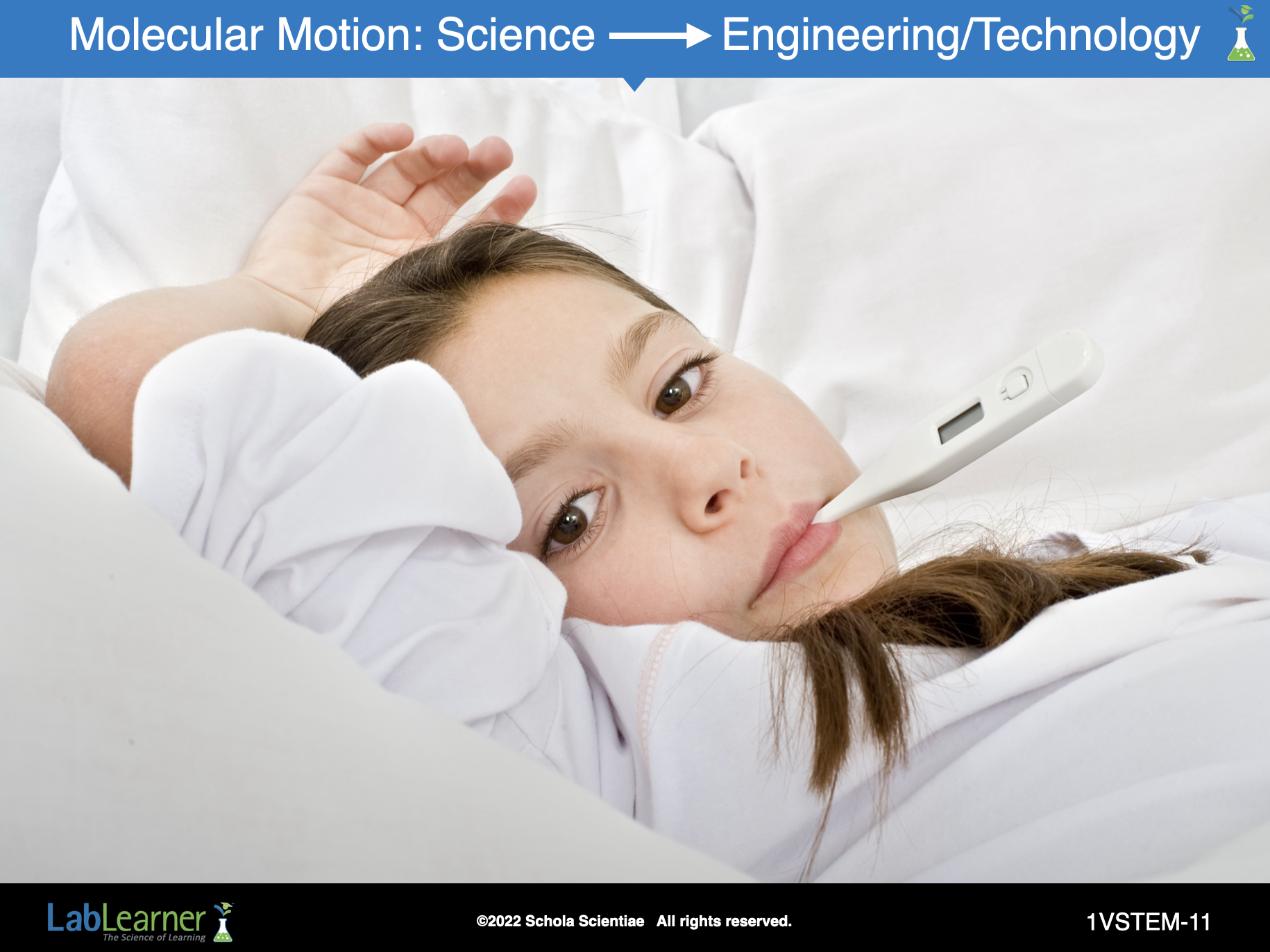
The first modern thermometers using a liquid-fill glass tube was in 1709 by Daniel Fahrenheit. We still use similar thermometers today. However, science, technology, and engineering have pushed the thermometer technology much further in recent times.
The girl pictured in this slide is using a Resistance Temperature Detectors (RTD) thermometer. This kind of thermometer is very commonly used today. Let’s see how science, technology, engineering, and mathematics have made it possible.
______________________________________________
SLIDE 1VSTEM-12
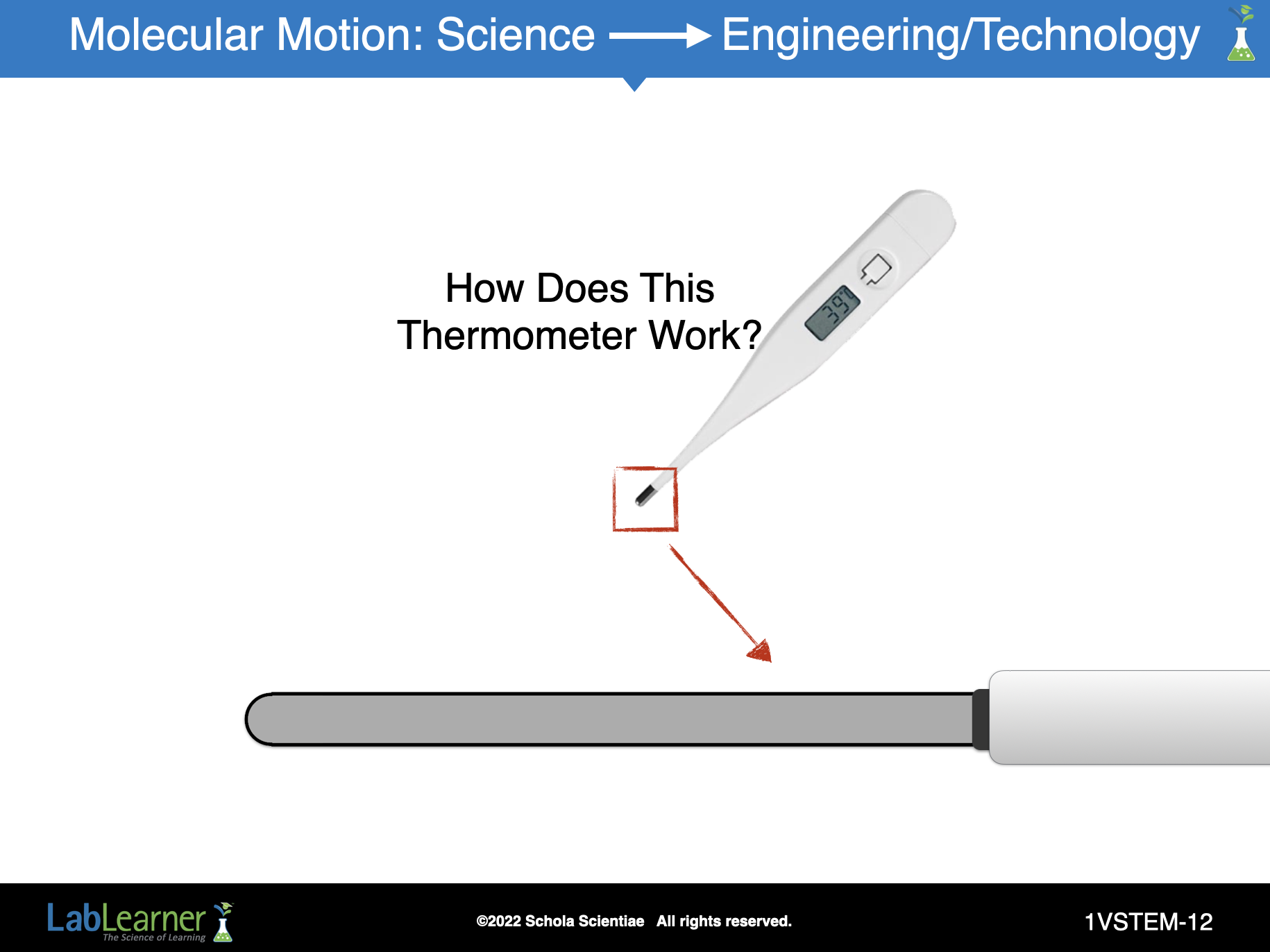
The RTD thermometer has a metal tip. This is where the sensor is located. The next slide shows more detail.
______________________________________________
SLIDE 1VSTEM-13
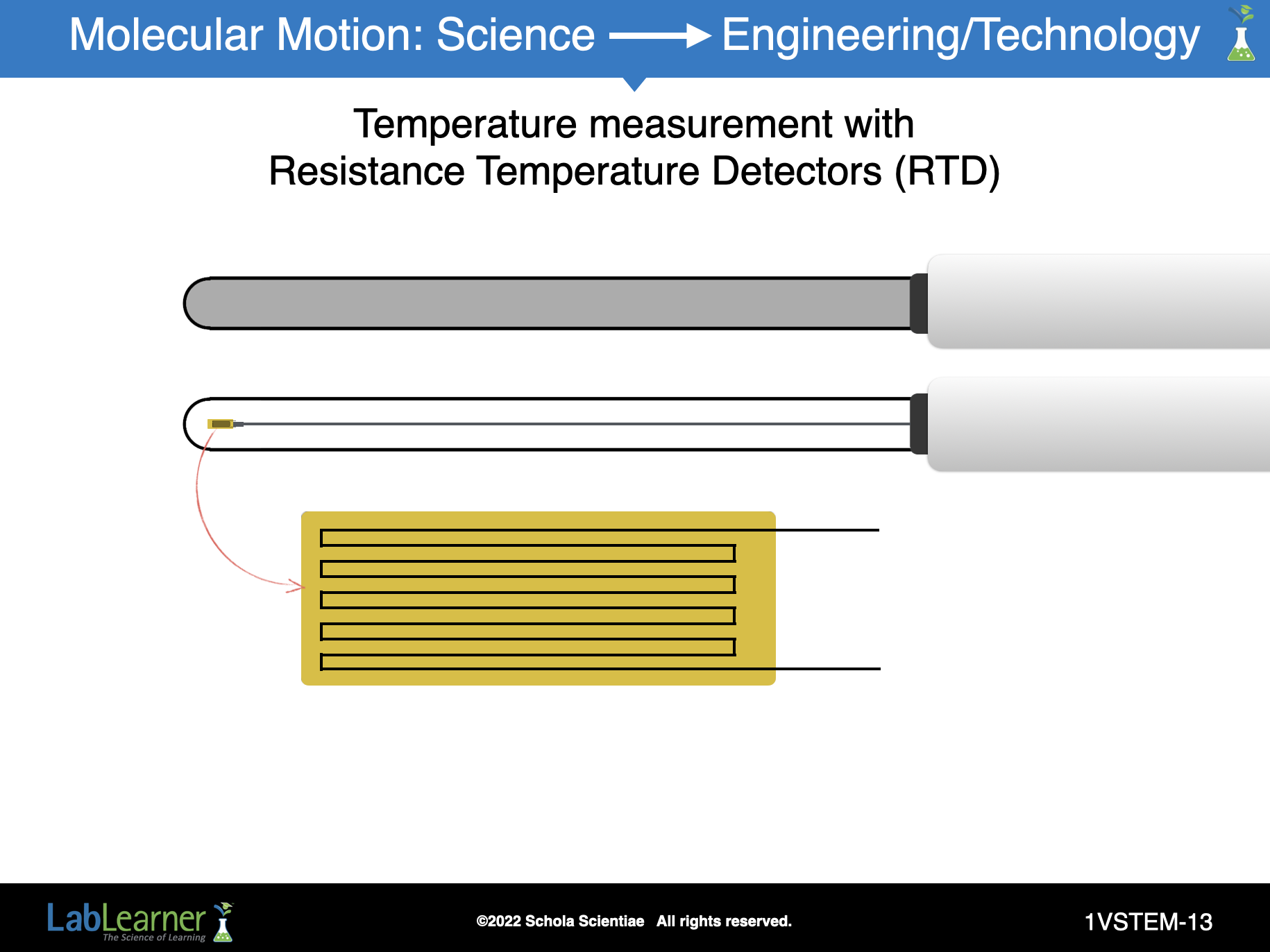
Inside the metal tip, the sensor (yellow box) has a very fine wire that is folded back and forth within the tip. The wire is a part of a circuit. The wire can be seen entering and leaving the sensor in this illustration.
The wire within the sensor is shown in greater detail in the next slide.
______________________________________________
SLIDE 1VSTEM-14
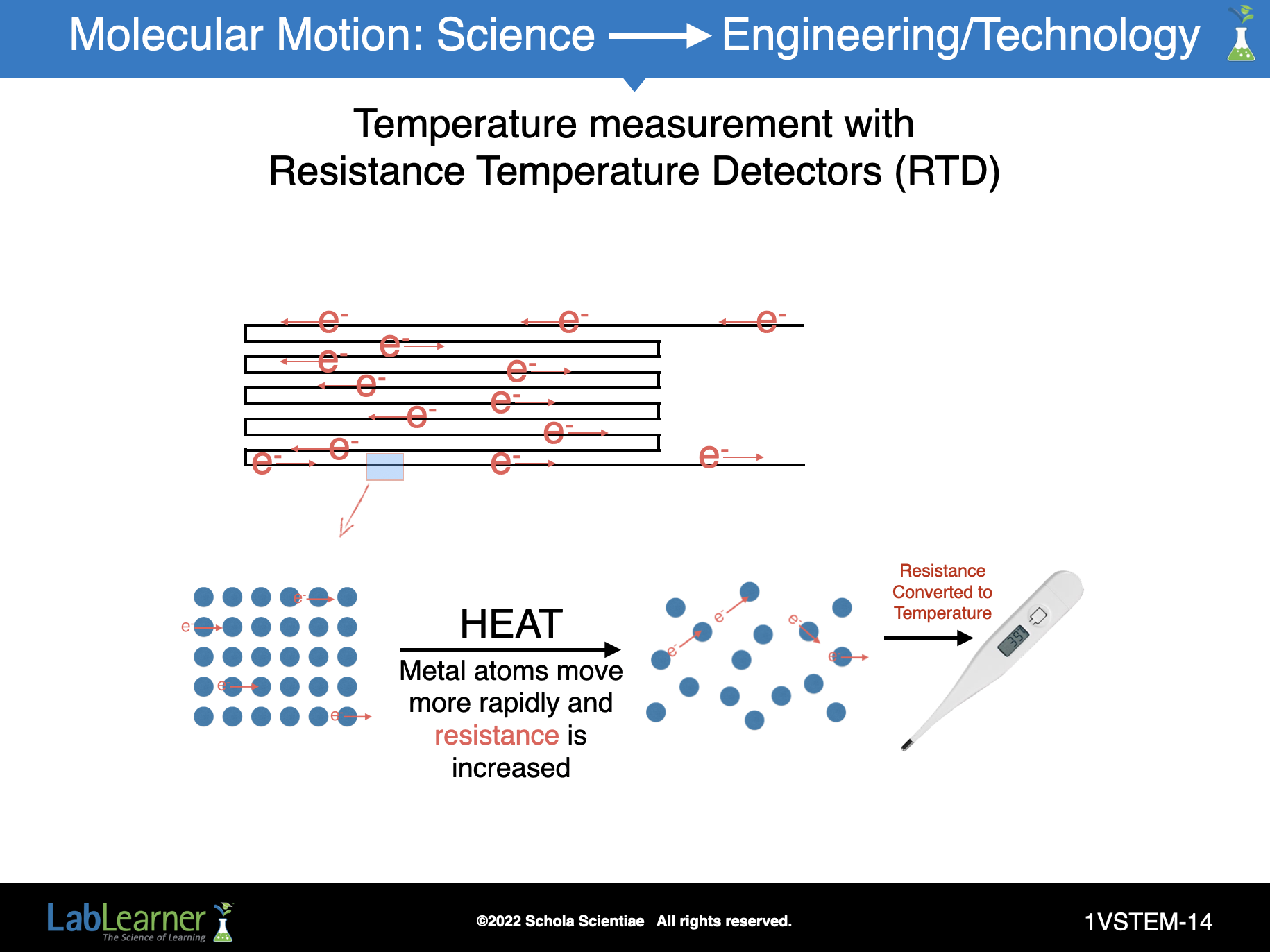
Just as in any electrical circuit, electrons flow through the metal wire. The electrons move from one metal atom to the next and therefore flow into and out of the sensor as an electric current.
A small section of the sensor wire is shown on the bottom left. The metal atoms are depicted as blue dots. The 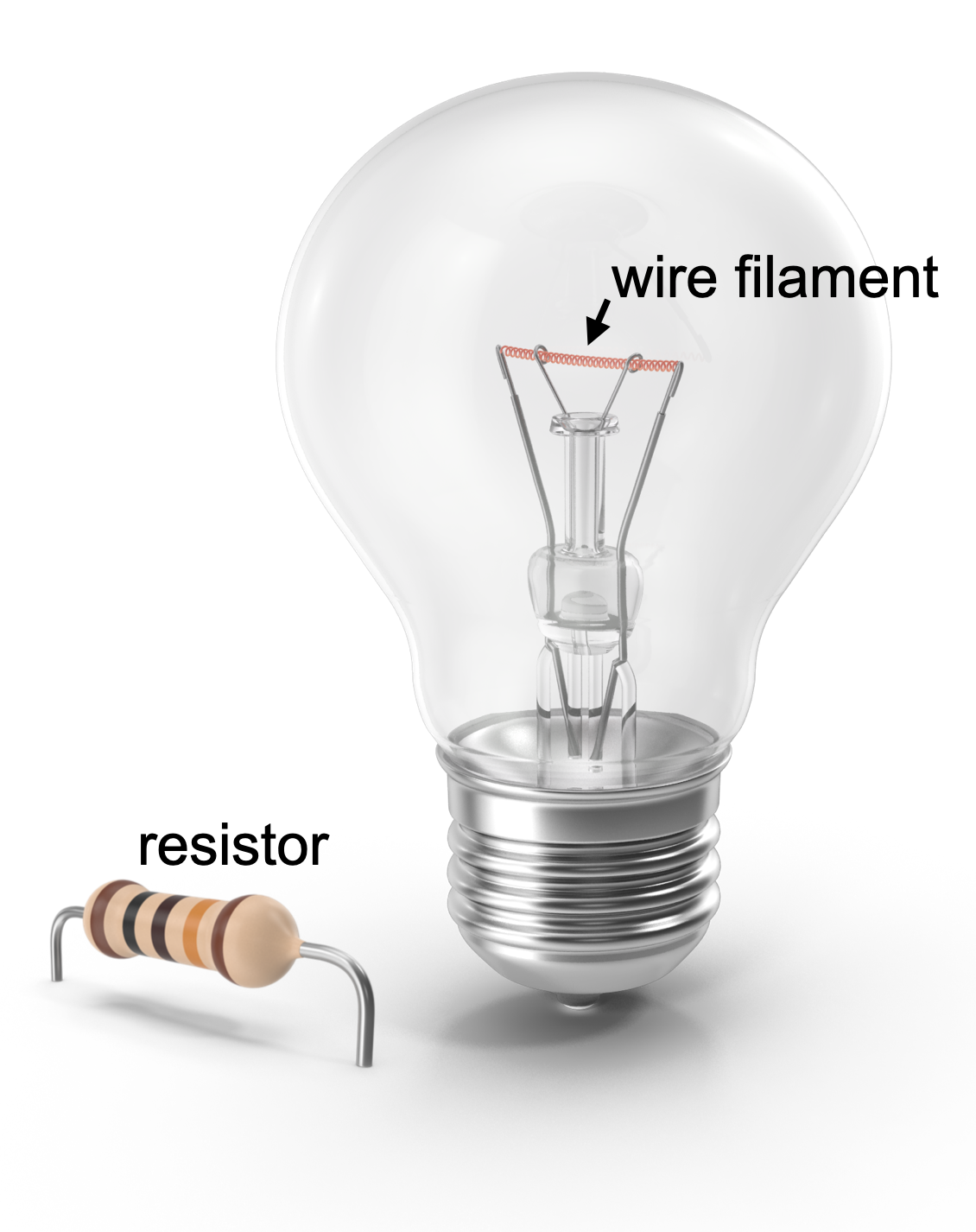 electrons of the electrical current move from one metal atom to the next in a smooth flow.
Just as we have discussed that the kinetic energy of heat cause atoms and molecules in liquids and gases to move faster and expand further apart, so is the case in the solid wire in the sensor. As the molecular motion of the metal atoms increases with temperature, the current electrons find it more difficult to move from one atom to the next, which causes the resistance in the wire to increase, much like the filaments in a lightbulb or resister causes a resistance to electron flow.
Finally, resistance is transposed into temperature by a small chip in the device, which shows up on on the thermometer’s display.
______________________________________________
SLIDE 1VSTEM-15
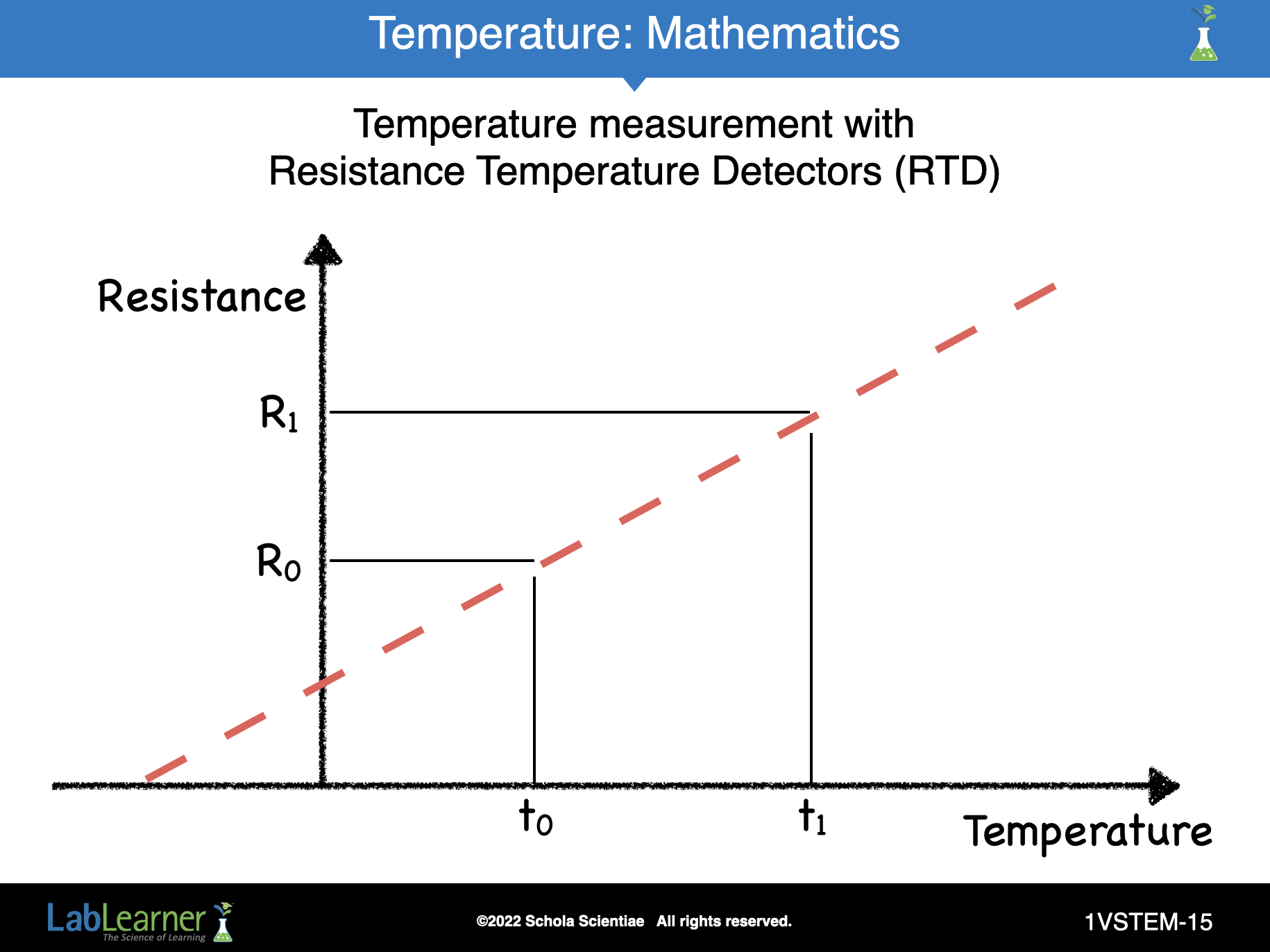
To calibrate the thermometer, the internal chip uses a mathematical relationship between resistance and temperature of the wire in the sensor according to the principle shown in the graph on this slide.
By applying this mathematical relationship between electrical resistance and temperature, the thermometer is able to convert the measured resistance in the sensor to the temperature of the wires within.
______________________________________________
SLIDE 1VSTEM-16
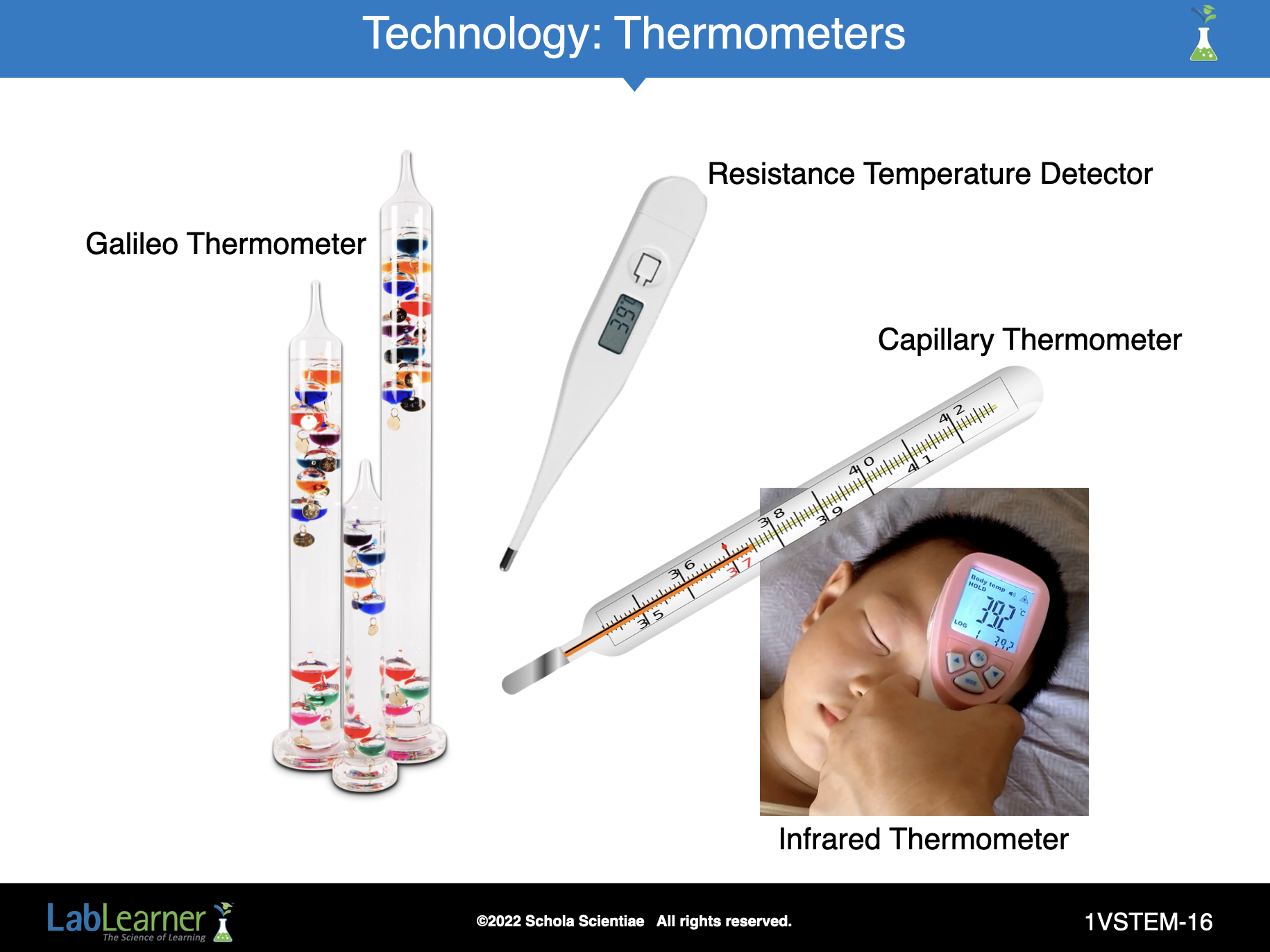
This slide summarizes just a few of the thermometers that have been developed through the relationship between science, technology, engineering, and mathematics over the years.
Interestingly, the Galileo thermometer pictured here works on the scientific principle that the density of the water within the thermometer becomes less dense as its temperature increases and more dense as its temperature decreases. The colorful balls are made of glass with varying amounts of liquid inside, thus they have slightly different masses.
Depending on the water temperature (and therefore density), different balls will either sink or float. Each glass ball has a temperature written on a metal tag hanging from it. The thermometer is read by looking at the last ball that floats. As the temperature increase another ball will float up and its labeled can be read. While cleaver and beautiful, the thermometer is very slow to adjust to changing temperatures and not practical to use for experiments, checking for fever, and so on. Today it is mainly used as a decoration and conversation piece.
Nonetheless, it was through the STEM approach that Galileo related temperature and density (pure science concepts), and the need to be able to measure temperature (technology and engineering) that he was able to invent this device.
______________________________________________
SLIDE 1VSTEM-17
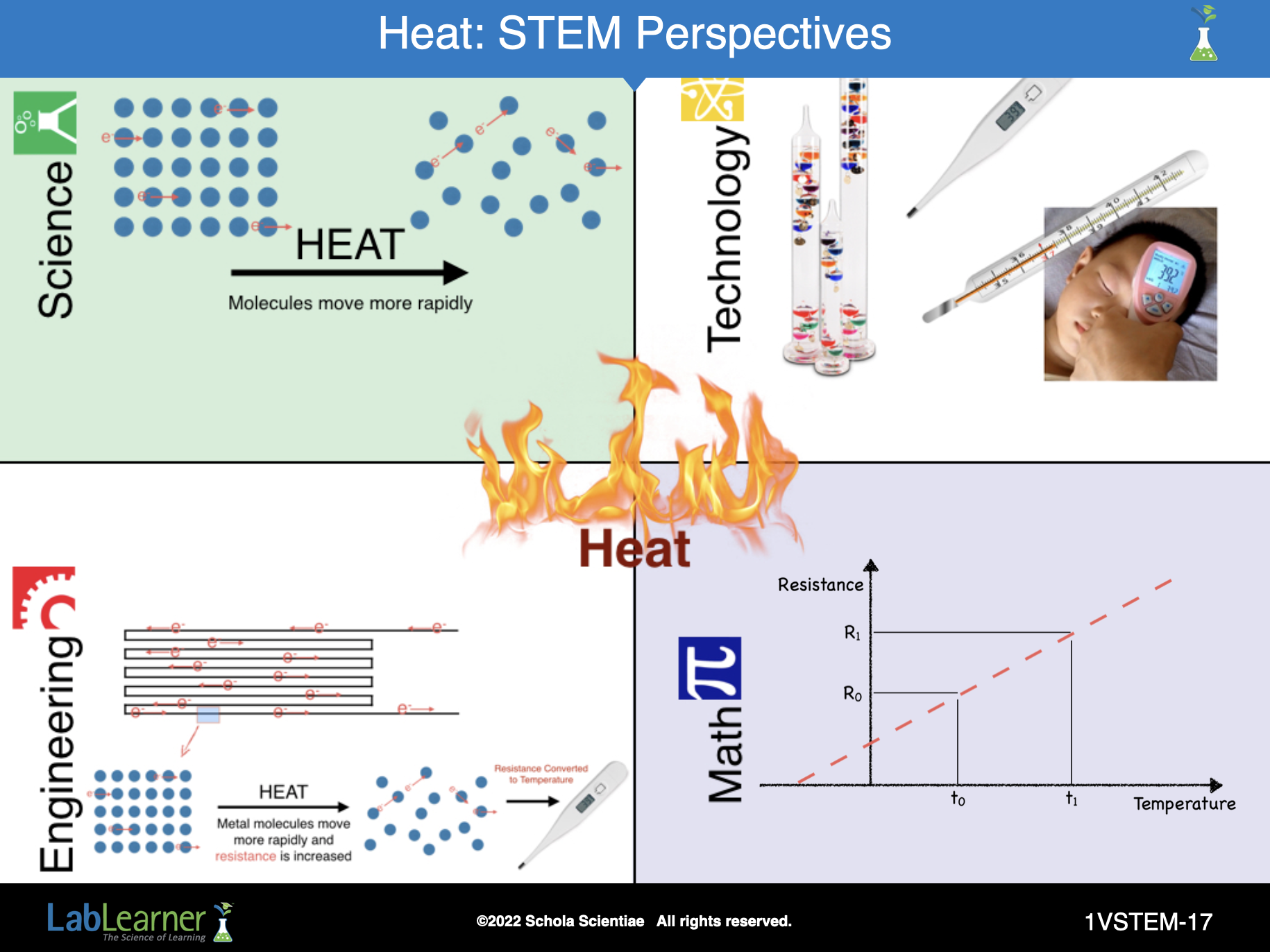
As you can see, using the STEM components to attack and solve problems has many advantages and has served as a powerful tool in engineering over the years. Innovation and technological advancements by applying the STEM approach can only be expected to accelerate in the future.
______________________________________________
SLIDE 1VSTEM-18
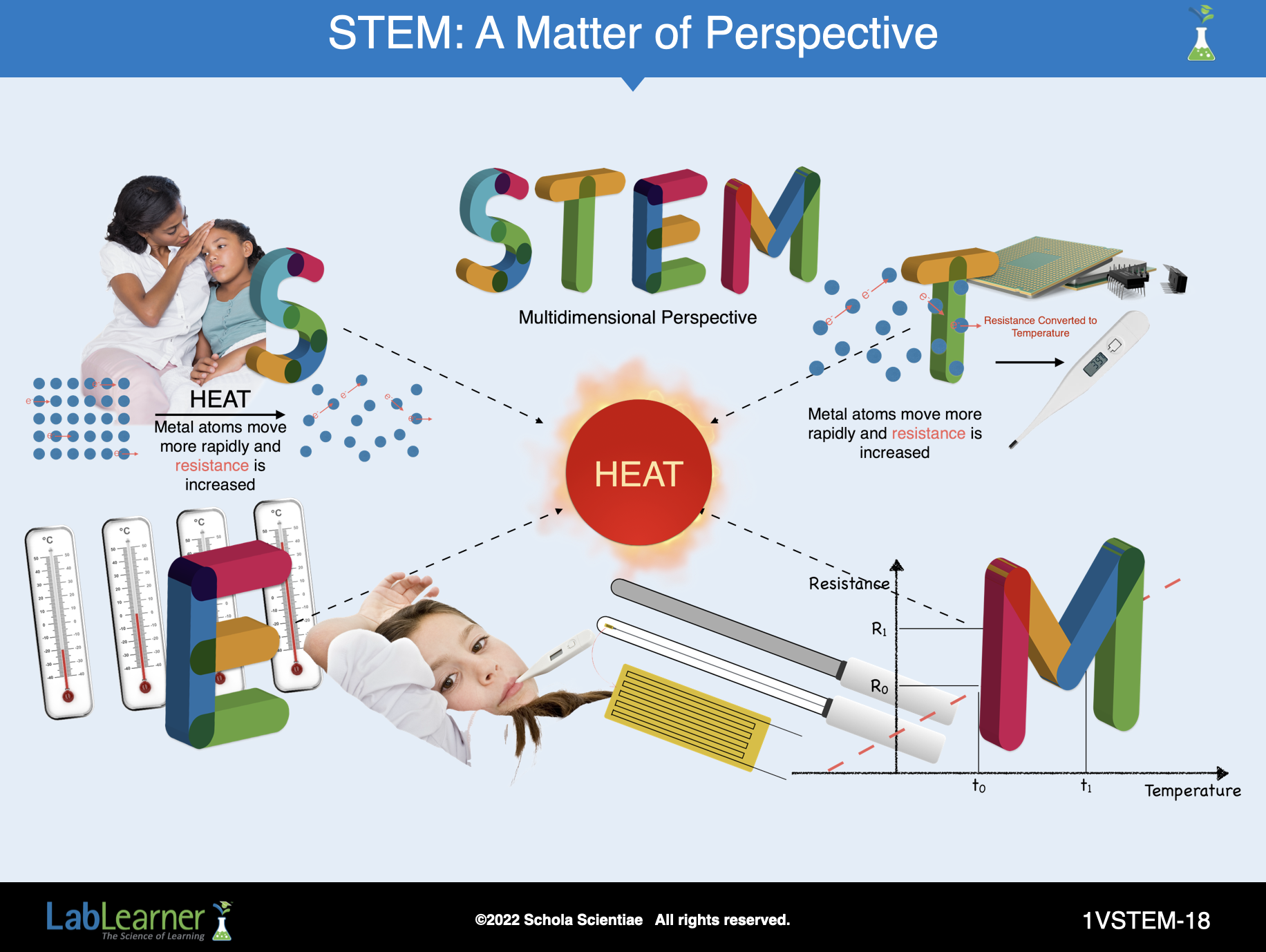
While we focused only on heat and temperature in this particular example, students should appreciate that it is a general method of innovation. A method that they will gain more and more expertise should they pursue a STEM career!