
Teacher Portal:
Our Solar System
Investigation 5
 Investigation 5 CAP
In addition to the PreLab, Lab, and PostLab sections for Investigation 5 of Our Solar System, below is an additional CAP lesson. It looks at planetary movement in terms of balanced and unbalanced forces. It accentuates basic concepts, many of which were addressed in Investigations 1 through 5. Click on the CAP to the right to go to the CAP lesson.
Investigation Five: Movement of the Planets
During Investigation Five, students will continue in their exploration of the movement and position of planets in the Solar System. Students will focus their study on the orbits of planets around the Sun, exploring the forces and motions that shape their orbits.
All of the planets revolve around the Sun in continuous elliptical orbits. This motion, known as circular motion, occurs because of two factors. First, an object (e.g., a planet) is already moving at a certain speed in a particular direction. In other words, the planet already has forward velocity or forward motion. Second, a linear force (e.g., gravity) acts on the object (e.g., the planet). The force of gravity is a force that exists between two objects. In the case of the Earth and the Sun, gravity exists between them. Because the Sun has a much larger mass than the Earth, the force of gravity would cause the Earth to speed up in a straight line toward the Sun. If the force of gravity was the only factor affecting the movement of the Earth, the Earth would speed up until it collided with the Sun.
The Earth and Sun do not collide, however, because of the first factor affecting the movement of the Earth – its forward motion. At the same time, the Earth is being pulled toward the Sun due to the Sun’s gravitational force, the Earth also has forward velocity in a straight line parallel to the Sun (see illustration below). The combination of the Earth’s forward velocity and the Sun’s gravitational pull on the Earth gives it a curved path around the Sun. This curved path ultimately becomes the Earth’s orbit.
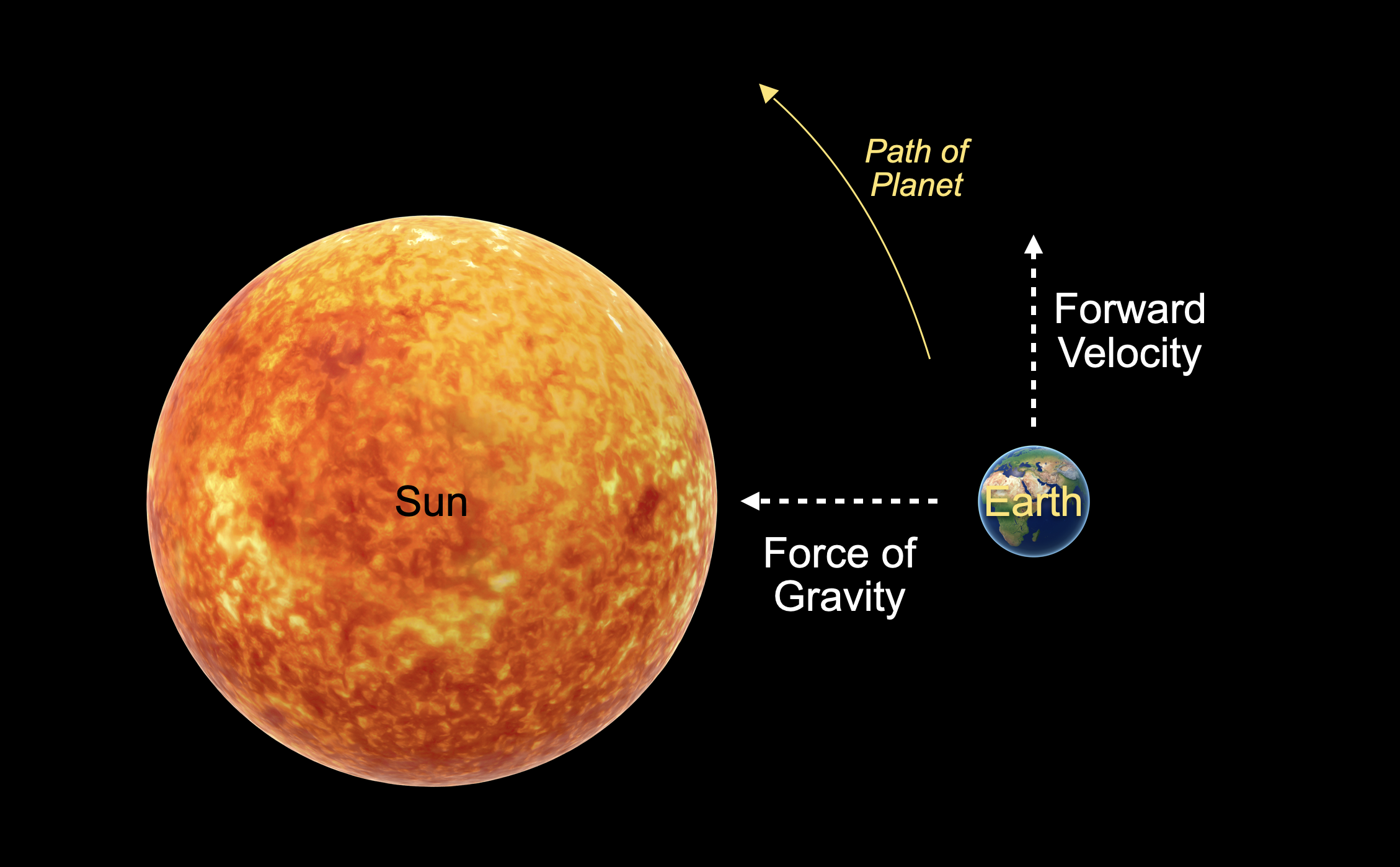
To see that the Earth’s orbit is affected by its forward velocity, students will simulate what would occur if the force of gravity from the Sun did not exist. By using a model, students will find that if gravity from the Sun did not pull the Earth toward it, the Earth would continue in a straight (tangential) line past the Sun. Without the effect of the Sun’s gravity, the Earth would not orbit the Sun.
Another demonstration of this principle will be encountered by students in the LabLearner middle school CELL Space. In this activity (shown below) student seated on a 4-wheel scooter (the planet) is pushed from behind in a straight line (forward velocity). The “Sun” holds a rope attached to the scooter that prevents the straight, forward direction caused by the forward velocity. The combination of the two forces acting on the “planet” result in a curved path around the Sun (person holding the rope). If the rope is dropped by the “Sun”, the curved path of the scooter is immediately transformed into a straight, forward motion caused by the continued forward velocity.
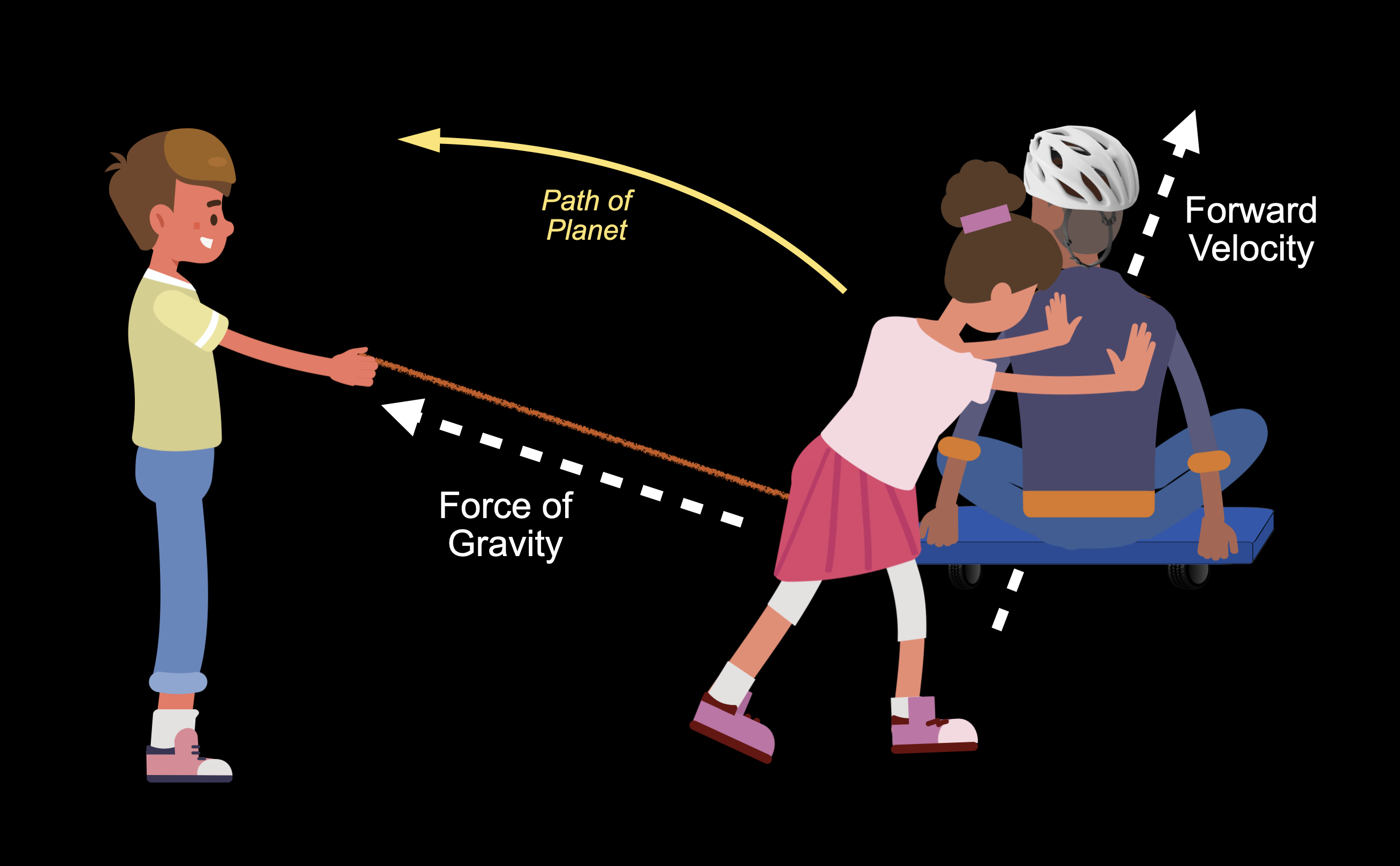
This model of the Earth and Sun which includes only two factors, the force of gravity and forward velocity, explains the motion of all of the planets. In fact, the orbit of the Moon around the Earth is also explained by the Moon’s forward velocity and the force of gravity between the Earth and the Moon.
During Investigation Five, students will complete their study of the movement and position of the parts of the Solar System by investigating planetary orbits and the factors affecting them. Through the use of models, students will find that the forward motion (or velocity) of planets and the Sun’s gravitational force cause planets to orbit the Sun. Likewise, the forward motion of the Moon and the Earth’s gravitation force causes the Moon to orbit the Earth.
In this way, students will conclude that these two factors, forward motion, and gravity, play a large role in creating the Solar System as we know it. Students will begin to understand that without this movement, the Earth would not experience a pattern of seasons and temperature change, the Moon would not cycle through appearance changes as viewed from Earth, and the eight major planets would not orbit the Sun in a continuous and orderly fashion.
Our Solar System: Investigation 5-Mathematics Concepts
Prelab
- problem-solving
- greater than/less than/equal to
Lab
- geometry
Postlab
- whole numbers
- data table
- data analysis
- parts/whole
- problem-solving
Our Solar System: Investigation 5 - Procedural Tools

Our Solar System: Investigation 5 - Cognitive Tools

Our Solar System:
Investigation 5 Quiz

