
Teacher Portal:
Properties of Matter
Investigation 5
Investigation Five: Exploring Buoyancy
Investigation One introduced students to the properties of matter through observation of the three states of matter. In Investigations Two, Three, and Four, students were introduced to the specific properties of volume, density, and weight. Students discovered that density determined floating and sinking, but volume and weight did not. Investigation Five continues students’ exploration of the properties of matter through experiments involving buoyancy.
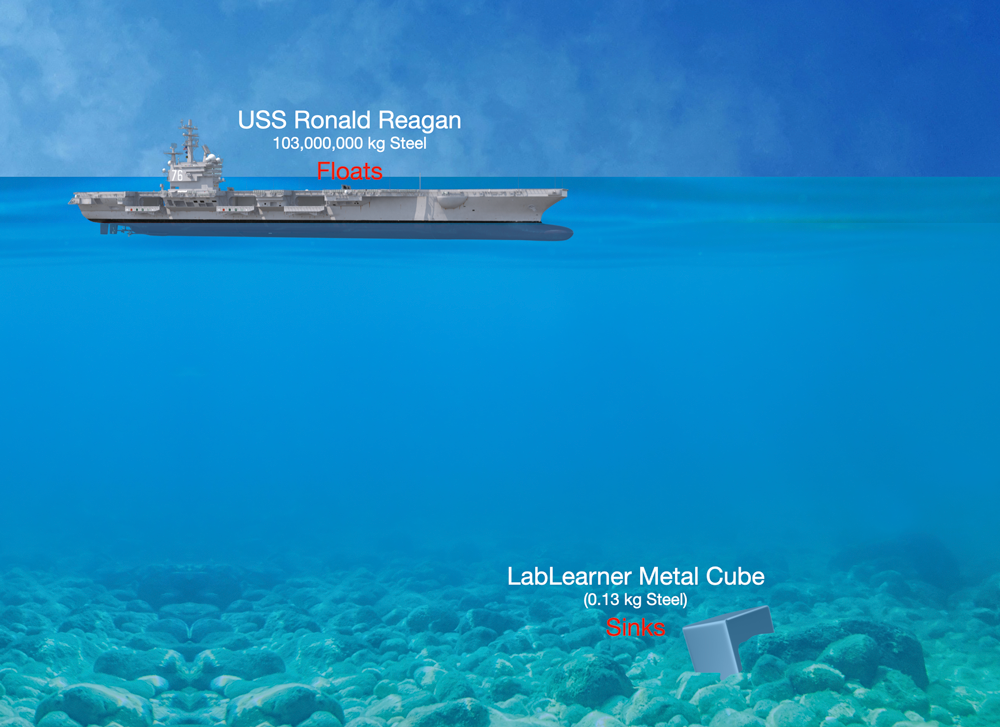
The illustration above demonstrates an enormous paradox. It shows that the aircraft carrier, the USS Ronald Reagan has a mass of 103,000,000 kg of steel and floats easily across the oceans of the world. On the other hand, a LabLearner metal cube made of similar steel and has a mass of well less than a single kilogram yet sinks to the ocean floor like a rock! Why? Buoyancy.
Buoyancy is something’s ability to float. Buoyancy can be changed. It is a principle that involves the whole object that is floating or sinking and not just the material it is made of. To further explain, a boat’s buoyancy is not determined simply by the material it is made of. The buoyancy also takes into account the air and cargo inside of the ship. Because buoyancy is affected by that combination, substances that are denser than the liquid they are in can be made to float if they are part of an object that contains substances that are less dense than the liquid they are in.
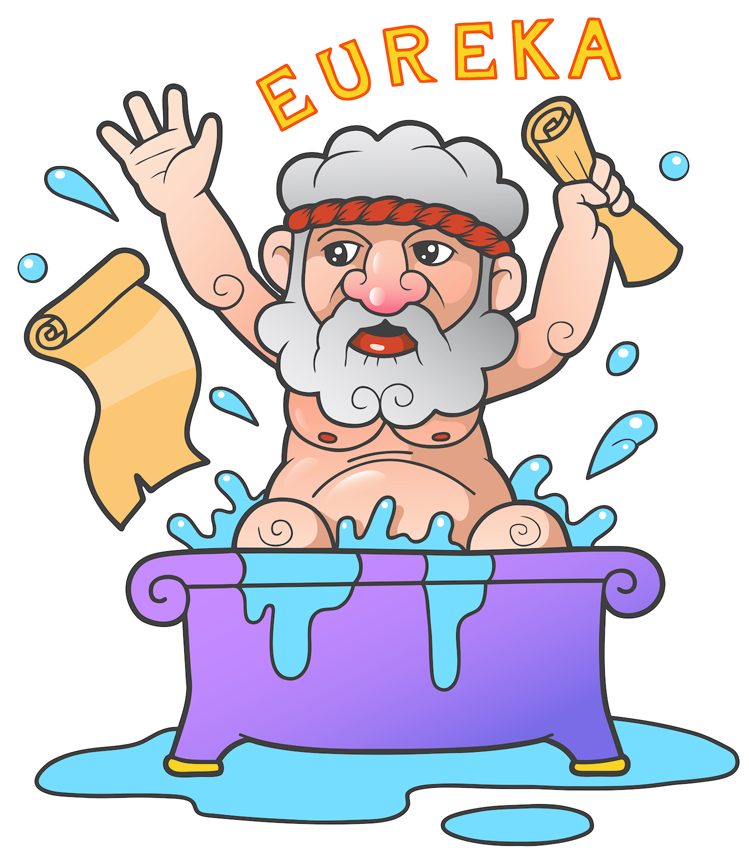 Archimedes is credited with discovering buoyancy. The Archimedes Principle states that the buoyant force on an object underwater is equal to the weight of the water that the object displaces. According to Legend, King Hiero had commissioned a goldsmith to create a crown and gave the goldsmith an amount of gold to do so. When the king received the finished crown, he suspected the goldsmith had cheated him and not used all of the gold he had given him.
Because of the shape of the crown, the king did not know how to compare the amount of gold he had given the goldsmith to the amount of gold in the crown. Archimedes was given the task of measuring the volume of the crown. When Archimedes was taking a bath, he noticed that the amount of water that overflowed out of the tub was equal to the amount of his body that was submerged in the water. He was so excited by his discovery that ran through the streets shouting, “Eureka!” Archimedes tested the crown and it was found to have less gold than the goldsmith was given by the king. The goldsmith’s thievery was exposed.
Buoyancy is not the same as density. A ball of clay has a given density. When a ball of clay is placed in water, it will sink. The shape of the clay can be changed and molded into a bowl. However, changing the shape of the clay does not change its volume and does not change its mass. Therefore, the density of the clay is still the same. If the bowl shape is placed in water, the bowl will float. The buoyancy of the clay bowl is different than the buoyancy of the clay ball. How can this be? The buoyancy of the clay bowl involves the air that is inside the clay bowl. The air inside the clay bowl is less dense than water. If the clay bowl were to be filled with water it would sink, just like a metal ship would sink if filled with water.
Air is not the only substance that will increase buoyancy. As a general rule, substances can be made more buoyant by the addition of another substance that is less dense than the medium it is in. For example, a boat carrying oil could be buoyant because oil is less dense than the water that the boat is in.
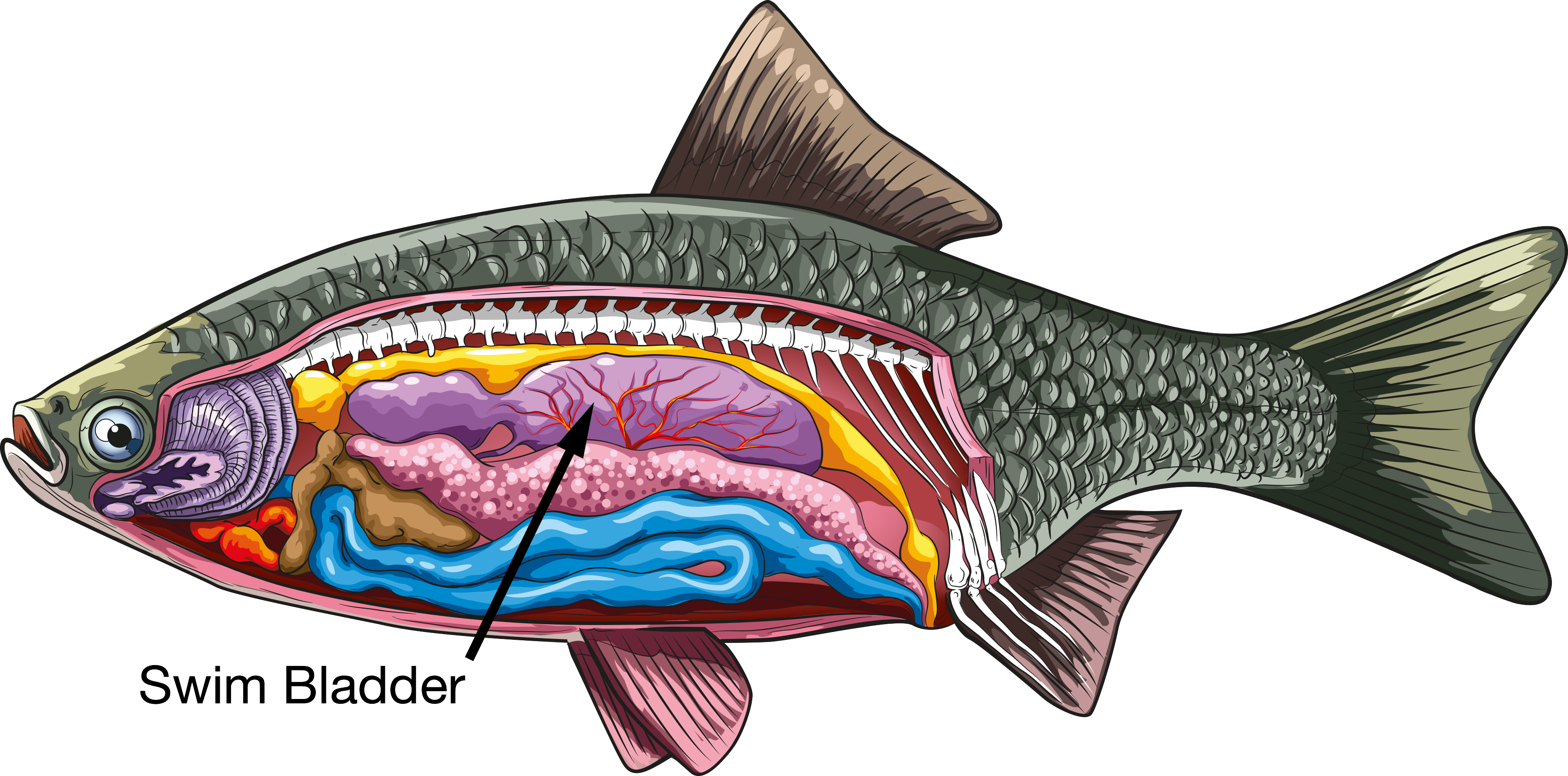 Buoyancy is an important adaptation for some organisms. In particular, the ability to control buoyancy is advantageous. Many fish have a swim bladder that controls their buoyancy in the water. The swim bladder is a gas-filled sac in the fish’s body. A fish will use less energy if its buoyancy is neutral, meaning it will not float or sink. If a fish is less buoyant than the water it is swimming in, its body will increase the amount of gas in the swim bladder until it regains neutral buoyancy. In the same way, if a fish is more buoyant than the water it is swimming in, its body will force the gas out of the swim bladder until it regains neutral buoyancy. The swim bladder is a natural buoyancy regulator. Sharks, on the other hand, do not have swim bladders. If they stop swimming, they sink.
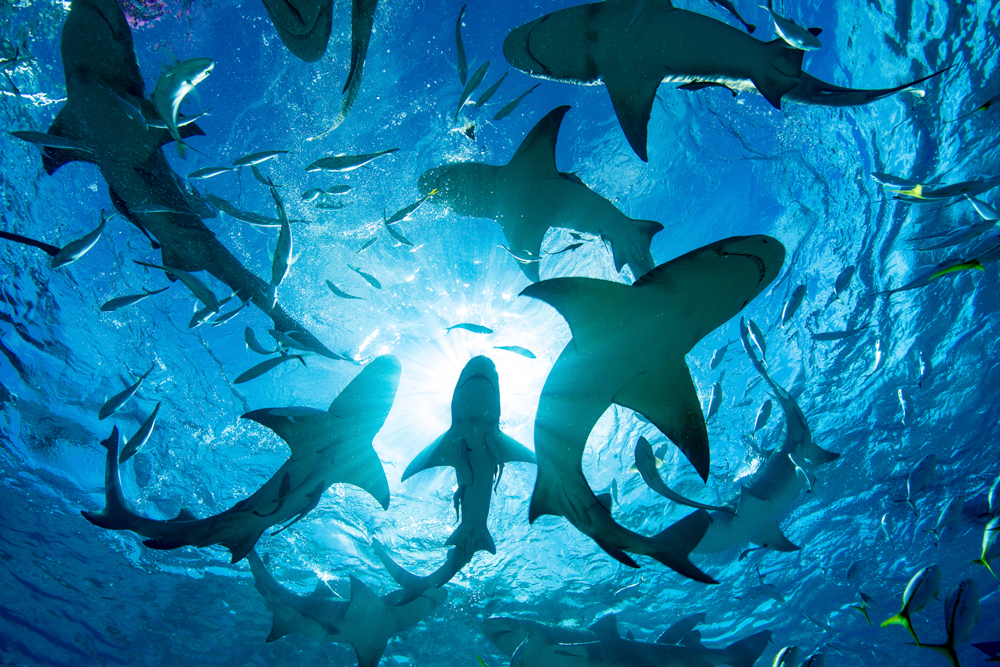
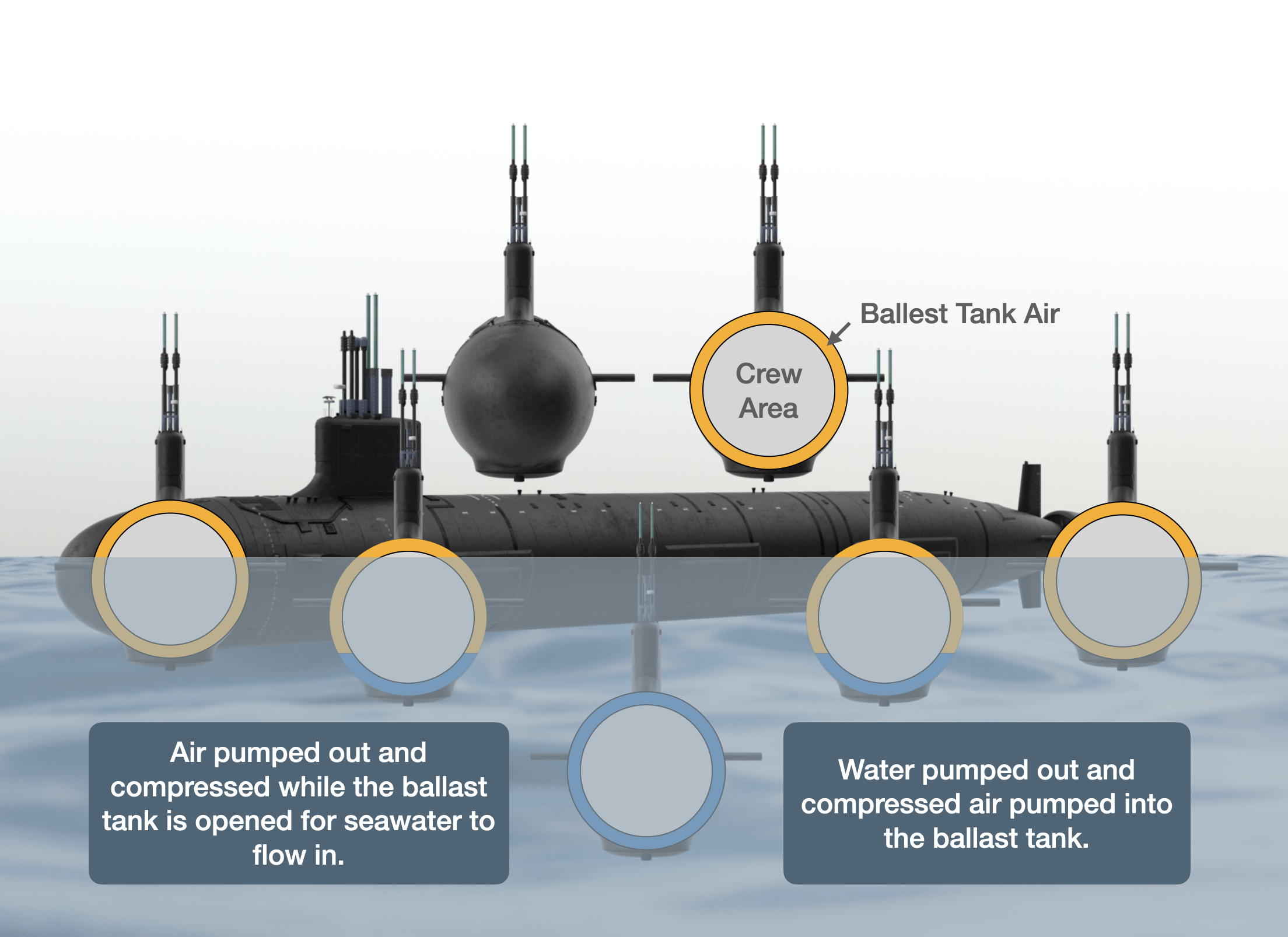
Humans have mimicked the principle behind the swim bladder. Submarines have air chambers called ballast tanks that work in the same fashion as a fish’s swim bladder. A submarine with its chambers filled with air will float on the surface of the water. When a submarine dives, the air is pulled out of the chamber and reserved in a compressed compartment. As the air is pulled out of the chamber, the chamber fills with water. The buoyancy of the submarine is changed. With the correct balance of air and water in the chambers, a submarine can obtain neutral buoyancy and sustain a certain depth in the water even without moving.
Properties of Matter: Investigation 5 - Mathematics Concepts
Prelab
• whole numbers
• classifying groups
• comparing (non)measurable characteristics
• estimation
Lab
• data table
• weight in grams
Postlab
• greater than/less than/equal to
• problem-solving
Properties of Matter: Investigation 5 - Procedural Tools

Properties of Matter: Investigation 5 - Cognitive Tools

Properties of Matter:
Investigation 5 Quiz

