
Teacher Portal:
Properties of Matter
Investigation 3
Investigation Three: Density and Water
In Investigation One, students were introduced to the properties of matter. Investigation Two focused on a specific property, volume. In this Investigation, students will explore another property of matter – density.
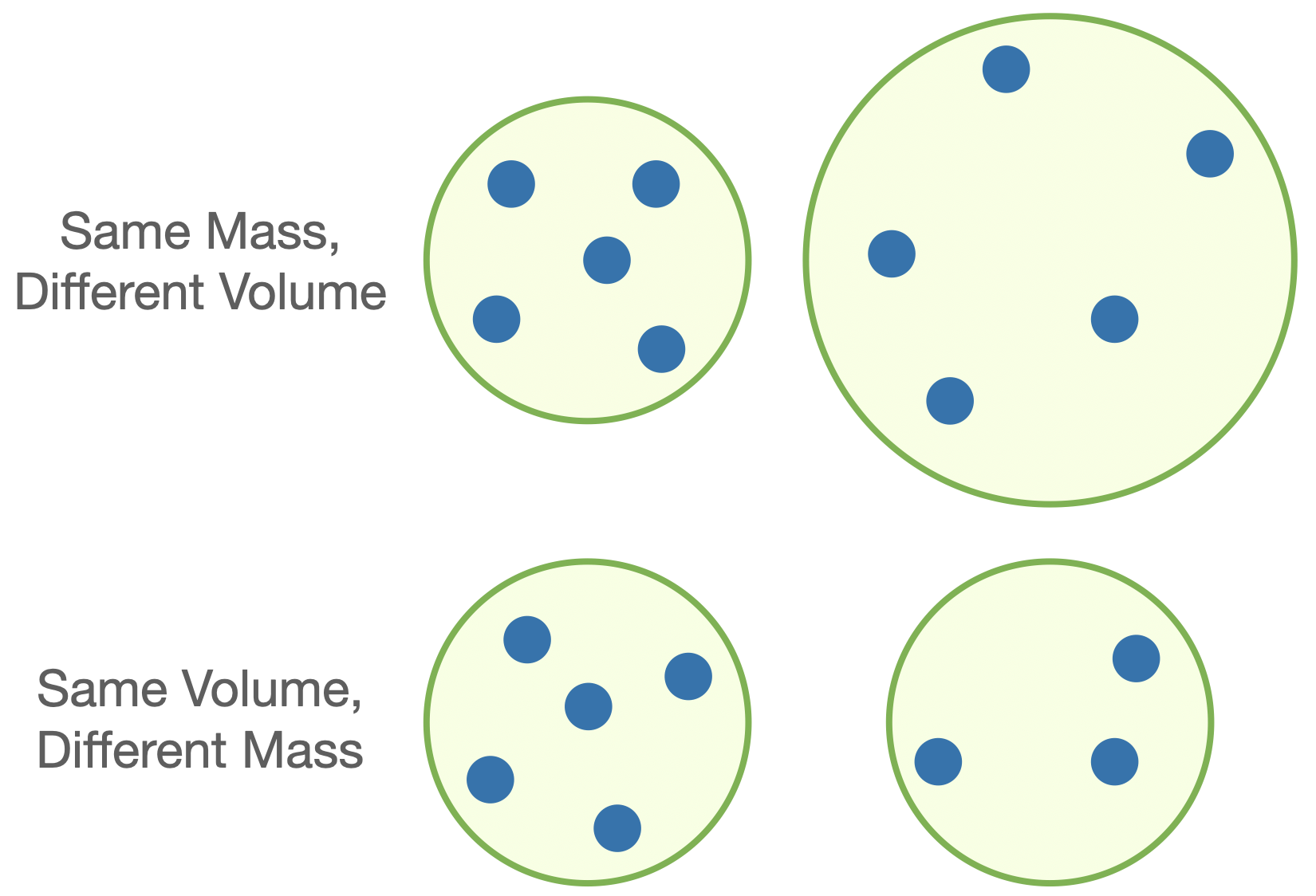
The concept of density refers to how tightly packed the molecules are in a substance. All matter has density. Solids, liquids, and gases all have densities because solids, liquids, and gases are all matter that have mass and volume. Density is a derived physical property that involves both mass and volume. The equation for calculating density is density=mass/volume or d=m/v. Density can therefore be expressed in grams per cubic centimeter. Substances that have the same mass (same amount of molecules) can have different densities if the volumes (sizes) are different. In the same way, substances that have the same volume (same size) can have different densities if the mass (amount of molecules) is different. This concept is illustrated below:
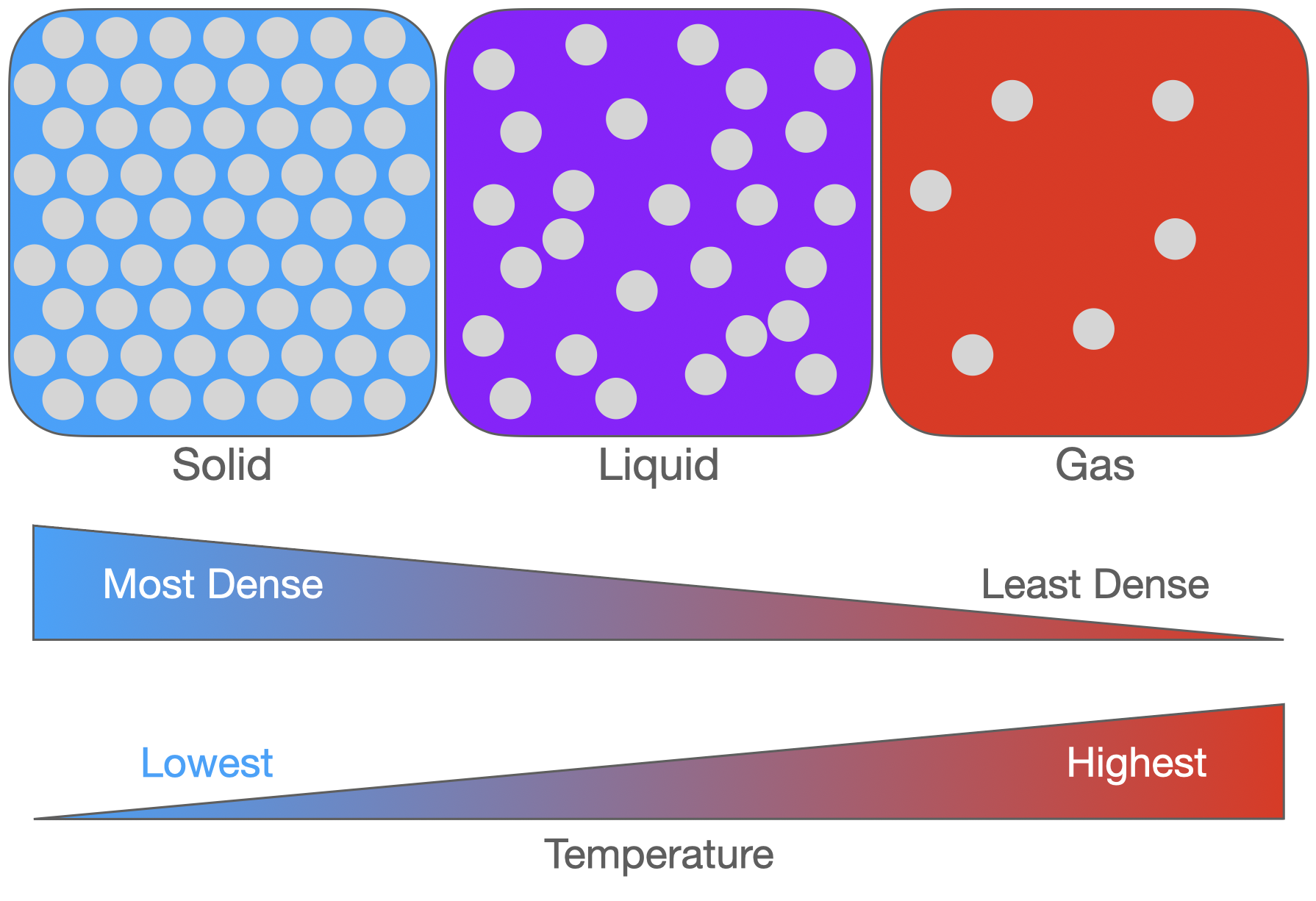
The general rule for solids, liquids, and gases is that a substance is most dense in its solid state and least dense in its gaseous state. The change in density occurs because the volume of a substance changes as it changes states. The molecules of a solid have less kinetic energy and are tightly packed. The molecules of a gas have the most kinetic energy and push way from each other, increasing the volume.
 Water is Very Special
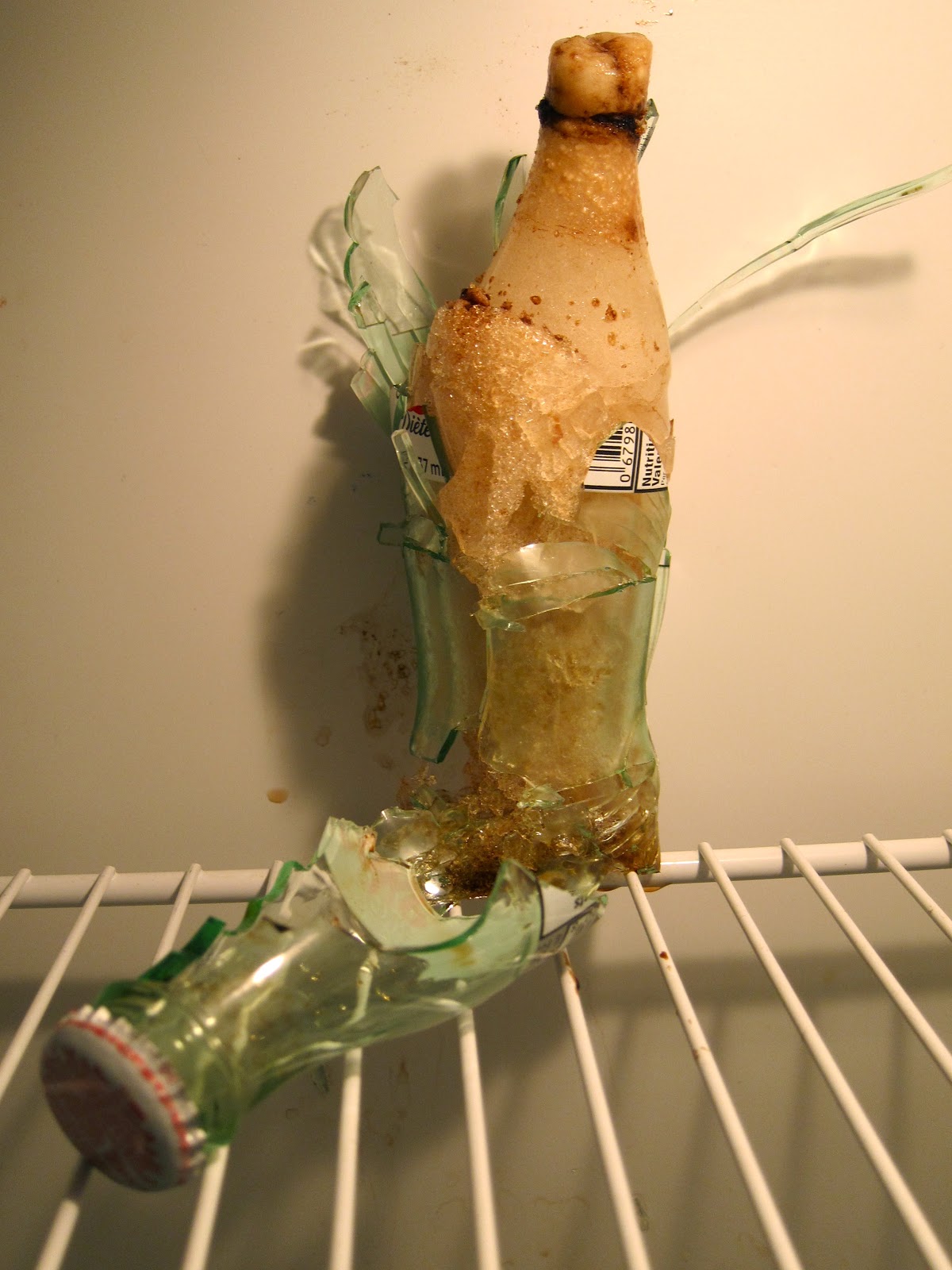
Water is one substance that comprises the exception to this rule. The volume of water actually increases as it freezes because of its unique molecular structure of hydrogen and oxygen. Since the volume is greater as a solid than it is as a liquid, the density of ice is lower than the density of liquid water. This is the reason why ice cubes float in your soda and lakes freeze on the surface. It is also the reason that one should NOT place watery liquids, like soda, in the freezer. Look at the result of allowing a bottle of soda (which is nearly all water) to stay in a freezer!
Floating and Sinking
The relative density of a substance is what determines whether it will float or sink. A substance that is more dense than the liquid or gas it is placed in will sink. If the substance is less dense than the liquid or gas it is placed in, it will float. For example, a penny sinks when tossed into a fountain because the penny is more dense than the water. Ice floats in water because it is less dense than water.
If you have ever tried to float in a swimming pool, you know that it can take effort to do so. A human’s density is not different enough from the pool water to make a person float easily. However, when a person swims in the Dead Sea or the Great Salt Lake, they float with great ease.
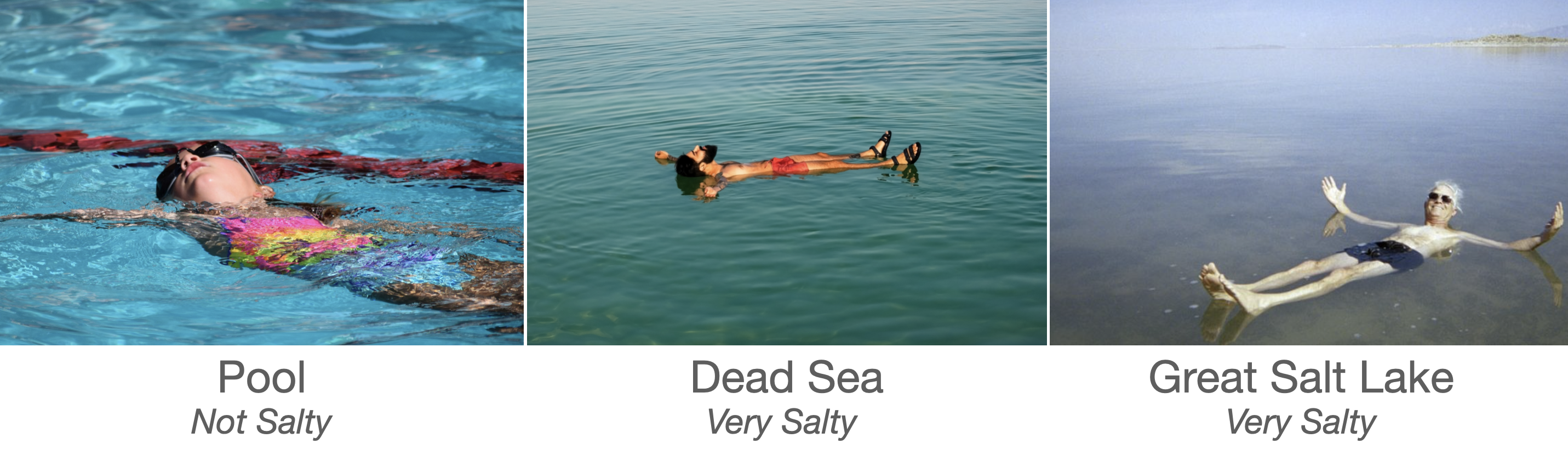
In fact, this occurs to an extent that it may actually be difficult to swim. How can this be if the swimming pool, Dead Sea, and the Great Salt Lake are all water? The Dead Sea is the saltiest body of water on Earth. The amount of salt dissolved in the Dead Sea makes it much more dense than any other lake or even ocean. The Great Salt Lake is less salty than the Dead Sea but is still very salty as well. The body’s density does not change when in a swimming pool or the Dead Sea, but the difference between the body’s density and the density of the Dead Sea or the Great Salt Lake is greater than the difference between the body’s density and the density of the swimming pool.
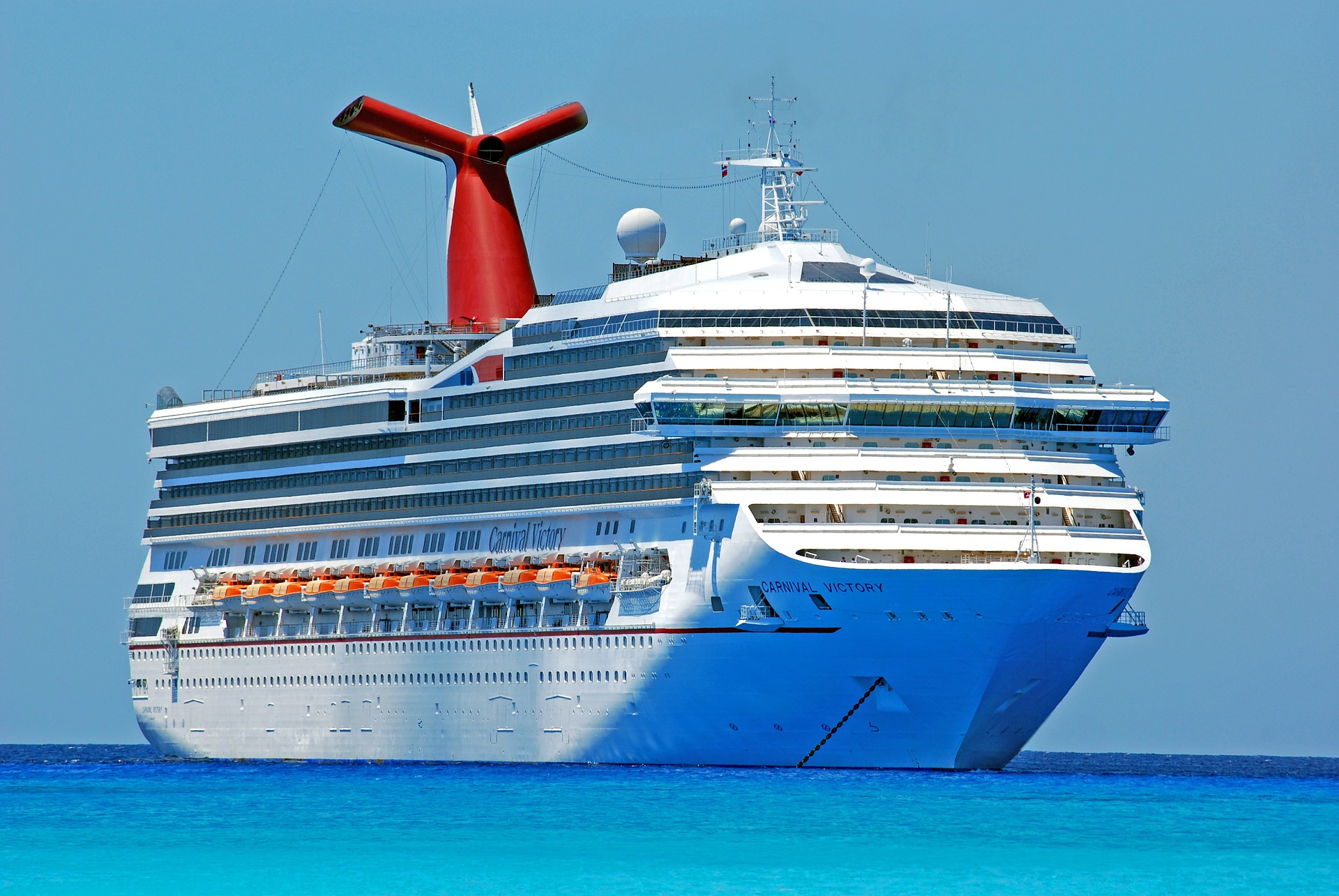 Students may wonder how it is possible that a ship made of metal can float. The material of the boat itself is more dense than the water, but other factors allow the boat to float. Students will explore this concept further in Investigation Five when they explore buoyancy. For this Investigation, they will focus on the relative densities of given substances. Students will not be asked to calculate density, but merely to explore the concept of density in the context of sinking and floating.
Students will first attempt to predict if objects will float or sink in water. They will then be given the relative density of objects compared to the density of water. Students will be asked to use the information about density to predict whether objects will float or sink in water. They will then test each object to find if they float or sink in water.
Properties of Matter: Investigation 3 - Mathematics Concepts
Prelab
• least to greatest
• greater than/less than/equal to
• addition/subtraction
• classifying groups
Lab
• counting whole numbers
• volume in mL
• manipulatives
• data table
• comparing (non)measurable characteristics
• greater than/less than/equal to
Postlab
• least to greatest
• data table
• greater than/less than/equal to
Properties of Matter: Investigation 3 - Procedural Tools

Properties of Matter: Investigation 3 - Cognitive Tools

Properties of Matter:
Investigation 3 Quiz

