Teacher Portal:
Microscopes and Magnification
Investigation 5 – PostLab
 PRINT IT
Use your browser to download a printable PDF as help during the slide presentation and to make additional notes. In your browser, go to File > Print and then choose to save as PDF.
NAVIGATE IT
Once the slide presentation is launched
- use your left and right arrows to advance or go back in the slide presentation, and
- hover your mouse over the left edge of the presentation to get a view of the thumbnails for all the slides so that you can quickly move anywhere in the presentation.
- Click HERE to launch the slide presentation for the CELL.
SHARE IT
SLIDE M&M5-post-1
This was the fifth and final regular Investigation of Microscopes and Magnification. The next Investigation will be a Performance Assessment.
______________________________________________
SLIDE M&M5-post-2
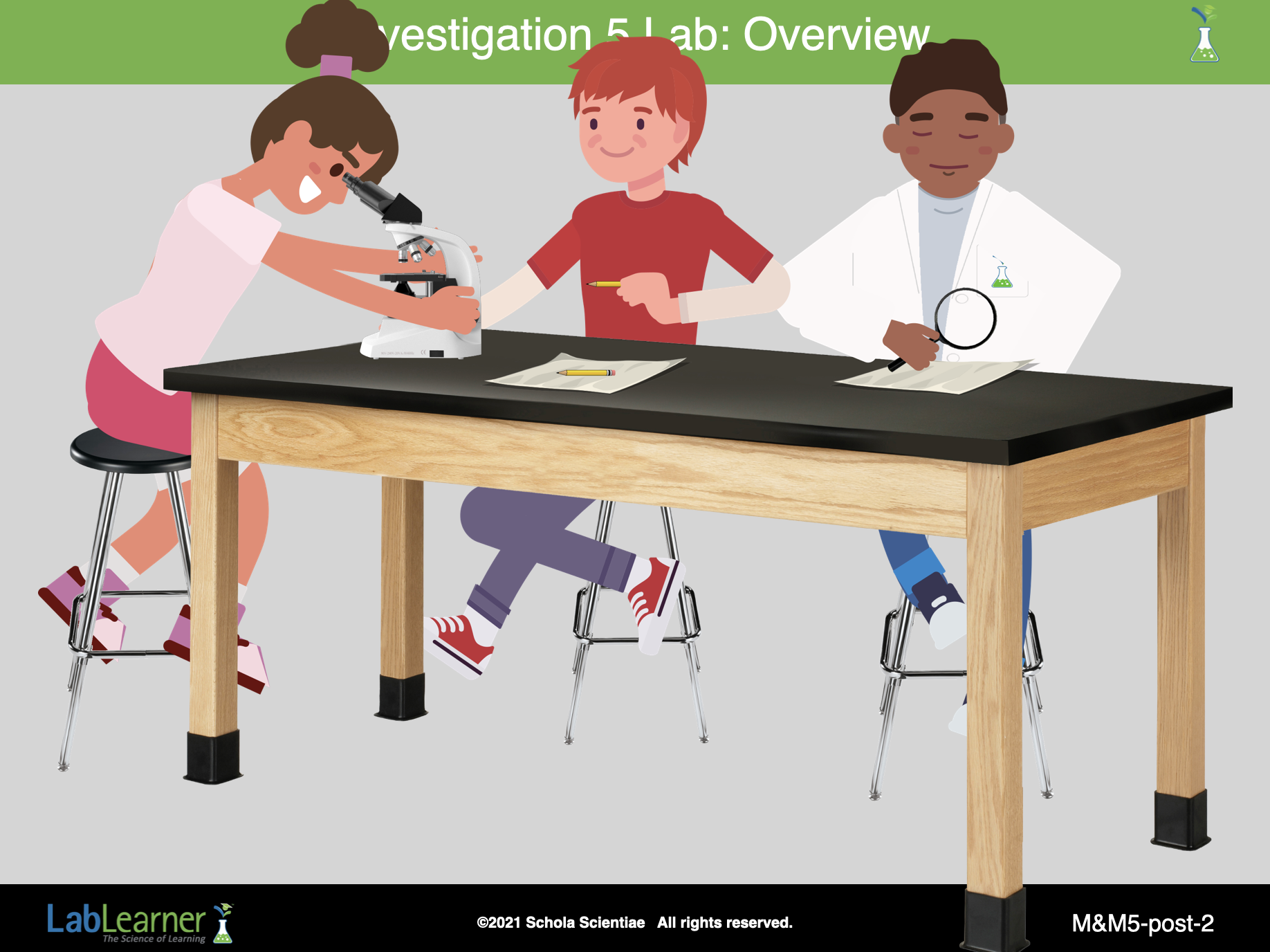
A. Review the concept of refraction as illustrated in the Lab.
1. The following questions are intended to guide a class discussion about convex lenses and refraction:
• Ask students: What structures are present in the eye, the hand lens, and the microscope? Student answers will vary. The eye, the hand lens, and the microscope all contain convex lenses. The eye and the hand lens contain one lens and the compound microscope contains four lenses.
• Ask students: How do convex lenses affect the image of an object? Student answers will vary. Convex lenses magnify the image of an object. The image produced may be right-side up or inverted. One exception, however, is when the distance between the object and the lens is substantially increased, at which point the image appears to be reduced in size.
• Ask students: What evidence from the Investigation you conducted in the lab suggests that convex lenses magnify images? Student answers will vary. The images of objects viewed through the hand lens and the microscope were larger than the objects themselves.
• Ask students: How do convex lenses magnify? Student answers will vary. Convex lenses bend or refract light so the light forms an image that is, in the context of this experiment, larger than the object.
______________________________________________
SLIDE M&M5-post-3
2. Ask students the following questions about their observations of refraction in the lab. Ask students to refer to Problem 3 in their Student Data Record.
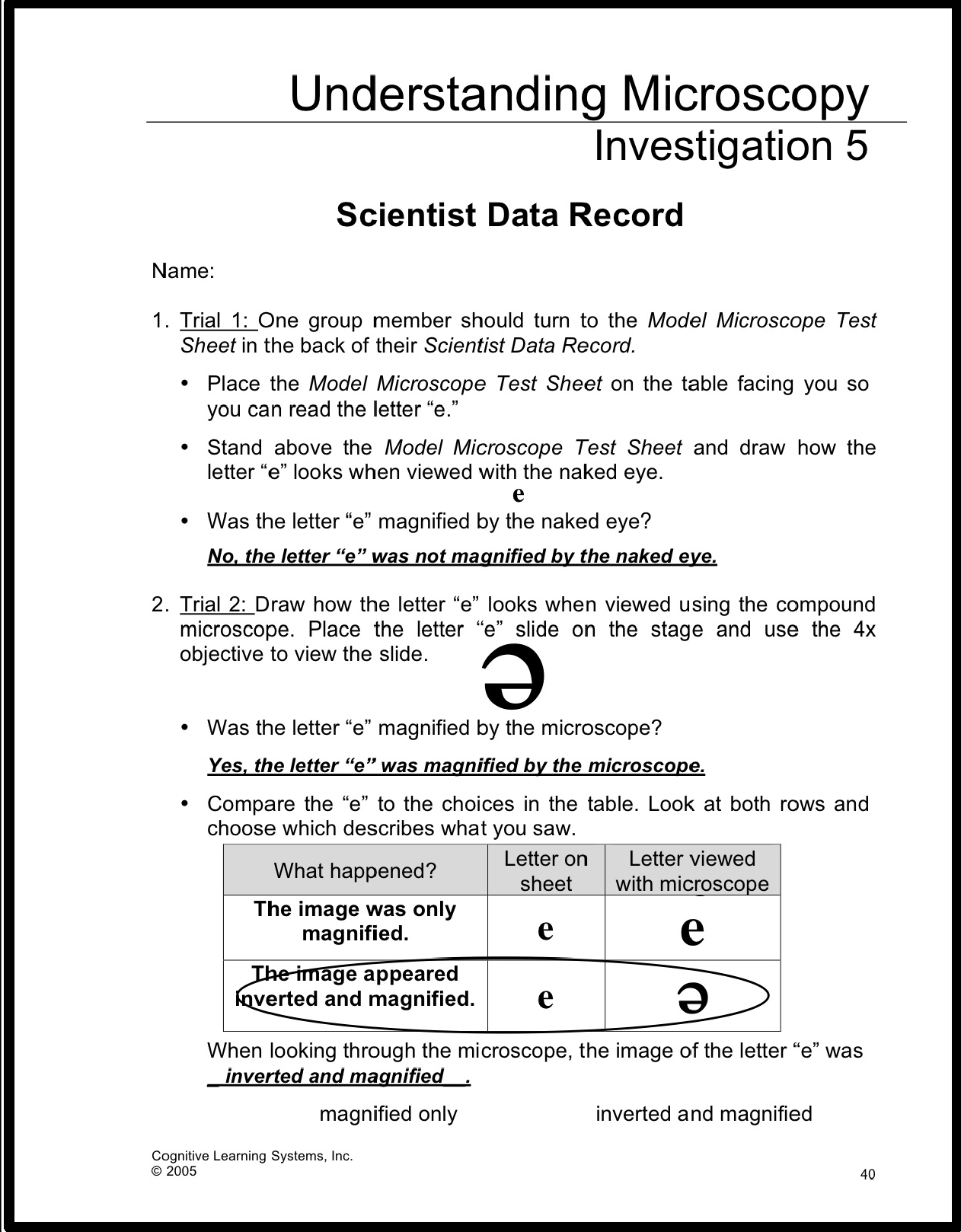
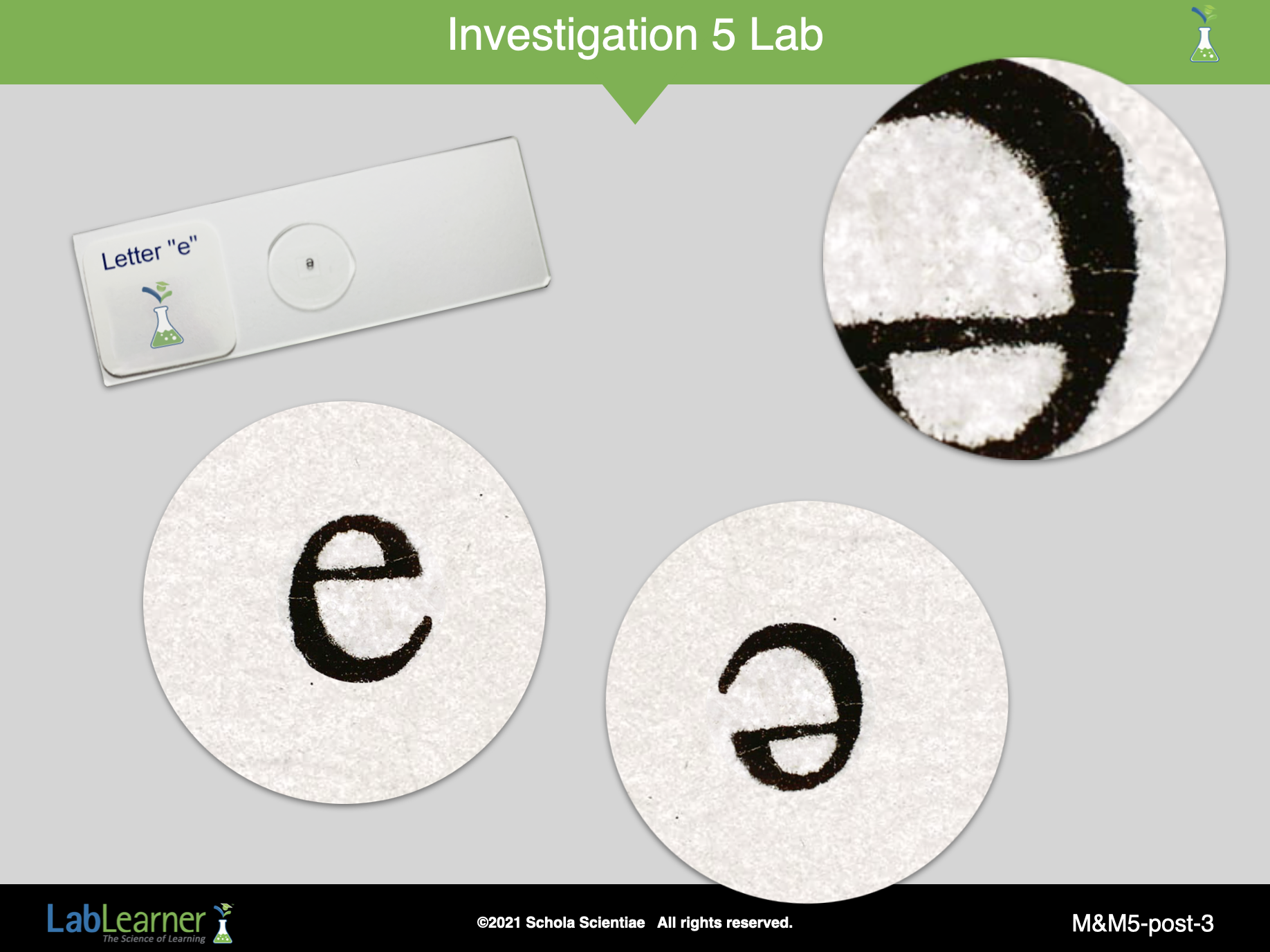
• Ask students: How do you know that the convex lenses in the microscope refracted light? The microscope magnified the image of the letter “e” on the letter “e” slide.
• Ask students: Aside from being magnified, was the image of the letter “e” changed in any other way compared to the letter “e” on the slide? Student answers will vary depending on the type of microscope used. Many compound microscopes produce a letter “e” that appears inverted compared to its appearance on the slide.
______________________________________________
SLIDE M&M5-post-4
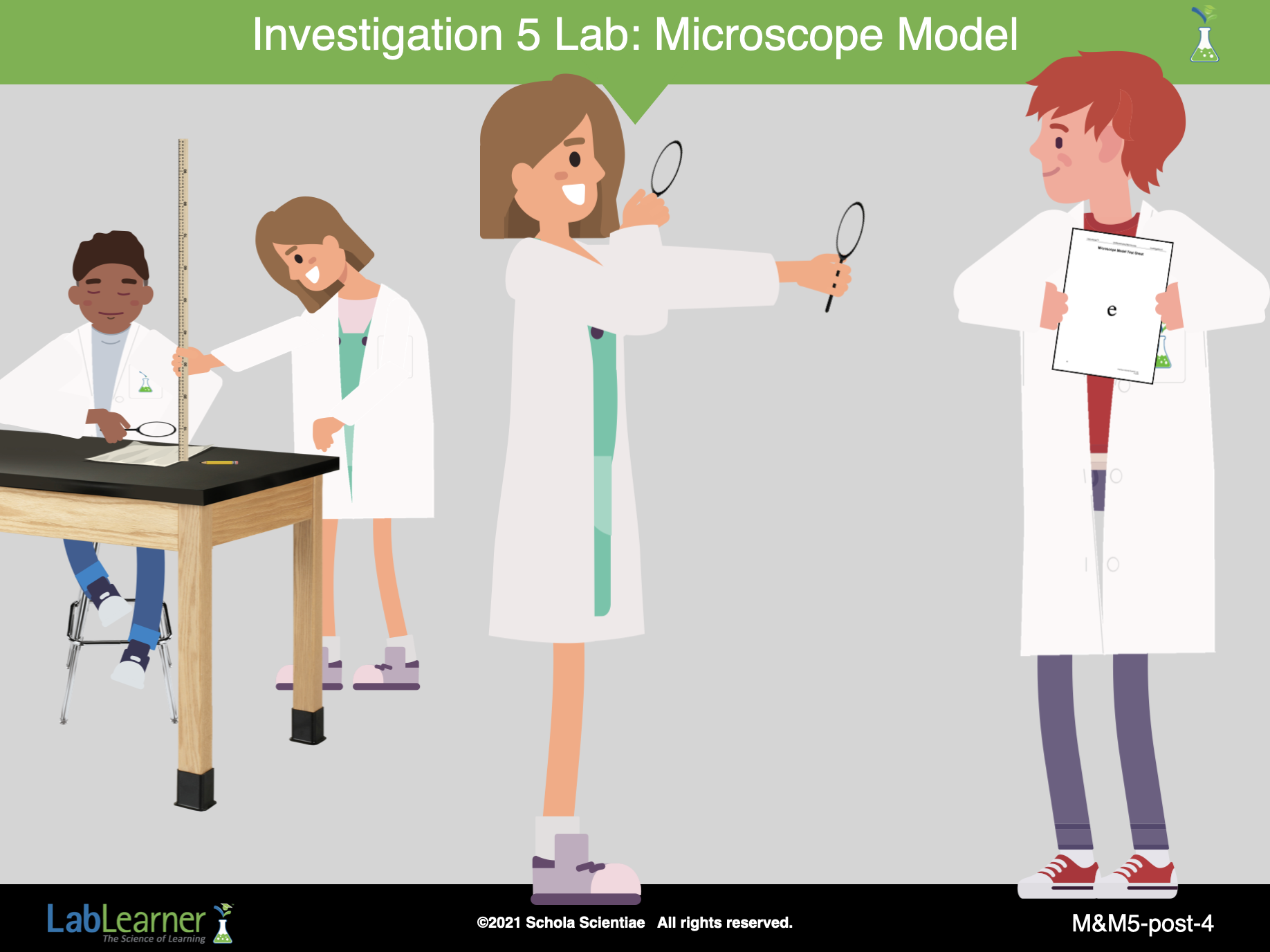
B. Review the portion of the Lab in which students created the model microscope.
1. Ask the following questions about students’ observations using the model microscope.
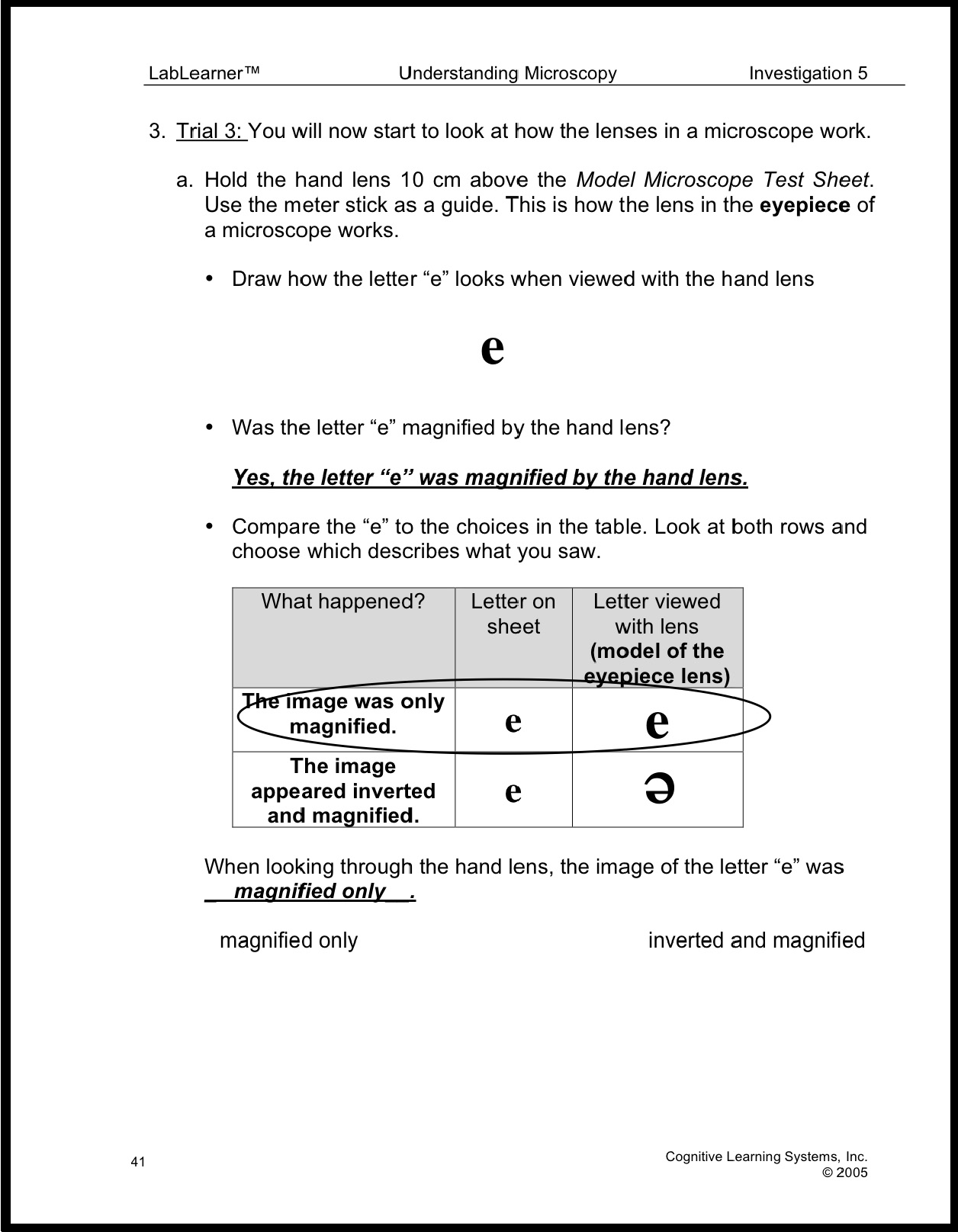
• Ask students to refer to Problem 3a in their Student Data Record. This Trial modeled how the convex lens in the eyepiece of a compound microscope works. How did the image of the letter ”e” appear with the model eyepiece? The image of the letter “e” was right side up and magnified.
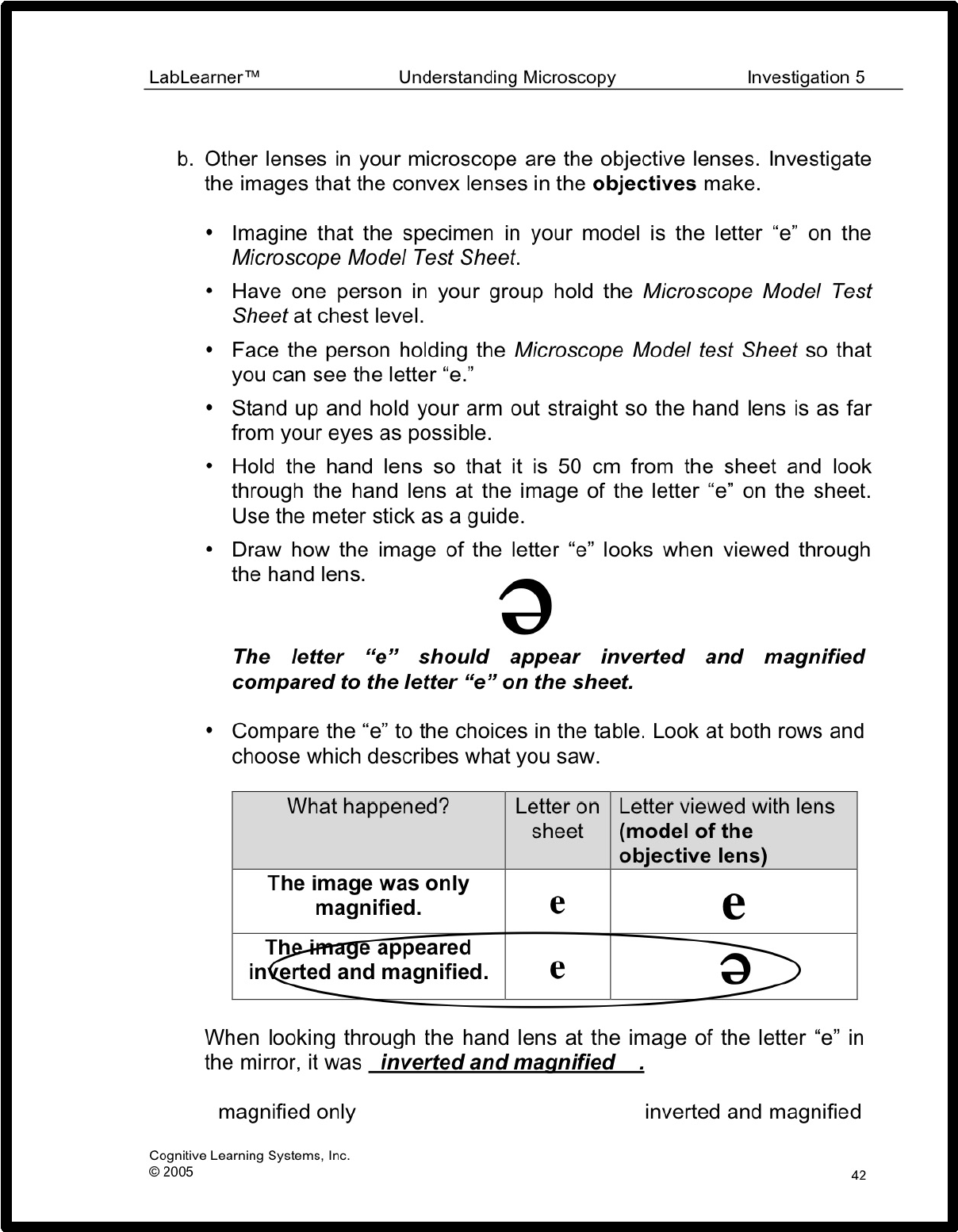
• Ask students to refer to Problem 3b in their Student Data Record. This part of the trial modeled how the convex lenses in the objective work. How did the image of the letter ”e” appear in the model objective? The letter “e” image was inverted (upside down) and magnified.
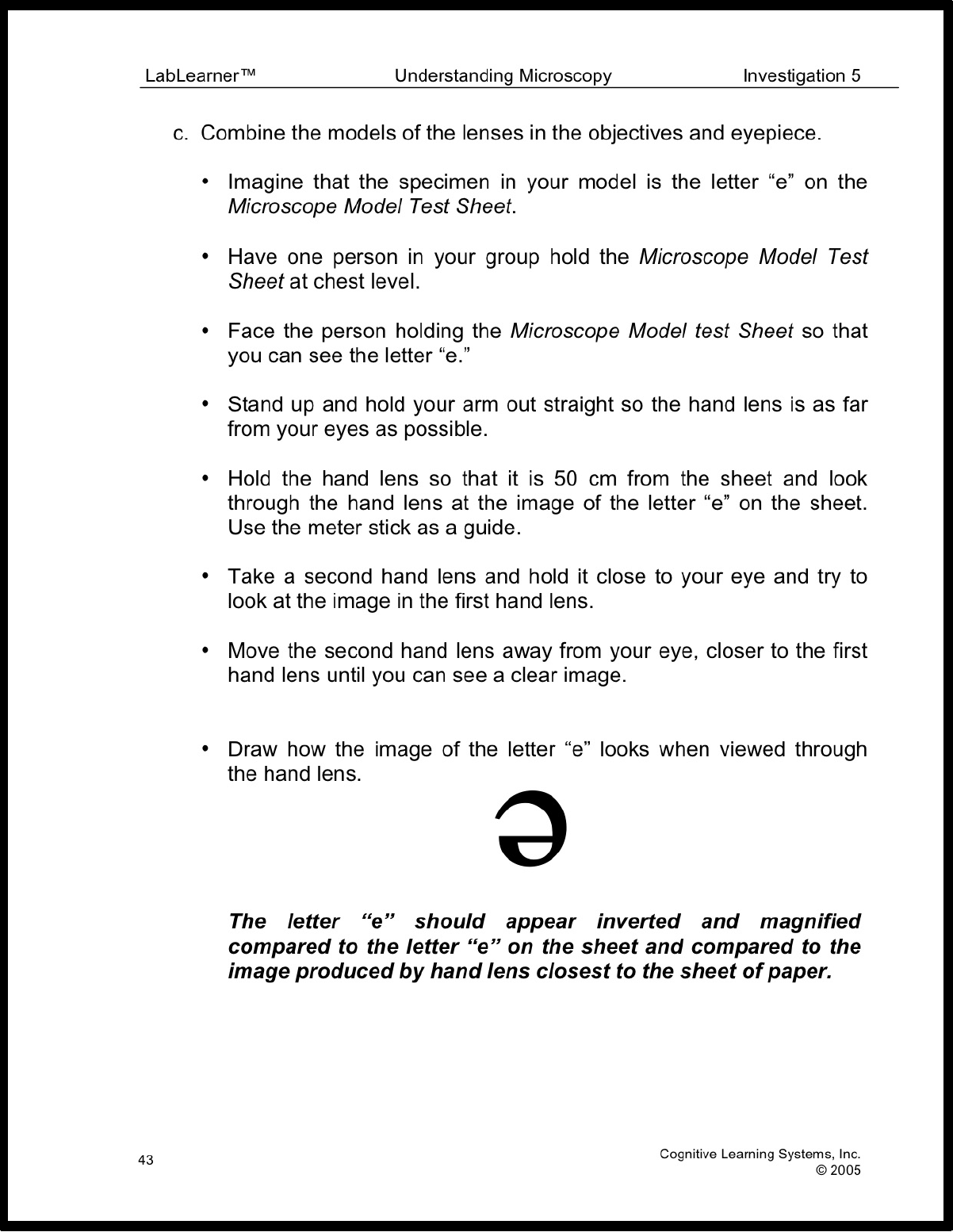
• Ask students to refer to Problem 3c in their Student Data Record. This part of the trial modeled how the combination of convex lenses in the objectives and eyepiece produces an image. How did the image of the letter “e” appear in the model of the microscope? The image of the letter “e” was inverted and magnified. Its magnification was greater than seen when either the “eyepiece” or “objective” lens was used alone.
2. Ask students the following questions comparing the model microscope with the real microscope. Ask students to refer to Problem 3d in their Student Data Record.
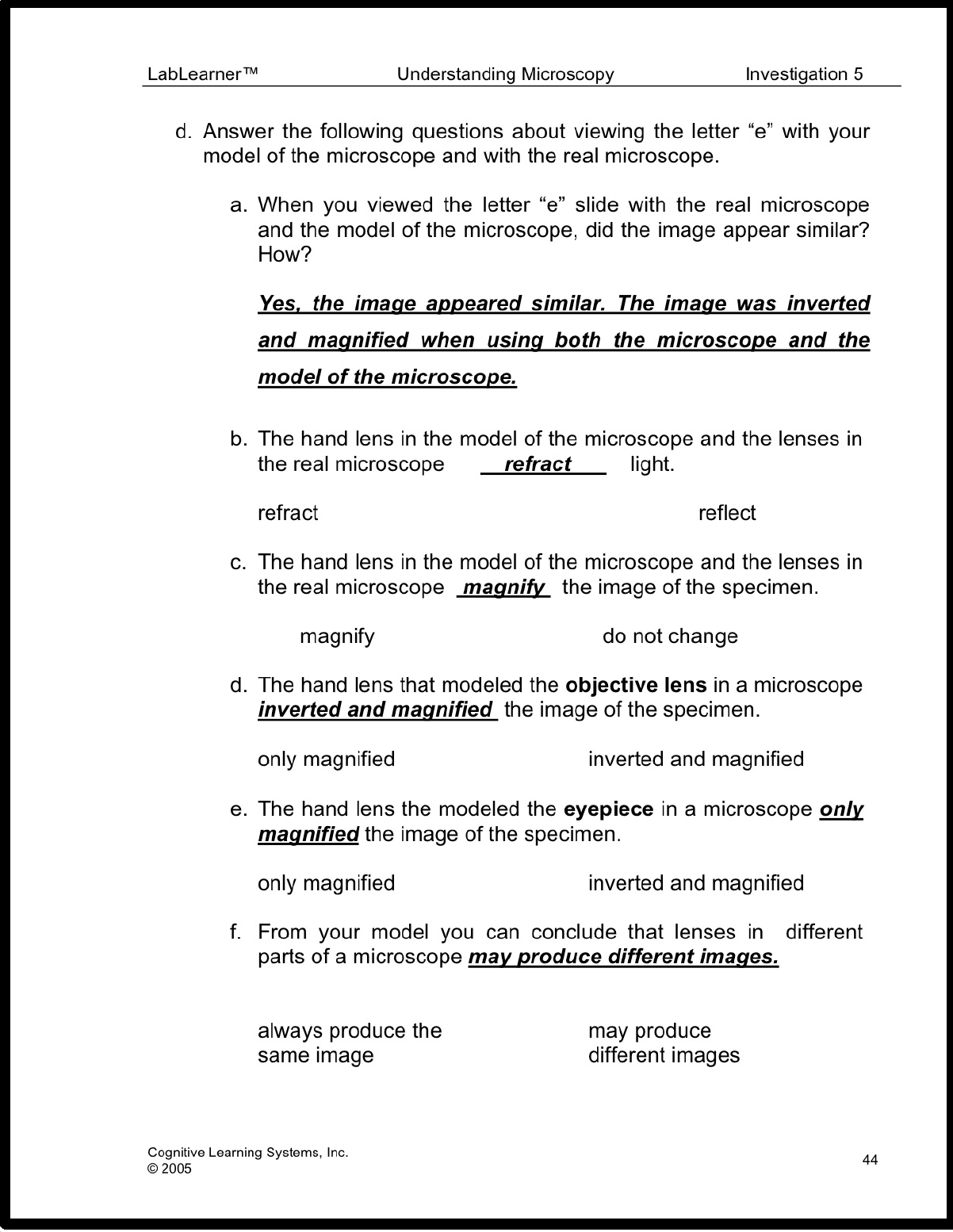
• Ask students: When you viewed the letter “e” slide with the real microscope and the model of the microscope, did the image appear similar? How? Student answers will vary. The image appeared similar. The image was magnified and inverted when using both the microscope and the model of the microscope.
• Ask students: Did the hand lens in the model of the microscope and the lenses in the real microscope refract or reflect light? Student answers will vary. Both refracted light.
• Ask students: Did the hand lens in the model of the microscope and the lenses in the real microscope magnify the image of the specimen? Student answers will vary. Both magnified the image of the specimen.
• Ask students: Did the hand lens that modeled the objective lens in a microscope only magnify the image of the specimen or did it invert it also? Student answers will vary. The model objective produced a magnified AND inverted image.
• Ask students: Did the hand lens that modeled the eyepiece in a microscope only magnify the image of the specimen or did it invert it also? Student answers will vary. The model eyepiece ONLY produced a magnified image. It did not invert the image.
• Ask students: What can you conclude about the lenses in different parts of a microscope? Students should suggest that the convex lenses in the eyepiece and the objectives of a microscope may produce different images.
______________________________________________
SLIDE M&M5-post-5
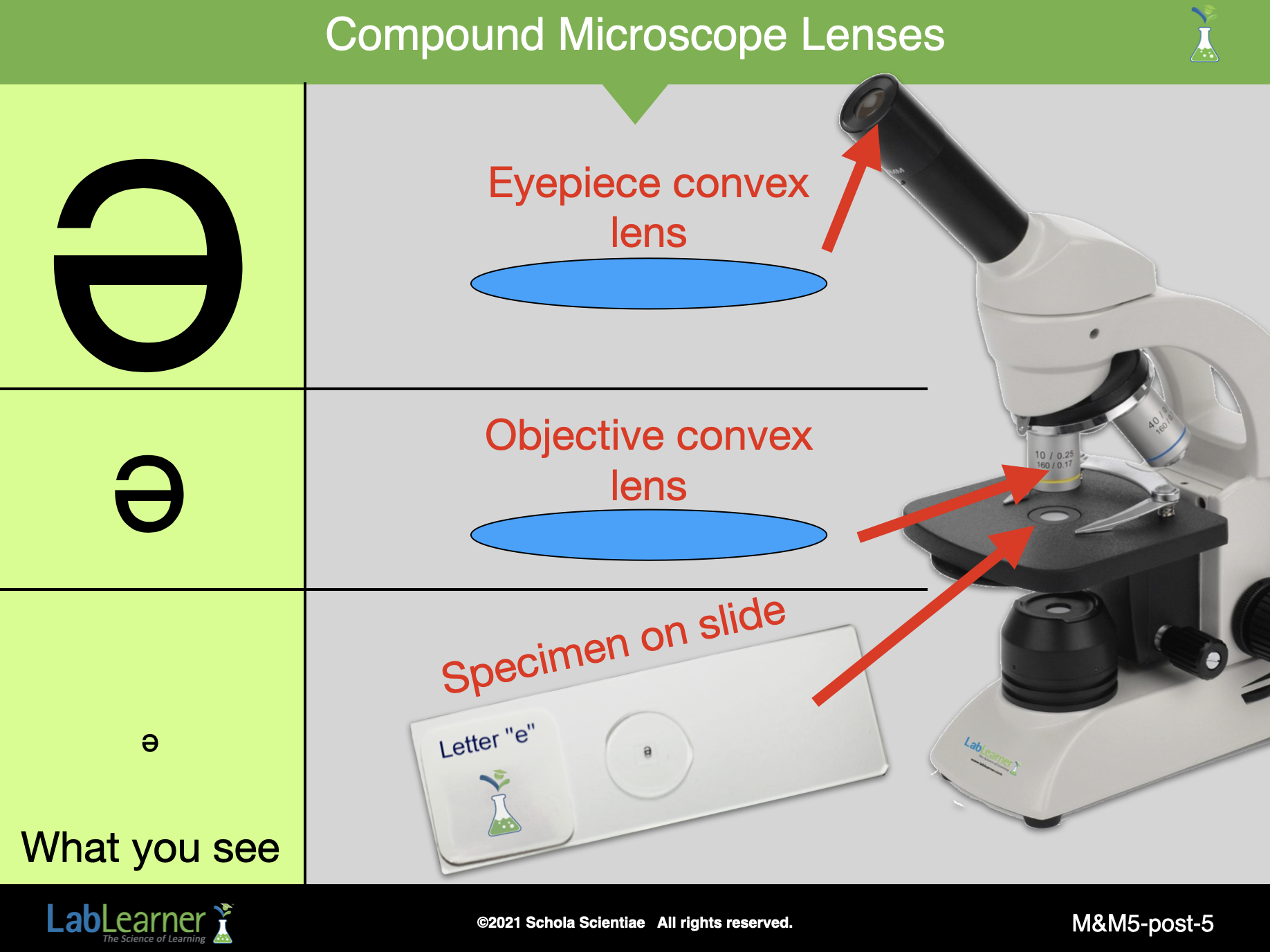
C. Provide an opportunity for students to use their observations from the lab to better understand the role of lenses in microscopy and in microscope construction. Use the Lenses in Microscopes Transparency to aid in the discussion.
1. Show students the image on the top portion of the transparency. Discuss how this image relates to the model they built in the lab.
2. Discuss how the convex lens in the objective produced a magnified and inverted image. In the lab, students observed this when they looked at the letter “e” with the hand lens far from the letter “e” on the Model Microscope Test Sheet. The image they saw was magnified and inverted.
3. Explain that this image served as the “object” for the convex lens in the eyepiece.
4. Discuss how the convex lens in the eyepiece magnified but did not invert the image. In the lab, students observed the magnification by the eyepiece lens when they held the hand lens close to the letter “e” on the Model Microscope Test Sheet. The image they saw was only magnified.
5. Encourage students to remember how the image observed in the lab when BOTH the model objective and model eyepiece were used produced an image that was inverted and magnified, and that the magnification was more than that seen with either the objective or eyepiece alone.
______________________________________________
SLIDE M&M5-post-6
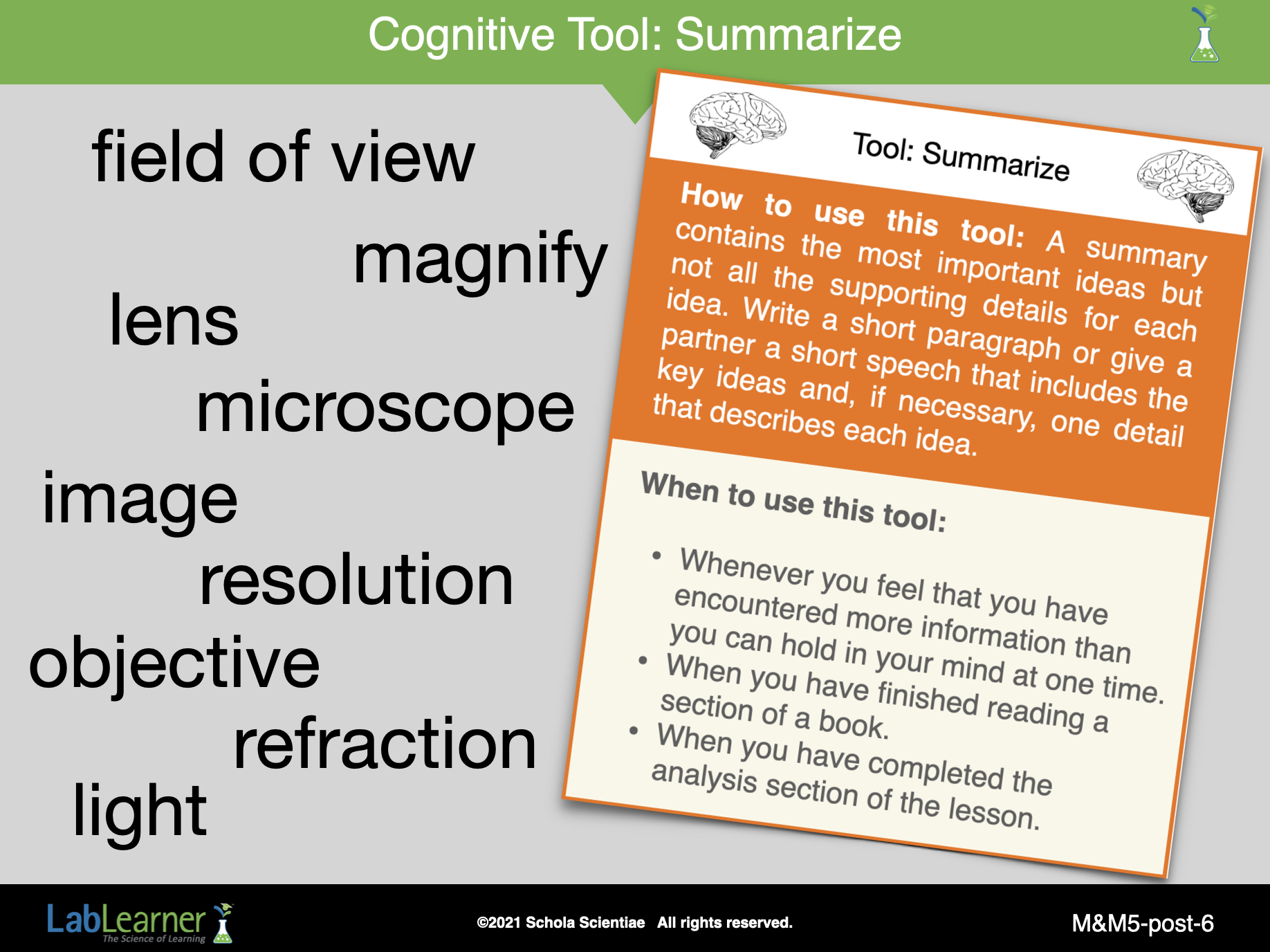
D. Ask students to use the Summarize tool to provide closure for the Investigation.
Explain to students that up until now they have been retelling their experiences in the lab. Tell students that today they are going to use a new tool in their Cognitive Toolbox, Summarize.
Explain that scientists do not always explain every step and every observation they make in the lab. Instead, they try to choose the most important observations, but not all the details of the observations. The most important observations are then told to other scientists and other people.
By doing this, scientists can make it easier for other people to understand what they found and how it relates to the question they were investigating. It also helps the scientists remember the important results from their experiments. Summarizing is a scientist’s way of recording the discoveries from his or her experiment that were most important.
• Refer to the following key terms on the slide: light, magnify, microscope, mirror, lens, objective, refraction, resolution, image and field of view.
• Ask students to include one or two of the terms in a sentence that describes something that they learned in the CELL.
• Sample sentences could include:
Microscopes refract light in order to magnify an image.
Lenses can either magnify or reduce the size of an object’s image.
As the resolution and magnification of an object’s image increases, the field of view decreases.
A lens refracts light.
KEYS: POSTLAB