Teacher Portal:
Microscopes and Magnification
Investigation 3 – PreLab
 ASK WHY
Microscopes have made a tremendous contribution to science since their use began in the sixteenth century (the 1500s).
Microscopes are one of the most important scientific instruments developed. In fact, in the medical field, microscopes are largely responsible for making modern medicine “modern”!
BRANCH OUT
Microscopists today work in many different fields including field and laboratory life sciences, chemistry, materials science, and nearly every branch of biomedical research and medicine.
PRINT IT
Use your browser to download a printable PDF as help during the slide presentation and to make additional notes. In your browser, go to File > Print and then choose to save as PDF.
MINDSET
This Investigation is designed to:
- promote students’ understanding of the history of the microscope.
- introduce students to a new type of magnifying tool by finding, identifying, and discussing the basic parts of the compound microscope.
- introduce students to the operation of the microscope.
- allow students to practice the procedure for focusing the microscope on a specimen.
- allow students to demonstrate their knowledge of magnification through creative writing and discussion.
- review the differences between a microscope and a hand lens.
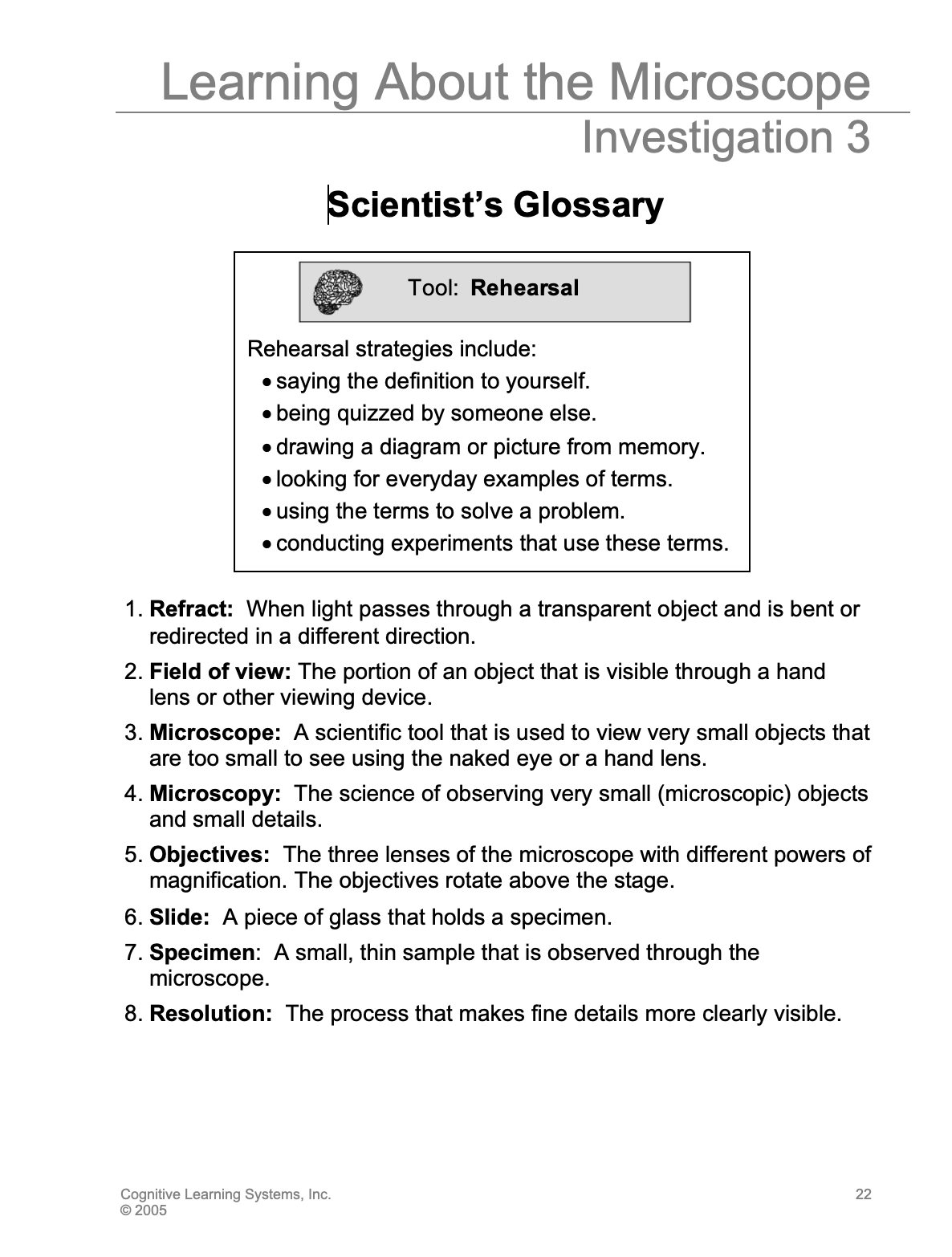
SCIENTIST’S GLOSSARY
- Refract: When light passes through a transparent object and is bent or redirected in a different direction.
- Field of view: The portion of an object that is visible through a hand lens or other viewing device.
- Microscope: A scientific tool that is used to view very small objects that are too small to see using the naked eye or a hand lens.
- Microscopy: The science of observing very small (microscopic) objects and small details.
- Objectives: The three lenses of the microscope with different powers of magnification. The objectives rotate above the stage.
- Slide: A piece of glass that holds a specimen.
- Specimen: A small, thin sample that is observed through the microscope.
- Resolution: The process that makes fine details more clearly visible. and a hand lens.
BE PREPARED
Watch the Investigation 3 Teacher Video and Student Video below to prepare for the PreLab.
SET FOR SUCCESS
- Tell students that they are about to begin the third Investigation of the Microscopes and Magnification CELL, in which they will learn about the history of the microscope and how to use a compound microscope.
- Ask students to share the kinds of things they might learn in these Investigations.
Begin the PreLab Concept Slides to start students on their learning journey. Then watch the Pre-Lab Student Video as a class.
NAVIGATE IT
Once the slide presentation is launched
- use your left and right arrows to advance or go back in the slide presentation, and
- hover your mouse over the left edge of the presentation to get a view of the thumbnails for all the slides so that you can quickly move anywhere in the presentation.
- Click HERE to launch the slide presentation for the CELL.
SHARE IT
SLIDE M&M3-pre-1
Tell students that as they begin Investigation Three, you would like them to Recall what they know about magnification and refraction. The following questions may be useful in prompting students’ recall:
How would you describe magnification? When a lens refracts light and increases the size of an object’s image.
How would you describe refraction? When light passes through a transparent object and is bent or redirected in a different direction.
What have you used in Investigation Two that both magnified an image and refracted light? A convex lens.
______________________________________________
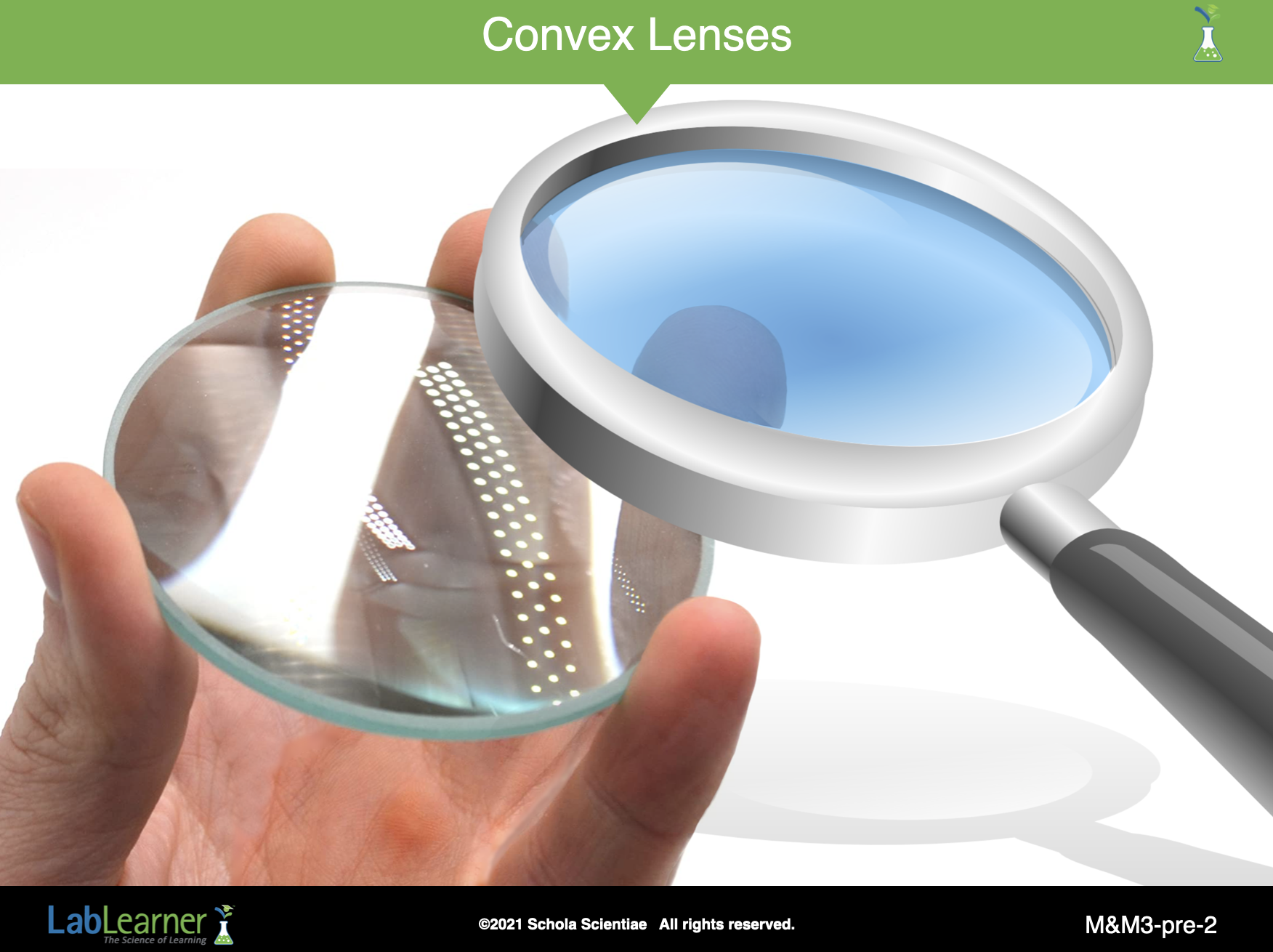
SLIDE M&M3-pre-2
Ask students to look at the terms listed in their Scientist’s Glossary. As a class, review the terms and ask student volunteers to read the terms aloud.
Ask students the following question:
What do a hand lens and a convex lens have in common? Student answers may vary. Both are made of glass, are transparent, contain a convex lens, and magnify the image of objects.
______________________________________________
SLIDE M&M3-pre-3
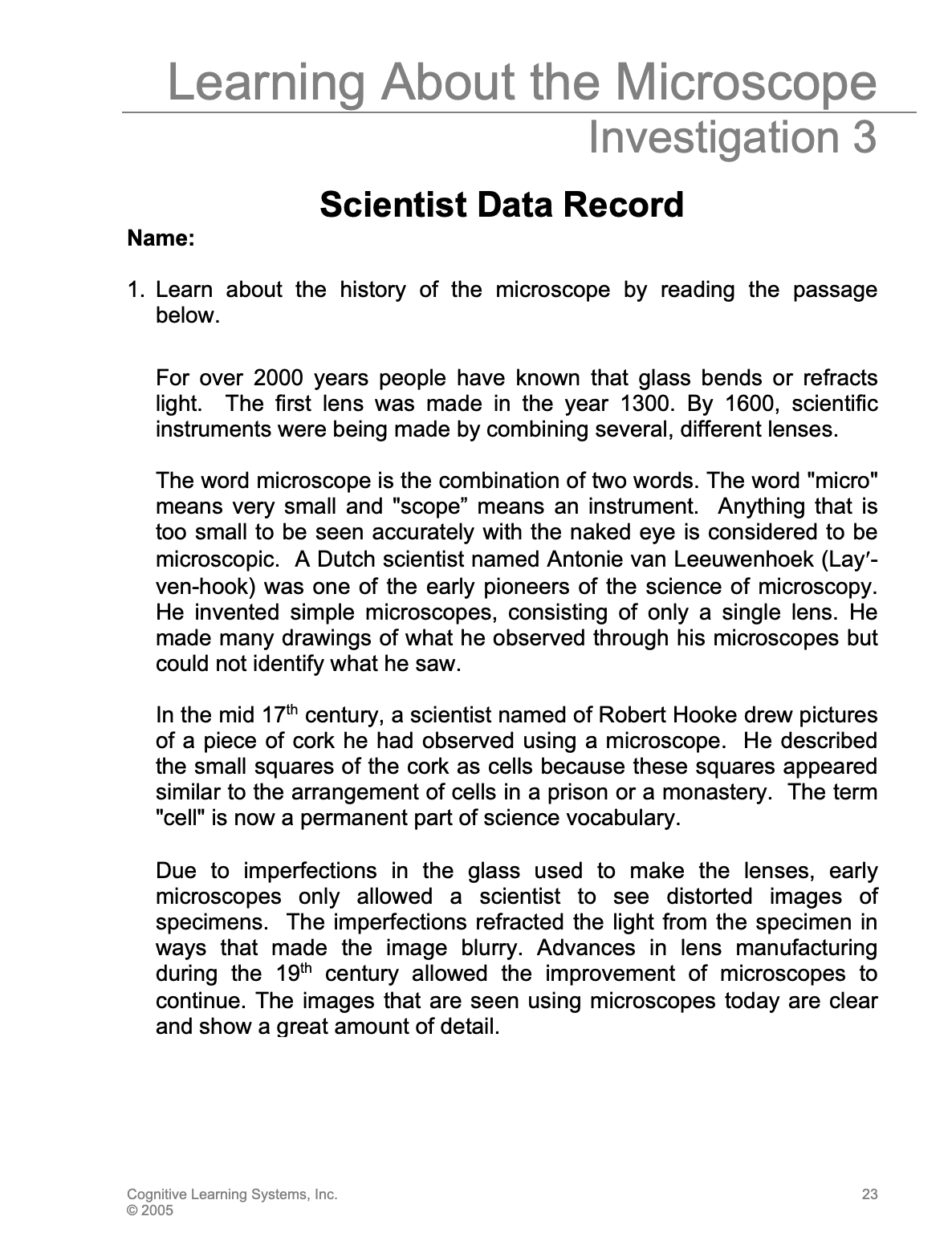
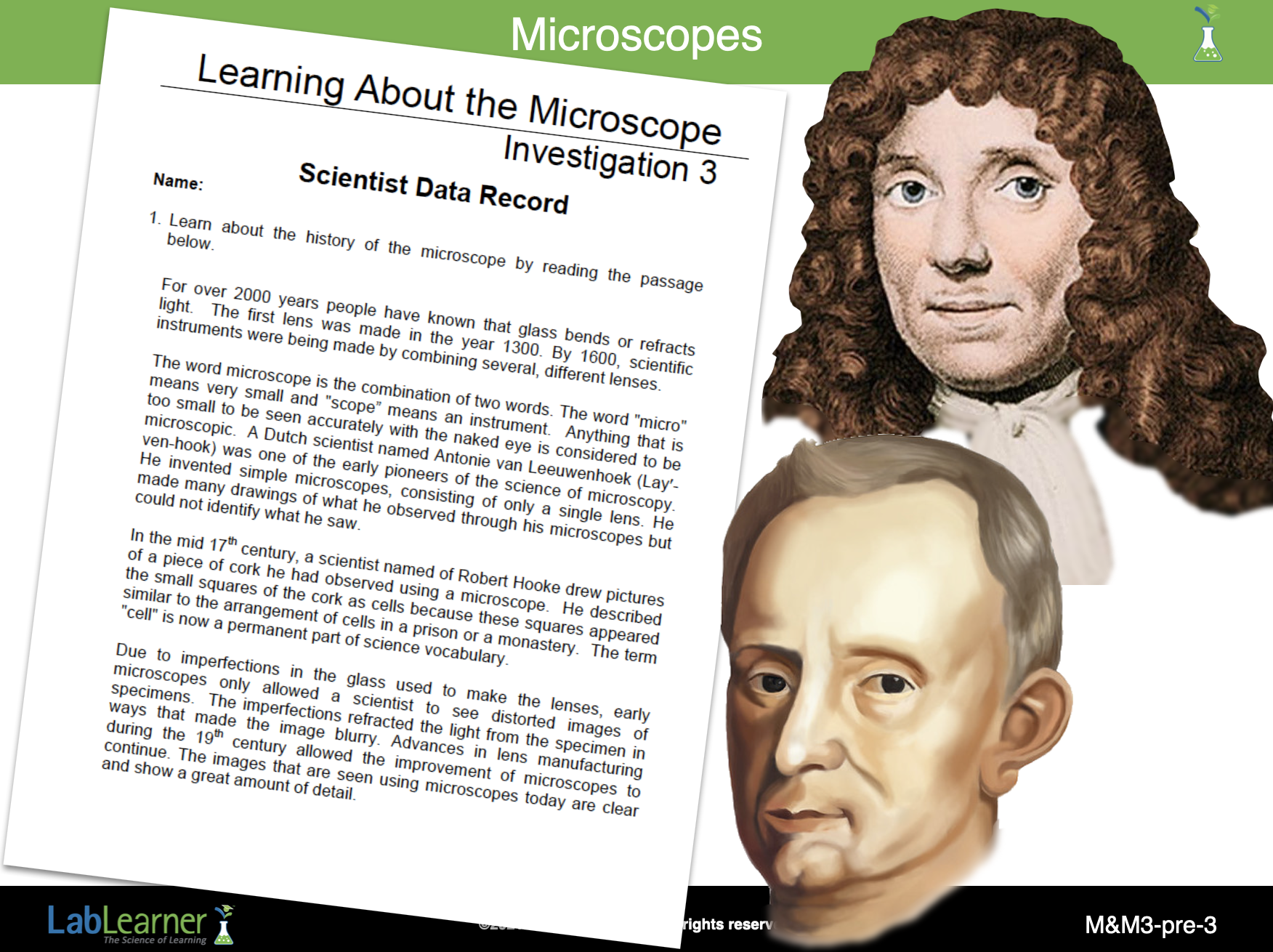
Ask students to turn to Problem 1 in their Student Data Record and read the passage about the history of the microscope. The passage is shown here for your convenience.
The two scientists mentioned in the passage are shown on this slide. Antonie van Leeuwenhoek is shown at the top and Robert Hooke at the bottom.
______________________________________________
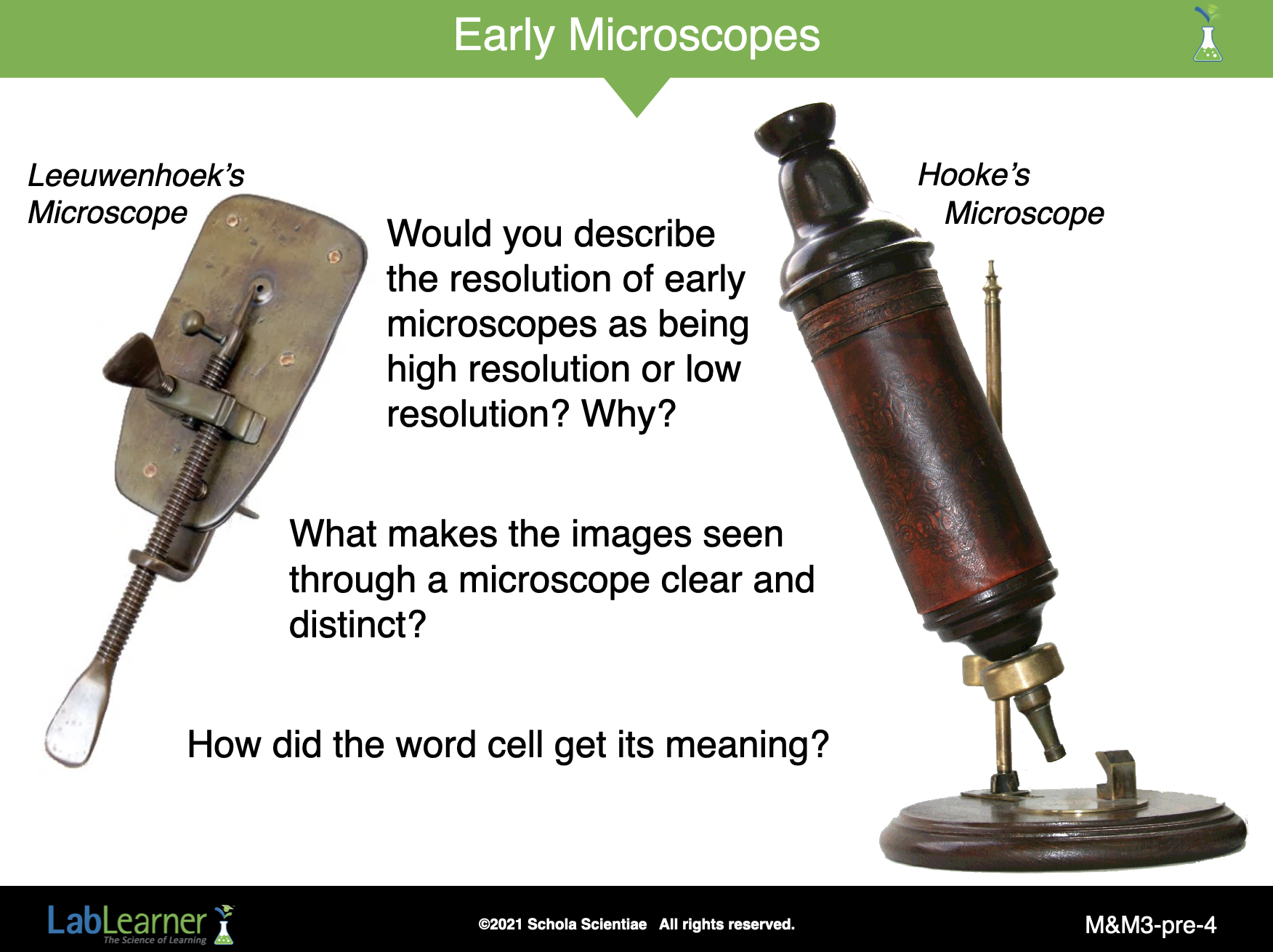
SLIDE M&M3-pre-4
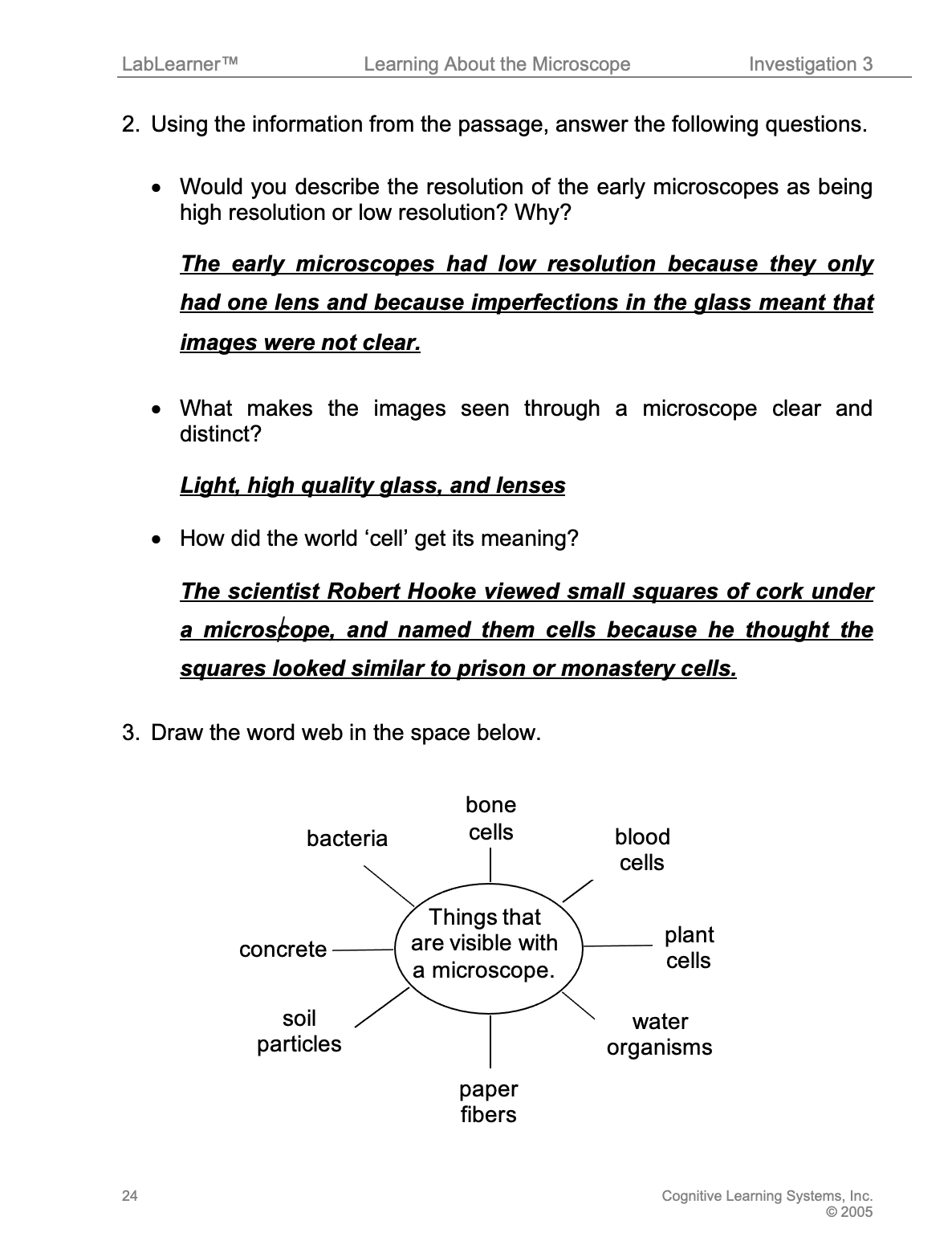
Divide the class into pairs. Ask student pairs to work together to answer the questions in Problem 2 about the passage listed in Problem 1 of their Student Data Records. When students have answered the questions, ask for student volunteers to share their answers with the class.
______________________________________________
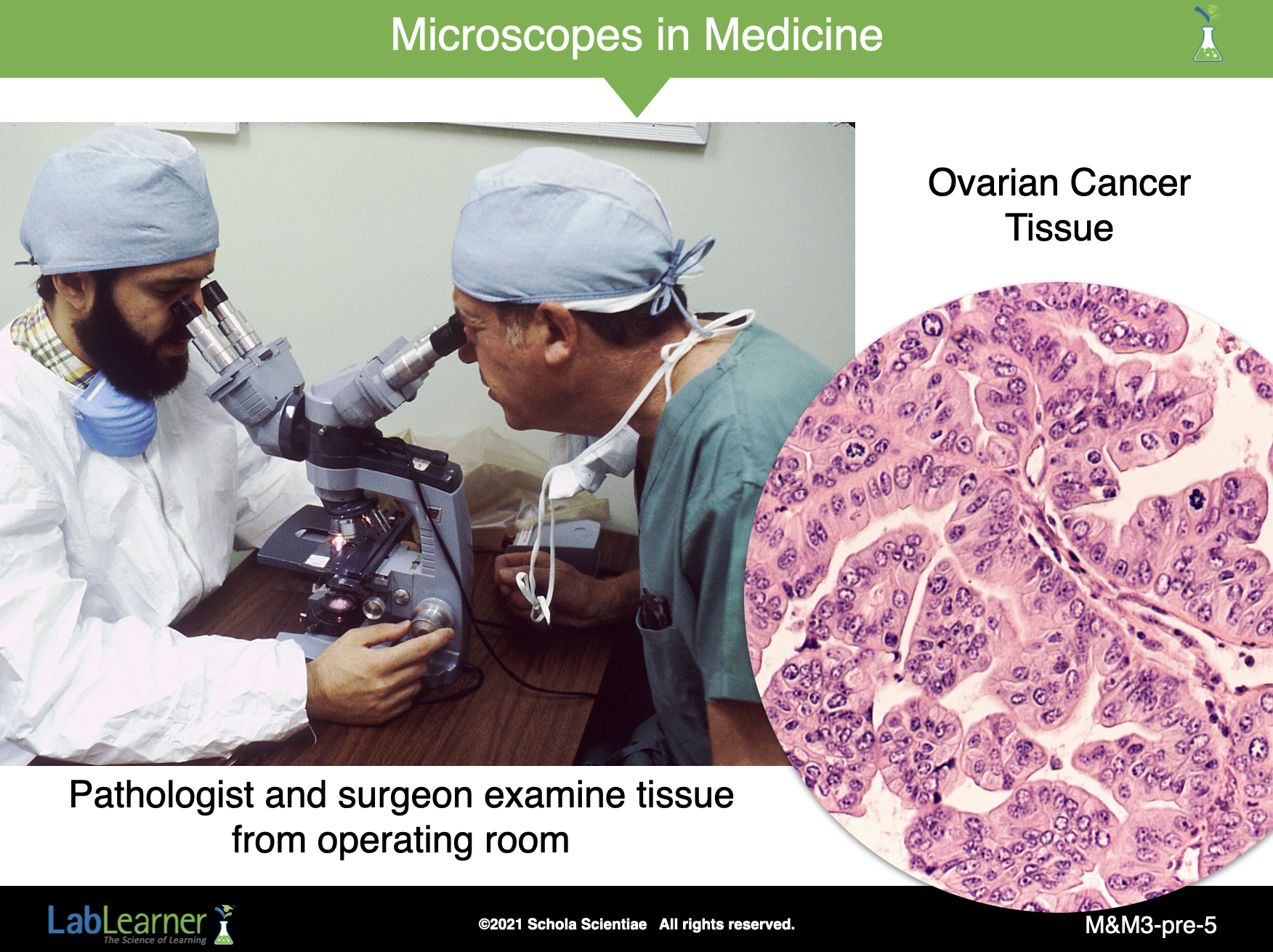
SLIDE M&M3-pre-5
Explain to the class that four hundred years ago, microscopic objects were unexplored since these objects were too small to be seen with the naked eye. Until the invention of the microscope, nothing was known about the structure of plant or animal cells. Medical science did not know that bacteria existed and certainly did not know that they could cause infections. The microscope has allowed the discovery of many things that could only be guessed at before.
Ask students to list some uses of the microscope and write the list on the board.
Examples may include:
• Microscopes are used in medicine. Scientists discovered bacteria. Microscopes have aided in finding the causes for many diseases.
______________________________________________
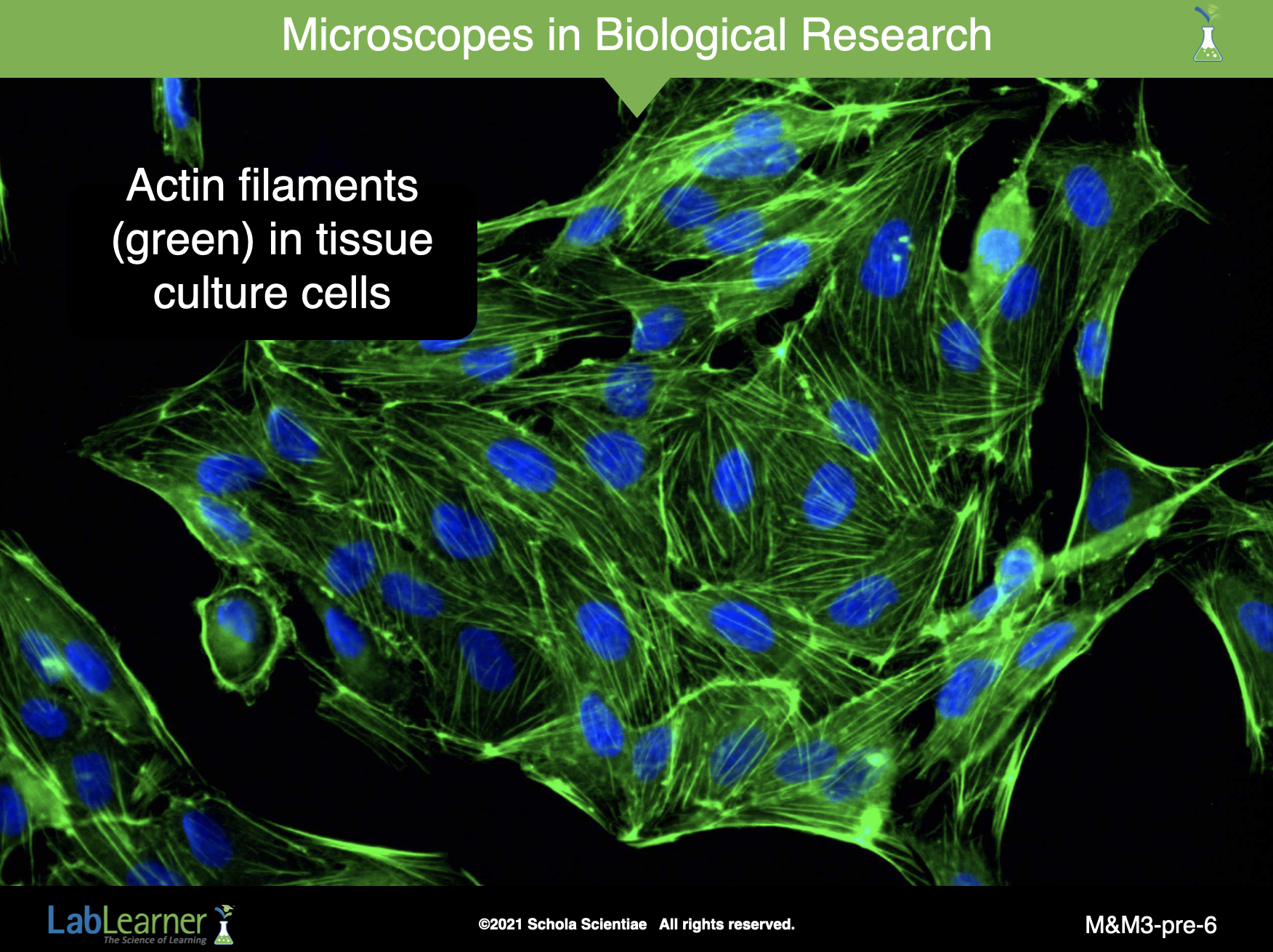
SLIDE M&M3-pre-6
Ask students to list some uses of the microscope and write the list on the board.
Examples may include:
- Microscopes are used in biological research. Scientists are able to view cells and determine how they to function and how the human body works.
- This slide shows cells grown in a laboratory. It is treated to be able to see a particular protein call actin. Actin forms strings or filaments (green) in cells and is involved in many different cellular functions – including cell movement. The blue-stained structures are cell nuclei.
______________________________________________
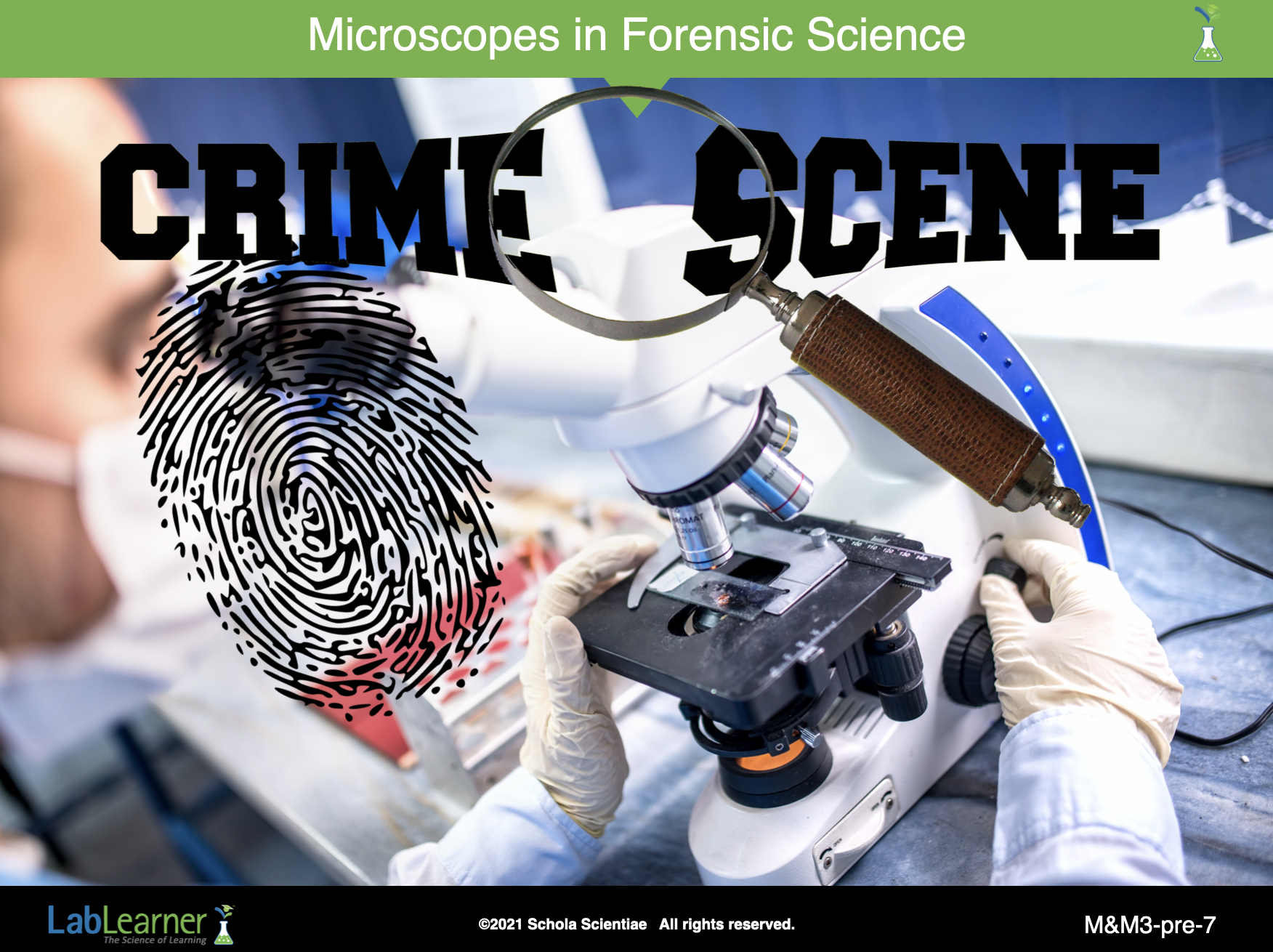
SLIDE M&M3-pre-7
Ask students to list some uses of the microscope and write the list on the board.
Examples may include:
• Forensic science uses microscopes to solve crimes. Evidence is taken from the crime scene and examined for clues using high powered microscope.
______________________________________________
SLIDE M&M3-pre-8
Ask students to list some uses of the microscope and write the list on the board.
Examples may include:
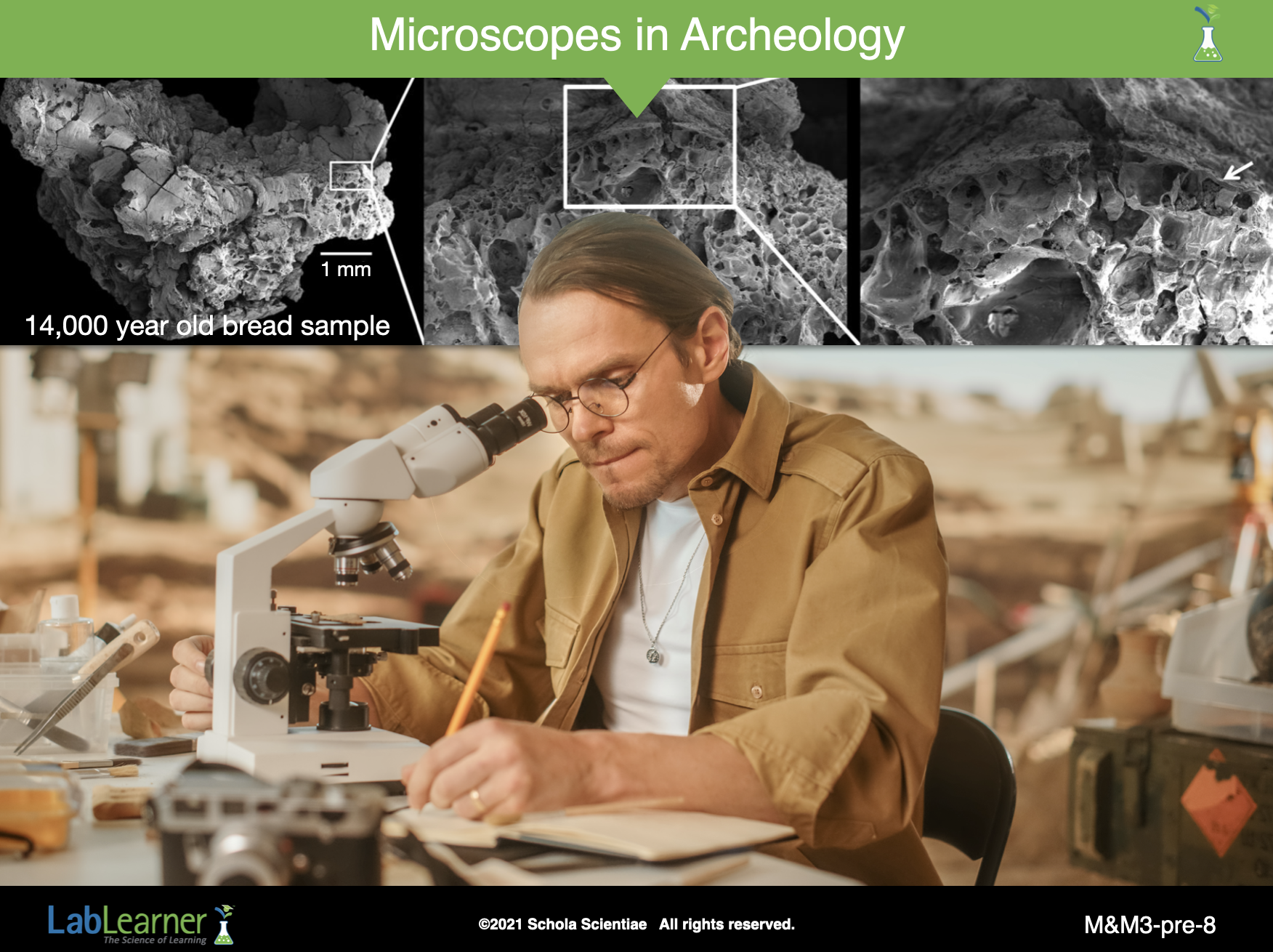
• Archaeologists use microscopes to determine how people and animals lived a long time ago. For example, animal bones can be examined under a microscope to determine whether they were domestic or wild animals. In the upper portion of this slide are highly magnified images of a 14,000+ year-old fragment of bread discovered at an archeological site. Analyzing such artifacts (ancient, very old specimens) helps reveal the type of flour used and other distinguishing characteristics.
______________________________________________
SLIDE M&M3-pre-9
Ask students to list some uses of the microscope and write the list on the board.
Examples may include:
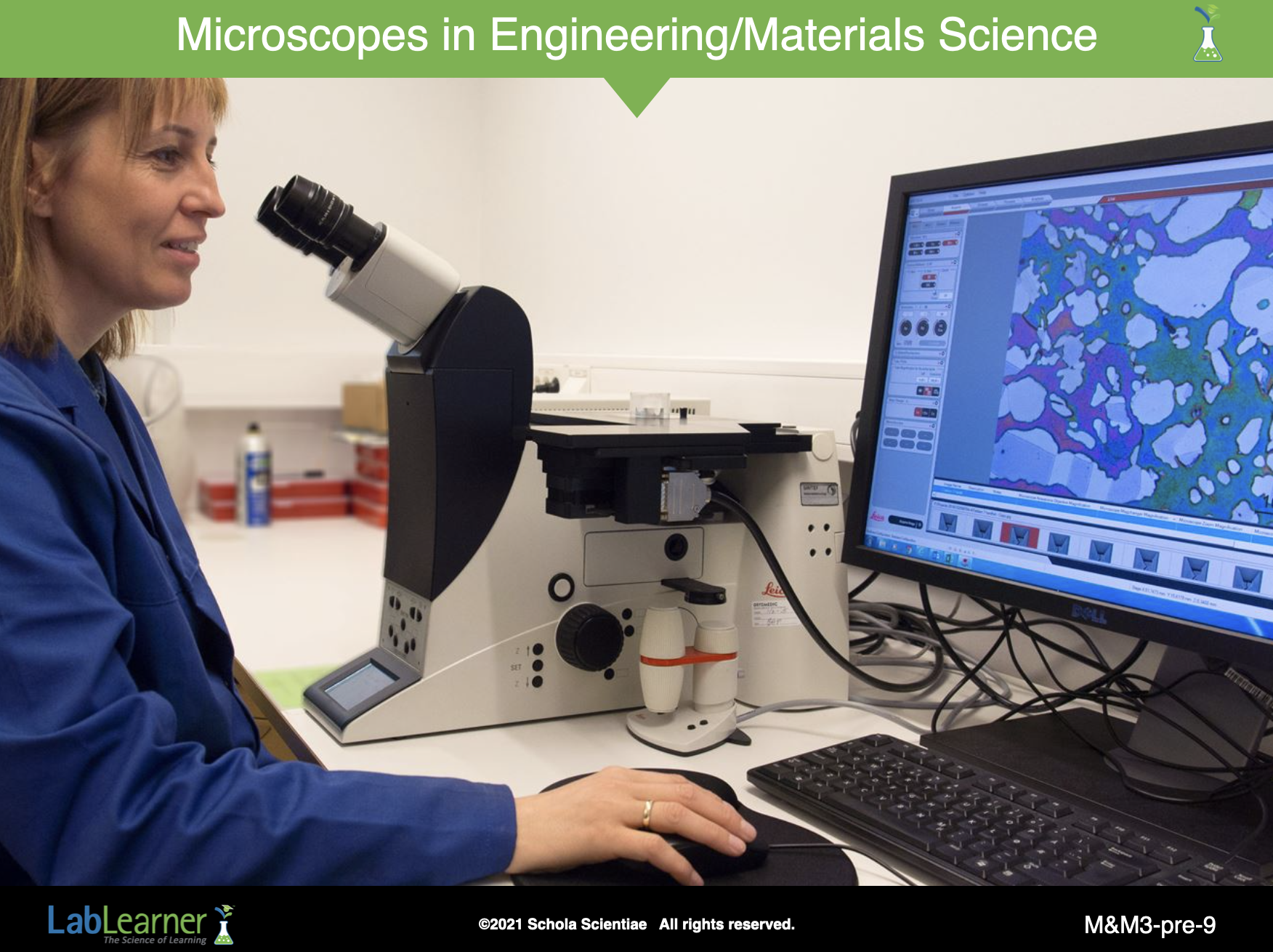
• Engineers use microscopes. Different materials can be observed under a microscope. The materials can be tested to see how they withstand different stresses.
______________________________________________
SLIDE M&M3-pre-10
Ask students to list some uses of the microscope and write the list on the board.
Examples may include:
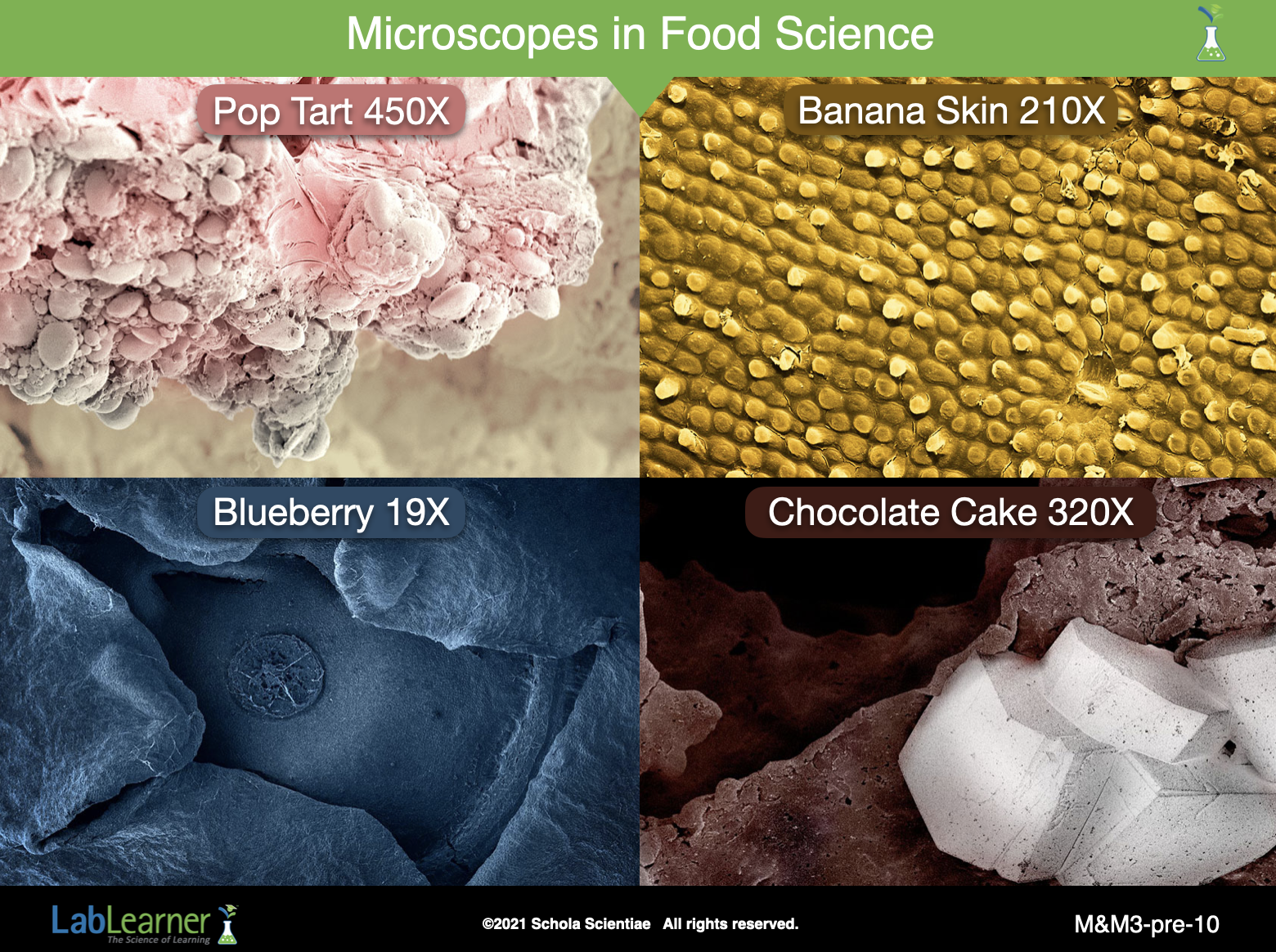
- Microscopes are used in the food industry. They help to examine bacteria and other harmful parasites that can destroy crops.
- All of the photographs in this slide were taken with an electron microscope. Notice the sugar crystals in the chocolate cake sample.
______________________________________________
KEYS: PRELAB