Teacher Portal:
Microscopes and Magnification
Investigation 3 – PostLab
 ASK WHY
Microscopes have made a tremendous contribution to science since their use began in the sixteenth century (the 1500s).
Microscopes are one of the most important scientific instruments developed. In fact, in the medical field, microscopes are largely responsible for making modern medicine “modern”!
BRANCH OUT
Microscopists today work in many different fields including field and laboratory life sciences, chemistry, materials science, and nearly every branch of biomedical research and medicine.
PRINT IT
Use your browser to download a printable PDF as help during the slide presentation and to make additional notes. In your browser, go to File > Print and then choose to save as PDF.
NAVIGATE IT
Once the slide presentation is launched
- use your left and right arrows to advance or go back in the slide presentation, and
- hover your mouse over the left edge of the presentation to get a view of the thumbnails for all the slides so that you can quickly move anywhere in the presentation.
- Click HERE to launch the slide presentation for the CELL.
SHARE IT
SLIDE M&M3-post-1
Initiate a review of the Lab by asking the following questions:
What scientific tool was used? The compound microscope was used.
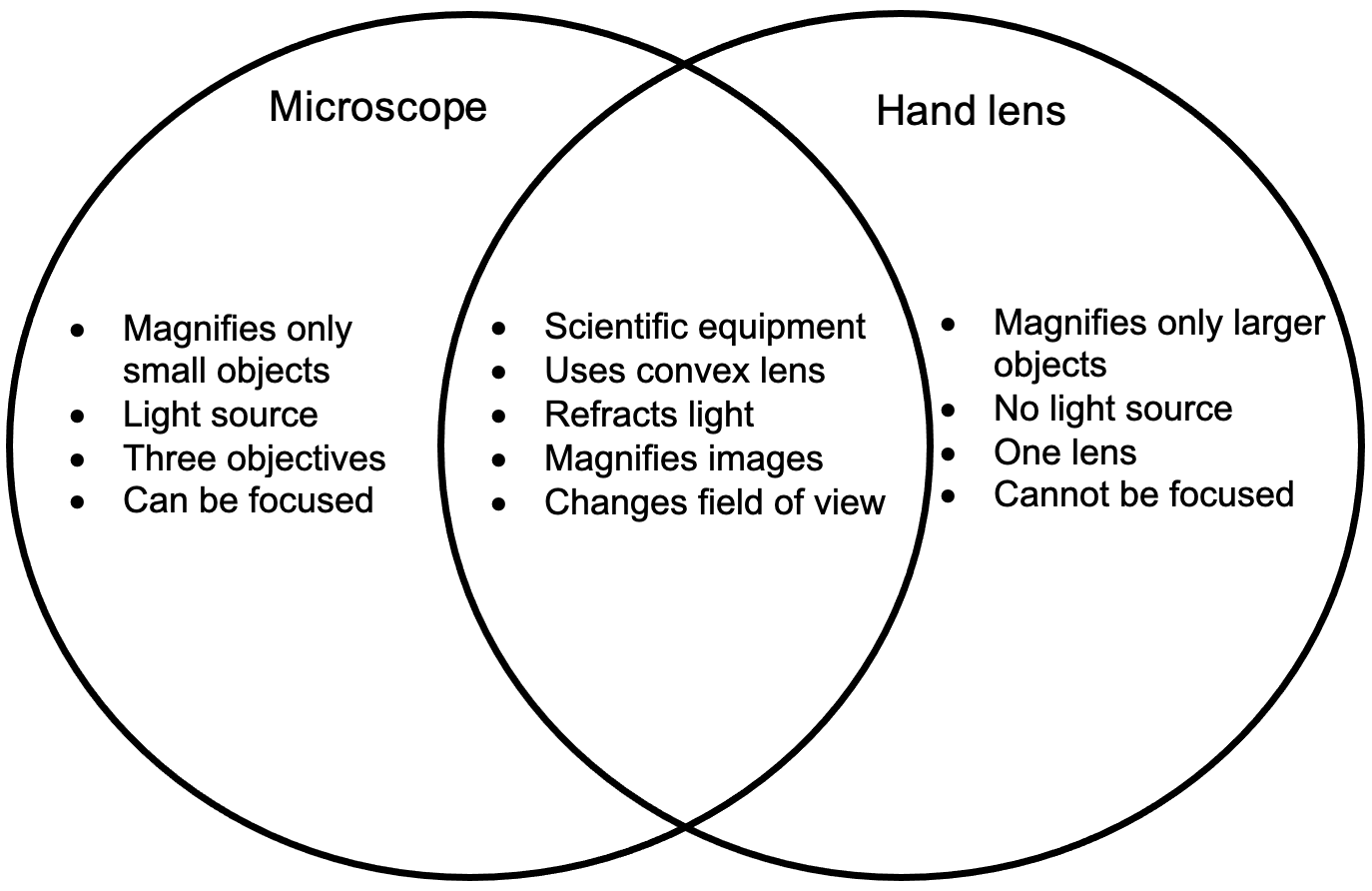
How is the compound microscope different than the hand lens? The microscope has a greater total magnification, two more lenses, and a light source to help magnify the specimen. The microscope can only view a specimen fixed on a slide, while the hand lens can be moved to freely view any object.
[Additional review questions begin on the next slide]
______________________________________________
SLIDE M&M3-post-2
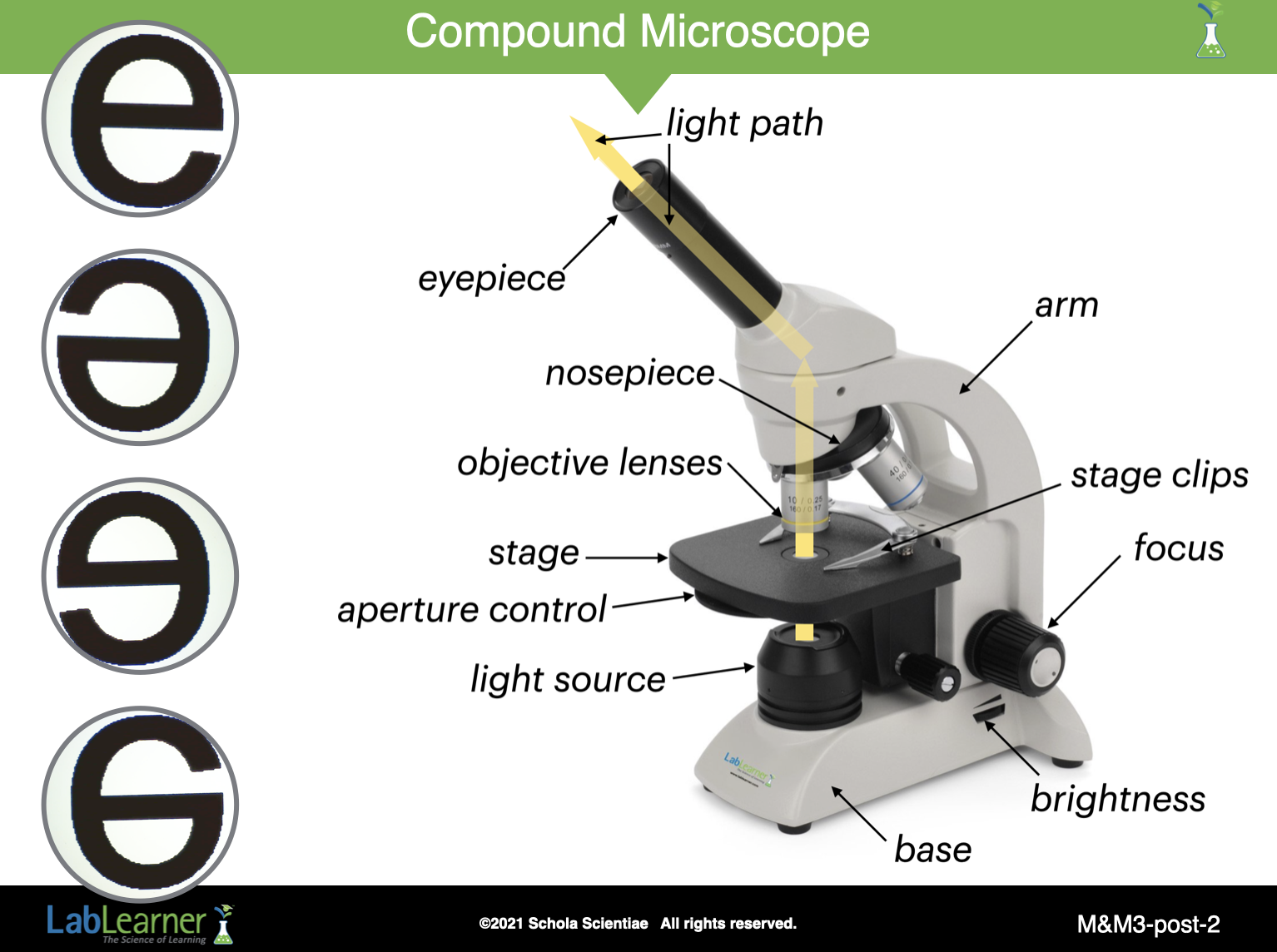
Where are the lenses in the microscope? The lenses are found in the three objectives and the eyepiece.
What powers of magnification were the lenses in each objective? The low power objective has a power of magnification of 4x, the medium, 10x, and the high, 40x. A lens with a 10x power of magnification is also found in the eyepiece.
What does the “x” in the power of magnification mean? Student answers will vary. The “x” means the number of times the image of a specimen is magnified compared to its actual size.
How did the two objectives change the magnification of the letter “e”? Student answers will vary. The letter ”e” was larger when the 10x objective was used compared to the 4x objective. The magnification was greater with the 10x objective.
Did the two objectives change how much of the letter “e” was visible? How? Student answers will vary. Yes. Less of the letter ”e” was visible when the 10x objective was used compared to the 4x objective.
How are the lenses of the microscope used to refract light into a viewable image? Light from the light source shines through the specimen and is reflected by structures of the specimen into the objective. Light is refracted as it travels through the lenses of the objective and the eyepiece. Magnification of the object results from the combination of the two lenses of the objective and the eyepiece.
How is the microscope used to aid our view of a specimen? It allows the viewing of very small objects that normally cannot be seen with the naked eye.
______________________________________________
SLIDE M&M3-post-3
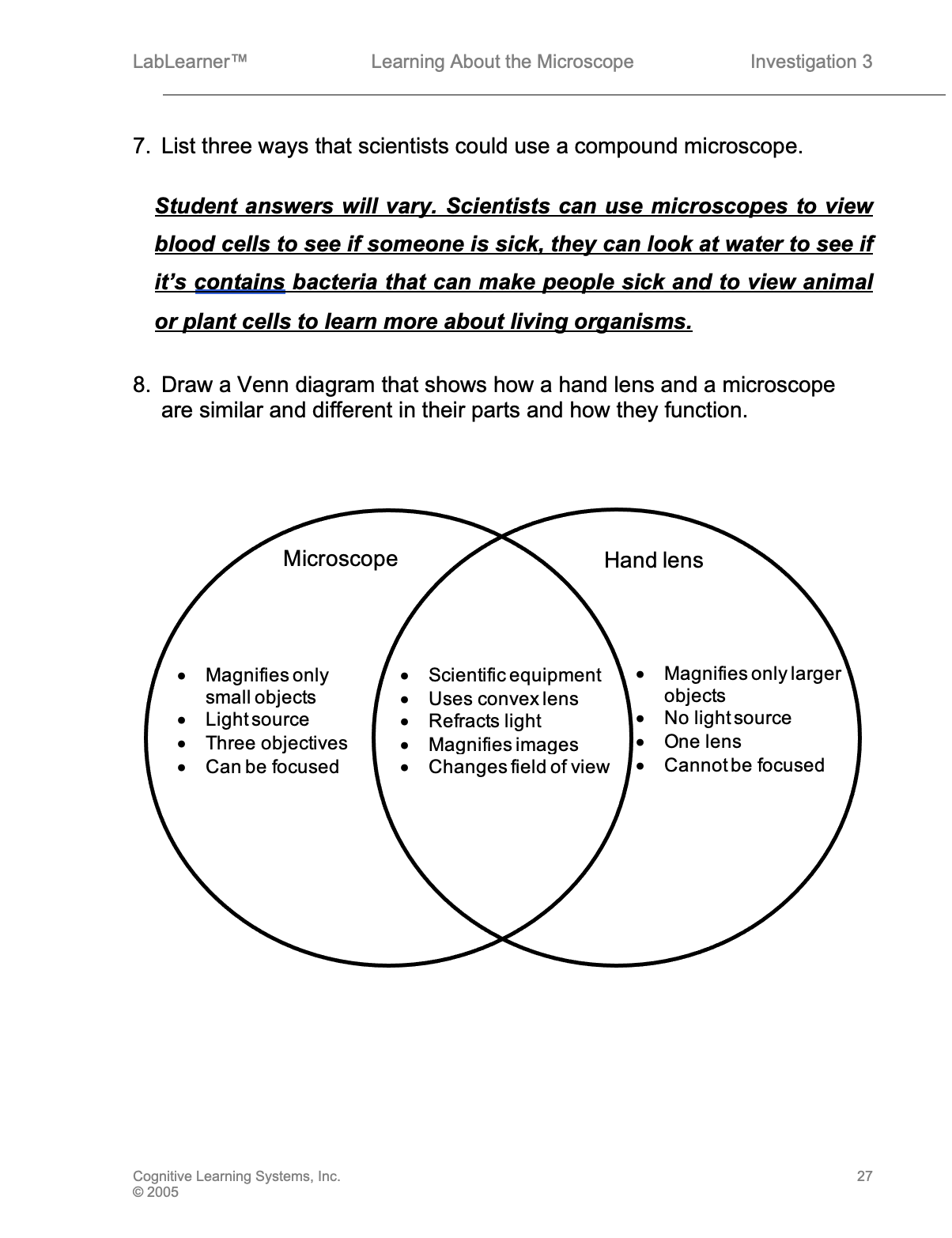
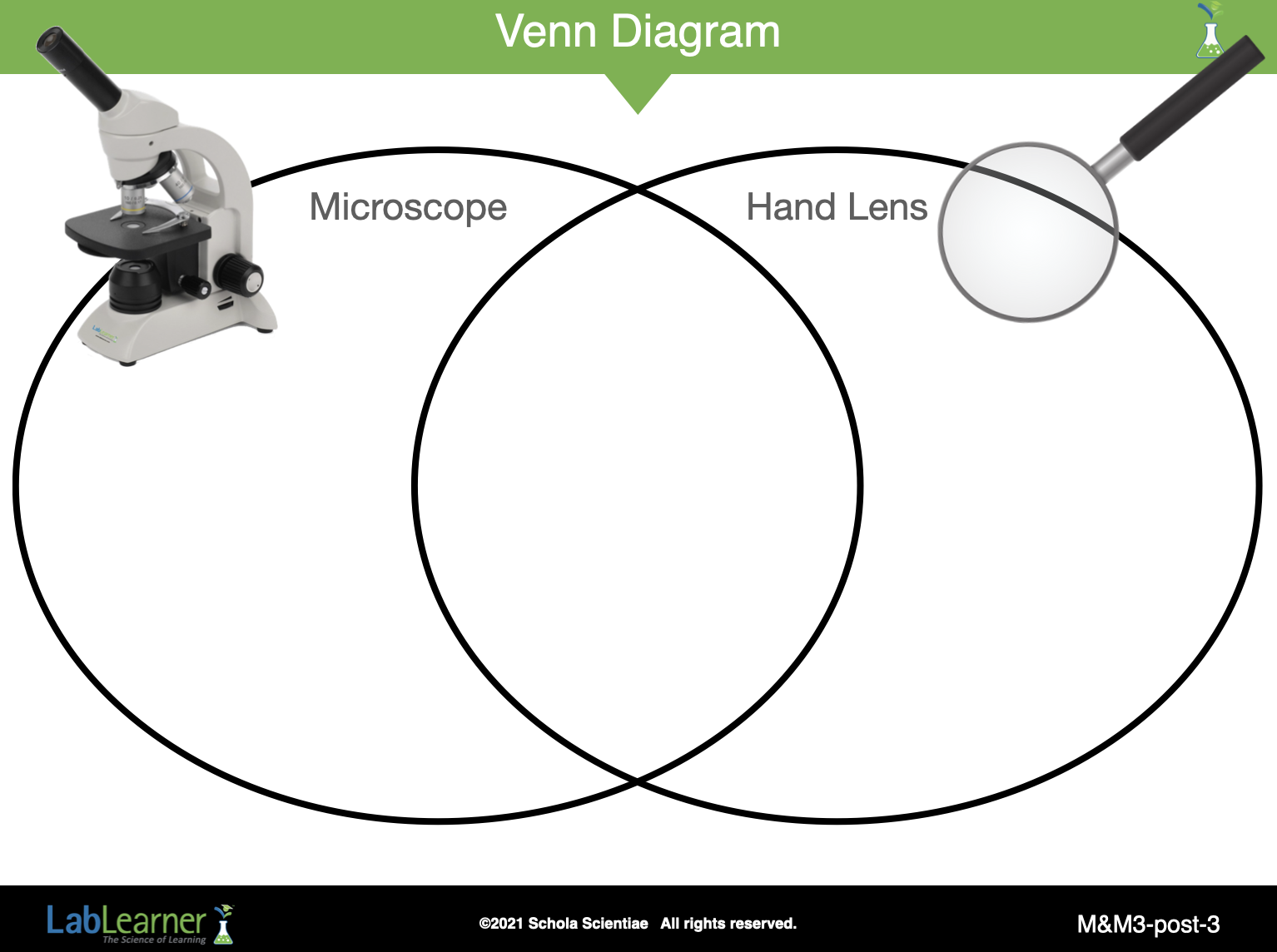
Ask students to compare and contrast the hand lens with the compound microscope using a Venn Diagram. Divide students into pairs and ask them to draw their diagram in Problem 8 in their Student Data Record.
See the sample Venn diagram below for ideas.
______________________________________________
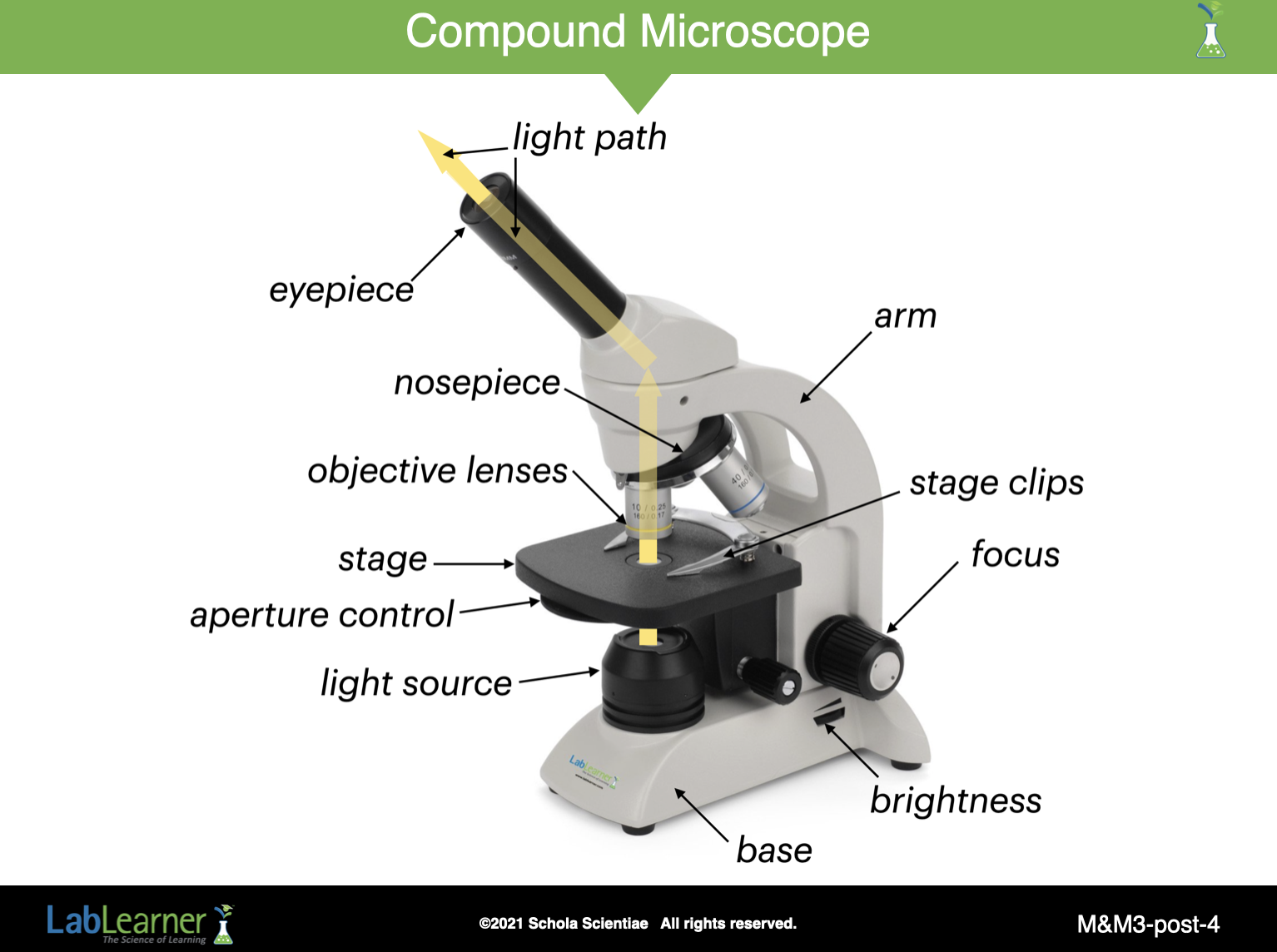
SLIDE M&M3-post-4
Ask students the following questions about the use and operation of the compound microscope:
Where is the slide of the specimen placed? The slide is placed under the clips on the stage.
Why did you use the largest aperture opening on the stage? The largest aperture allows the most light to pass through the specimen.
What does turning the focusing knobs do to the stage? Turning the focusing knobs moves the stage closer to or farther from the objective.
Which objective should be used first to view a specimen? Why? The low power objective should be used first. Trying to focus on a specimen by first using the high power objective can inadvertently damage the slide or the objective if the objective contacts the slide.
______________________________________________
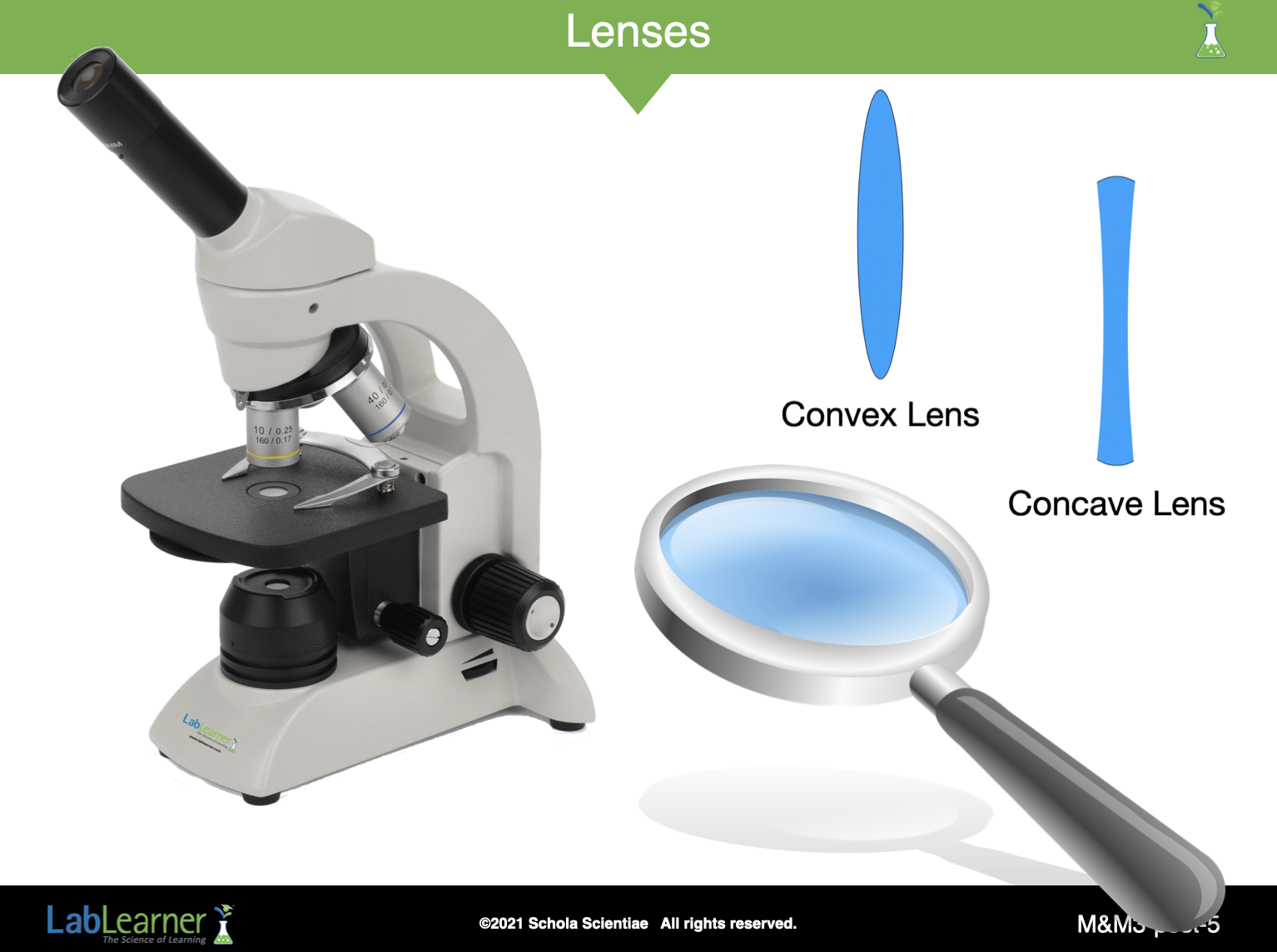
SLIDE M&M3-post-5
Ask students the following questions about the compound microscope:
What type of lens is in a microscope? Students should predict that convex lenses are present in a microscope since they observed in Investigation Two that convex lenses produce magnified images while concave lenses produce reduced images.
Ask students to predict the curvature of a microscope’s lenses compared to the curvature of the lens of a hand lens. Students should predict that the microscope’s lenses will have a greater curvature than the lens found in the hand lens since a microscope has a greater power of magnification than a hand lens.
Ask students to predict whether the lenses of a microscope or the lens of a hand lens result in more refraction? Students should predict that the microscope lenses produce greater refraction of light because the microscope has a greater power of magnification than a hand lens.
______________________________________________
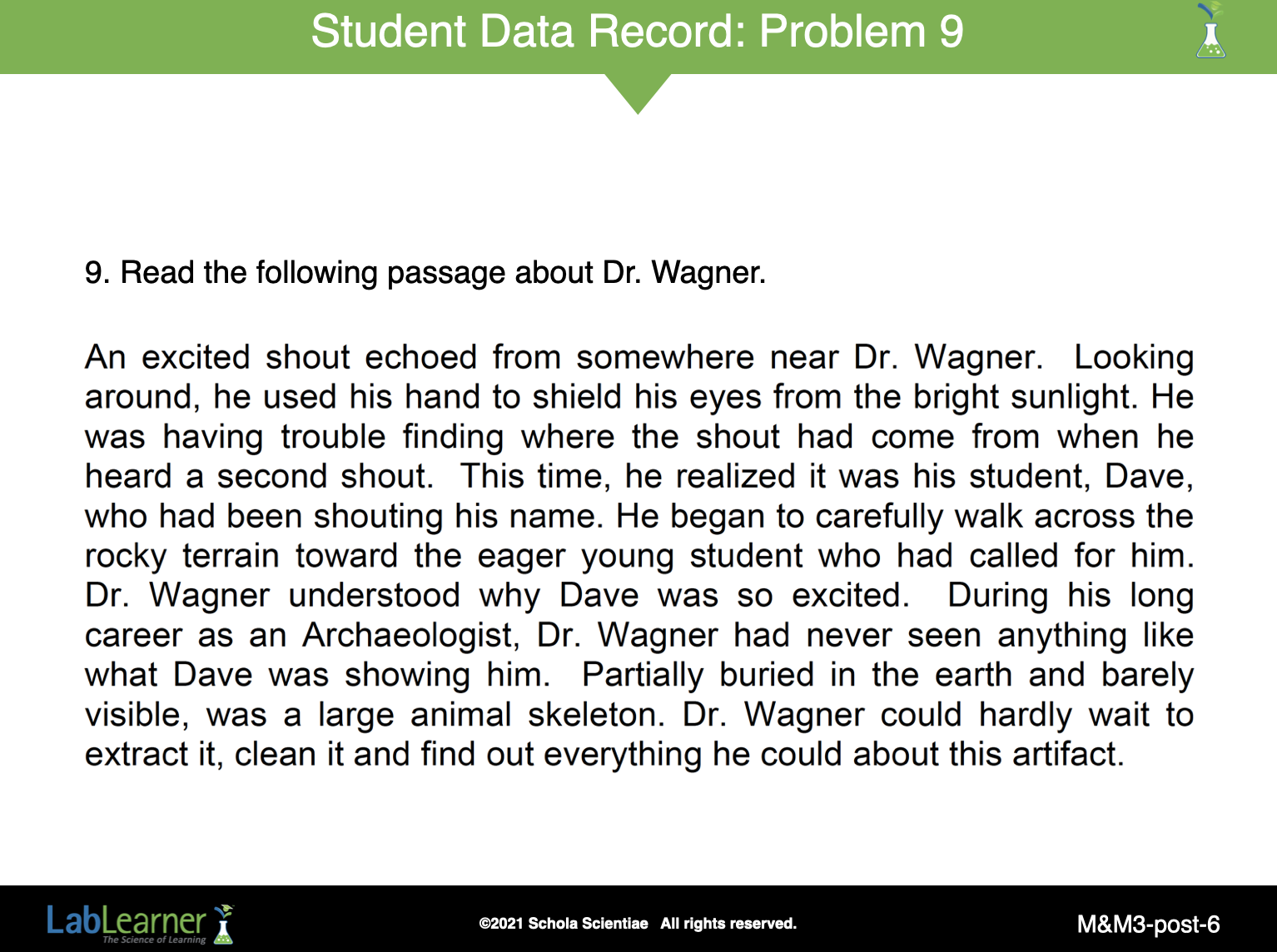
SLIDE M&M3-post-6
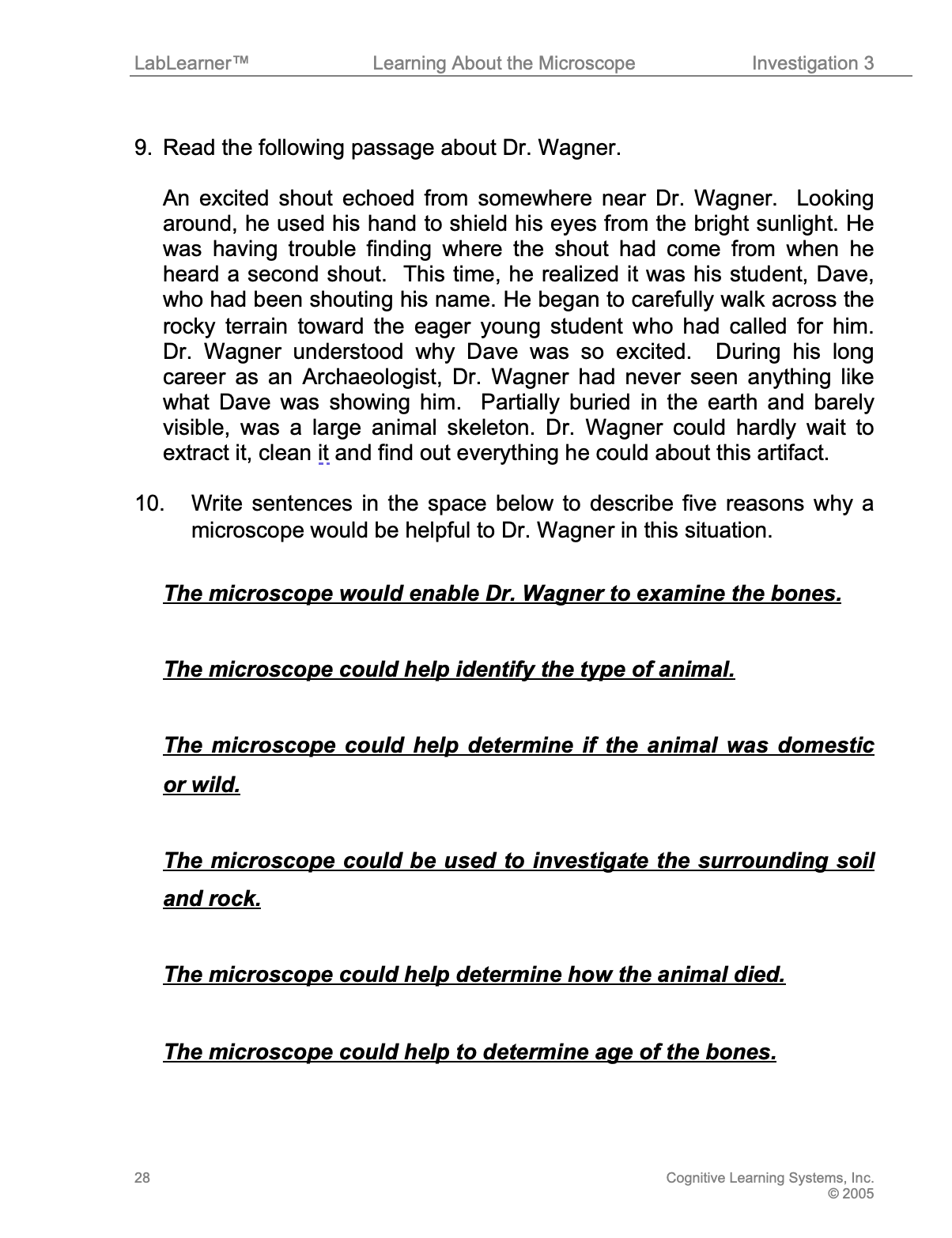
Explain to the class that they are going to read a short scenario from Problem 9 in their Student Data Record. Ask for student volunteers to read aloud or have students read to themselves.
Read the passage about Dr. Wagner.
After the scenario has been read, instruct students to write five to six sentences in Problem 10 of their Student Data Record describing how a microscope could help in the scenario. Ask for several volunteers to read their sentences to the class.
______________________________________________
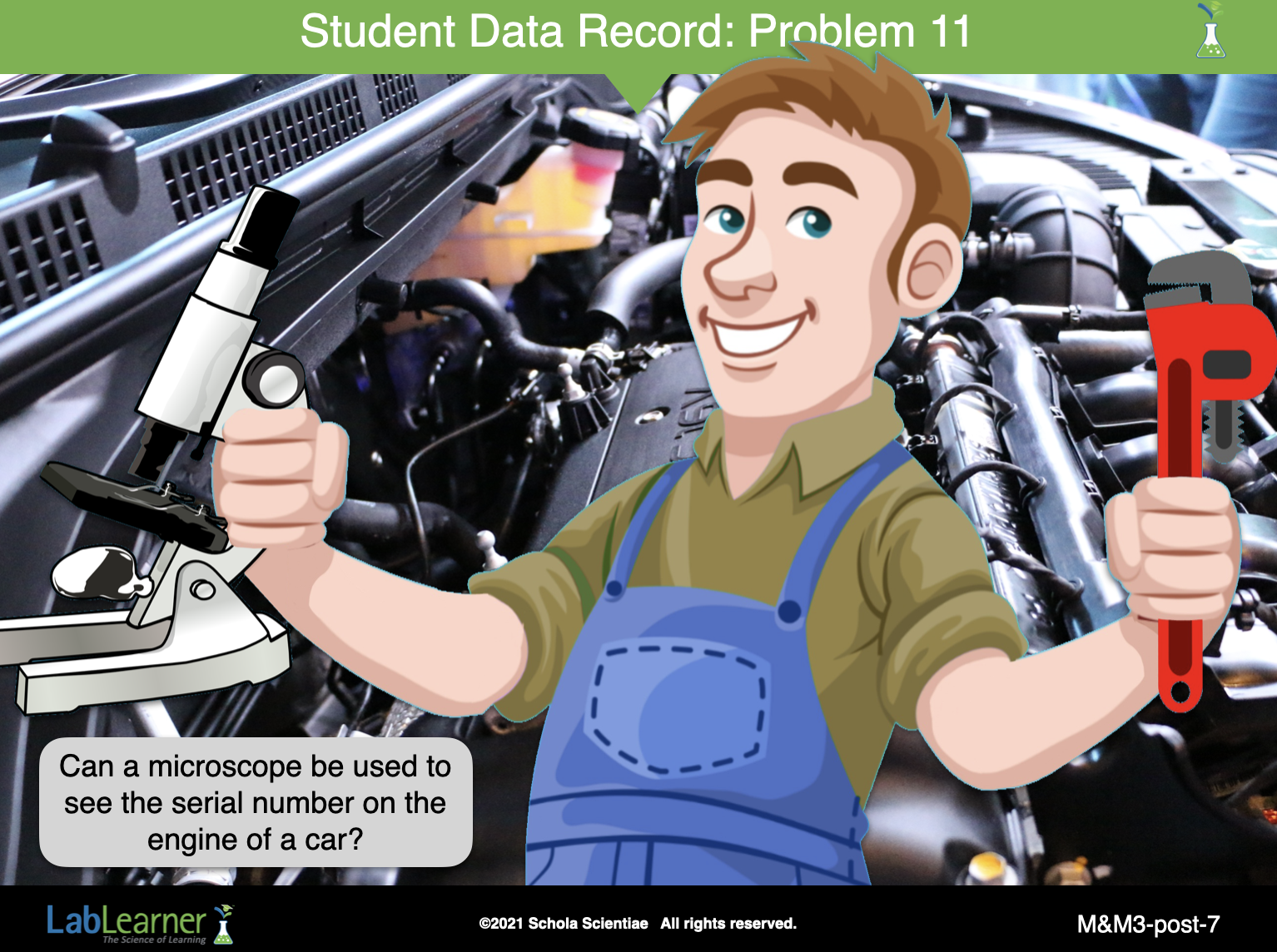
SLIDE M&M3-post-7
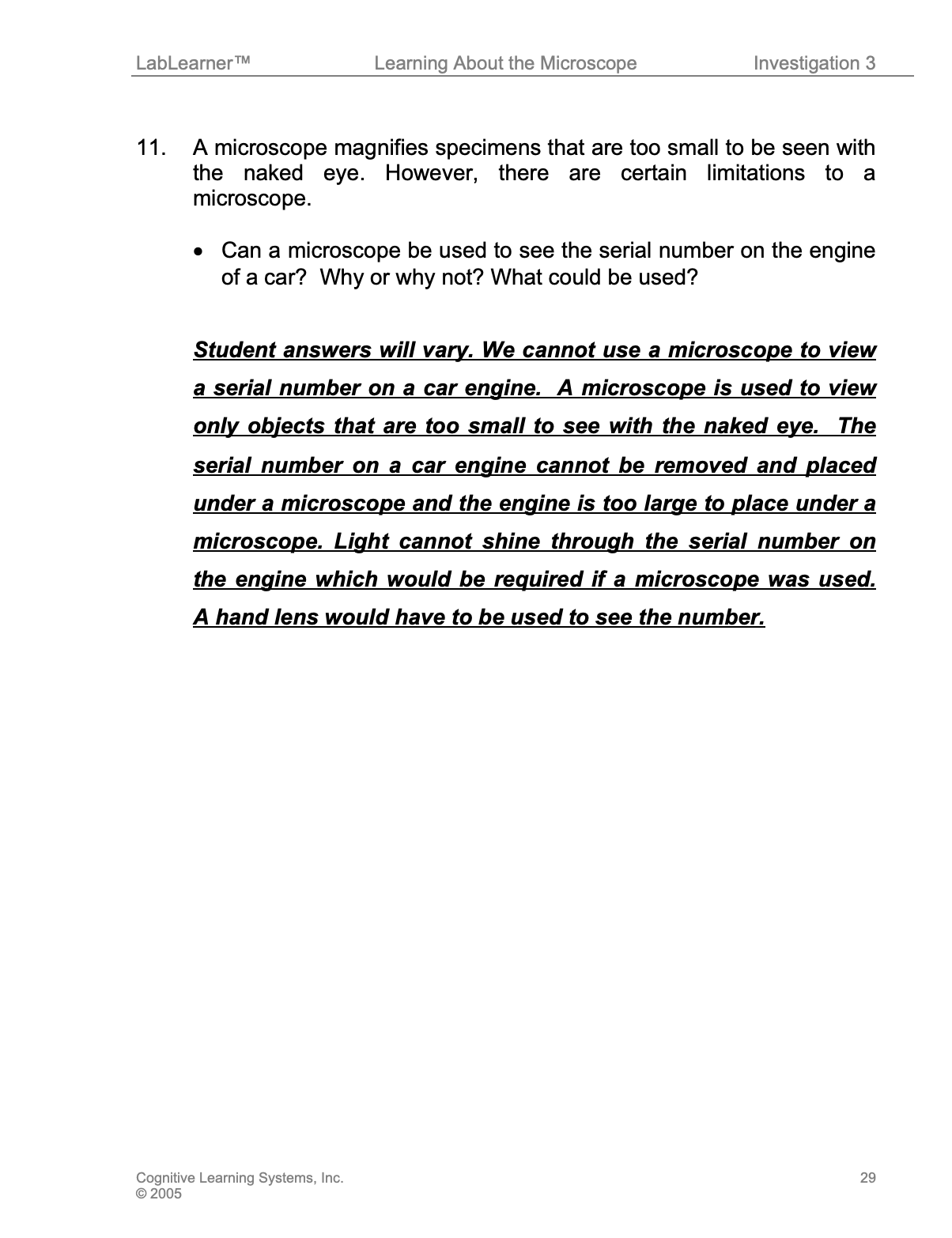
A microscope magnifies specimens that are too small to be seen with the naked eye. However, there are certain limitations to a microscope. Ask students to answer Problem 11 in their Student Data Record.
______________________________________________
KEYS: POSTLAB