Teacher Portal:
Microscopes and Magnification
Investigation 2 – PreLab
 ASK WHY
Microscopes have made a tremendous contribution to science since their use began in the sixteenth century (the 1500s).
Microscopes are one of the most important scientific instruments developed. In fact, in the medical field, microscopes are largely responsible for making modern medicine “modern”!
BRANCH OUT
Microscopists today work in many different fields including field and laboratory life sciences, chemistry, materials science, and nearly every branch of biomedical research and medicine.
PRINT IT
Use your browser to download a printable PDF as help during the slide presentation and to make additional notes. In your browser, go to File > Print and then choose to save as PDF.
MINDSET
This Investigation is designed to:
- demonstrate that light travels through transparent materials.
- allow students to investigate the concept of refraction.
- demonstrate that lenses can magnify and/or reduce the size of an image.
- demonstrate the application of refraction in “assisted observation” to students.
- allow students to investigate how the curvature of a lens contributes to refraction.
- demonstrate that flat surfaces refract light but not to the degree that curved surfaces refract light.
- enable students to differentiate between an object and its image.
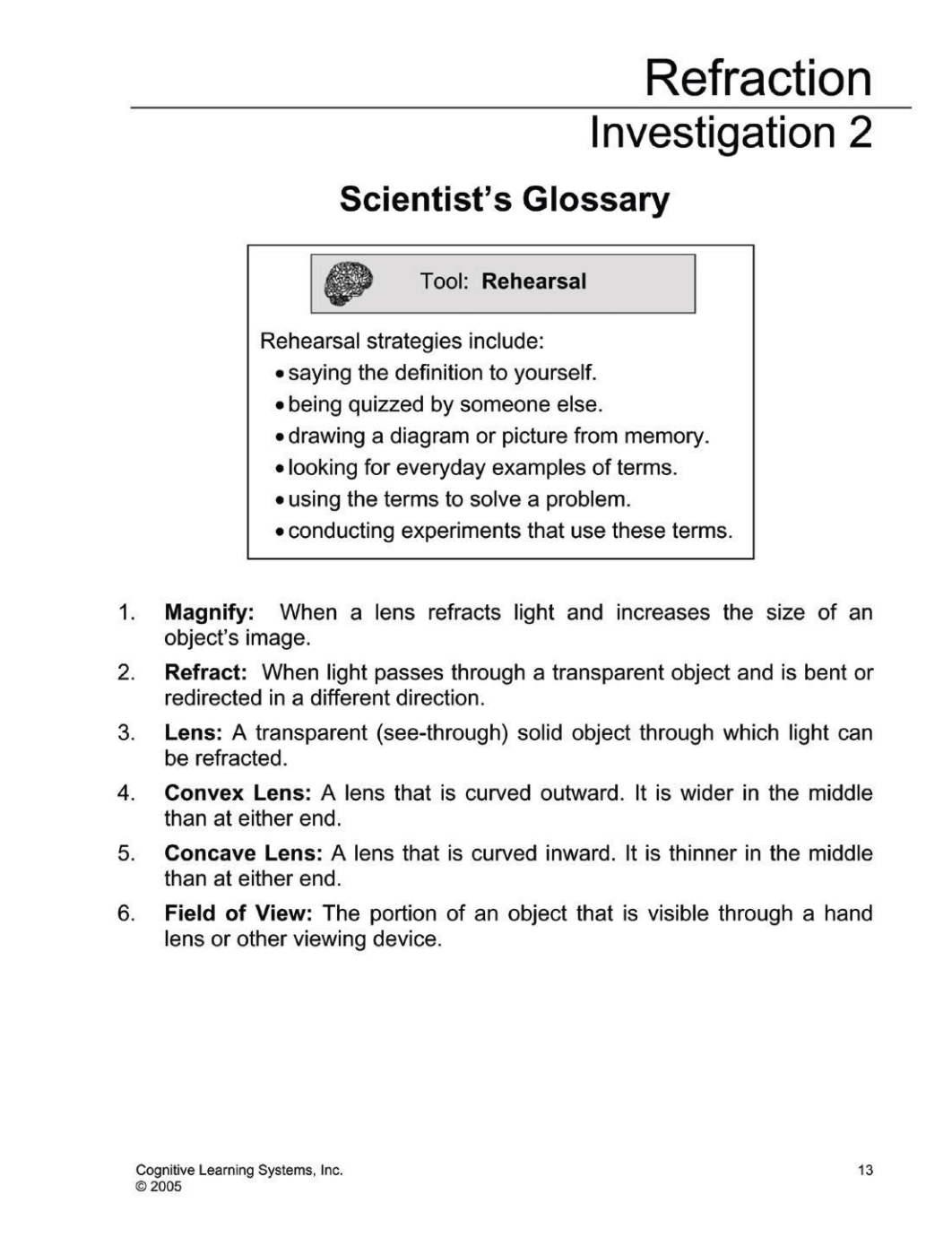
SCIENTIST’S GLOSSARY
- Magnify: When a lens refracts light and increases the size of an object’s image.
- Refract: When light passes through a transparent object and is bent or redirected in a different direction.
- Lens: A transparent (see-through) solid object through which light can be refracted.
- Convex Lens: A lens that is curved outward. It is wider in the middle than at either end.
- Concave Lens: A lens that is curved inward. It is thinner in the middle than at either
- Field of View: The portion of an object that is visible through a hand lens or other viewing device.
BE PREPARED
Watch the Investigation 1 Teacher Video and Student Video below to prepare for the PreLab.
SET FOR SUCCESS
- Tell students that they are about to begin the second Investigation of the Microscopes and Magnification CELL, in which they will study lenses and the refraction of light through lenses.
- Ask students to share the kinds of things they might learn in these Investigations.
Begin the PreLab Concept Slides to start students on their learning journey. Then watch the Pre-Lab Student Video as a class.
NAVIGATE IT
Once the slide presentation is launched
- use your left and right arrows to advance or go back in the slide presentation, and
- hover your mouse over the left edge of the presentation to get a view of the thumbnails for all the slides so that you can quickly move anywhere in the presentation.
- Click HERE to launch the slide presentation for the CELL.
SHARE IT
SLIDE M&M2-pre-1
Begin the Investigation by explaining to students that this Investigation will explore how light is refracted by lenses.
Ask students to look at the terms listed in their Scientist’s Glossary. As a class, review the terms and ask student volunteers to read the terms aloud.
Discuss the meaning of the term magnification. Use the following cues to help students understand the concept.
- Magnification occurs when the image of an object appears larger than the object itself.
- Lenses are transparent solids that can magnify an object’s image.
Ask students where they might find lenses. Student answers will vary. Students may notice that lenses can be found in eyeglasses, or may recall that lenses are used in microscopes and telescopes. Students should recall from Investigation One that the eye has a lens.
Inform students that lenses include the lens in each of our eyes, eyeglasses, microscopes and telescopes. Magnification occurs due to the refraction of light by the lens. Lenses can magnify and also reduce the size of an object’s image.
______________________________________________
SLIDE M&M2-pre-2
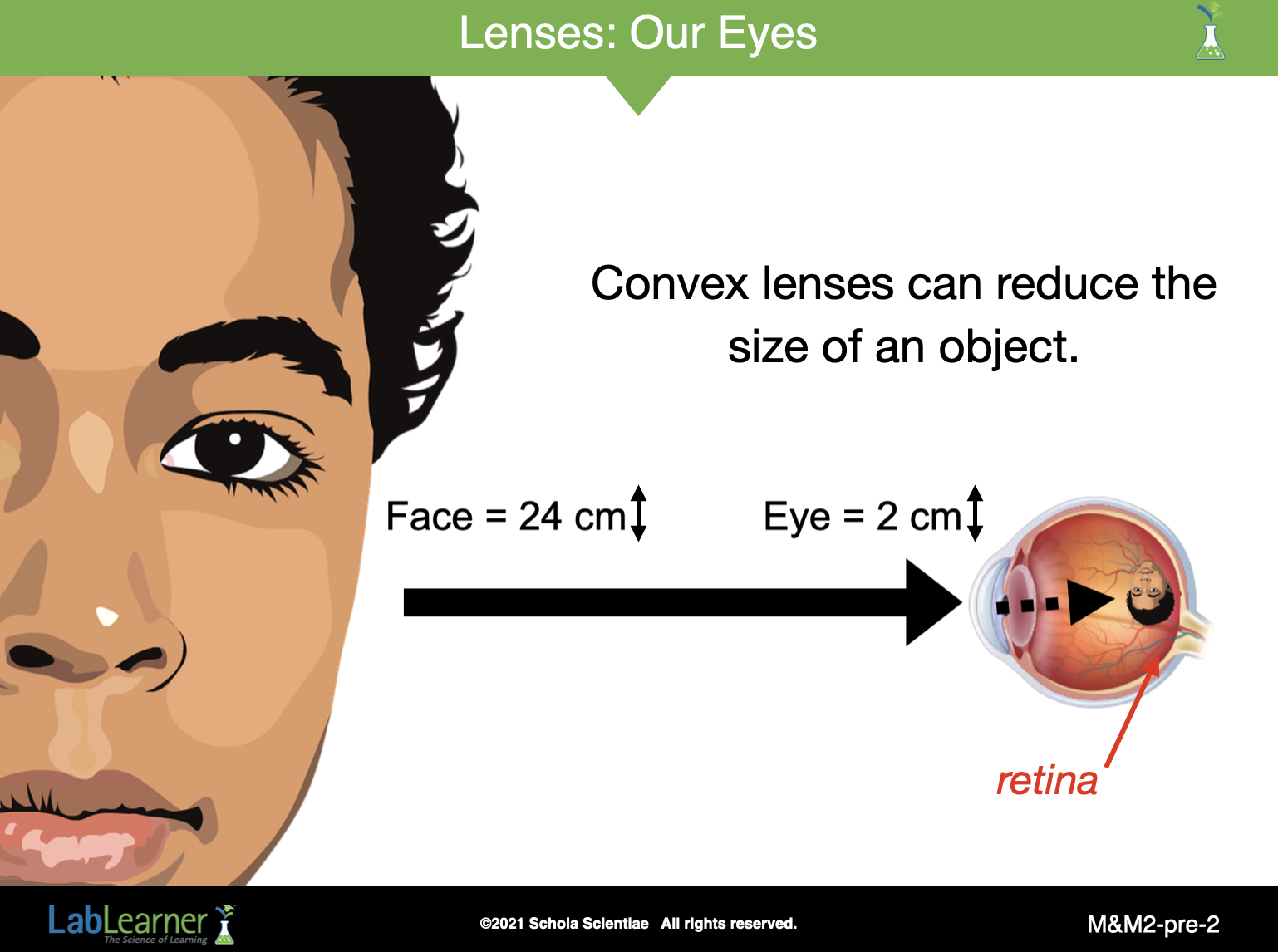
Ask students how they can prove that a lens can also reduce the size of an object’s image.
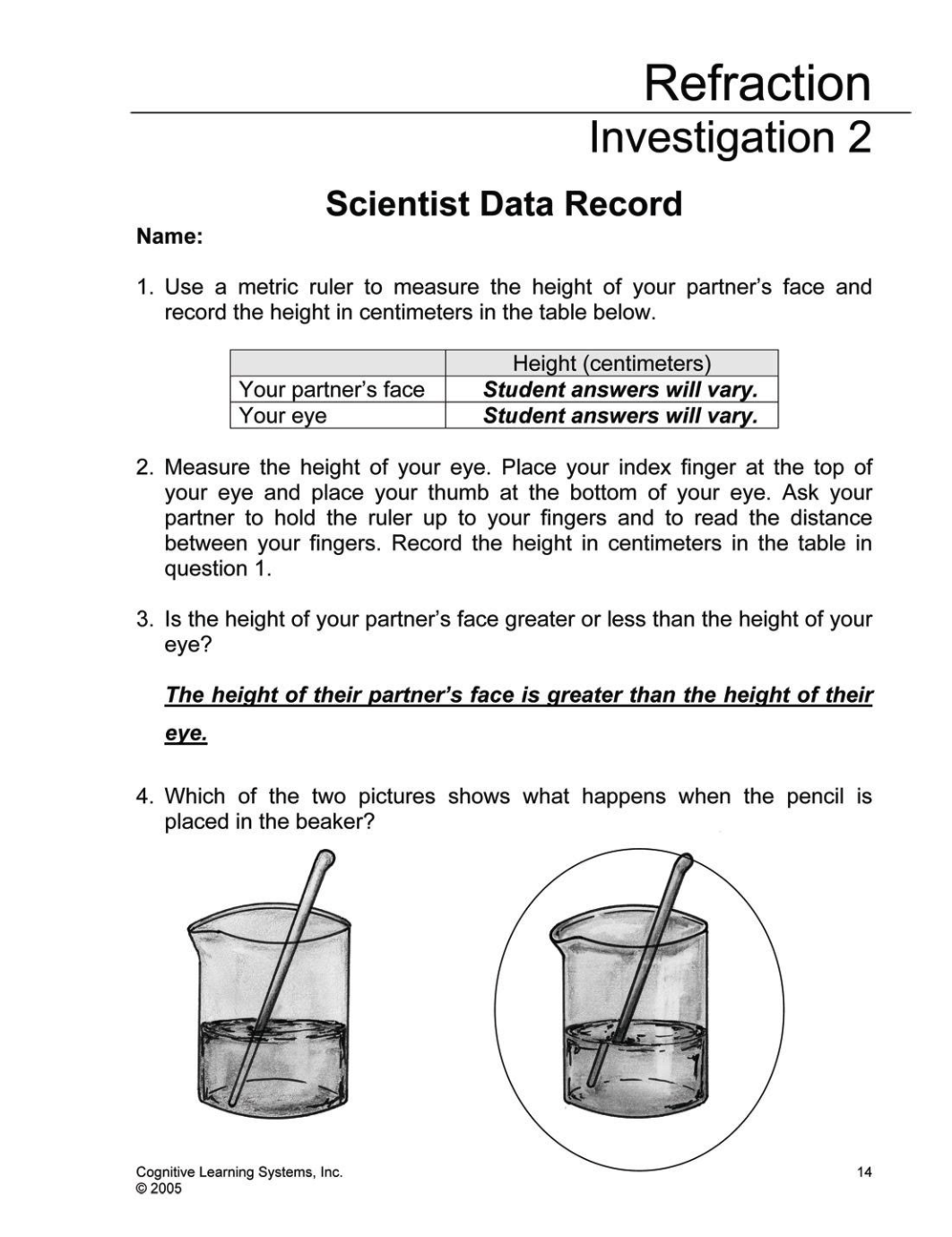
Inform students that they are going to perform an experiment to find out the answer to this question. Divide students into pairs and ask students to turn to Problem 1 in their Scientist Data Records.
Ask students to follow the directions in their Scientist Data Record and measure the height of their partner’s face with a ruler and record the height in the Table in Problem 1.
Students should then follow the directions in Problem 2 and measure the height of their own eye.
Students should then answer Problem 3.
Which had the greater height, your partner’s face or your own eye? Student answers may vary. The height of their partner’s face will have the greater height.
Where is an image produced after light passes through the lens in your eye? The image falls on the retina.
What can you conclude about the lens in your eye and whether it magnifies or reduces an object’s image? The height of a student’s eye will be much less than the height of their partner’s face. This shows that the lens of their eye reduces and does not magnify the image of their partner’s face so the image can fit on the retina. If the eye’s lens magnified images, then an image would be too large to fit on the surface of the retina and only a portion of the image would be detected.
How could you change the field of view when looking at your partner’s face? Student answers may vary. Guide students to conclude that field of view may be changed by either moving towards the partner (object) or by the partner moving away from the viewer. Changing the distance between the object and the viewer (lens) will result in more or less of the object being visible, and hence a larger or smaller field of view. If necessary, refer student to the definition of field of view in the Scientist’s Glossary.
______________________________________________
SLIDE M&M2-pre-3
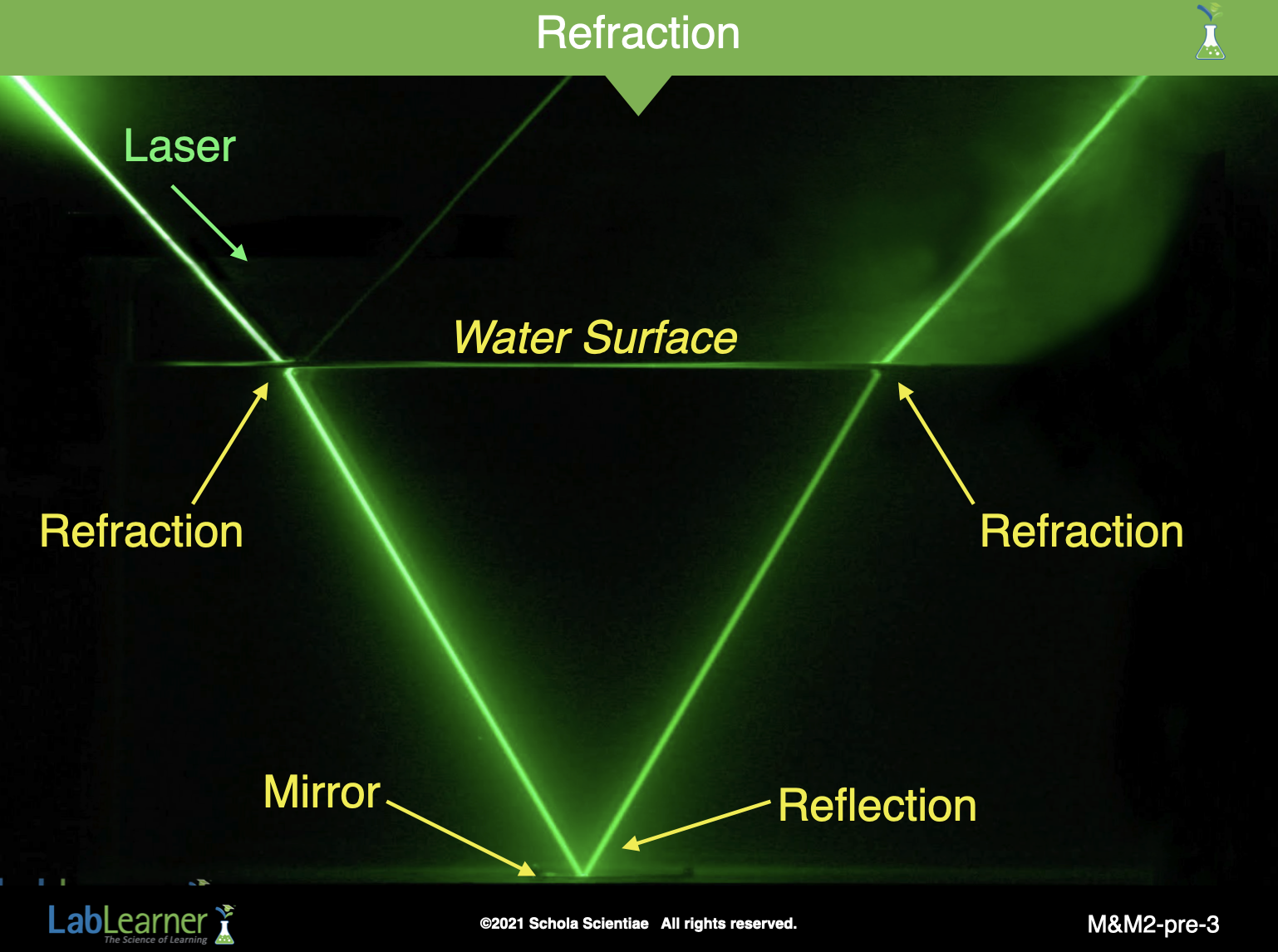
This slide shows a green laser (coming from the upper left) directed into a tank of water with a mirror at the bottom of the tank.
Discuss the meaning of the term refraction. Use the following cues to help students understand the concept:
- Light rays cannot be seen as they travel through air. Light rays can only be seen when they reflect off of an object and the light then enters our eyes.
- Refraction occurs when light rays travel through one transparent substance and enter and travel through a second transparent substance.
- Refraction occurs when the speed of light is greater in the first substance compared to its speed in the second substance.
- A change in the speed of light results in the bending or redirection of light rays. Bending or redirecting light is called refraction.
- The more the light rays are bent, the more noticeable the refraction.
______________________________________________
SLIDE M&M2-pre-4
Ask students: How could you prove that refraction takes place? Student answers will vary but could include the separation of colors in rainbow, the color of the setting sun, looking through the water of a swimming pool or pond at an object at the bottom or the distortion of an image by a drinking glass, which is not uniform in thickness.
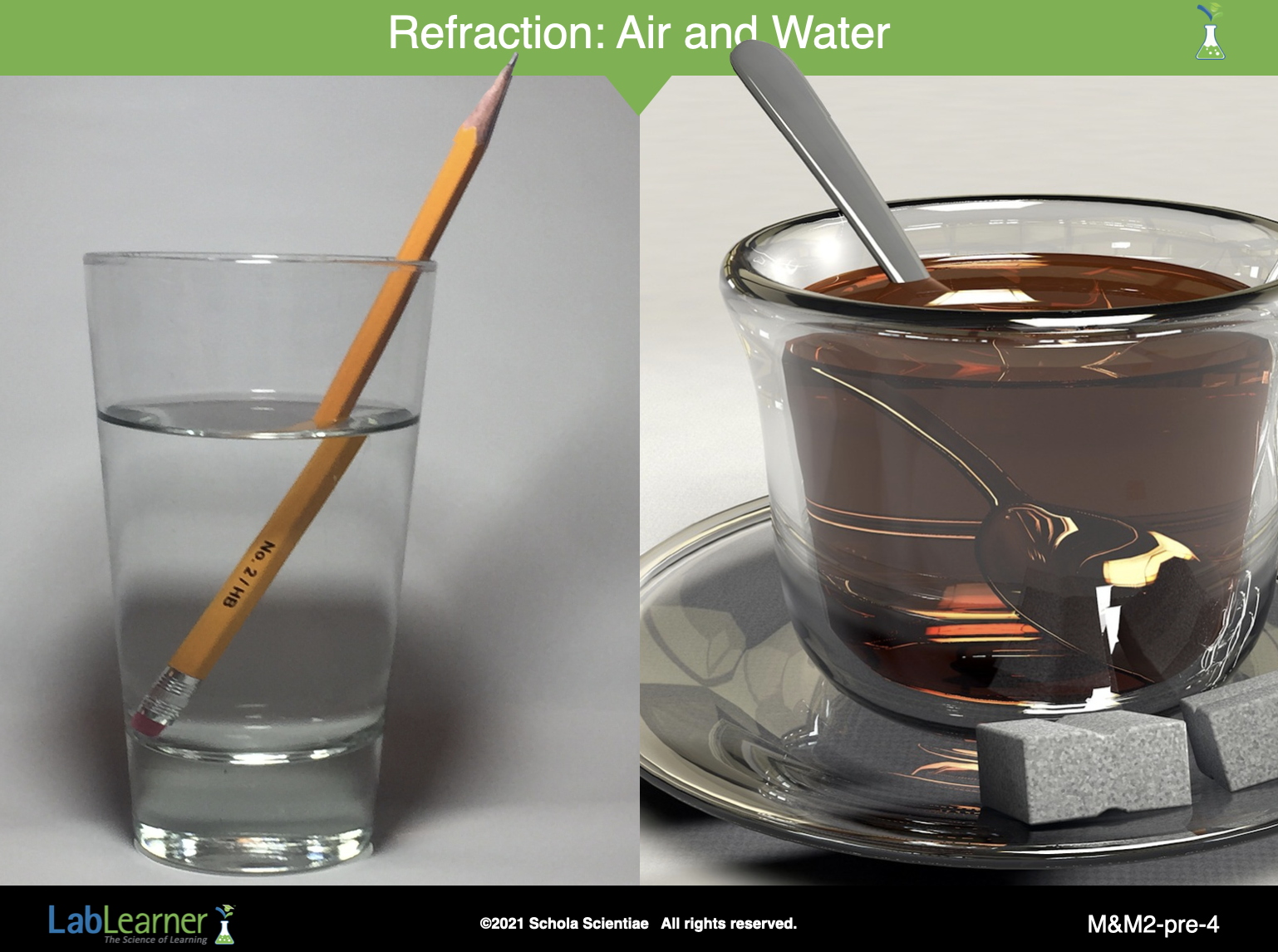
Demonstrate refraction by placing the pencil in the glass or beaker of water.
- Allow students to view the pencil from a distance of 30 cm by slowly raising and lowering a glass.
- The pencil is best viewed when students are looking down slightly at the pencil through the cup, glass or beaker and through the surface of the water.
- Ask students to circle the picture in problem 4 in their Scientist Data Record that best matches their observations of the pencil.
- Ask students, How does the pencil appear? Student answers may vary. The pencil should appear “bent.”
Inform students that the speed of the light is less in water than in air.
- The pencil appears bent because of the difference in the speed of the light through the air and the water.
- Inform students that the light that forms the image of the pencil is refracted just as light is refracted by a lens.
______________________________________________
SLIDE M&M2-pre-5
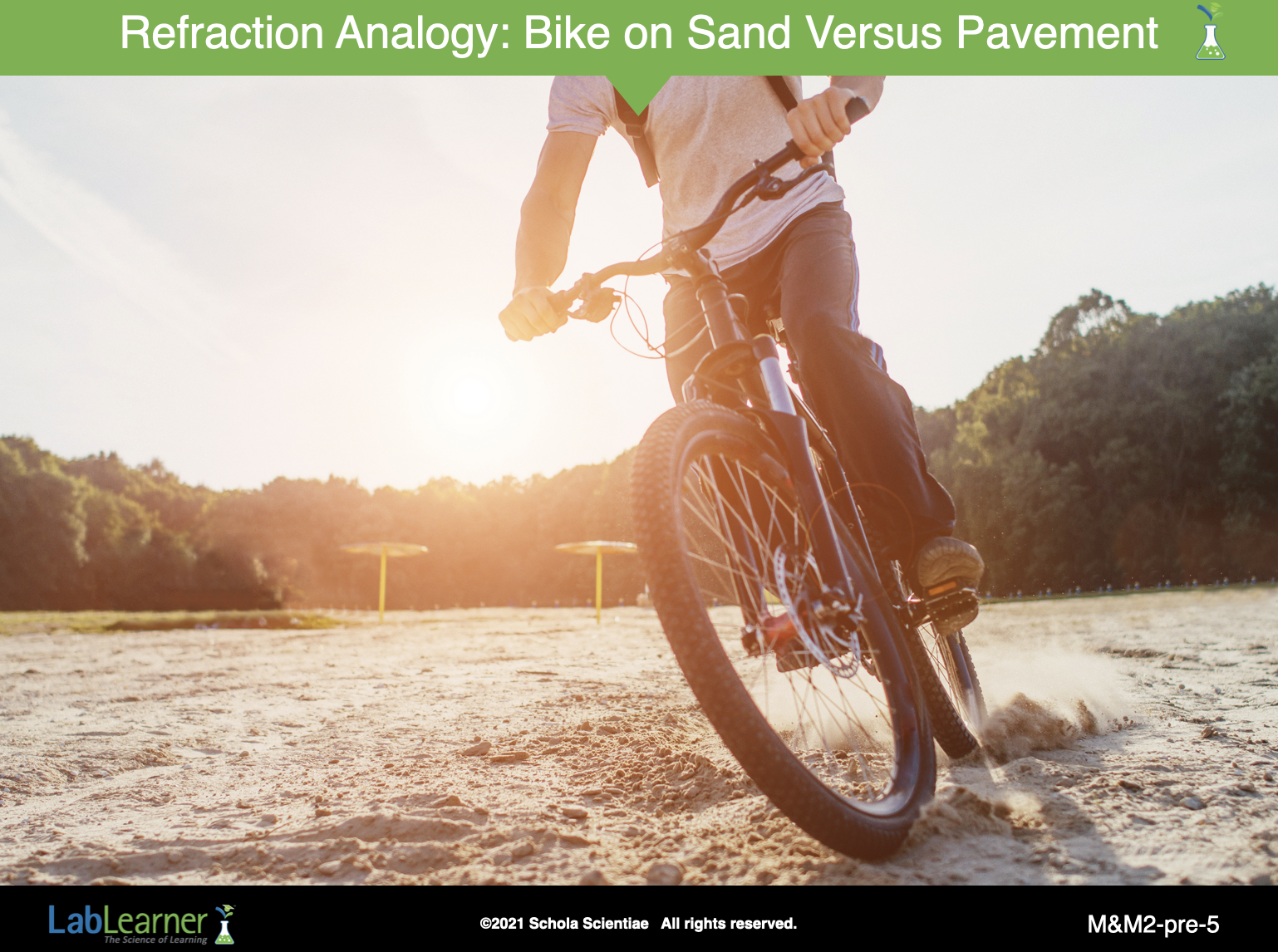
To aid students’ understanding, explain to students that light traveling from one medium into a different medium is analogous to a bicycle moving from hard pavement into soft sand.
- The bike slows down as it enters the sand. The bike will also change direction as it enters the sand, unless it is steered by the rider.
- Light behaves just like the bike. When it slows down, light changes direction and is bent or refracted.
______________________________________________
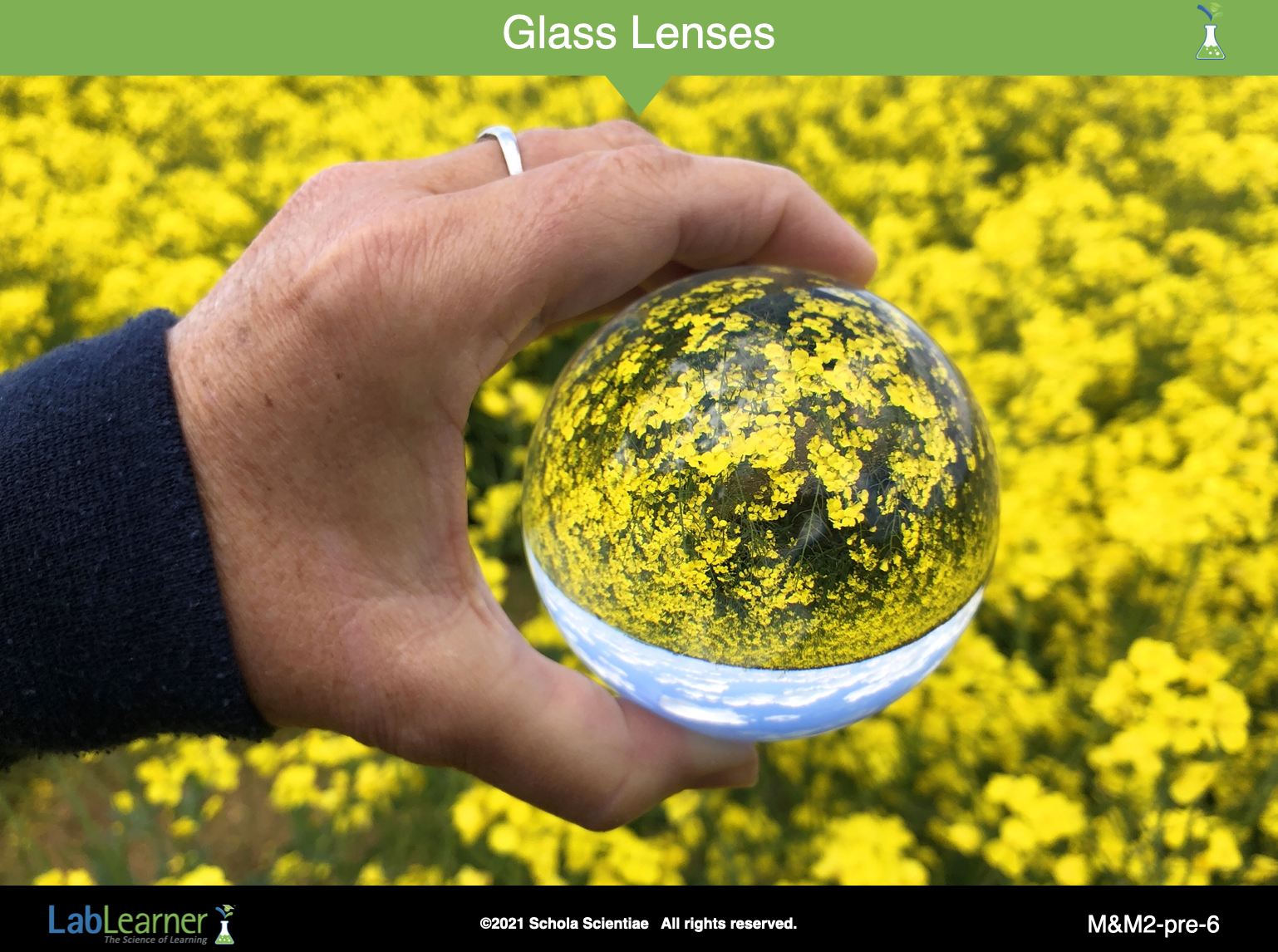
SLIDE M&M2-pre-6
This slide illustrates an inverted image seen through a crystal ball.
Inform students that they will perform experiments in the lab to find out the following questions:
- How does refraction occur?
- Could the pencil demonstration explain how a hand lens magnifies the appearance of an object?
- Do all lenses magnify?
- Do all lenses refract light?
- What is the relationship between magnification and field of view?
______________________________________________
KEYS: PRELAB