Teacher Portal:
Microscopes and Magnification
Investigation 2 – PostLab
 ASK WHY
Microscopes have made a tremendous contribution to science since their use began in the sixteenth century (the 1500s).
Microscopes are one of the most important scientific instruments developed. In fact, in the medical field, microscopes are largely responsible for making modern medicine “modern”!
BRANCH OUT
Microscopists today work in many different fields including field and laboratory life sciences, chemistry, materials science, and nearly every branch of biomedical research and medicine.
PRINT IT
Use your browser to download a printable PDF as help during the slide presentation and to make additional notes. In your browser, go to File > Print and then choose to save as PDF.
NAVIGATE IT
Once the slide presentation is launched
- use your left and right arrows to advance or go back in the slide presentation, and
- hover your mouse over the left edge of the presentation to get a view of the thumbnails for all the slides so that you can quickly move anywhere in the presentation.
- Click HERE to launch the slide presentation for the CELL.
SHARE IT
SLIDE M&M2-post-1
Begin the Post-Lab Analysis by reviewing the experiments and main ideas of the Lab. The following questions are intended as a guide for class discussion:
What types of lenses did you use? Student answers will vary. Students used convex, concave, and straight-sided lenses.
How does refraction occur? Student answers will vary. Refraction occurs when light is bent by passing through a second, different material.
Do all lenses magnify? Student answers will vary. No, not all lenses magnify, some reduce the size of an object’s image
Do all lenses refract light? Student answers will vary. Yes, all lenses refract light.
______________________________________________
SLIDE M&M2-post-2
Begin this part of the Investigation by reviewing students’ observations recorded during Trial 1. Ask students the following questions and draw the answers on the board.
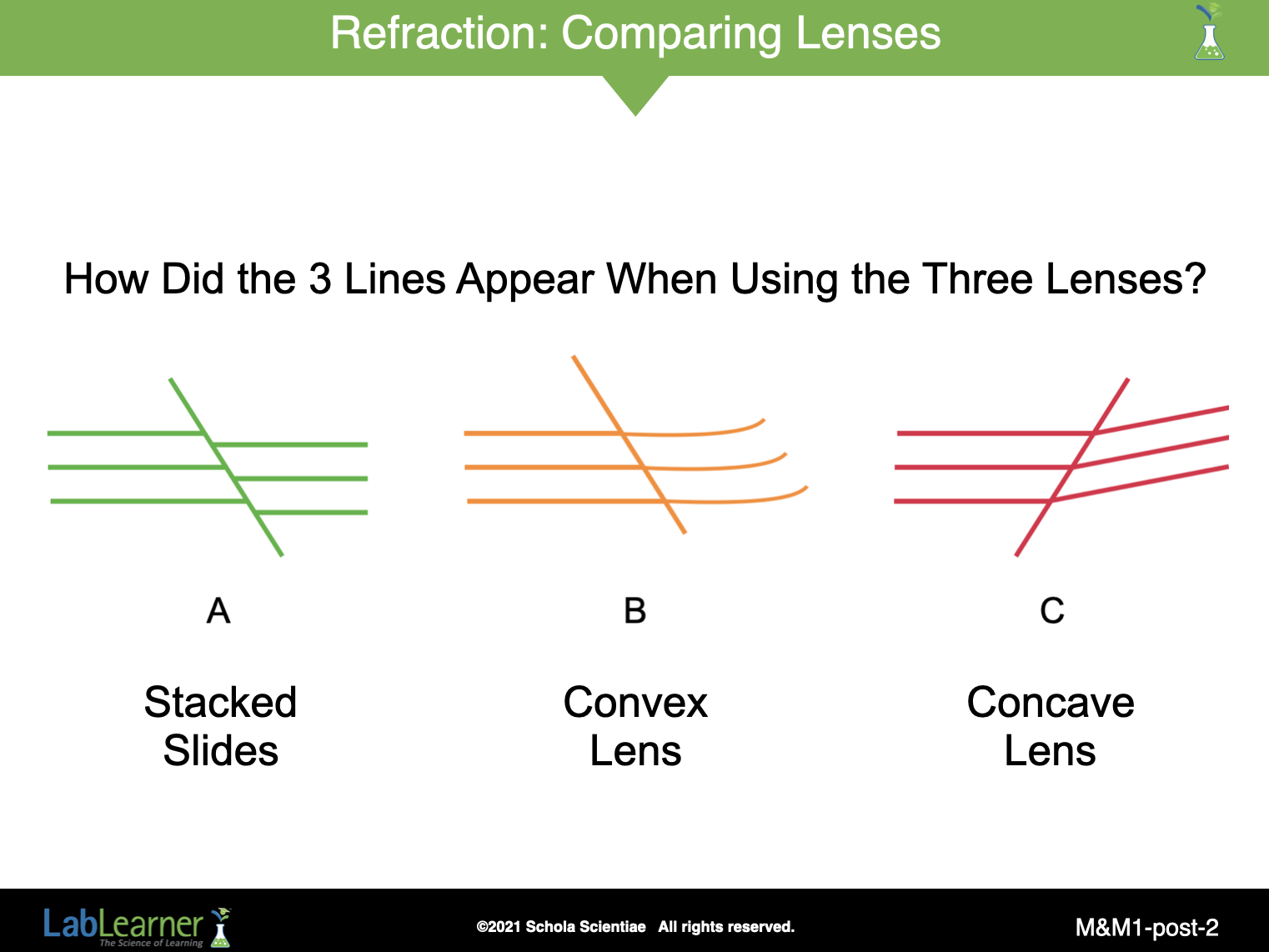
(A) How did the lines appear when you viewed them through the stacked microscope slides? Can you explain their appearance? The lines appeared to be offset from one another, not straight. The appearance suggests that the slides refracted the light.
(B) How did the lines appear when you viewed them through the convex lens? Can you explain their appearance? The lines were bent upward more than they were bent by the glass slide. The appearance suggests that the convex lens refracted the light to a greater extent than the slides.
(C) How did the lines appear when you viewed them through the concave lens? Can you explain their appearance? The lines were bent more than they were bent by the slides and in a different direction than by the convex lens. The appearance suggests that the concave lens refracted the light in a different way than the slides or the convex lens.
______________________________________________
SLIDE M&M2-post-3
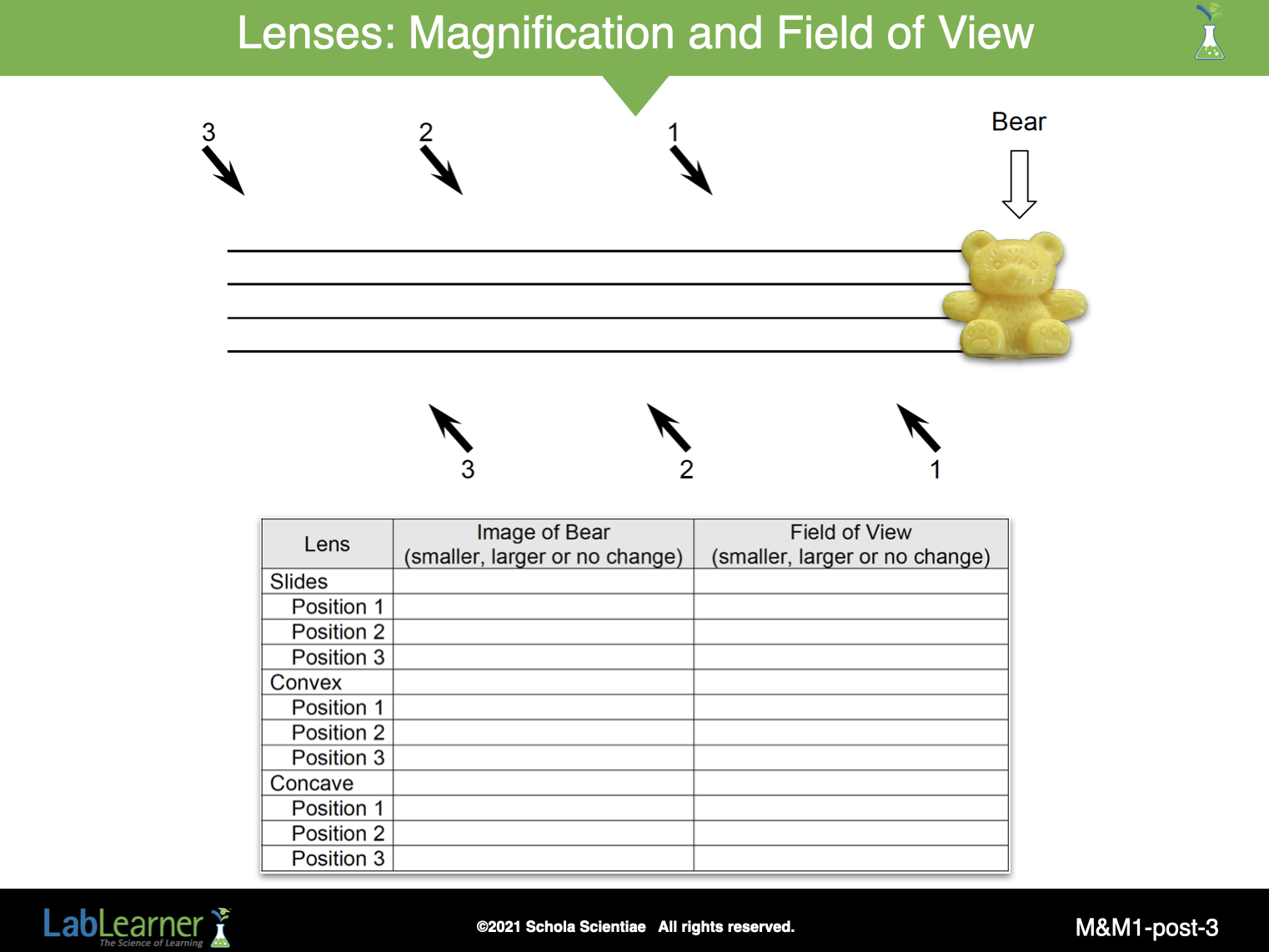
Ask students to refer to the data in the Table in Problem 9 of their Scientist Data Record. Ask students the following questions and summarize their data on the board:
Did each of the three lenses change the image of the bear? Student answers may vary. The slides did not change the image of the bear. The convex lens magnified the size of the image and the concave lens reduced the size of the image of the bear.
Based on the data in the table, which of the three lenses refracted light? Student answers may vary. The convex and concave lenses refracted light because they changed the size of the image. Because the lenses were thicker in some parts and thinner in others light would be refracted more in some parts of the lens (the thicker parts) than others. This resulted by the apparent curvature of the lines. The slides were the same thickness throughout and so the lines were refracted uniformly. Inform students that even though the slides did not change the size of the bear’s image, they are still able to refract light.
Ask students to refer to Trial 1 in their Scientist Data Record. The slides bent the image of the lines demonstrating that even though they do not affect the size of an image, they are still able to refract light.
Did the convex and concave lens refract light in the same way? Student answers may vary. No, the convex lens refracted light and magnified the image of the bear so it was larger. The concave lens refracted light causing the image of the bear to be smaller.
How did the lenses affect the field of view? Student answers may vary. The convex lens caused the field of view to become smaller and the concave lens caused the field of view to become larger.
Can you explain how the field of view can decrease as the magnification of the image increases? Student answers may vary. As the magnification increases, the image size increases and more detail is visible. As the image increases in size, less of it is visible through the lens and the field of view decreases.
______________________________________________

SLIDE M&M2-post-4
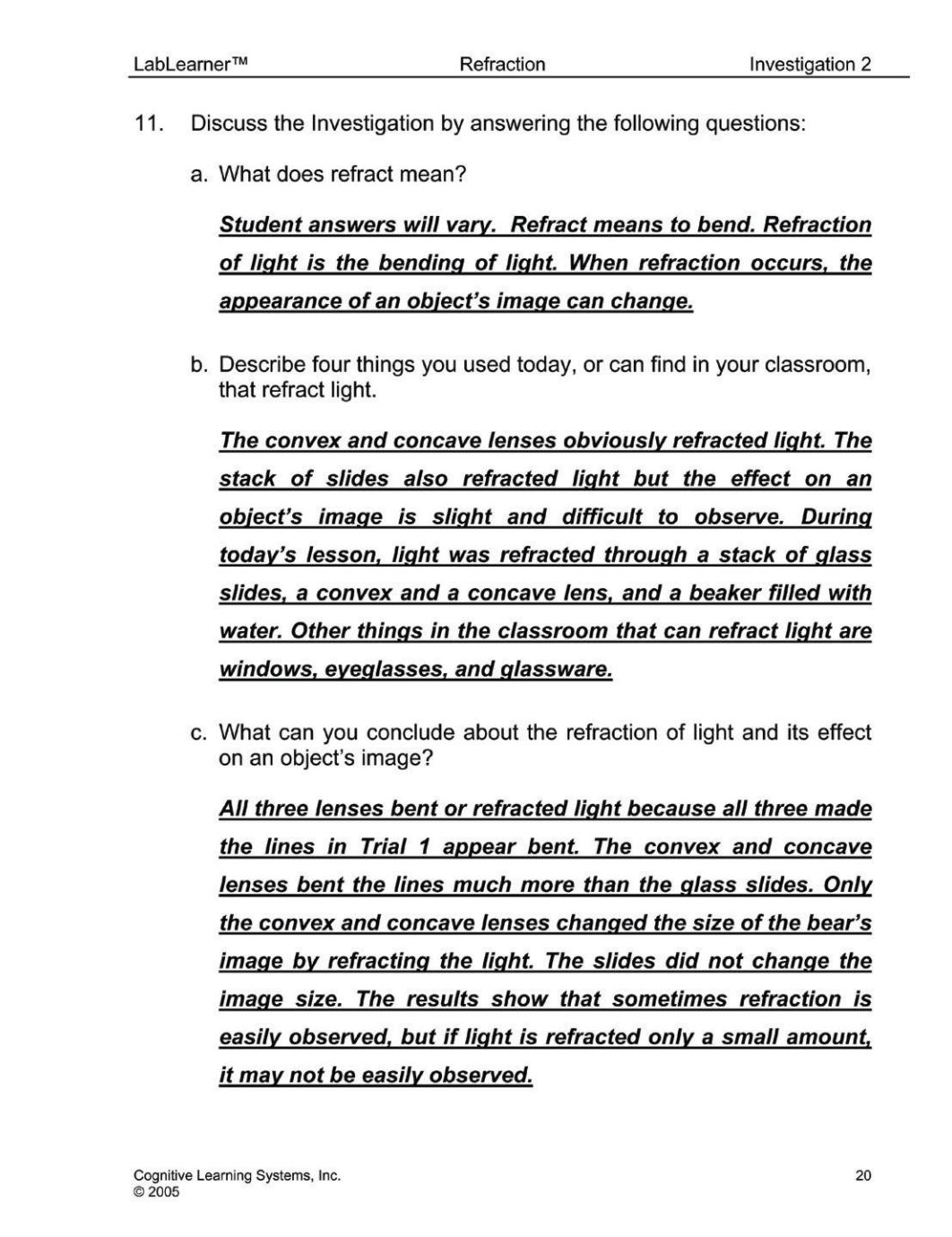
Divide students into groups and direct them to discuss and answer Problems 11a through 11c in their Scientist Data Record.
______________________________________________

SLIDE M&M2-post-5
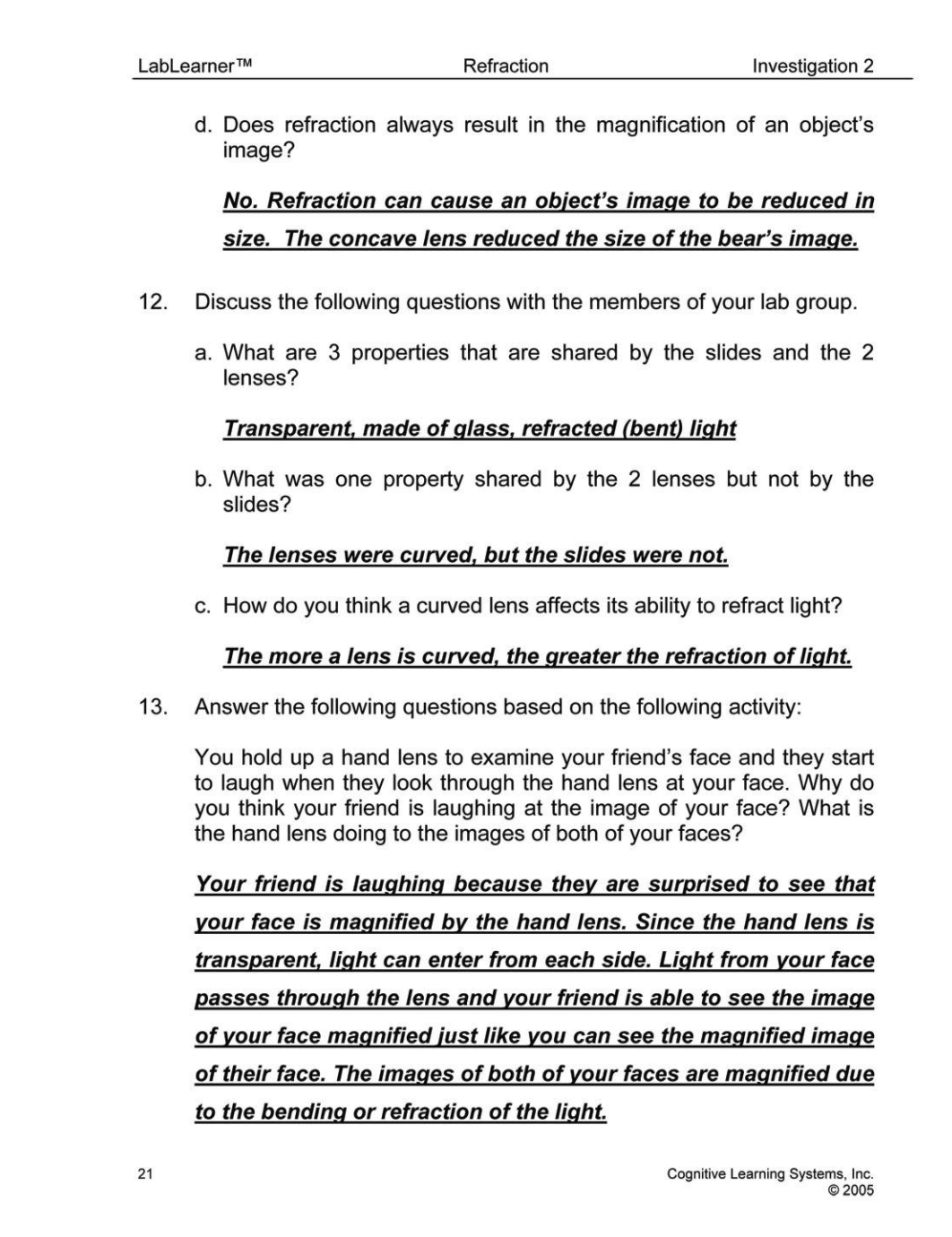
Divide students into groups and direct them to discuss and answer Problem 12a through 12c in their Scientist Data Record.
Allow 5-10 minutes for students to work in their groups.
After 5-10 minutes ask student groups to share their ideas. In the discussion, lead the students to the realization that the greater the curvature, the more refraction that occurs.
What three properties were shared by the slides and the two lenses? Transparent, made of glass and bent the lines (refracted the light).
What property was shared by the two lenses but not the glass slides? The lenses were curved but the slides were not.
How do you think the curvature of a lens affects its ability to refract light? The more a lens is curved the more the light will be refracted. The slides only slightly refracted the light from the lines and did not change the image size of the bear. The convex and concave lenses refracted the light from the lines much more and changed the image size of the bear. One of the differences between the glass slides and lenses is that the lenses are curved. Even though all three lenses refracted light, the refraction was greater and more noticeable when the glass was curved.
______________________________________________
SLIDE M&M2-post-6
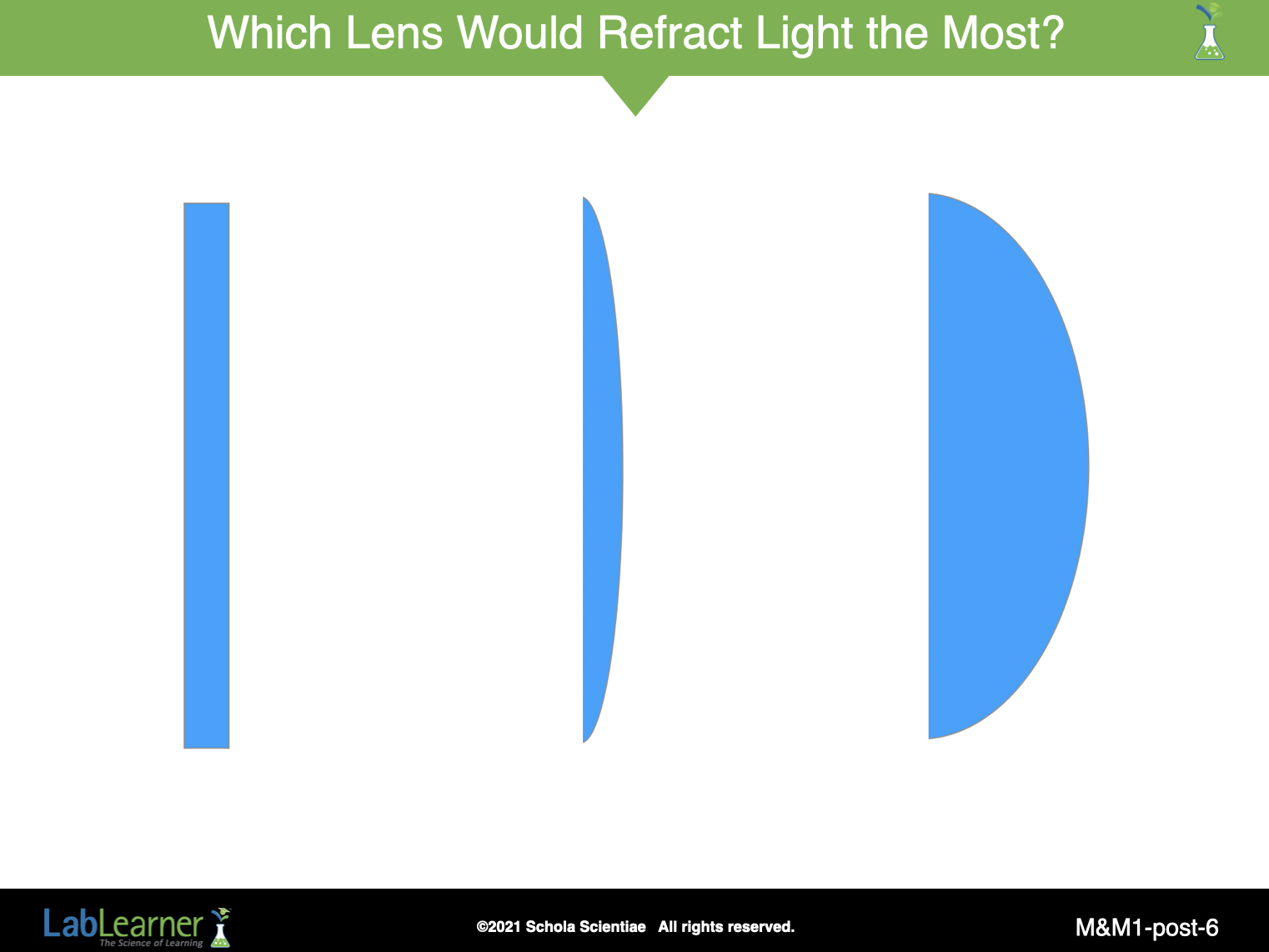
Which of the three lenses would you expect to refract light the most? The one on the far right.
Which of the three lenses would you expect to refract light the least? The one on the far left.
Why would you expect these lenses to do so? The lens on the far right has the greatest curvature so light when passing through this lens is refracted the most.
______________________________________________

SLIDE M&M2-post-6
Ask students to read the passage in Problem 13 in their Scientist Data Record and answer the question below:
Ask students: Why do you think your friend is laughing at the image of your face? What is the hand lens doing to the images of both of your faces? Your friend is laughing because they are surprised to see that your face is magnified by the hand lens. Since the hand lens is transparent, light can enter from each side. Light from your face passes through the lens and your friend is able to see the image of your face magnified just like you can see the magnified image of their face. The images of both of your faces are magnified due to the bending or refraction of the light from both of your faces.
KEYS: POSTLAB