
Teacher Portal:
Microscopes and Magnification
Investigation 2 – Lab
 ASK WHY
Microscopes have made a tremendous contribution to science since their use began in the sixteenth century (the 1500s).
Microscopes are one of the most important scientific instruments developed. In fact, in the medical field, microscopes are largely responsible for making modern medicine “modern”!
BRANCH OUT
Microscopists today work in many different fields including field and laboratory life sciences, chemistry, materials science, and nearly every branch of biomedical research and medicine.
BE PREPARED
Supplies and Equipment:
Group Materials:
- 6 microscope slides
- 1 medium binder clip
- 1 convex lens
- 1 concave lens
- 1 bear, large (12g)
Individual Materials:
- 1 Student Data Record
Teacher Preparation
- Place required materials at a central location.
- Divide the class into five groups.
INVESTIGATE
Trial 1
Explain to students that in Trial 1, they will investigate refraction by conducting experiments using three different lenses.
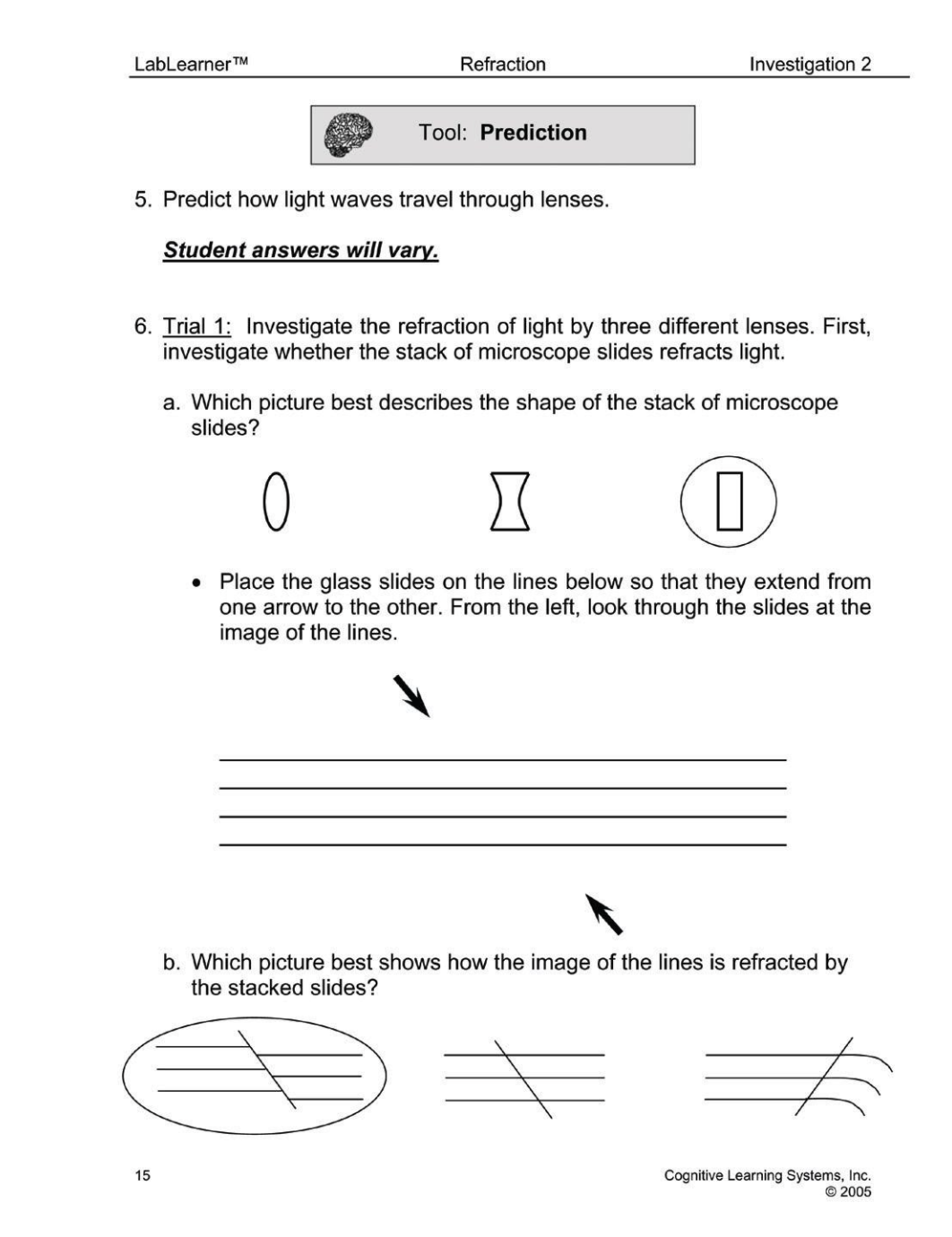
a. Inform students that they will first use the stacked slides which form a lens with straight sides. Students should stack the slides and use the binder clip to secure them together at the center of the long side.
- Students should observe the stacked slides and answer Problem 6a in their Scientist Data Record.
Instruct students to look from the left through the slides at the image of the lines.
Ask students to circle the picture that best shows how the image of the lines is refracted by the stacked slides.
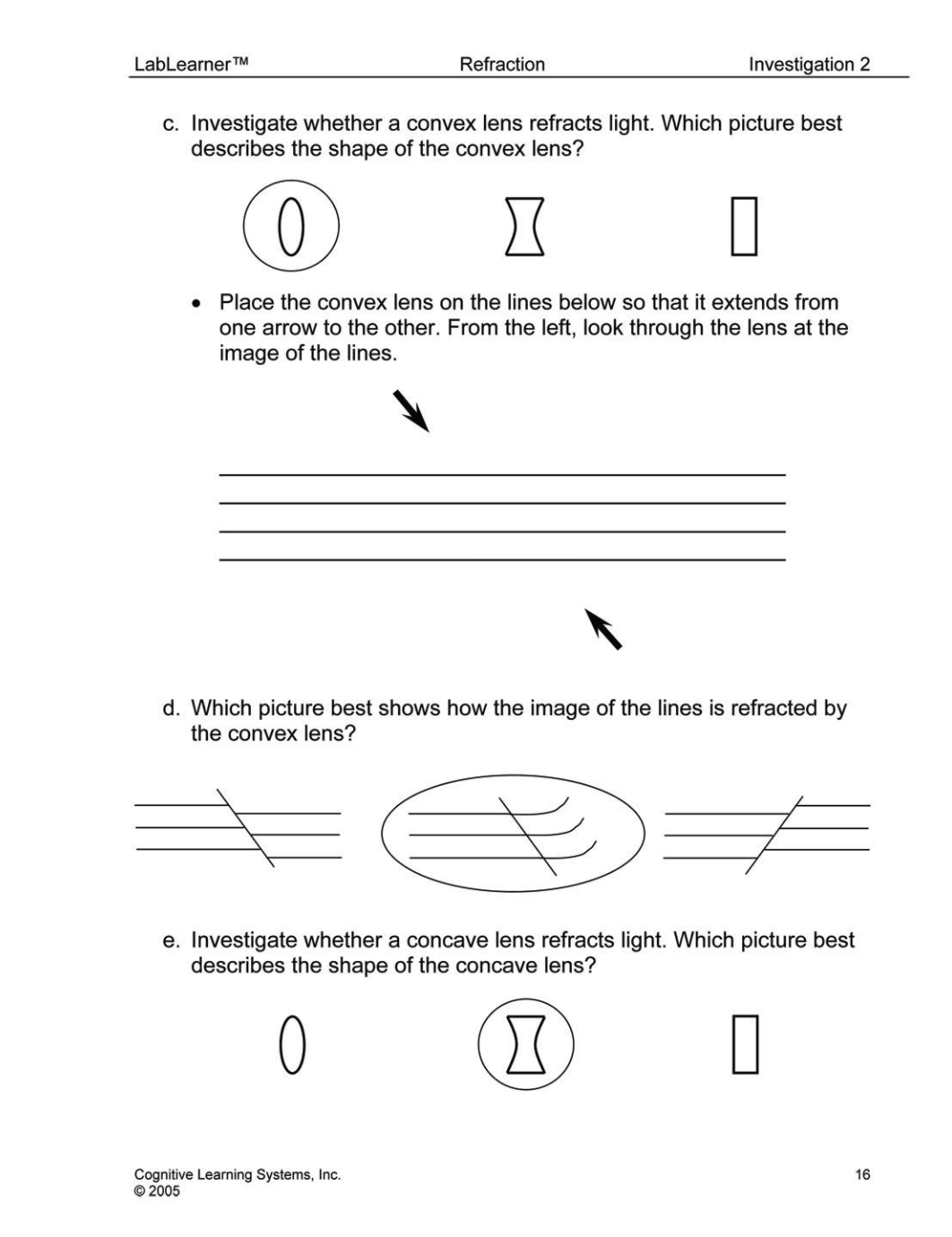
b. Inform students that they should next use the convex lens which is a lens with curved sides.
- Students should observe the convex lens and answer Problem 6b in their Scientist Data Record.
- Ask students to locate the set of lines in Scientist Data Sheet Problem 6b. Ask students to place the convex lens on the lines so that they extend from one arrow to the other.
- Instruct students to look from the left through the lens at the image of the lines.
- Ask students to circle the picture that best shows how the image of the lines is refracted by the convex lens.
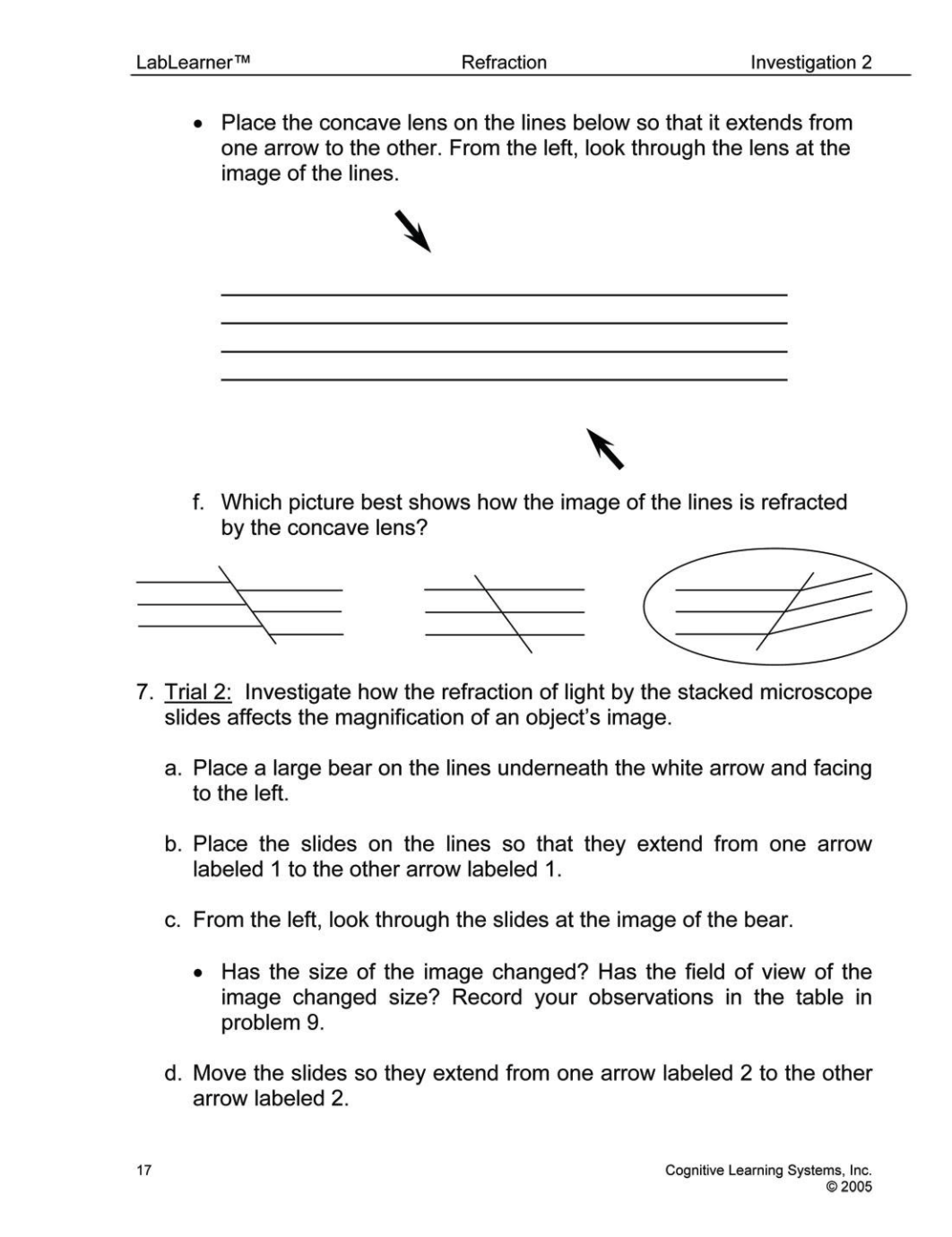
c. Inform students that they should next use the concave lens which is a lens with curved sides that have a curvature reverse of the convex lens.
- Students should observe the concave lens and answer Problem 6c in their Scientist Data Record.
- Ask students to locate the set of lines in Scientist Data Record Problem 6c. Ask students to place the concave lens on the lines so that they extend from one arrow to the other.
- Instruct students to look from the left through the lens at the image of the lines.
- Ask students to circle the picture that best shows how the image of the lines is refracted by the concave lens.
Trial 2
Explain to students that in Trial 2, they will investigate how refraction can change the size of an object’s image using the stacked microscope slides.
Ask students to locate problem 7 in their Scientist Data Record.
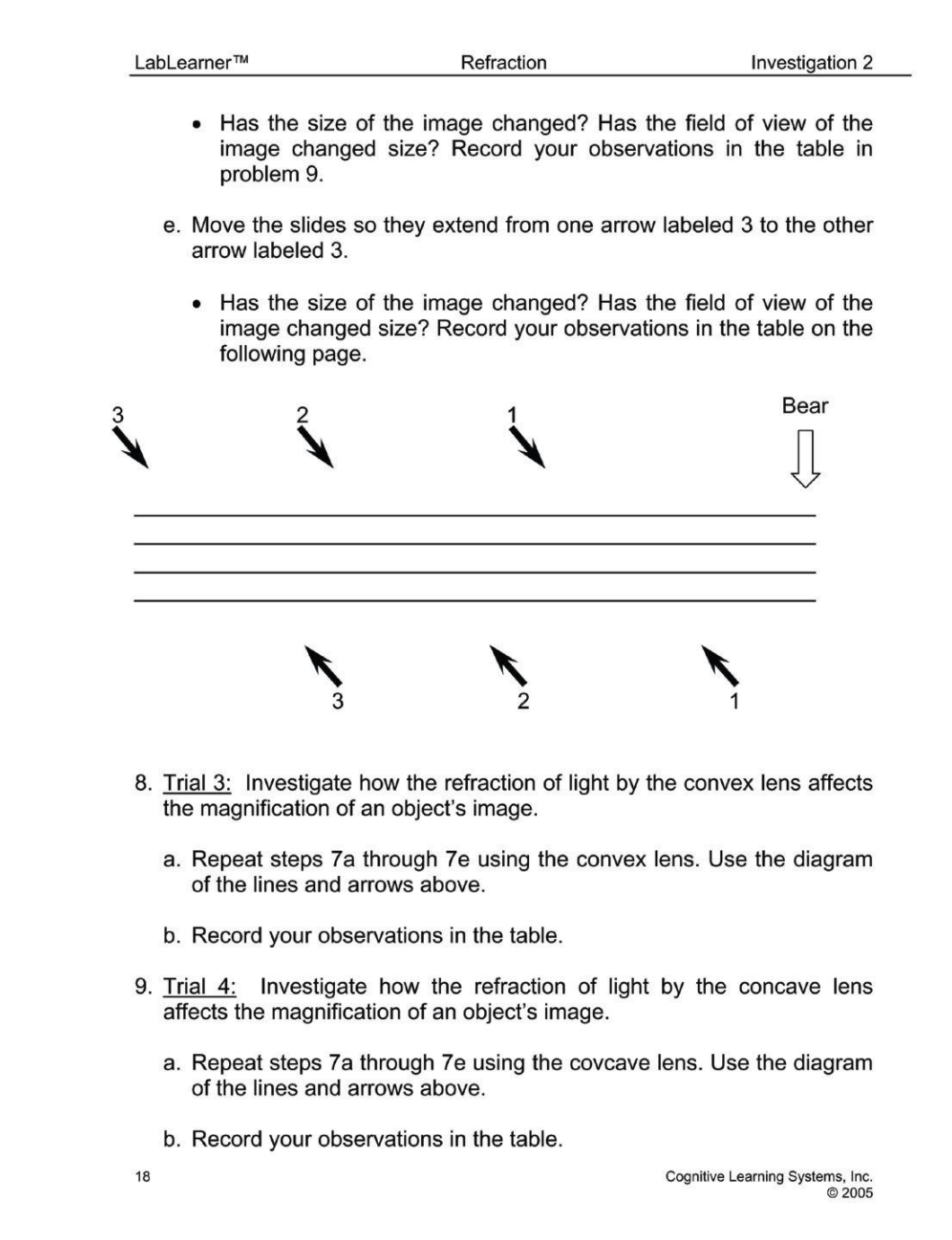
Ask students to place the bear on the lines facing to the left under the white arrow.
- Students should place the slides on the lines so that they extend from one arrow labeled 1 to the other arrow labeled 1.
- Students should observe the stacked slides and answer Problem 6a in their Scientist Data Record.
- Ask students to locate the set of lines in Scientist Data Record Problem 6a. Ask students to place the stacked slides on the lines so that they extend from one arrow to the other.
- Instruct students to look from the left through the slides at the image of the lines.
- Ask students to circle the picture that best shows how the image of the lines is refracted by the stacked slides.
Students should next repeat the procedure by placing the slides first on the arrows labeled 2 and then on the arrows labeled 3.
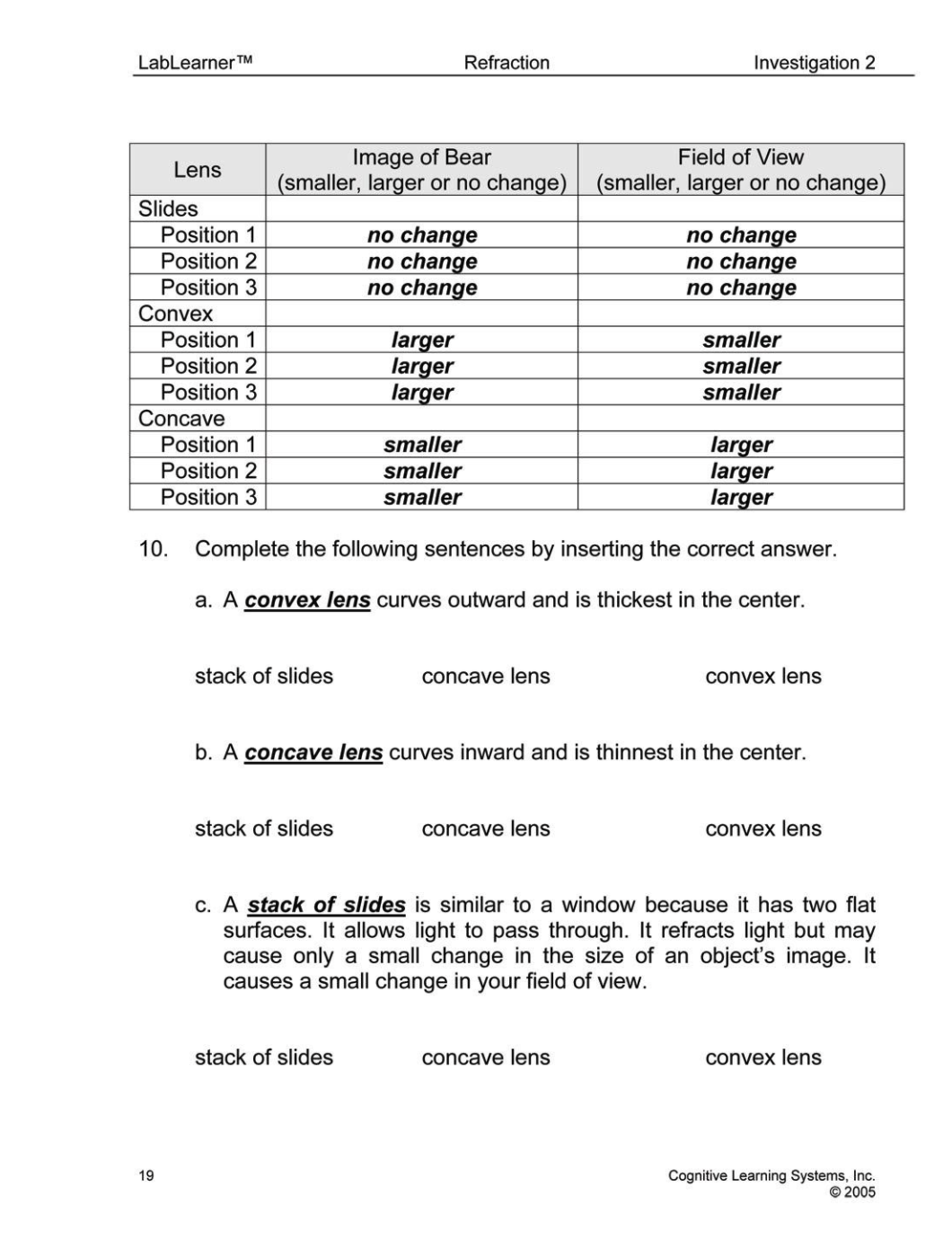
- Students should repeat their observations for these two positions and record their observations in the Table in Problem 9.
Trial 3
Explain to students that in Trial 3, they will investigate how refraction acts to change the size of an object’s image using the convex lens. Students should locate Problem 8 in their Scientist Data Record and repeat steps 7a through 7e using the convex lens. Students should record their observations in the Table at the end of Problem 9.
Trial 4
Explain to students that in Trial 4, they will investigate how refraction acts to change the size of an object’s image using the concave lens students should locate Problem 9 in their Scientist Data Record and repeat steps 7a through 7e using the concave lens. Students should record their observations in the Table at the end of Problem 9.
_________________________________
Ask students to answer problem 10 in their Scientist Data Record. Ask students to differentiate the shapes of the stacked slides, the convex lens, and the concave lens.
As a closure to the lesson, ask students the following questions:
How does refraction of light by the convex lens differ from refraction by the stacked microscope slides and the concave lens? The convex lens magnifies images, making objects appear larger. The concave lens causes the size of an object’s image to decrease. The stacked slides do not cause any noticeable change in an object’s apparent, size.
Does refraction always cause magnification of an object? No. If an object is viewed through glass with straight sides, the object may appear unchanged. If it is viewed through a concave lens, it may appear smaller. Refraction through a convex lens or another transparent material may result in magnification.
KEYS
CLEAN UP
Let students know your expectations for clean-up. Ask them to clean up.