
Teacher Portal:
Microscopes and Magnification
Investigation 1 – Lab
 ASK WHY
Microscopes have made a tremendous contribution to science since their use began in the sixteenth century (the 1500s).
Microscopes are one of the most important scientific instruments developed. In fact, in the medical field, microscopes are largely responsible for making modern medicine “modern”!
BRANCH OUT
Microscopists today work in many different fields including field and laboratory life sciences, chemistry, materials science, and nearly every branch of biomedical research and medicine.
BE PREPARED
Supplies and Equipment:
Pair Materials:
- 1 wood block
- 1 hand lens
- 1 bear, large (12 g)
Individual Materials:
- 1 Student Data Record
Teacher Preparation
-
- Place required materials at a central location.
- Divide the class into student pairs
GET FOCUSED
Inform students that they will be using the hand lens.
- Remind students that Hand Lens Use and Operation is one of the tools from their Procedural Toolbox. Encourage students to recall the steps they need to perform in order to use the hand lens. Refer students to a copy of the Procedural Toolbox included with this CELL if necessary.
- If necessary, instruct students in the correct use of the hand lens using their index finger as the object. Ask students to hold the hand lens in one hand close to the index finger of their other hand. Ask students to move the hand lens away from their finger, towards their eye, until the magnified image is clear.
- Inform students that they are using an “assisted eye” since they are using the hand lens to magnify the image of their finger. Using a “naked eye” or “unassisted eye” means to view an object without glasses or any other assistance or help.
INVESTIGATE
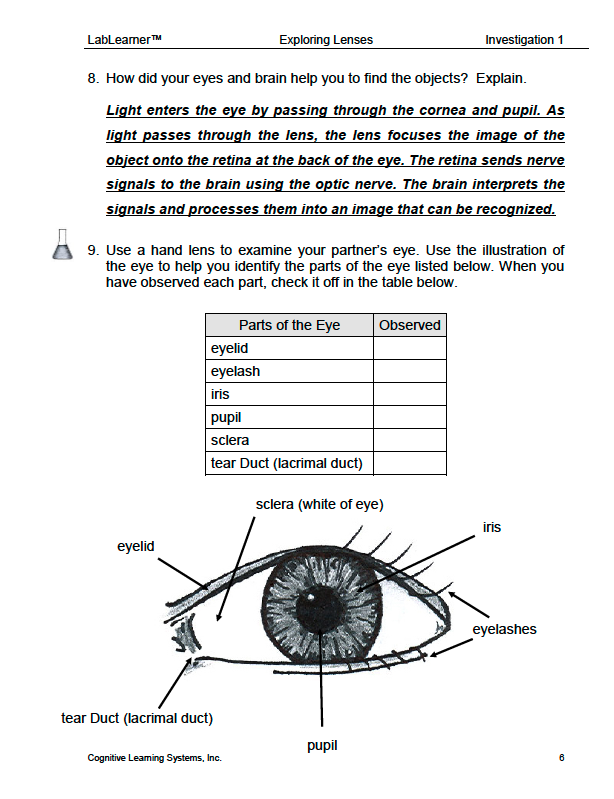
Ask students to read problem 9 in their Student Data Record. Each student of a pair should take turns viewing their partner’s eye using the hand lens. Students should use the illustration of the eye to help them examine and identify the parts of their partner’s eye. Ask students to check off each part of the eye listed in the table in problem 9 in their Student Data Record as they identify it.
- Ask students to think about how the hand lens assisted their eyes to observe and identify the parts of their partner’s eye. Ask students to answer problem 10 in their Student Data Record. Encourage students to discuss their answers with their partners and complete the question.
- Ask students to think about what the hand lens and their eye have in common. Inform students that to assist their answer they should place the hand lens next to the diagram of the eye. Students should answer problems 11 and 12 in their Student Data Record.
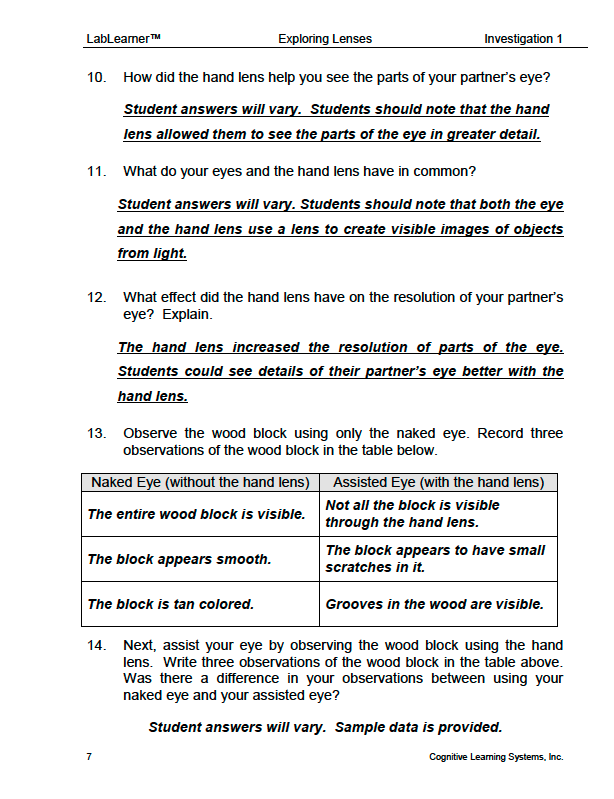
Instruct students to observe the woodblock using first their naked or unassisted eye and then their assisted eye by using the hand lens. Students should first use their naked or unassisted eyes and then record three observations of the woodblock in the Table in Problem 14 in their Student Data Record.
- Students should then observe the woodblock with an assisted eye by using the hand lens. Students should record three observations of the woodblock in the table in Problem 14 in their Student Data Record.
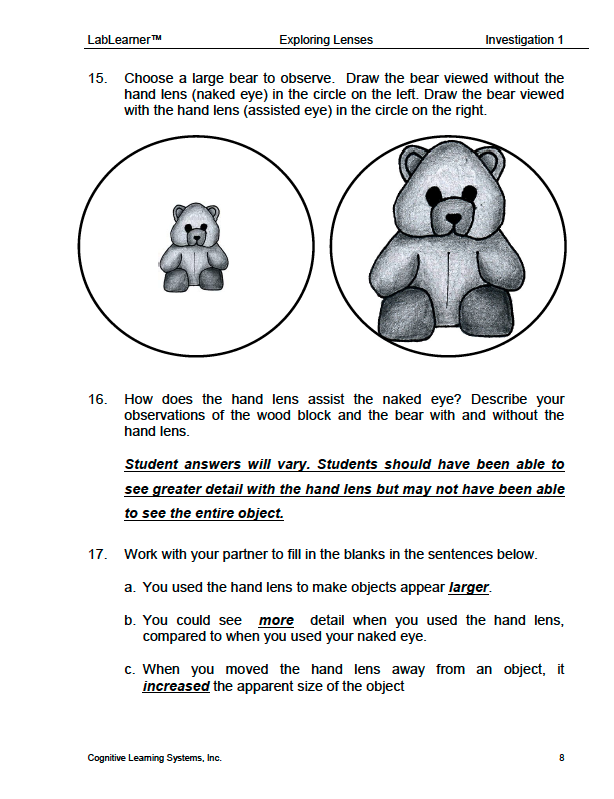
As a final demonstration of using their unassisted versus assisted eye, ask students to view a large bear.
- Students should view the bear with their naked or unassisted eyes and draw the bear in the indicated circle in problem 15 in their Scientist Data Record.
- Students should then observe the bear with an assisted eye by using the hand lens. Students should draw the bear in the indicated circle in Problem 15 in their Scientist Data Record.
To close the lesson, ask students to answer Problem 16 in their Student Data Record.
- How did you use the hand lens? At what point did the object appear to look larger? Student descriptions will vary. As students drew the lens away from the object, the object appeared to become larger.
- How does the hand lens assist the naked or unassisted eye? The naked eye may have difficulty focusing on small details without assistance. Using a hand lens magnifies details that are not discernable, enabling the “assisted eye” to see what the naked eye cannot.
- Describe your observations of the woodblock and the bear with and without the hand lens. Student answers will vary. Students should have been able to see greater detail with the hand lens but may not have been able to see the entire object.
KEYS
CLEAN UP
Let students know your expectations for clean-up. Ask them to clean up.