
Teacher Portal:
Light and Optics
Investigation 5
Investigation Five: Perception of Visible Light
In Investigation One, students were introduced to the absorption, transmission, and reflection of light. In Investigation Two, students were introduced to the Law of Reflection. In Investigation Three, students applied the Law of Reflection to take advantage of multiple angles of incidence and reflection allowing them to view an object hidden from direct view. In Investigation Four, students demonstrated that visible light can be separated by refraction into a continuous spectrum of waves of different wavelengths called the Visible Spectrum. In Investigation Five, students are introduced to the concept that light is a form of energy called electromagnetic energy and that the Visible Spectrum is only one part of the larger Electromagnetic Spectrum.
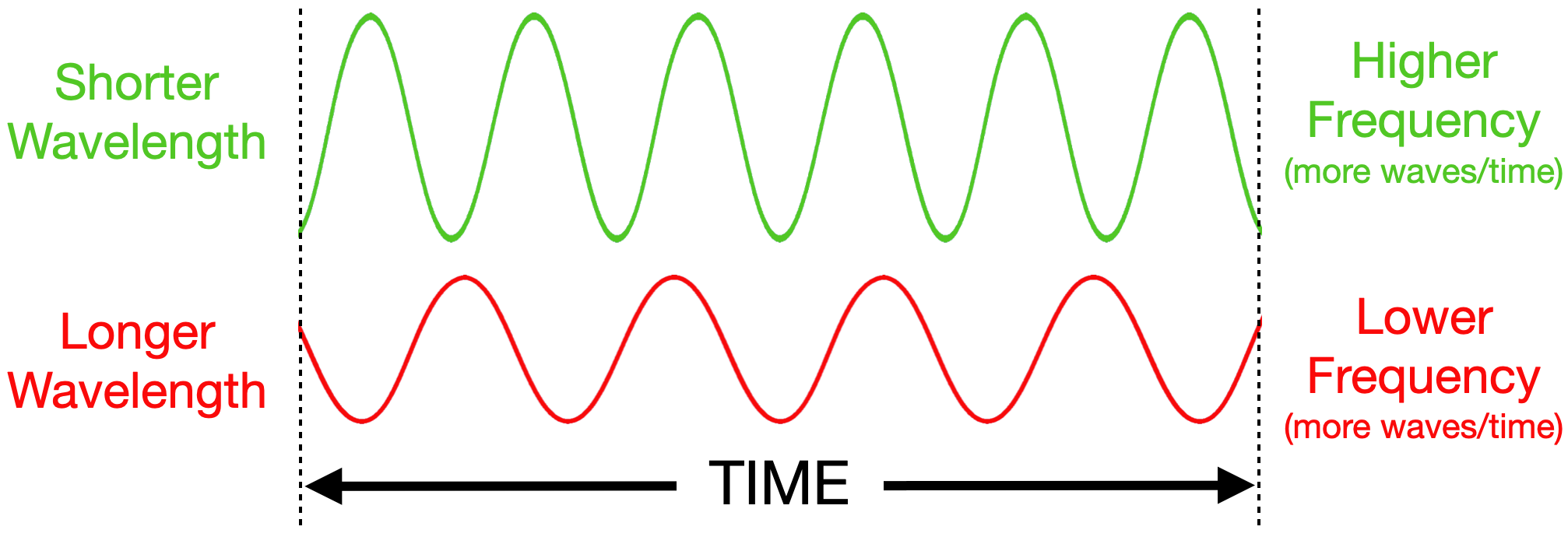 As students learn about the Electromagnet Spectrum, they will again consider the relationship between wavelength and frequency that was introduced in Investigation Four. Wavelength and frequency are related for the following reason. If a light wave possesses a large wavelength it will possess a low frequency. Conversely, a second wave with a short wavelength, possesses a high frequency.
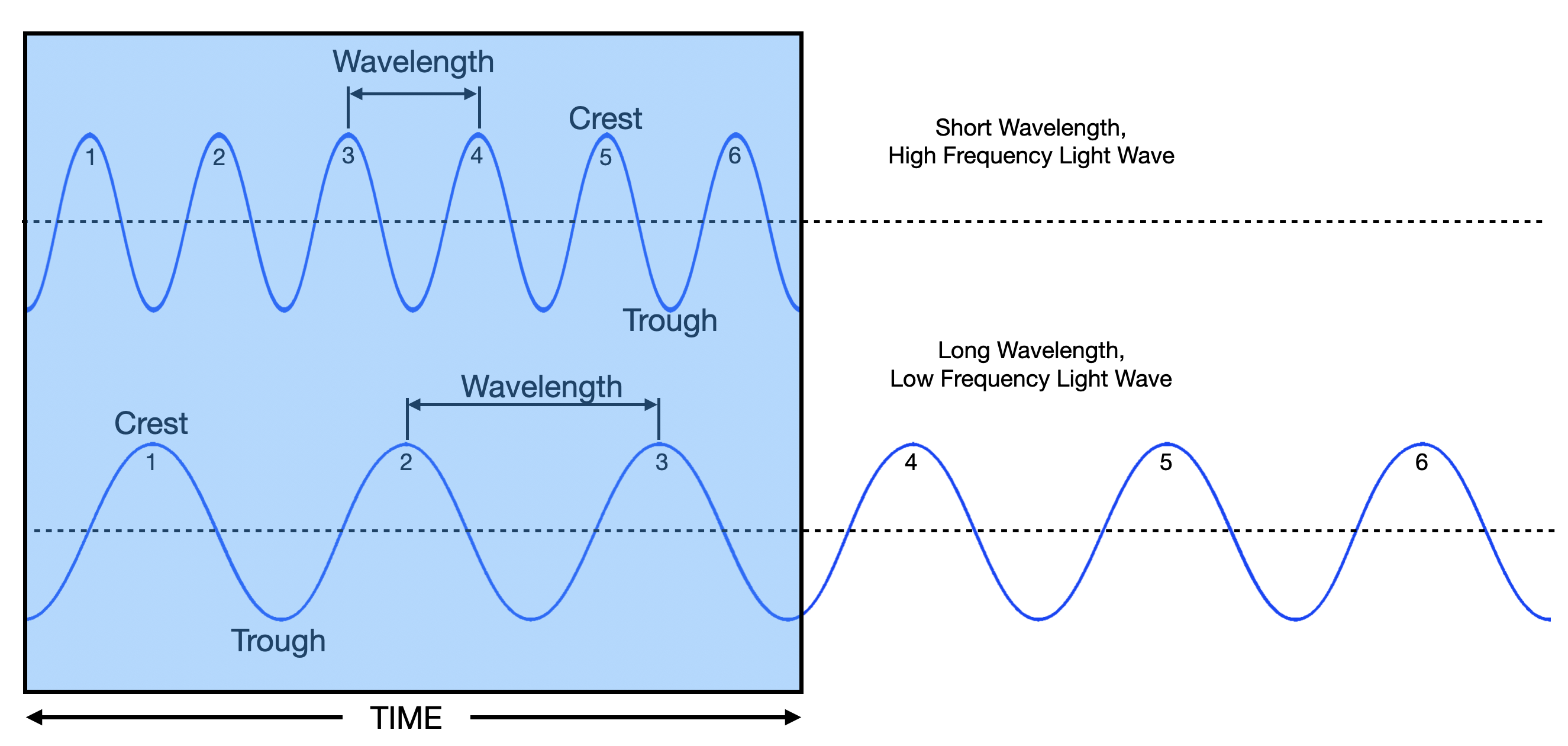
As the wavelength increases, the frequency of a wave decreases. For example, the two light waves shown below, each possess six crests and six troughs. The top wave possesses a wavelength that is one-half the wavelength of the bottom wave. In the time it takes all the six crests of the top wave to pass a stationary point, only three crests of the bottom wave will pass. The frequency of the crests of the top wave is greater than the frequency of the crests of the bottom wave.
The Visible Spectrum, that students first explored in Investigation Four, constitutes only a small portion of the larger Electromagnetic Spectrum of energy (see illustration below). Like visible light, other wave energies of the Electromagnetic Spectrum differ by their wavelengths and frequencies. Unlike the Visible Spectrum, however, no other wave energies of the Electromagnetic Spectrum are perceived by the human eye.
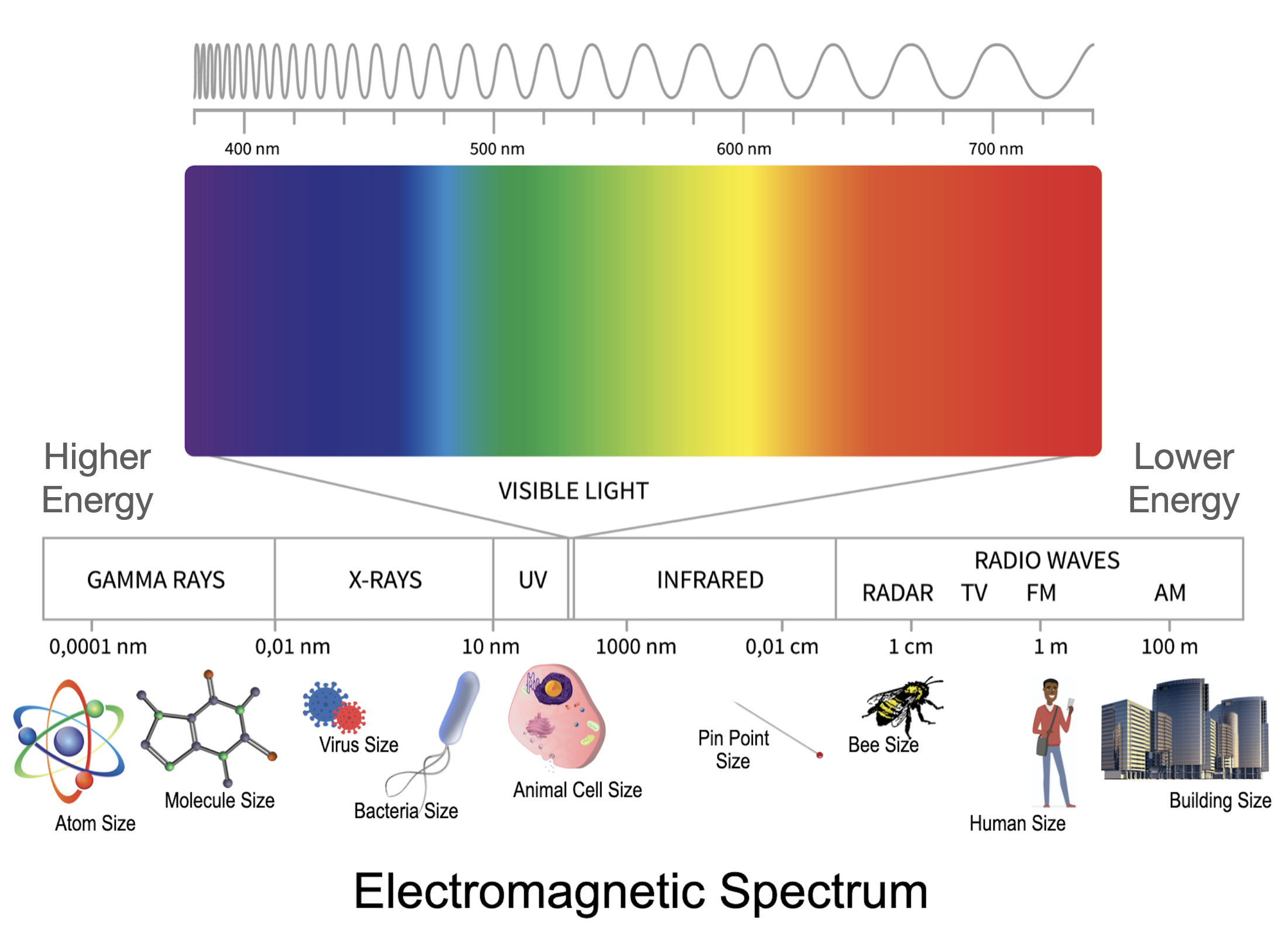
Even though only the small Visible Spectrum portion of the entire Electromagnetic Spectrum can be seen by the human eye, the effects of all wave energies are real and significant. For example, the infrared region contains wavelengths longer than visible red is responsible for the heating effect of the Sun. The ultraviolet (UV) region of the spectrum contains wavelengths shorter than visible violet. While this region of the Electromagnetic Spectrum is not visible, its effect is to produce sunburn in unprotected skin. It should be noted that as the wavelength of each energy wave decreases, the energy of each wave increases. Therefore, ultraviolet light possesses less energy than X-Rays which possess less energy than Gamma Rays. The above graphic of the Electromagnetic Spectrum shows the incredibly wide range of wavelengths that occurs in nature. While gamma rays have wavelengths the size of atoms, radio waves have wavelengths up to the size of buildings!
The perception of only the visible portion of the Electromagnetic Spectrum is a consequence of the visual system of the eye. The retina detects only those wavelengths of light that correspond to the Visible Spectrum. Wavelengths of the Visual Spectrum are detected by the eye as a result of the combination of the absorption, reflection and transmission of these light waves.
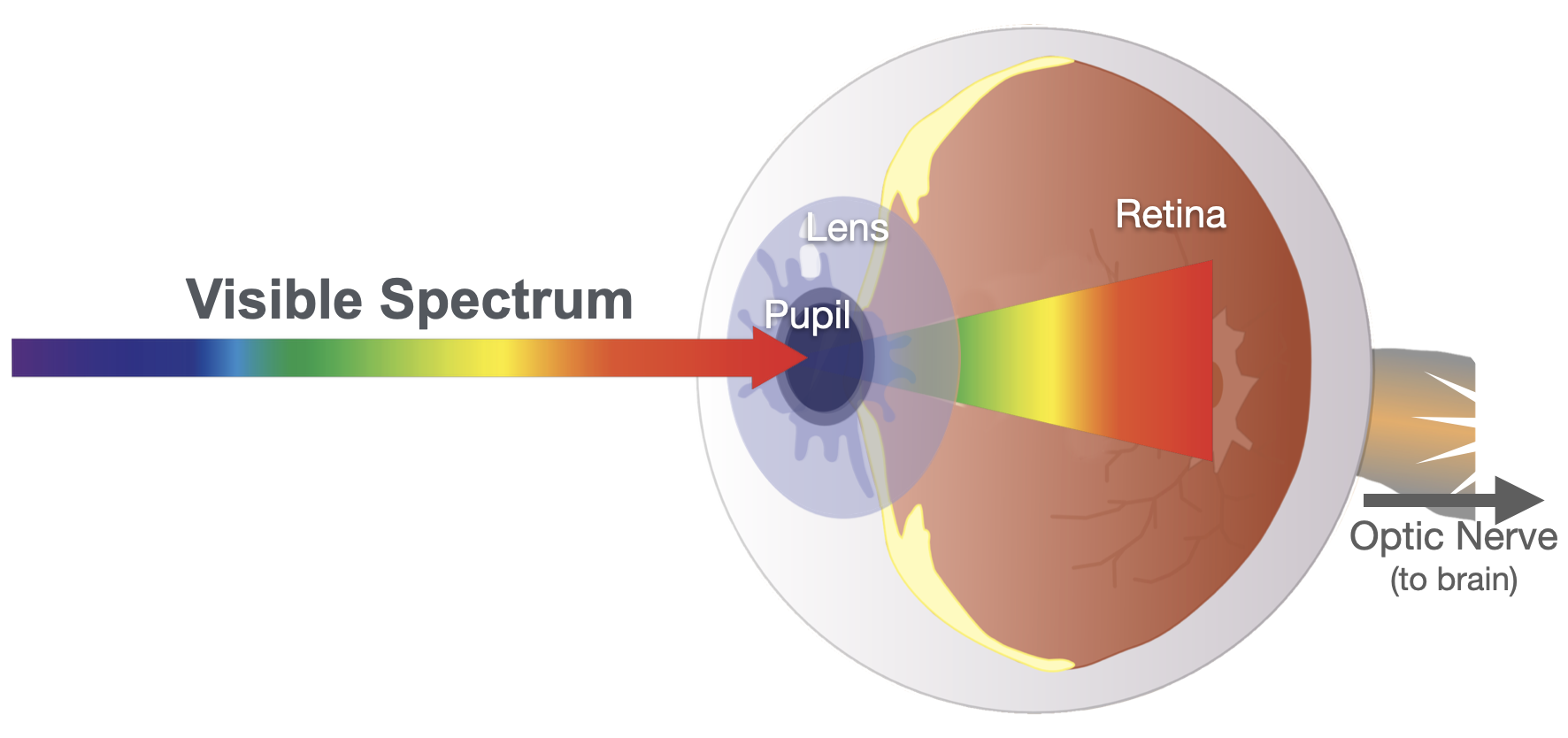
When white light strikes an opaque object of a specific color, all the wavelengths of the Visible Spectrum strike the object. These wavelengths of light can either be reflected or absorbed. Wavelengths of light that are reflected can then be detected by the eyes and interpreted by the brain. Wavelengths that are absorbed are not able to be detected by the eyes and therefore are not perceived by the viewer. The color that is perceived by a person, therefore, is the result of the wavelengths of light that are reflected off of the object. To give a simple example, if all wavelengths included in the Visible Spectrum, are absorbed by the pigments in the object except the wavelength corresponding to around 700 nm, the object will appear red (see the illustration below). That is, the light of red wavelengths is reflected by the object (the apple in this example) and can be detected by the human eye.
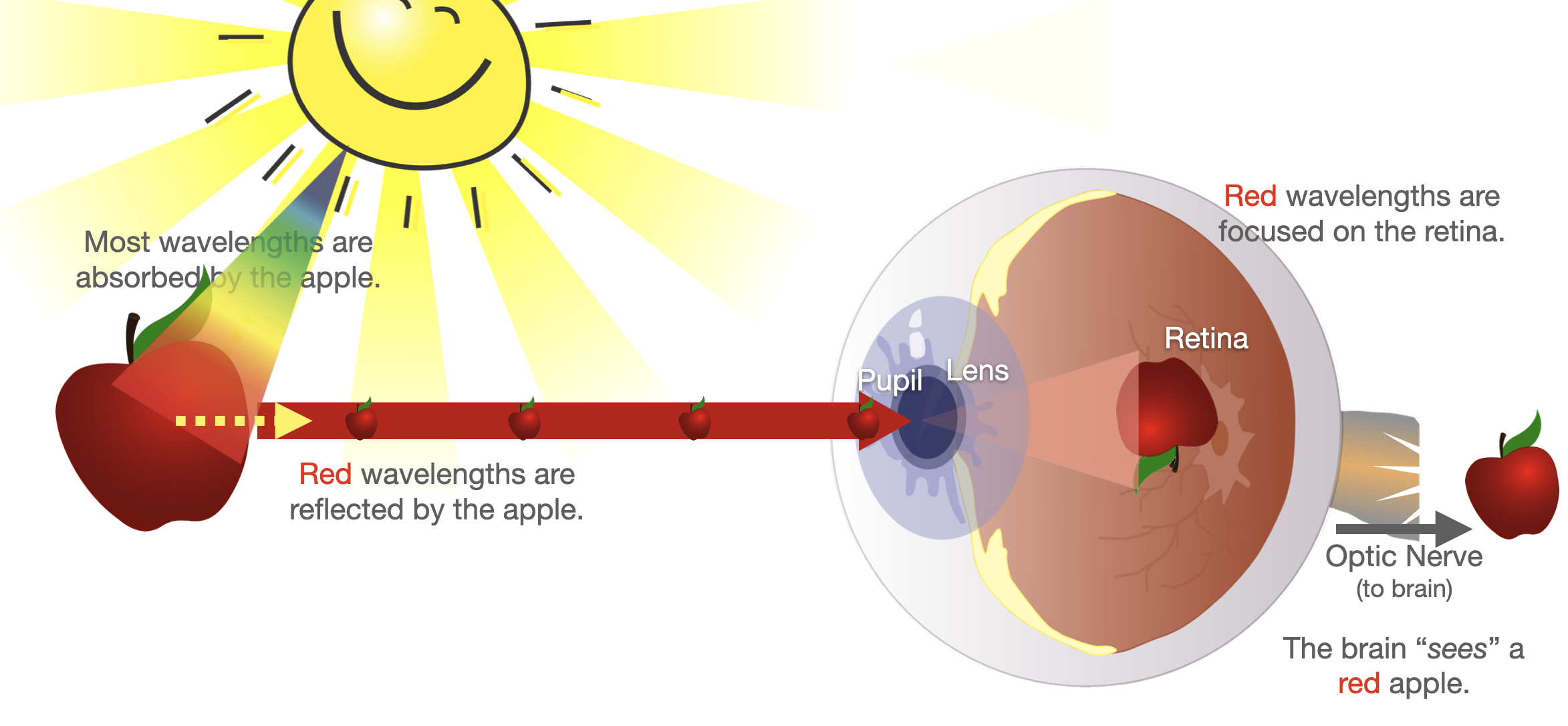
In the example described above, the color perceived was the result of the reflection of a single wavelength of light. However, this is not always the case. For instance, there are many different shades of red. Differences in the shade of red occur because of differences in the wavelengths of light that are absorbed and reflected by pigments in an opaque object. One way differences in shades can occur is if wavelengths corresponding to several different wavelengths are reflected. For example, if blue and red colors are reflected, the object will be perceived as a blue-red color. If wavelengths corresponding to orange and red colors are reflected, the object will be perceived as an orange-red color. Thus, as students discovered during their work with the transparent filters in Investigation Four, the color we perceive is often the result of the combination of different wavelengths that reach the eye.
In Investigation Five, students will have the opportunity to continue their exploration of light and color while viewing both transparent and opaque substances with the unassisted eye and through transparent filters. In doing so, students will expand their understanding of the Visible Spectrum and perception of color.
Light and Optic: Investigation 5 - Mathematics Concepts
Prelab
- continuum scale in meters
- frequency
- exponents
Lab
- distance in cm
- predict/verify measurements
- continuum scale in meters
- exponents
- comparing (non)measurable characteristics
- data table
Postlab
- data analysis
Light and Optics: Investigation 5 - Procedural Tools

Light and Optics: Investigation 5 - Cognitive Tools

Light and Optics:
Investigation 5 Quiz

