
Teacher Portal:
Light and Optics
Investigation 2
Investigation Two: Reflection
In Investigation One, students were introduced to three different ways that light is able to interact with substances (solids, liquids, and gases): absorption, transmission, and reflection. In Investigation Two, students investigate how surfaces reflect light through an introduction to the Law of Reflection.
Protractors
In this Investigation, measuring angles is very important. A protractor is a simple device that permits the accurate measurement of angles. Students will get practice using a protractor several times during the Investigation Two Lab.
Every circle is made up of 360 degrees (360o). A protractor is usually a half-circle, but sometimes you will see a circular protractor:
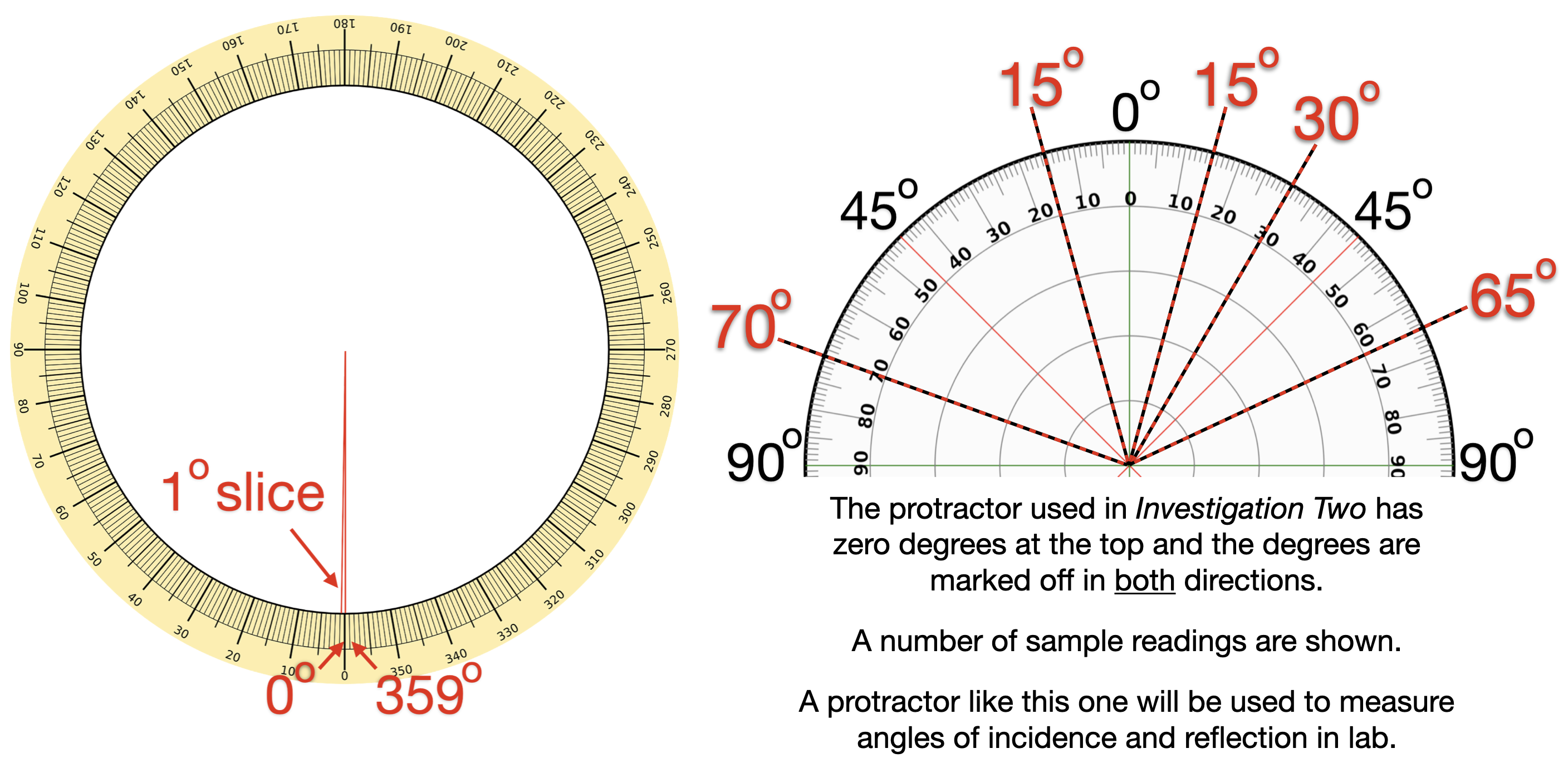
The protractor that students will use in Investigation Two Lab is shown on the illustration above on the right. Notice that straight up and down is the zero and that degrees are marked off both to the left and to the right. The reason for using this particular protractor is to permit easy use to determine both the angle of incidence and the angle of reflection. In addition, the illustration above also includes several example readings.
Protractors and degrees are important tools and concepts both in science and mathematics. This is because the protractor quantifies portions of a regular circle. Look at the pizza demonstration below.
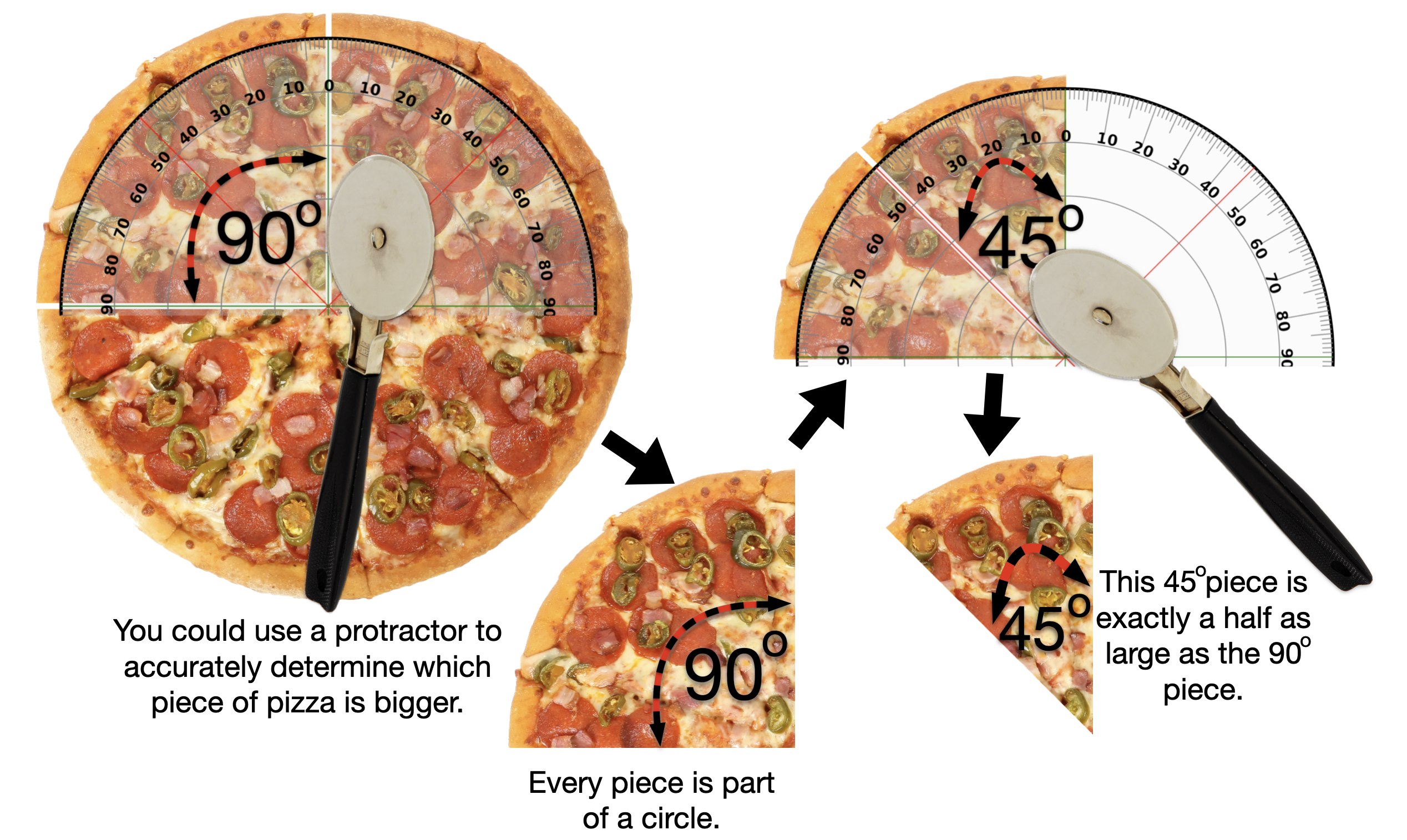
Isn’t it interesting that angles in a circle can be added or subtracted? If a 90-degree slice of pizza is cut, you may notice that this is exactly one quarter (0.25) of the pie. This is because there are a total of 360 degrees in every circle. Ninety degrees is a quarter of 360-degrees. If the 90-degree slice of pizza is cut exactly in half, the angle of the two new slices is 45-degrees, exactly half of 90 degrees. If one kept cutting each new slide in half in a similar manner, we would eventually have 360 pieces of pizza, each with a 1-degree angle. Putting all 360 of these small pieces back together, the entire pizza would be reformed. Angles always add up in this fashion. Which piece of pizza is larger, the 90-degree slice or the 45-degree slice? Not only are we sure that the 90-degree slice is bigger, but we know that it is exactly twice as big as the 45-degree slice because 90 is twice 45. It is pretty simple and students will have several opportunities to practice during Investigation Two lab.
The Law of Reflection
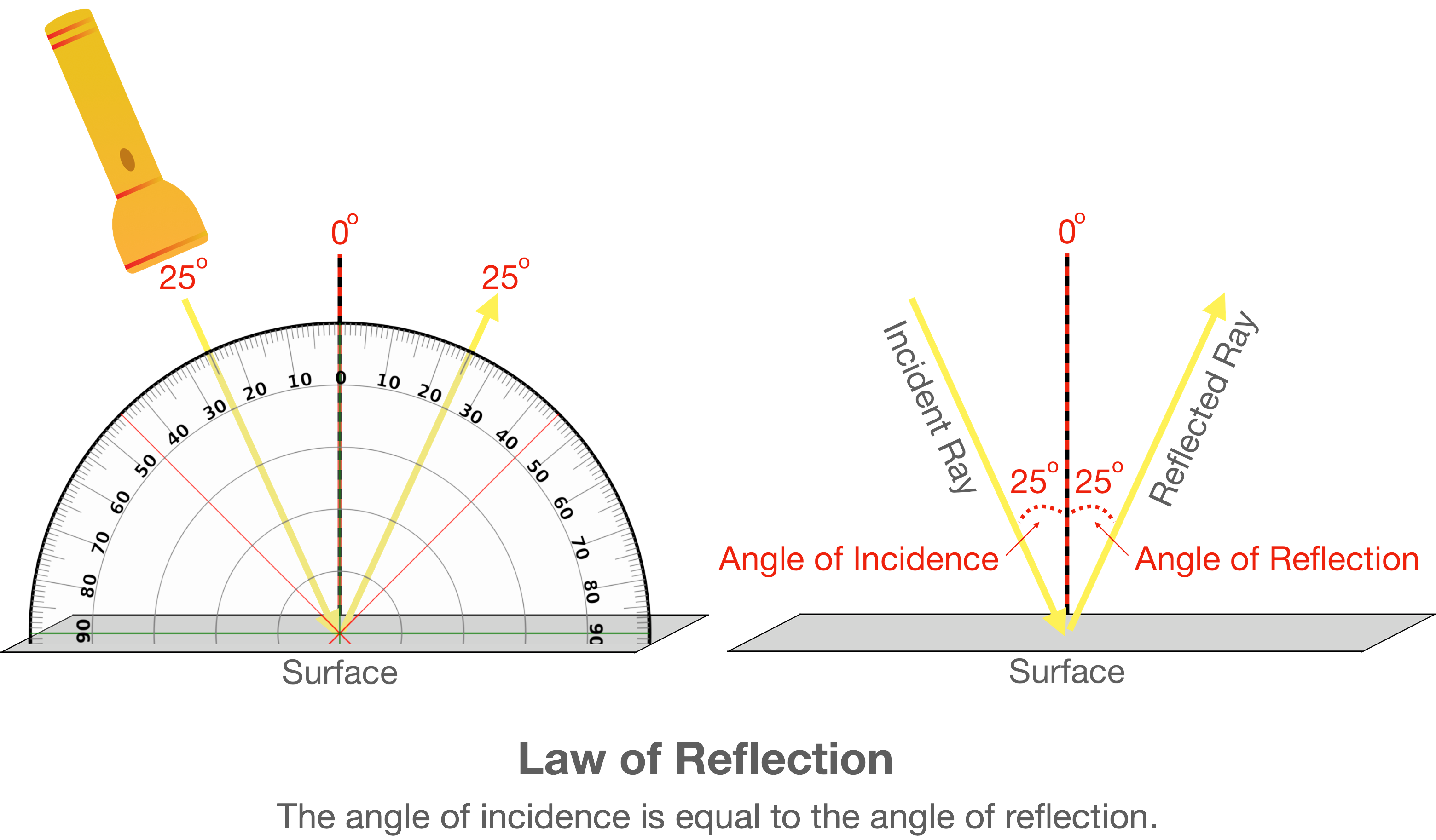
Reflection can be defined as the bouncing of light off of an object. Physicists can quantitatively describe reflection in terms of the angle at which light strikes an object and the angle at which light reflects off of an object. The angle at which light strikes an object is termed the angle of incidence. The angle at which light is reflected off of an object is termed the angle of reflection. The Law of Reflection states that the angle of incidence, in degrees, is equal to the angle of reflection.
Surface Features and Light Reflection/Absorption: Shade and Texture
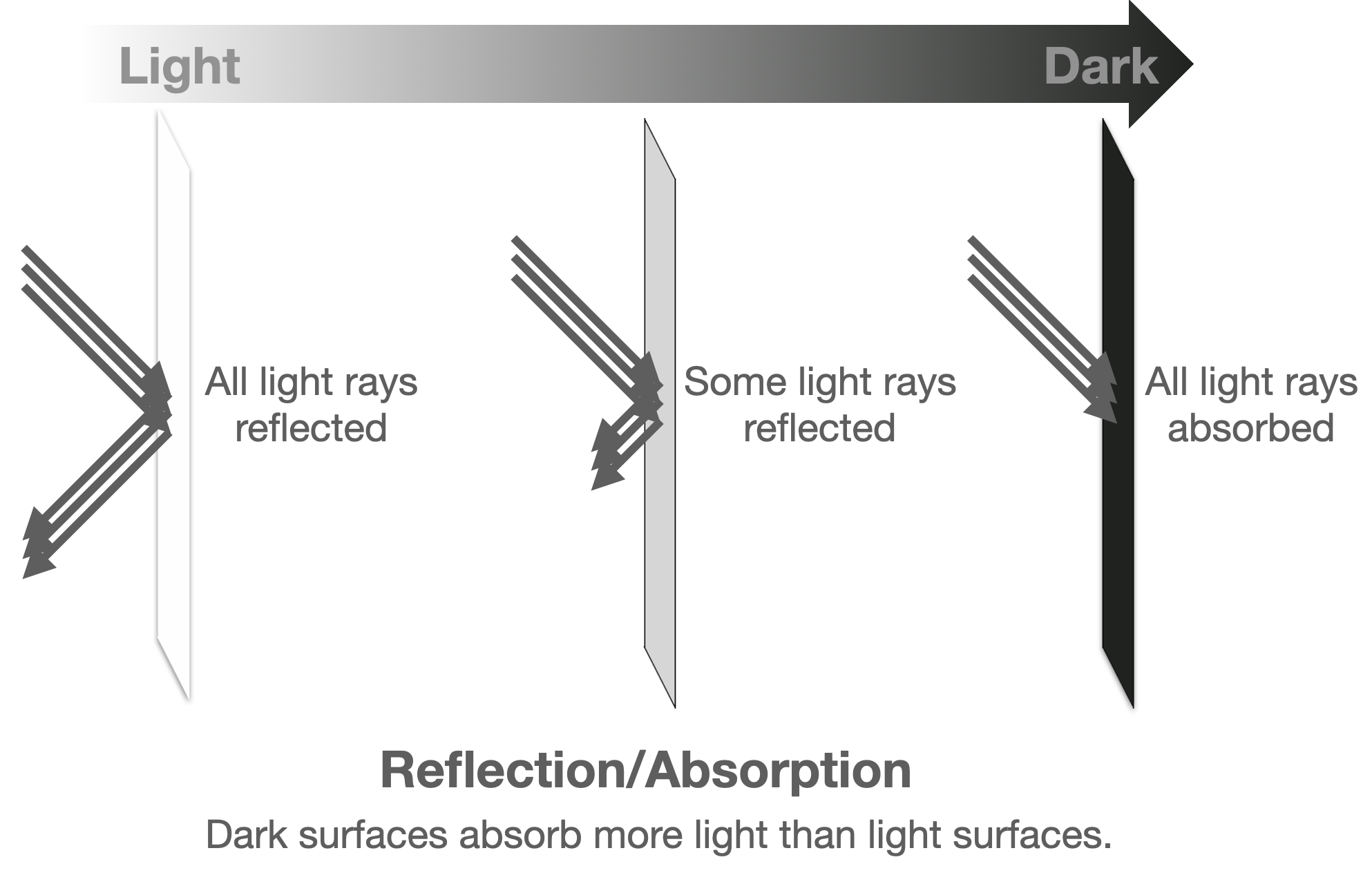
Almost all objects and surfaces reflect some amount of light, however, the manner in which light is reflected depends on two characteristics of the reflecting object. As students demonstrated in Investigation One, the amount of light that is reflected depends on the darkness or shade of the surface it strikes. A dark surface reflects less light than a surface that is lighter.
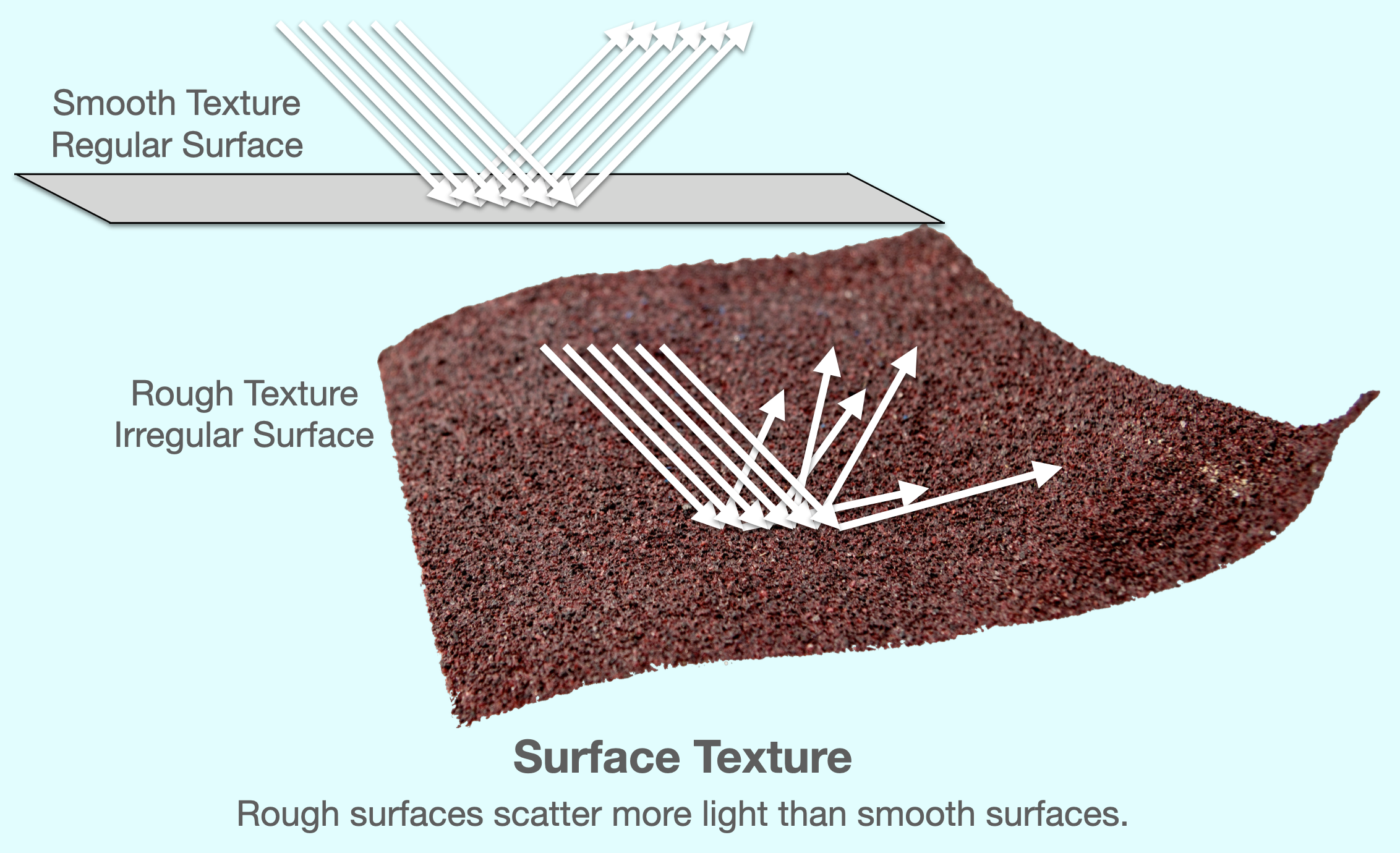
A second characteristic that determines how light is reflected is the texture of the reflecting surface. When light from an object strikes a flat, smooth surface like a mirror or the smooth surface of water, it is easy to see that the surface produces an exact “reflection” of the object. An exact “reflection” results because all the light rays from the object strike the surface at the same angle of incidence and are reflected by the surface at the same angle of reflection. Since the angle of reflection of each ray is the same as the angle of incidence of each ray, an exact image or representation of the object is produced.
The Law of Reflection describes the way that light is reflected off of objects. The Law of Reflection states that the angle at which light hits an object is equal to the angle at which light is reflected from the object.
As discussed above, the angle at which light hits an object is called the angle of incidence. The angle at which light is reflected off of an object is called the angle of reflection. The Law of Reflection states that the angle of incidence is equal to the angle of reflection as shown below.
When light strikes a rough or textured surface, however, even though each light ray still obeys the Law of Reflection, the total result is different. The angle of incidence at which each light ray strikes the surface is different so the angle of reflection of each light ray is different. The result is that the reflected rays scatter in all directions. A textured surface may reflect the same amount of light as a smooth surface, however, it is more difficult to see the reflected light because of the scattering. In Investigation Two, students will investigate the Law of Reflection using only a smooth surface.
Light and Optic: Investigation 2 - Mathematics Concepts
Prelab
- greater than/less than/equal to
- fractions
- angles in degrees
- parts/whole
Lab
- angles using protractor
- length in mm and cm
- data table
- predict/verify observations/measurements
- subtraction
- place value (ones, tens, hundreds)
- greater than/less than/equal to
Postlab
- angles in degrees
- greater than/less than/equal to
- subtraction
- problem-solving
Light and Optics: Investigation 2 - Procedural Tools

Light and Optics: Investigation 2 - Cognitive Tools


Light and Optics:
Investigation 2 Quiz

