Teacher Portal:
Inheritance and Adaptations
Investigation 5 – PreLab
 MINDSET
This Investigation is designed to:
- encourage students to realize that the genetic differences of individual organisms contribute to the process of natural selection.
- give students an opportunity to use a model to demonstrate natural selection.
- allow students to calculate the probability of dominant and recessive alleles appearing in a population of organisms.
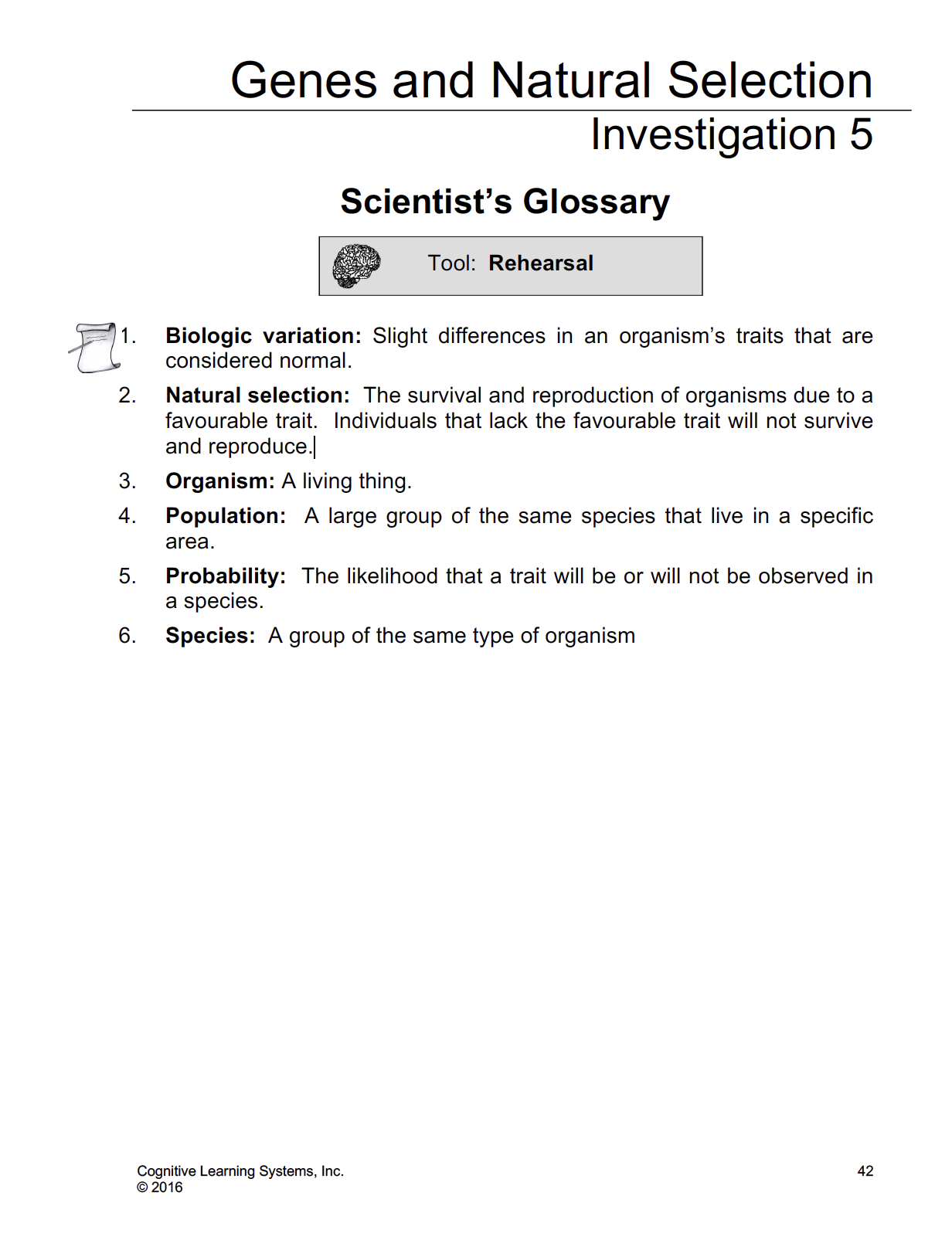
SCIENTIST’S GLOSSARY
- Biologic variation: Slight differences in an organism’s traits that are considered normal.
- Natural selection: The survival and reproduction of organisms due to a favorable trait. Individuals that lack the favorable trait will not survive and reproduce.
- Organism: A living thing.
- Population: A large group of the same species that live in a specific area.
- Probability: The likelihood that a trait will be or will not be observed in a species.
- Species: A group of the same type of organism.
BE PREPARED
Watch the Investigation 5 Teacher Video below to prepare for the PreLab. The Student Video is included at the end of the Share It sequence below.
SET FOR SUCCESS
- Tell students that they are going to continue learning about Inheritance and Adaptation.
- Tell students that they will begin to really understand why we have so very many different forms of life on Earth.
- Tell students that plants and animals can change over very long periods of time and that those changes cause them to become extinct like the dinosaurs.
- Ask students to share the kinds of things they might learn in this Investigation.
Begin the PreLab Concept Slides to start students on their learning journey. Then watch the Pre-Lab Student Video as a class.
NAVIGATE IT
Once the slide presentation is launched
- use your left and right arrows to advance or go back in the slide presentation, and
- hover your mouse over the left edge of the presentation to get a view of the thumbnails for all the slides so that you can quickly move anywhere in the presentation.
- Click HERE to launch the slide presentation for the CELL.
SHARE IT
SLIDE INHERIT5-pre-1
Begin Investigation Five by encouraging students to recall what they discovered about DNA and chromosomes in the previous Investigations. In this Investigation, we will focus on how genetic differences within a species can lead to the incredible diversity of life on Earth.
______________________________________________
SLIDE INHERIT5-pre-2
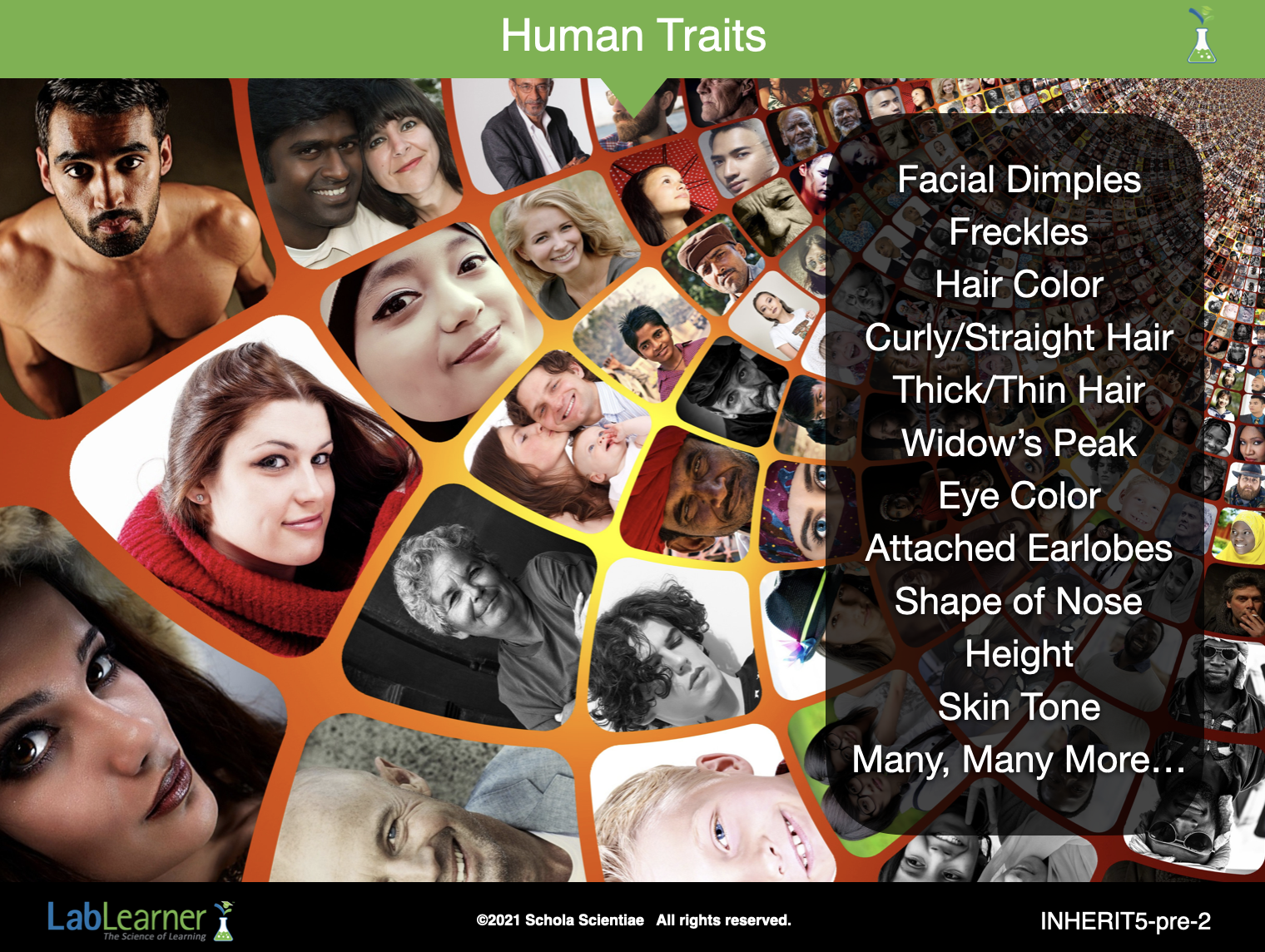
Begin the Investigation by reviewing some of the concepts that the students have encountered in the CELL thus far using the Recall Tool:
Ask students: How would you describe biologic variation? Can you give an example? Students should indicate that biologic variation means differences in the characteristics found in organisms. Examples would be different breeds of dogs, human beings of different heights, and disease resistance in plants.
Ask students: Do you think that a mutation can be passed on to the offspring of organisms? Why or why not? Students should indicate that a mutation is found in the genetic information of an organism, therefore, it could be potentially passed on to the offspring of that organism.
Ask students: Do you think mutations can have an effect on biological variation? Why or why not? Students should indicate that a mutation could have an effect on biological variation because mutations that exist in surviving parents are passed along to offspring. If a mutation produces an advantageous trait in an organism, that trait can be passed to offspring of later generations.
______________________________________________
SLIDE INHERIT5-pre-3
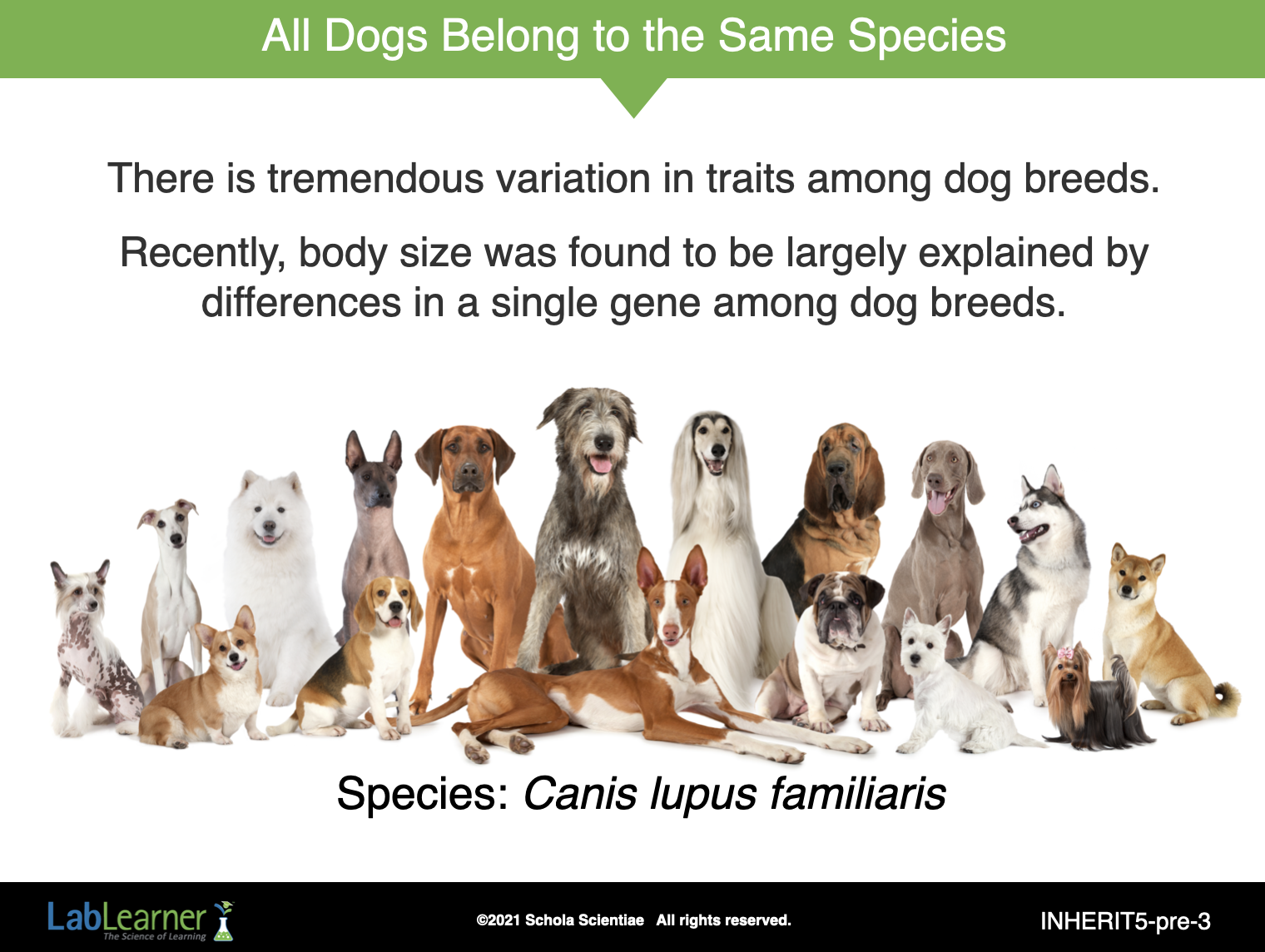
Direct the focus of this discussion to examine the similarities and differences of traits found in the same species.
Ask students: What is a species? Student answers may vary.
Ask a student volunteer to read the definition of species from the Scientist’s Glossary:
Species: A group of the same type of organism.
Notice that, even though there is such tremendous variation in color, size, fur, face shape, behavior, and intelligence, all dog breeds are of the same species: Canis lupus familiaris
Ask students: Can you give an example of different kinds of species? Student answers may vary. Sample answers include dogs, humans, roses, maple trees, squirrels, etc.
______________________________________________
SLIDE INHERIT5-pre-4
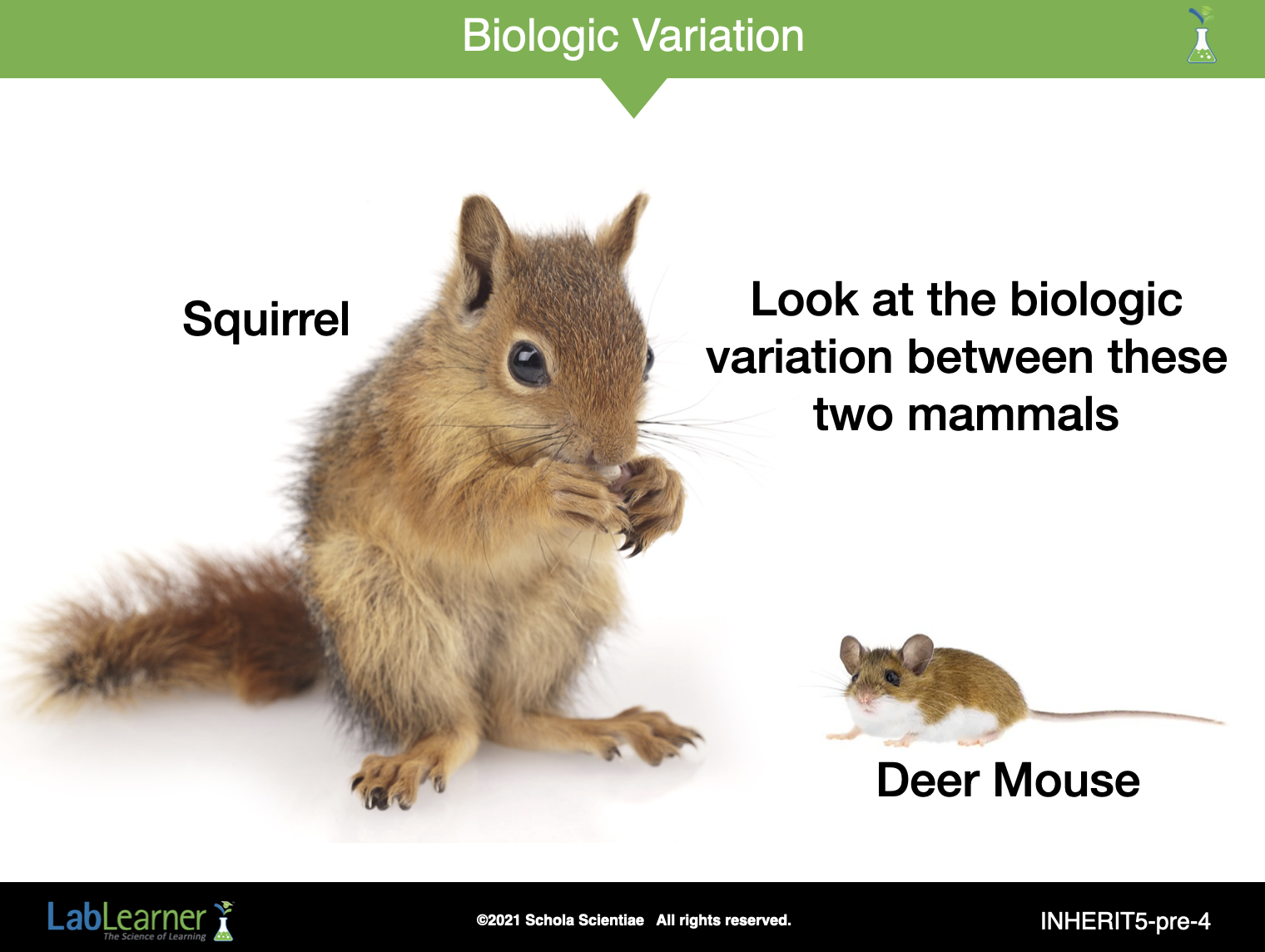
Even though animals may belong to different species, seemingly unrelated animals are nonetheless similar to each other in various ways. For example, the squirrel and mouse shown in this slide are both rodents, therefore, they will share some characteristics.
Ask students: Does a squirrel look like a deer mouse? Why? Students should indicate that squirrels do not look like a mouse because they are different species of rodents.
Ask students: Do squirrels look like other squirrels? Do deer mice look like other deer mice? Students should indicate that all squirrels share similar traits and all deer mice share similar traits.
Ask students: Can you think of some traits of deer mice that may be different in all deer mice? Student answers may vary. Some students may indicate that deer mice may have different colors of fur or may be different sizes from one another.
Ask students: What is the difference among individuals of the same species called? Students should indicate that it is called “biologic variation.”
______________________________________________
SLIDE INHERIT5-pre-5
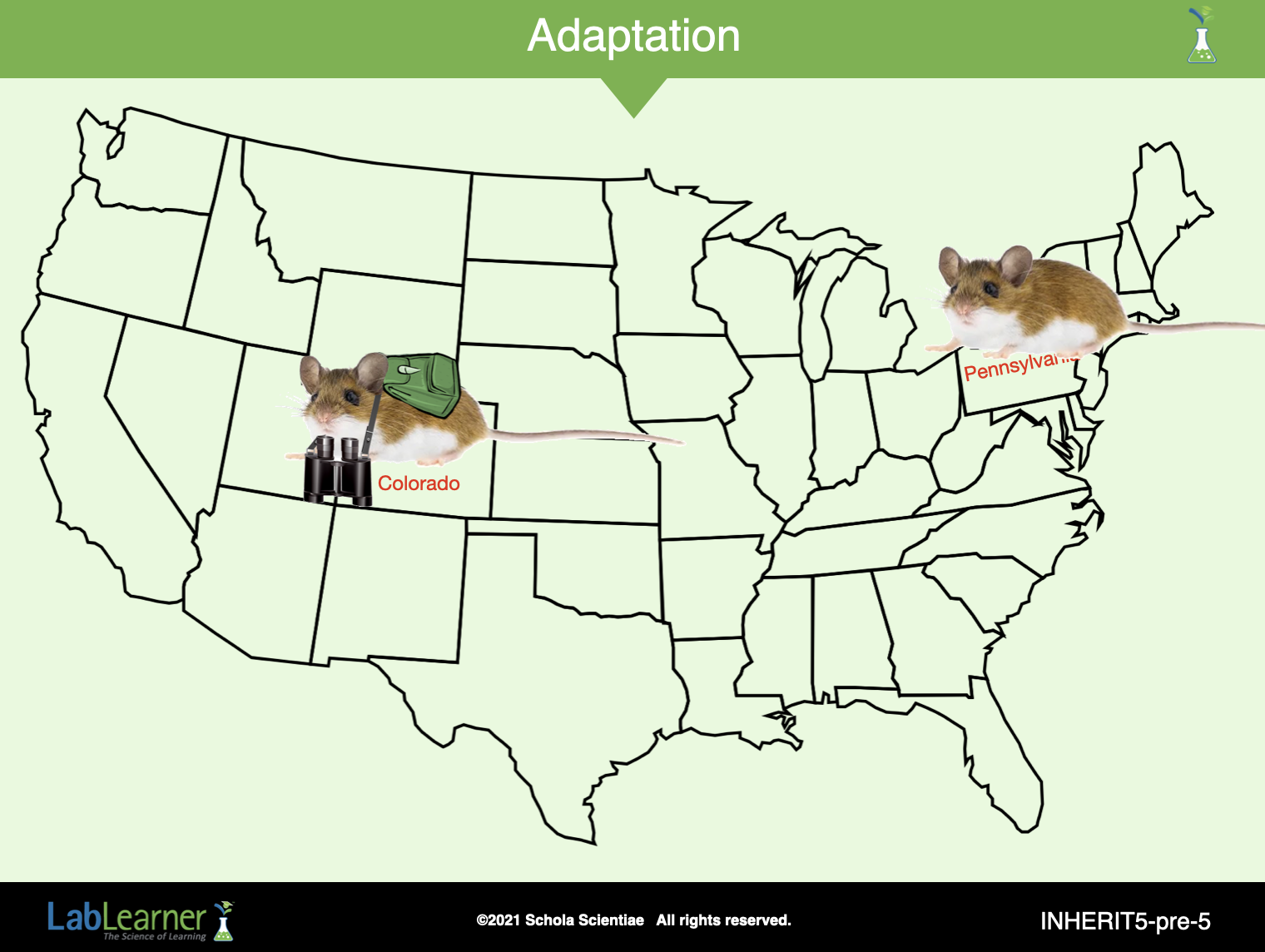
Ask students to think about a deer mouse that they might find in their backyard and compare it to a deer mouse that they might find in a different part of the country that has a different topography. For the purpose of this discussion, the examples will be a deer mouse that lives in the northeastern region of the United States (Pennsylvania) verses a deer mouse that lives in the western region of the United States (Colorado).
Explain to students that the northeastern states have lower elevations than the western states. That means that the northeastern states are closer to sea level. As you move to higher elevations, each breath of air contains less oxygen. As an organism moves to higher altitudes, it must work harder to obtain oxygen. This is done by breathing faster.
Ask students: Pennsylvania is a northeastern state. Colorado is a western state. Do think a deer mouse that lives in Pennsylvania will have traits that are similar to a deer mouse that lives in Colorado? Traits that are different? Student answers may vary. Sample answers include: Deer mice that live in Pennsylvania and Colorado would both be about the same size, have sharp front teeth, and both will have long, thin tails. Deer mice that live in Colorado may have thicker fur because of the colder temperatures and may have different lung capacities due to higher elevations.
Ask students: Do you think that the environment that these deer mice live in will have an effect on these traits? Student answers may vary. Encourage students to realize that environment does have an effect on traits of organisms.
Ask students: Imagine taking a deer mouse from a forest in Pennsylvania and relocating it to a forest in the Rocky Mountains of Colorado. Do you think the deer mouse would survive? Some students may indicate that it would survive while others may indicate it will not survive.
Ask students: Could the deer mouse adapt to survive? Student answers may vary. Guide students to realize that adaptation happens to populations of deer mice, not individual deer mice.
To facilitate understanding of this question, ask a student volunteer to read the definition of natural selection from the Scientist’s Glossary.
Natural selection: The survival and reproduction of organisms due to a favorable trait. Individuals that lack the favorable trait will not survive and reproduce.
Guide students to realize that slight differences in traits may provide an animal with an advantage that allows it to survive even if its environment changes. The trait is then passed along. An animal without the trait does not survive and pass along any genetic information. Over time, the number of animals with the advantageous trait increases. The number of animals without the trait decreases.
Explain to students that in the deer mouse example, the Pennsylvania deer mouse may not survive in Colorado. Its lungs may not be able to take in enough oxygen at the higher elevation therefore it may not be healthy or may die once it is relocated there. The lung capacity of a Pennsylvania deer mouse is not a favorable trait for the Rocky Mountain environment; therefore the Pennsylvania deer mouse will not survive and will not be able to pass the trait of “small lung capacity” to its offspring.
Ask students: Do you think that biologic variations found in organisms are only caused by changing the location of the organism? Student answers may vary. Encourage students to realize that humans can change environments over time. Often, environments change because of human pollution or building structures.
______________________________________________
SLIDE INHERIT5-pre-6
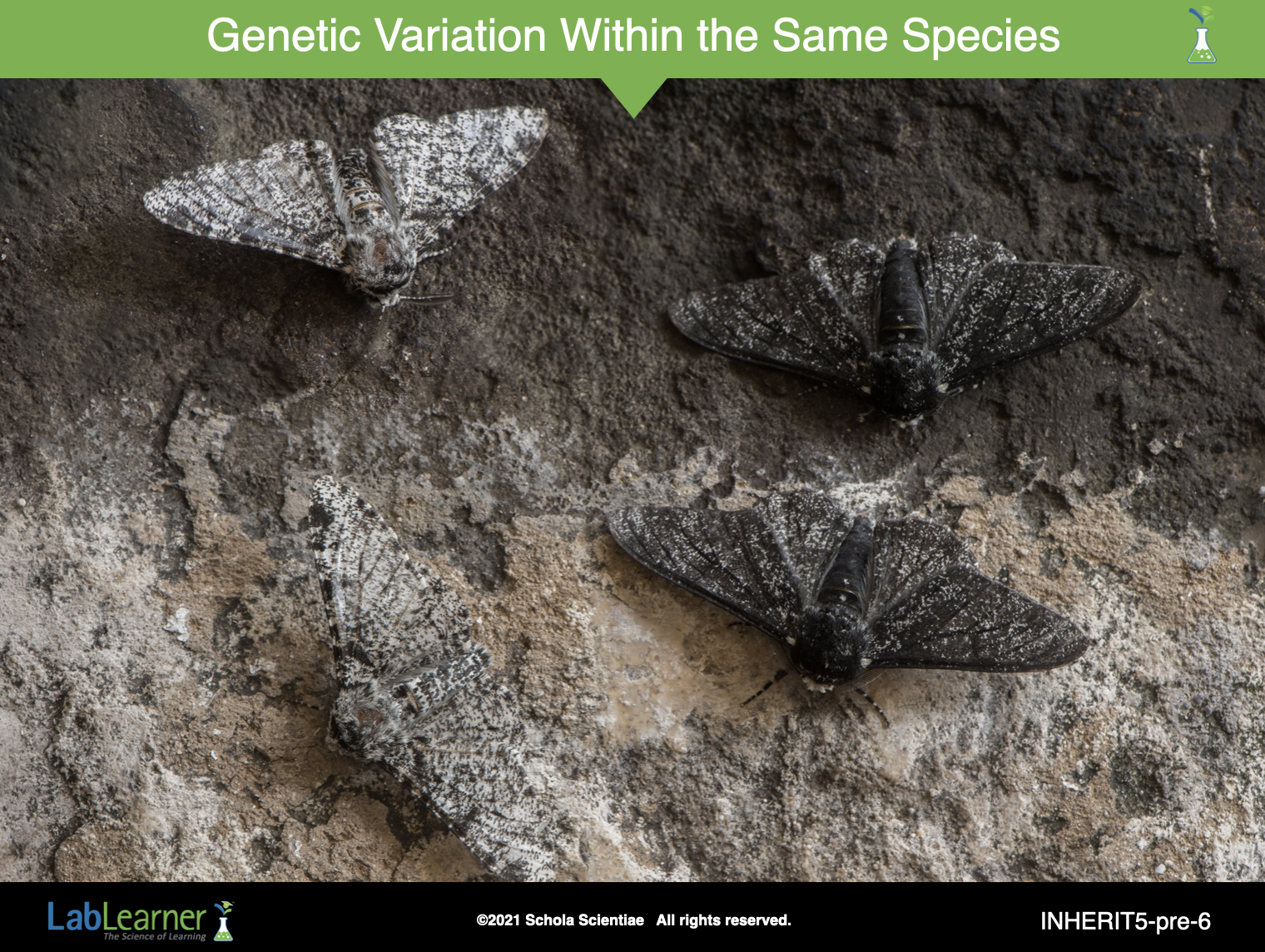
This is a photo of four individuals of the same species of moth. Notice the difference in color (pigmentation). Also, notice how well the moths blend in with their surroundings (their environment).
______________________________________________
SLIDE INHERIT5-pre-7
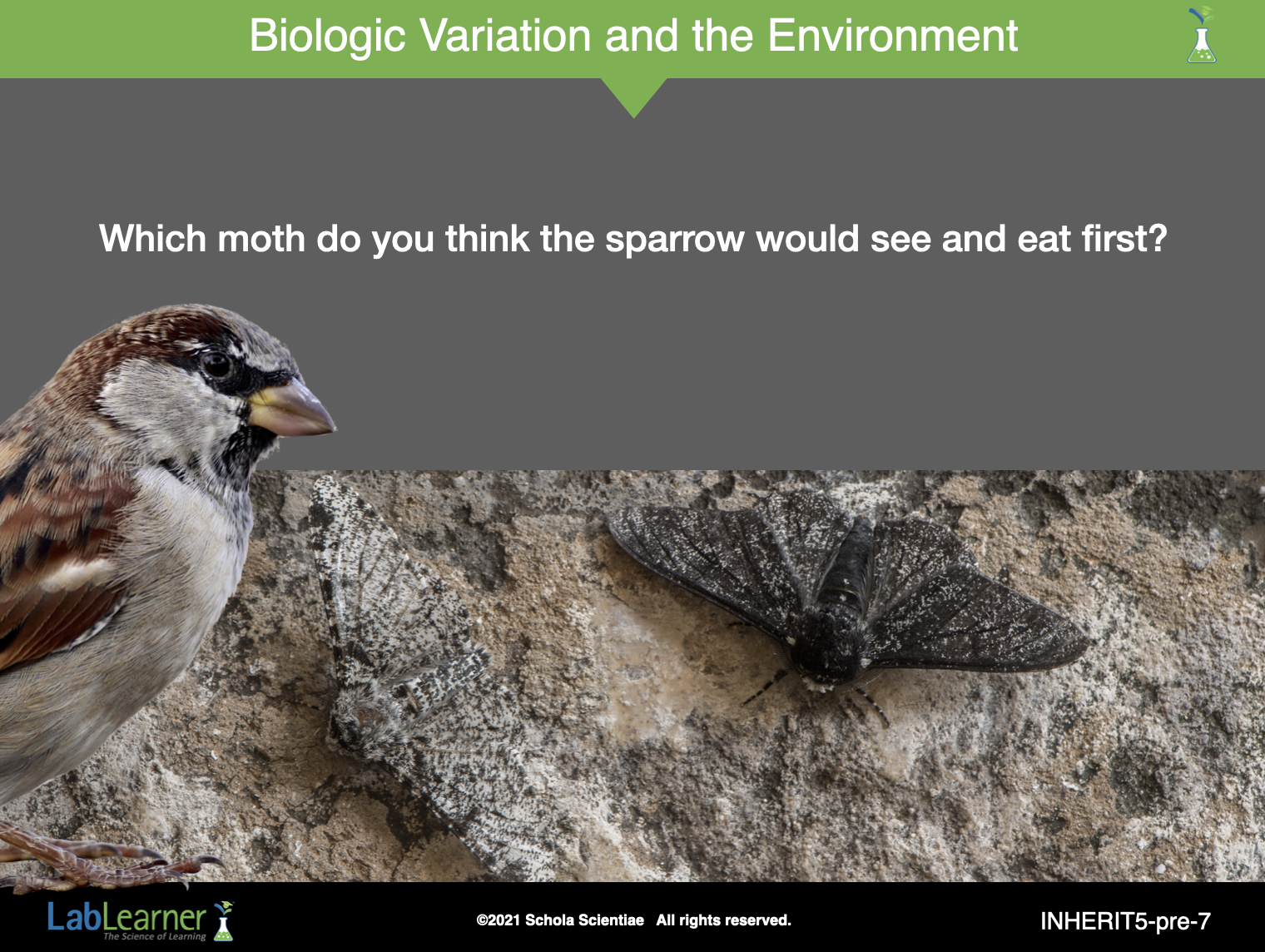
This slide focuses on the lower part of the picture shown on the previous slide. The two moths are shown on a light background.
A sparrow, who eats insects like moths, is also added to this slide. The question is asked as to which of the two colored moths would the sparrow most easily see on this background and therefore most likely eat first.
Obviously, on light-colored surfaces, the dark moth would be seen and eaten first. That would permit the light-colored moth to continue living and reproducing. This would also permit the light-color genes for the color trait to be passed on to futrure generations.
Under these conditions, we would say that the light-colored moth has a selective advantage compared to the dark-color moth because of its pigment gene. The dark-colored moth could eventually disappear from the population under such conditions.
______________________________________________
SLIDE INHERIT5-pre-8
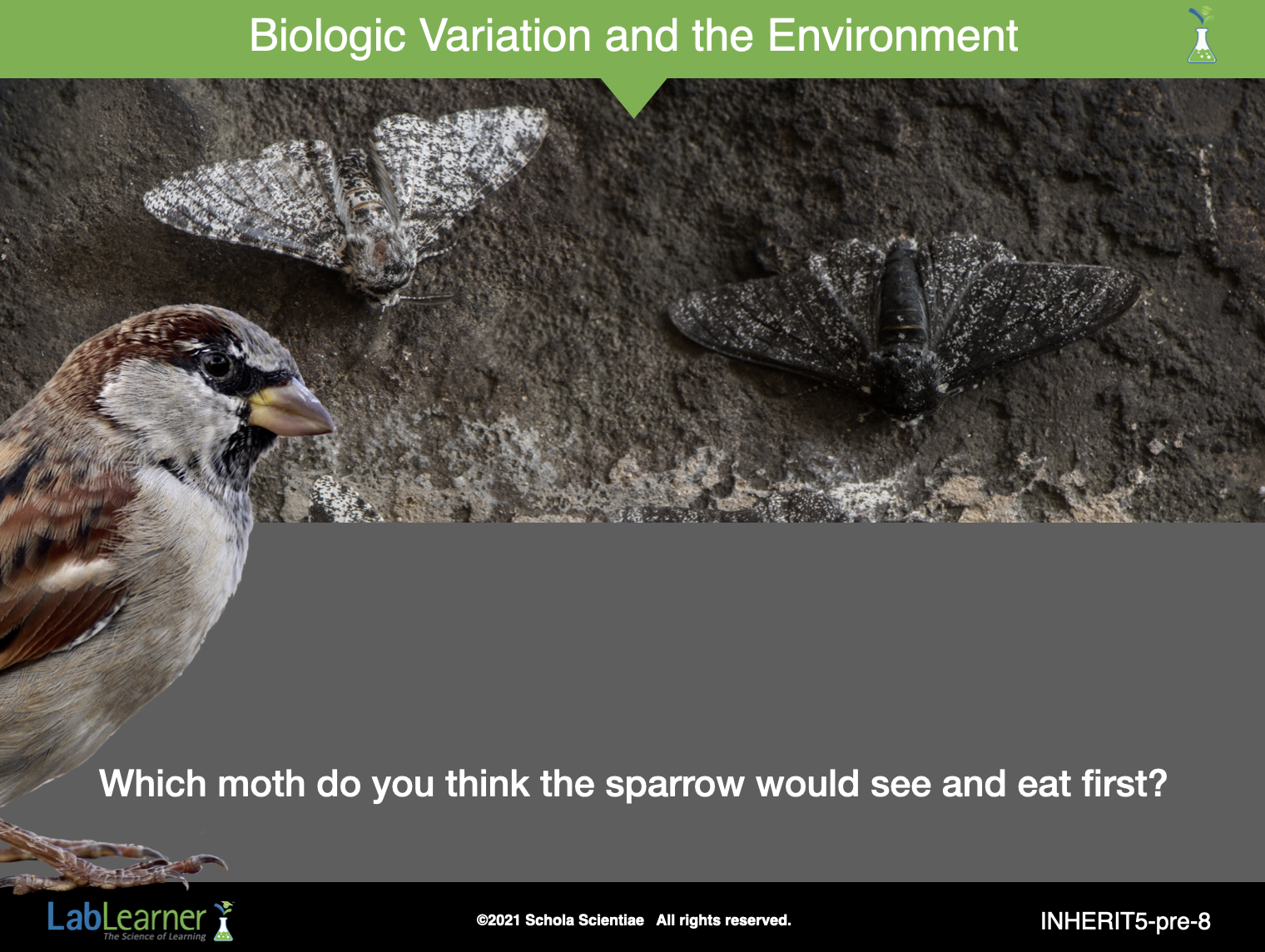
This slide focuses on the upper part of the picture. The two moths are shown on a dark background.
The situation is reversed here. The sparrow would most likely see and eat the light-color moth first. That would permit the dark-colored moth to continue living and reproducing. This would permit the dark-color genes for the trait to be passed on to future generations.
Under these conditions, we would say that the dark-colored moth has a selective advantage because of its pigment gene. The light-colored moth could eventually disappear from the population under such conditions.
______________________________________________
SLIDE INHERIT5-pre-9
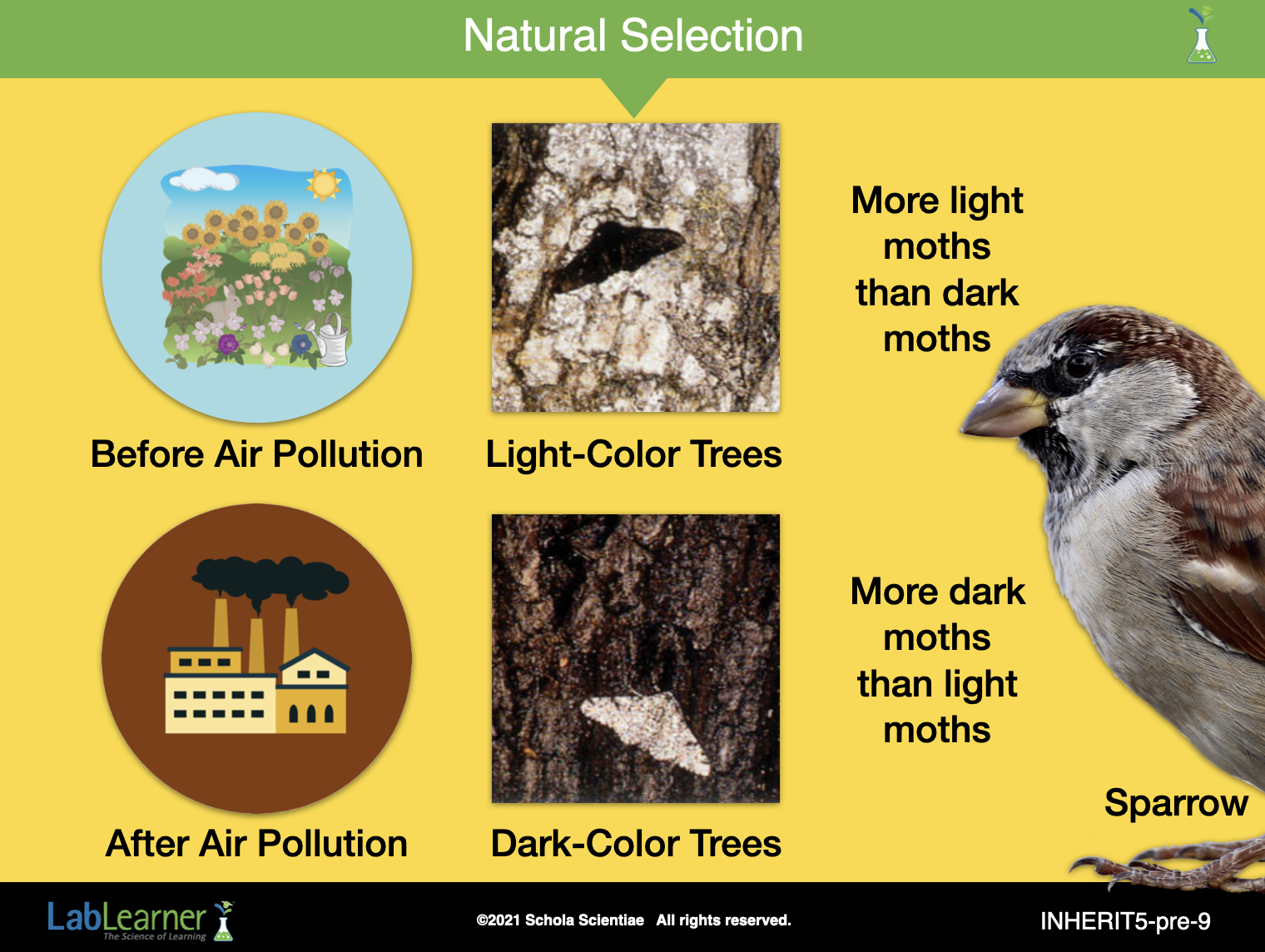
This is a famous historical incident demonstrating natural selection:
Manchester, England BEFORE the industrial revolution in the early 1800s:
- No air pollution from factories.
- Trees are light and have light-colored lichens (plant-like organisms) growing on them.
- Because they are better camouflaged, light moths are more abundant.
Manchester, England AFTER the industrial revolution in the early 1800s:
- Smoke and soot from factories cloud the sky and turn local trees dark.
- Light-color lichens are killed or discolored by the pollution.
- Because they are now better camouflaged, light moths are more abundant.
______________________________________________
SLIDE INHERIT5-pre-10
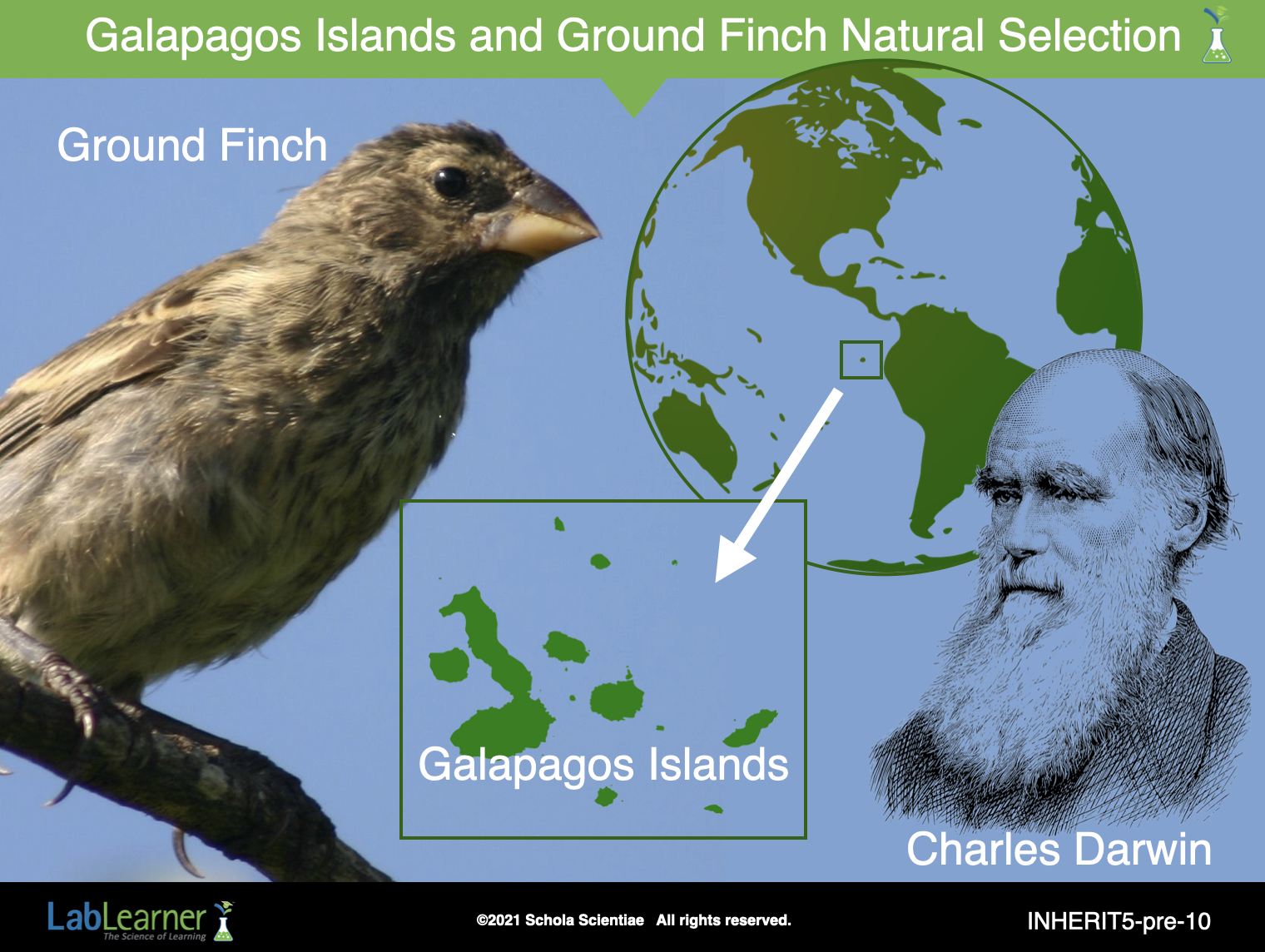
This slide provides a brief background to Problem 1 in the Student Data Record.
Charles Darwin was a British scientist who, in 1831 served as the ship’s naturalist on a voyage of discovery of the British ship, the HMS Beagle. During the nearly 5-year voyage, the young scientist collected thousands of biological specimens from around the world.
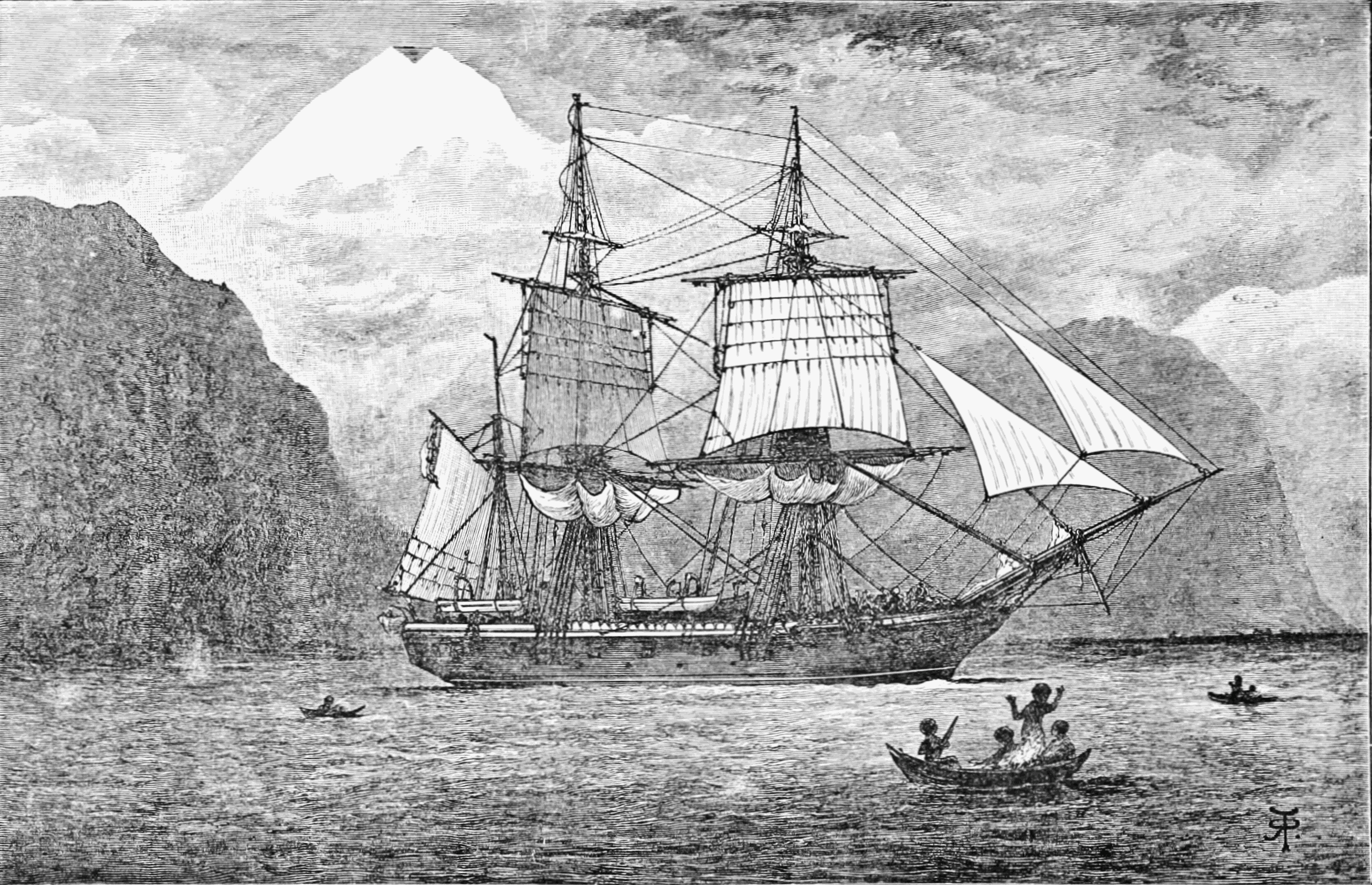
In September 1835, the HMS Beagle stopped at the Galapagos Islands, about 600 miles (965 km) west off the coast of Ecuador, on its return to England. It was in the Galapagos Islands that Darwin made observations and collected specimens that later led him to write up his ideas of natural selection and evolution of species over time by natural selection.
______________________________________________
SLIDE INHERIT5-pre-11
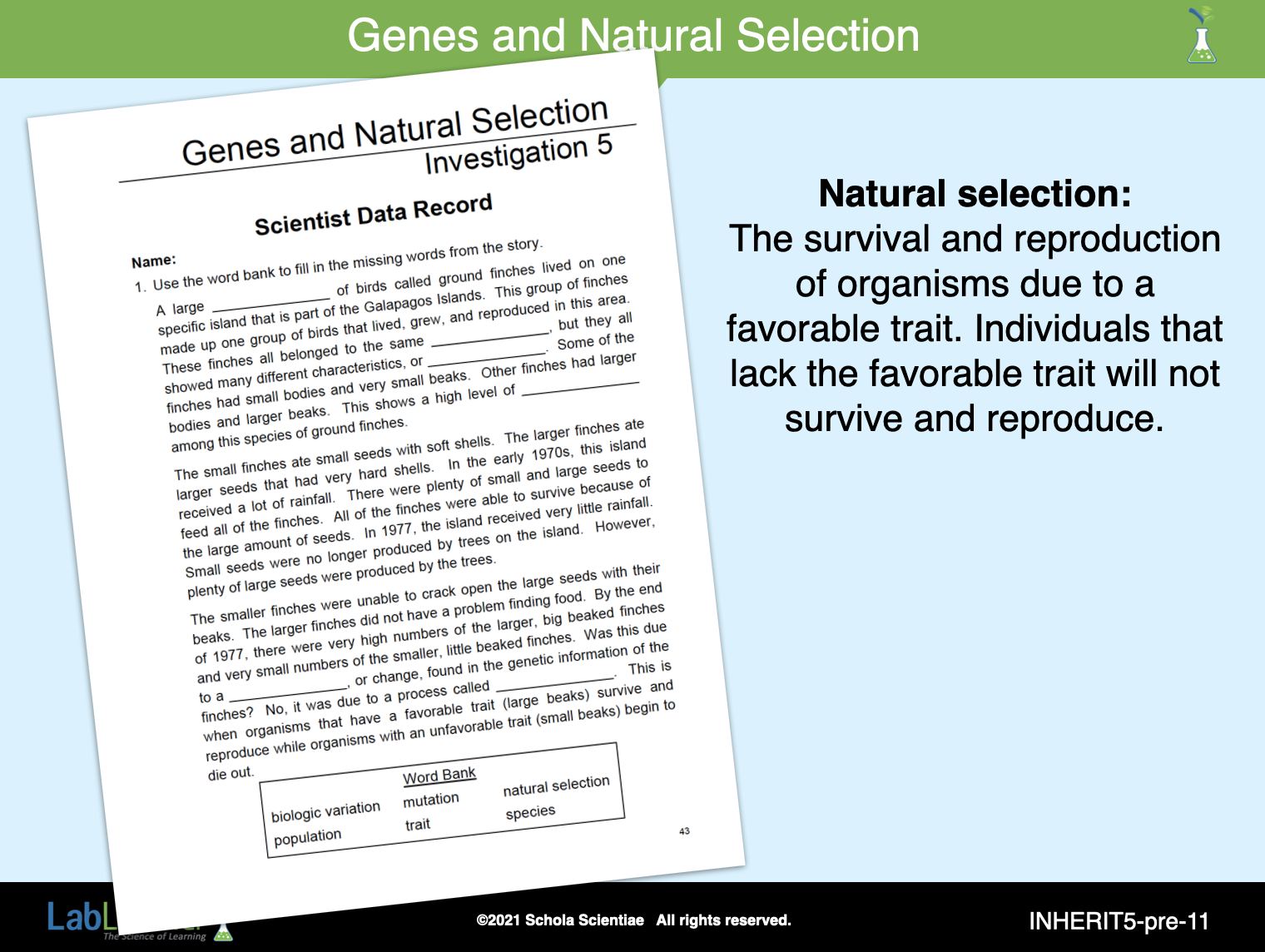
PreLab Activity:
1. Divide the students into groups of three.
2. Ask student groups to locate Problem 1 of their Student Data Record.
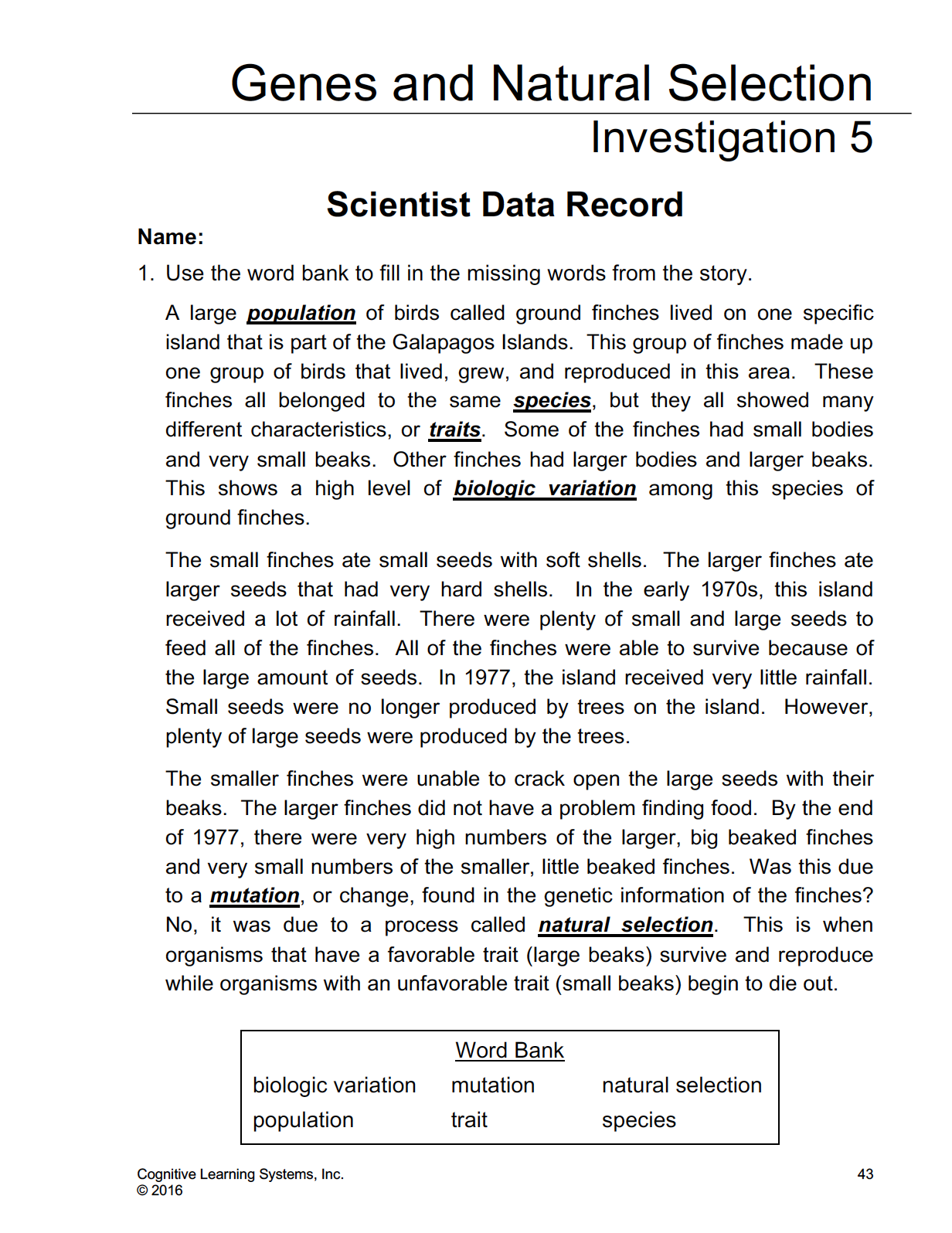
3. Explain to students that Problem 1 contains a story about the natural selection of ground finches. Encourage students to use the words found in the word bank to complete the story.
4. Allow sufficient time for students to complete this activity. When complete, ask several student volunteers to read portions of the story aloud to the class.
Tell students that in the Lab, they will examine the effect of natural selection on a population over time. As they conduct their experiment, ask them to consider the following questions:
-
-
- How does a species with an advantageous trait change over time?
- How does a species with a disadvantageous trait change over time?
-
VIEW IT
Play the following student video to the class and/or assign it as homework for students to prepare for Investigation Four lab.
KEYS: PRELAB EXERCISE