
Teacher Portal:
Inheritance and Adaptations
Investigation 5 – Lab
 BE PREPARED
| Class materials |
|
| Group materials: |
|
| Individual Materials |
|
________________________________________________________
Teacher Preparation
- Using the three-hole paper punch, punch 35 green paper punches and 35 red paper punches for each group.
- Assemble materials at a distribution point.
- Divide the class into groups of three.
Instruction
Direct each student group to obtain the following necessary materials from the distribution center: three (3) 100 ml beakers, thirty-five (35) green paper punches, thirty-five (35) red paper punches, one (1) piece of green construction paper, one (1) pencil, and one (1) stopwatch. Instruct one student from each group to obtain a small piece of modeling clay from the stick that is approximately the size of a pencil top eraser. Students should place the green paper punches in one 100 ml beaker and the red paper punches in a second 100 ml beaker.
GET FOCUSED
Students will use a model to test the effects of natural selection on a population of two beetle species.
Students should consider the following questions as they conduct their experiments:
-
-
- How does a population with an advantageous trait change over time?
- How does a population with a disadvantageous trait change over time?
- How does a species with an advantageous trait change over time?
- How does a species with a disadvantageous trait change over time?
-
INVESTIGATE
Trial 1
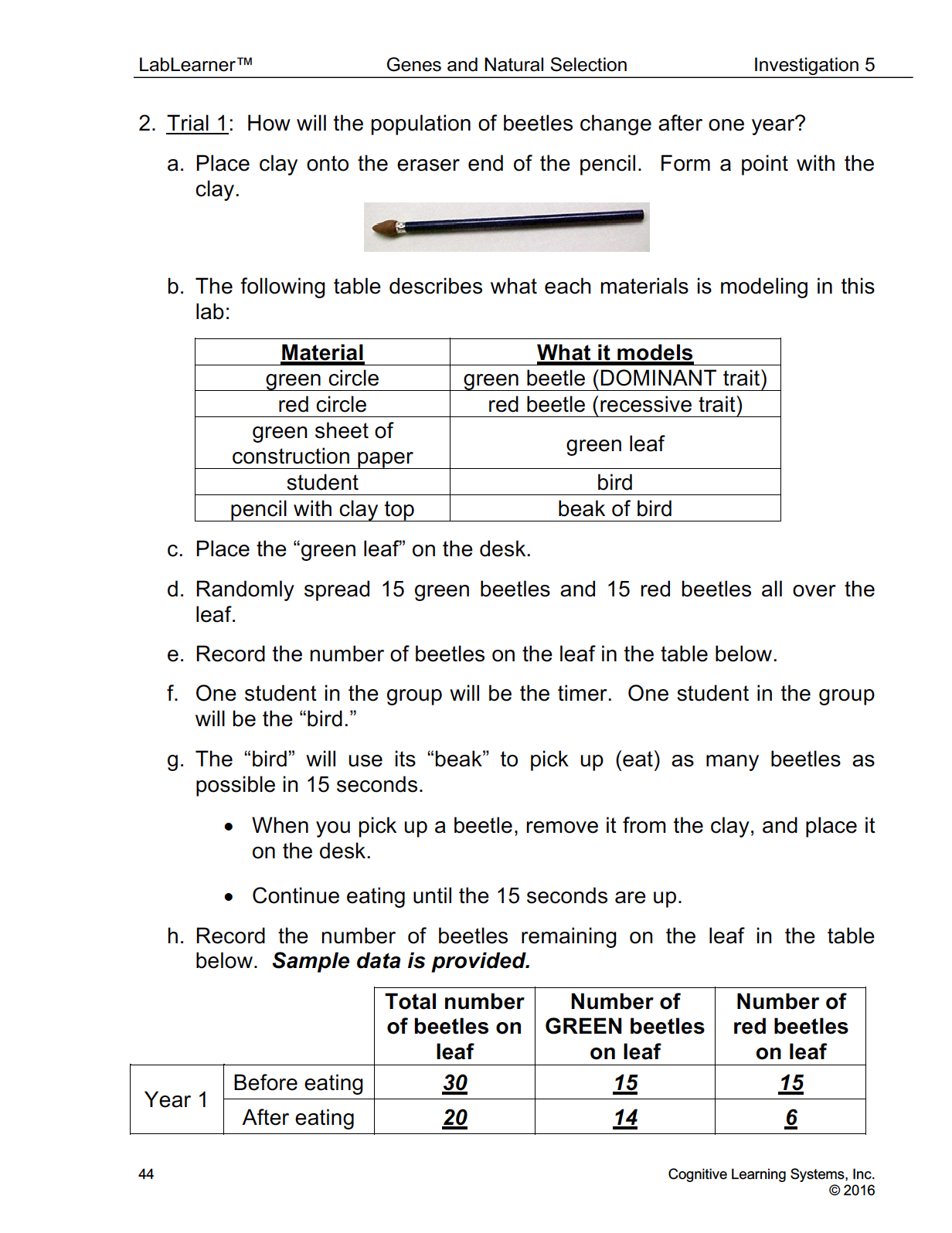
During this Trial, (Problem 1 in the Student Data Record) students will use a model to test the effects of natural selection on a population of two beetle species. In this environment, there are two colors of beetles: the red species and the green species. Students will act as a bird that eats these beetles. Students will monitor the population of beetles before and after eating. In doing so, students will complete a Data Table (Problem 1 in the Student Data Record) to record their results. If necessary, review the steps of the Procedural Toolbox tool, Completion of a Data Table, with students. Through this Trial, students should begin to realize that more green beetles will survive than red beetles due to the green beetles’ ability to hide in their environment.
-
- How does a population with an advantageous trait change over time?
- How does a population with a disadvantageous trait change over time?
Trial 2
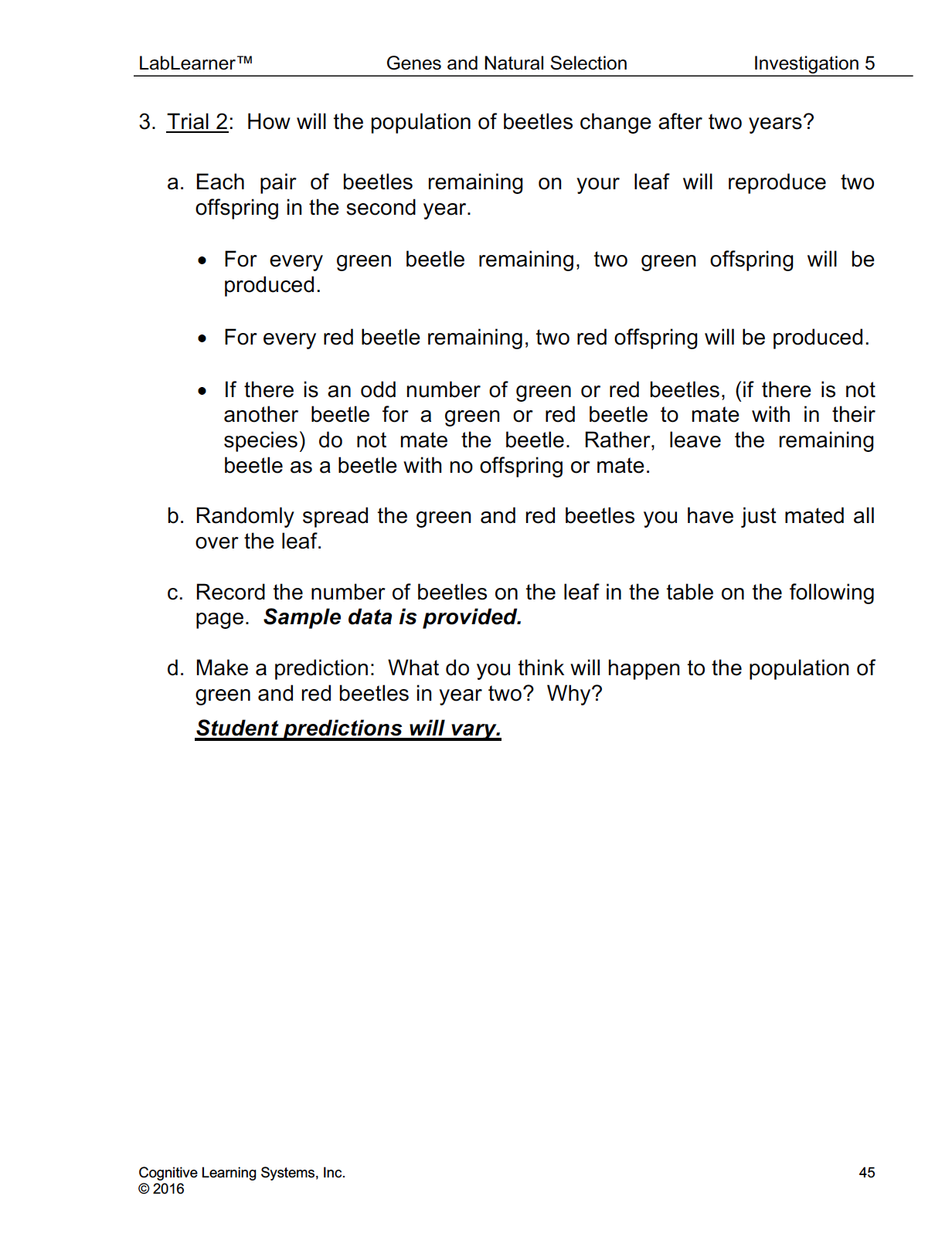
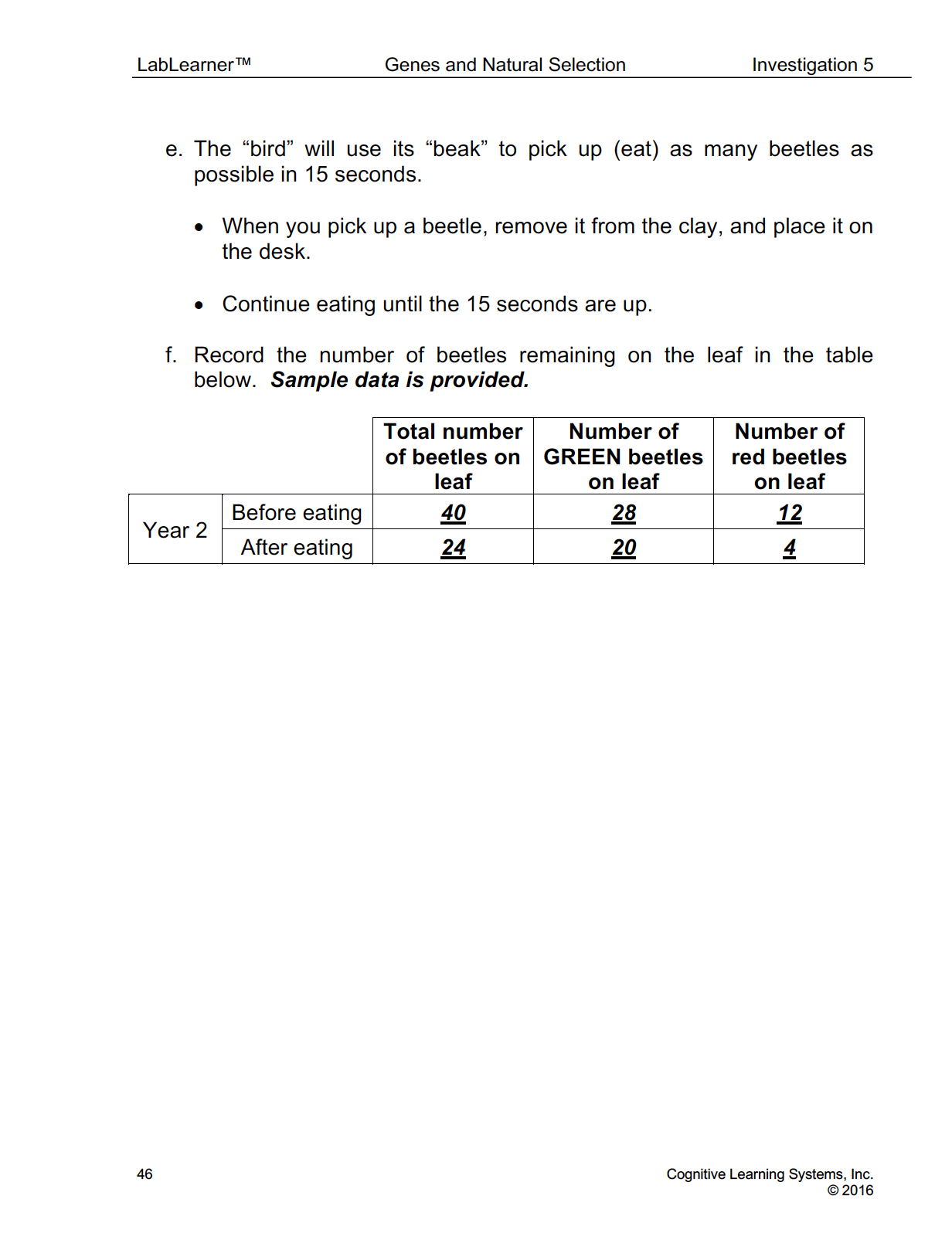
In this Trial (Problem 2 in the Student Data Record), students will now mate the remaining beetles from Trial 1. Each pair of beetles will produce two offspring. Two green offspring will be produced by two green parents. Two red offspring will be produced by two red parents. Students will again act as a bird that eats these beetles. Students will monitor the population of beetles before and after eating. In doing so, students will complete a Data Table (Problem 2 in the Student Data Record) to record their results.
Through this Trial, students will realize that more green beetles will survive than red beetles due to the beetles’ ability to hide in their environment. As students perform this Trial, they should consider the following questions:
-
- How does a species with an advantageous trait change over time?
- How does a species with a disadvantageous trait change over time?
Trial 3
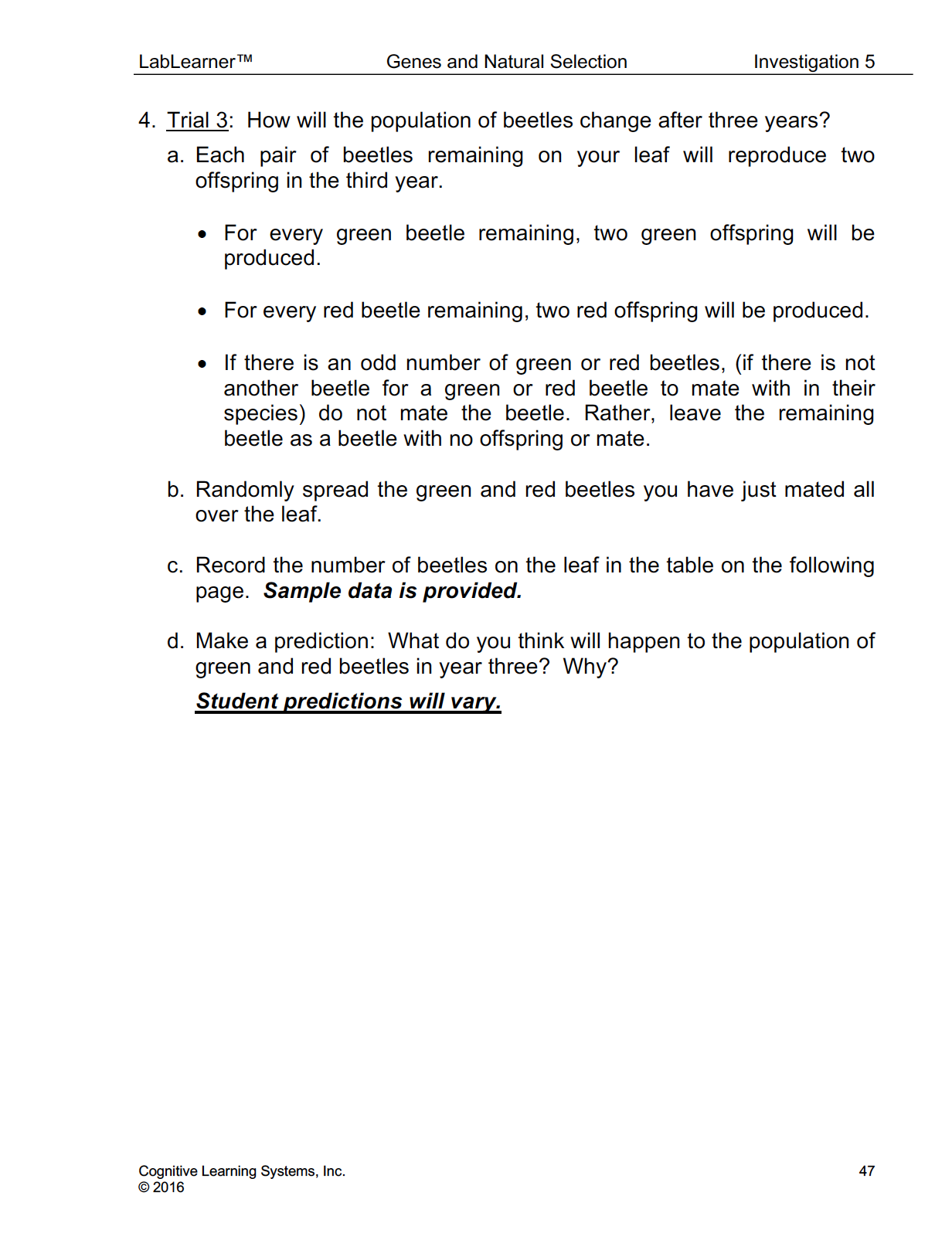
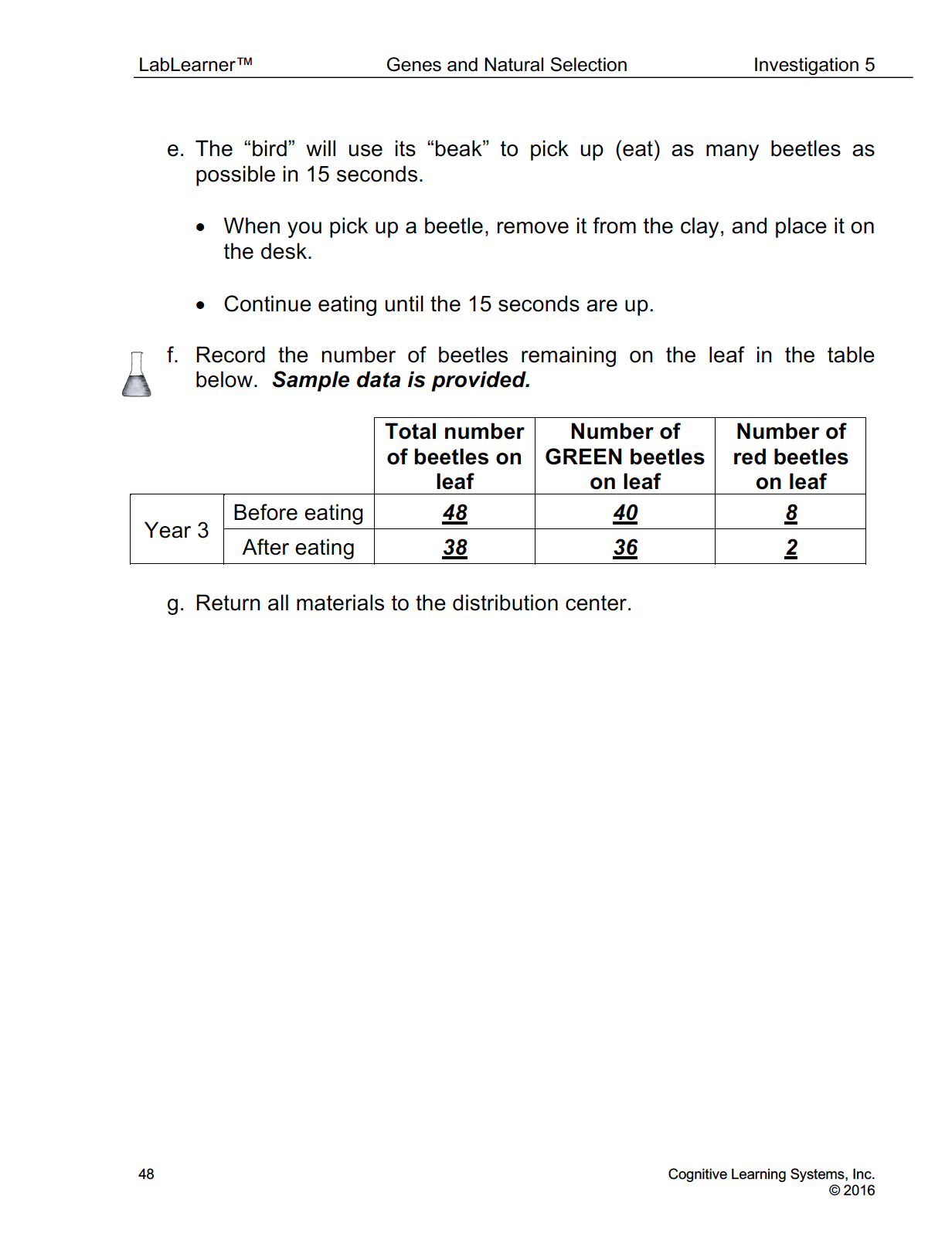
As in the previous Trial, students will now mate the remaining beetles from Trial 2 (Problem 3 in the student Data Record). Each pair of beetles will produce two offspring. Two green offspring will be produced by two green parents. Two red offspring will be produced by two red parents. Students will again act as a bird that eats these beetles. Students will monitor the population of beetles before and after eating. In doing so, students will complete a Data Table. (Problem 3 in the Student Data Record).
Through this Trial, students will realize that more green beetles will survive than red beetles due to the beetles’ ability to hide in their environment. As students perform this trial, they should consider the following questions:
-
- How does a species with an advantageous trait change over time?
- How does a species with a disadvantageous trait change over time?
KEYS
CLEAN UP
Let students know your expectations for clean-up. Ask them to clean up.