
Teacher Portal:
Inheritance and Adaptations
Investigation 4 – PreLab
 MINDSET
This Investigation is designed to:
- provide students with an understanding that genes are made up of nucleotides.
- reinforce the concept that proteins are needed to provide structure and to allow functions for organisms.
- provide students with an opportunity to analyze a sequence of nucleotides.
- allow students to discover that a cell uses the genetic code to change the genetic information into useable proteins.
- encourage students to realize that a mutation in a nucleotide sequence can change the function of a protein.
SCIENTIST’S GLOSSARY
- Amino Acid: The “building blocks” of protein molecules.
- Codon: Three adjacent nucleotides in DNA or RNA that code for a specific amino acid in a protein.
- DNA: Nucleic acid that carries genetic information in cells.
- Mutation: A change in the DNA sequence of a gene.
- Nucleotide: The “building block” of DNA.
- Protein: A large molecule consisting of one or more chains of amino acids.
- RNA: A group of nucleic acids that copy and translate the genetic code.
BE PREPARED
Watch the Investigation 4 Teacher Video and Student Video below to prepare for the PreLab.
SET FOR SUCCESS
- Tell students that they are going to continue learning about Inheritance and Adaptation.
- Ask students to share the kinds of things they might learn in this Investigation.
Begin the PreLab Concept Slides to start students on their learning journey. Then watch the Pre-Lab Student Video as a class.
NAVIGATE IT
Once the slide presentation is launched
- use your left and right arrows to advance or go back in the slide presentation, and
- hover your mouse over the left edge of the presentation to get a view of the thumbnails for all the slides so that you can quickly move anywhere in the presentation.
- Click HERE to launch the slide presentation for the CELL.
SHARE IT
SLIDE INHERIT4-pre-1
Begin Investigation Four by encouraging students to recall what they discovered about DNA and chromosomes in the previous Investigations.
______________________________________________
SLIDE INHERIT4-pre-2
Use the Recall tool to prompt student discussion:
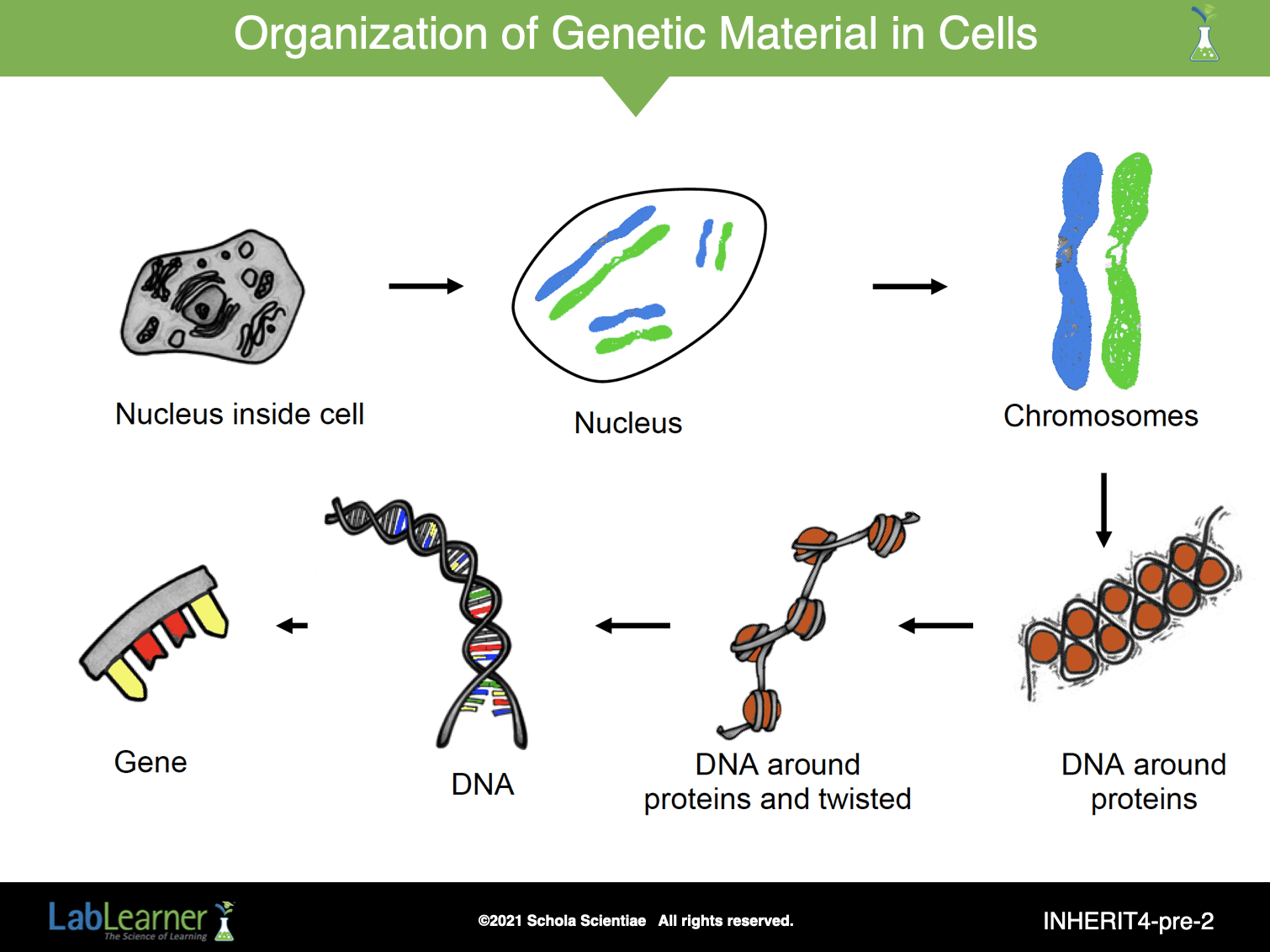
Ask students: Which part of this sequence did we examine in Investigation One? Which part of the sequence did we examine in Investigation Two? Which part of this sequence did we examine in Investigation Three? Students should indicate that in Investigation One, they examined the DNA around proteins and DNA portions of the pathway. In Investigation Two, they examined the chromosomes inside of a nucleus and chromosome portions of the pathway. In Investigation Three, they examined the chromosome and gene portions of the pathway.
What are chromosomes made of? Students should indicate that chromosomes are made up of many genes that are found on long strands of DNA. The DNA is then tightly wound around proteins and twisted together to form the chromosomes.
What is found on DNA? Students should indicate that genes are found on DNA. Genes contain dominant and recessive alleles which express specific traits or characteristics of an organism.
Explain to students that in this investigation, they will be examining DNA. Students looked at DNA and where it was located in the cell during Investigation One. In this investigation, students will be taking a closer look at the DNA itself and will learn how DNA is read and used by cells.
______________________________________________
SLIDE INHERIT4-pre-3
-
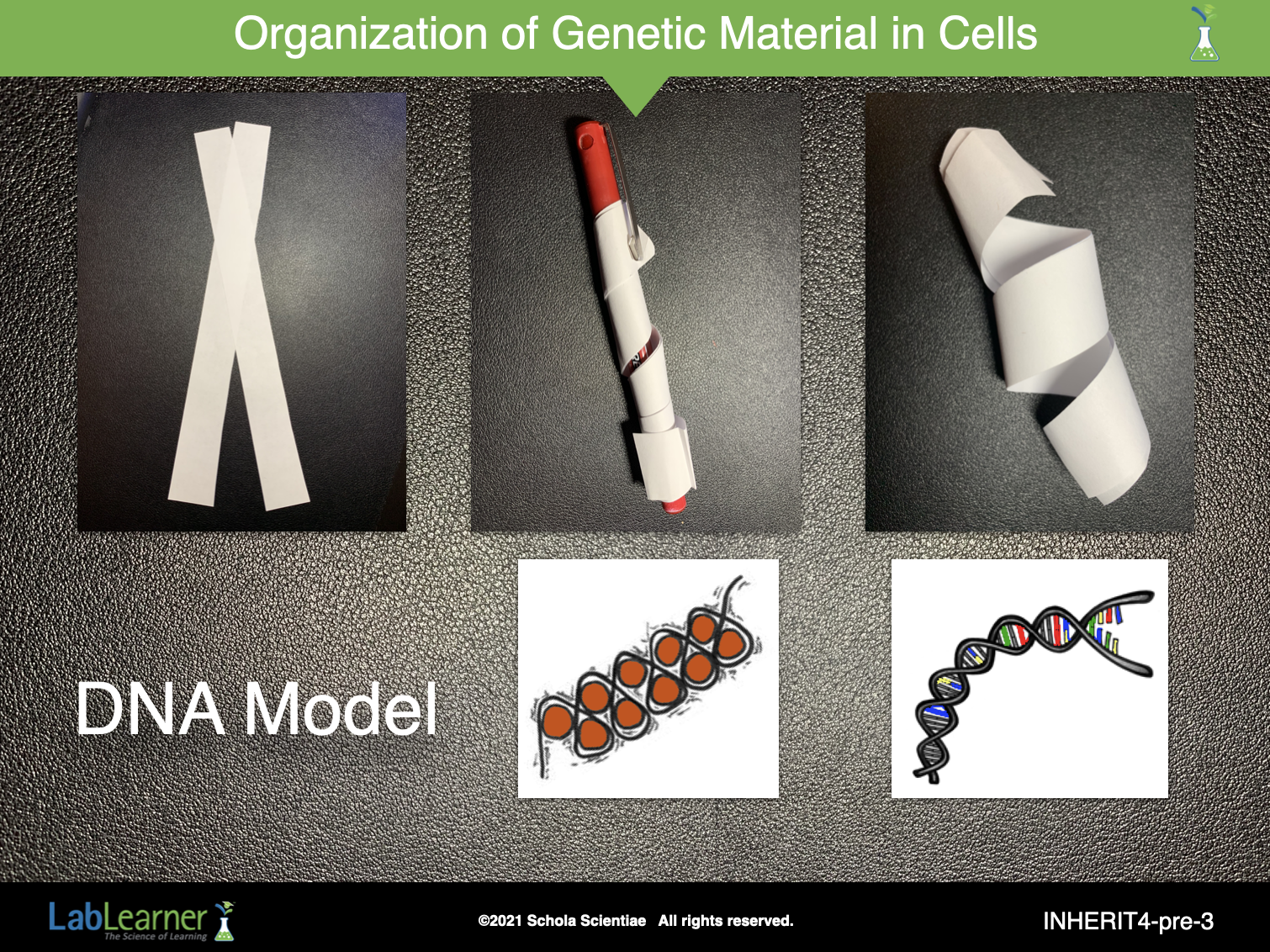
- Direct students to locate the two paper strips on their desks.
- Instruct students to lay one paper strip directly on top of the second paper strip. Ask students to carefully, but tightly, wind the paper strips around their pencils.
- Ask students to carefully remove the pencil from the paper strips.
Ask students: What do your paper strips look like? Students should indicate that their paper strips are long and twisted together in a spiral shape.
Ask students: Look at the Organization of DNA Transparency. What do you think your paper strips are modeling? Students should indicate that the paper strips are modeling DNA.
Ask students: During which experiment have you seen something like this before? Students should indicate that they saw DNA during the extraction of DNA from the onion cells experiment in Investigation One.
Ask students: What is the function of DNA? Students should indicate that DNA contains the genetic information that codes for proteins needed by the cells to carry on all of its functions.
Ask students: What smaller units do you think make up the information found on DNA? Student answers may vary.
______________________________________________
SLIDE INHERIT4-pre-4
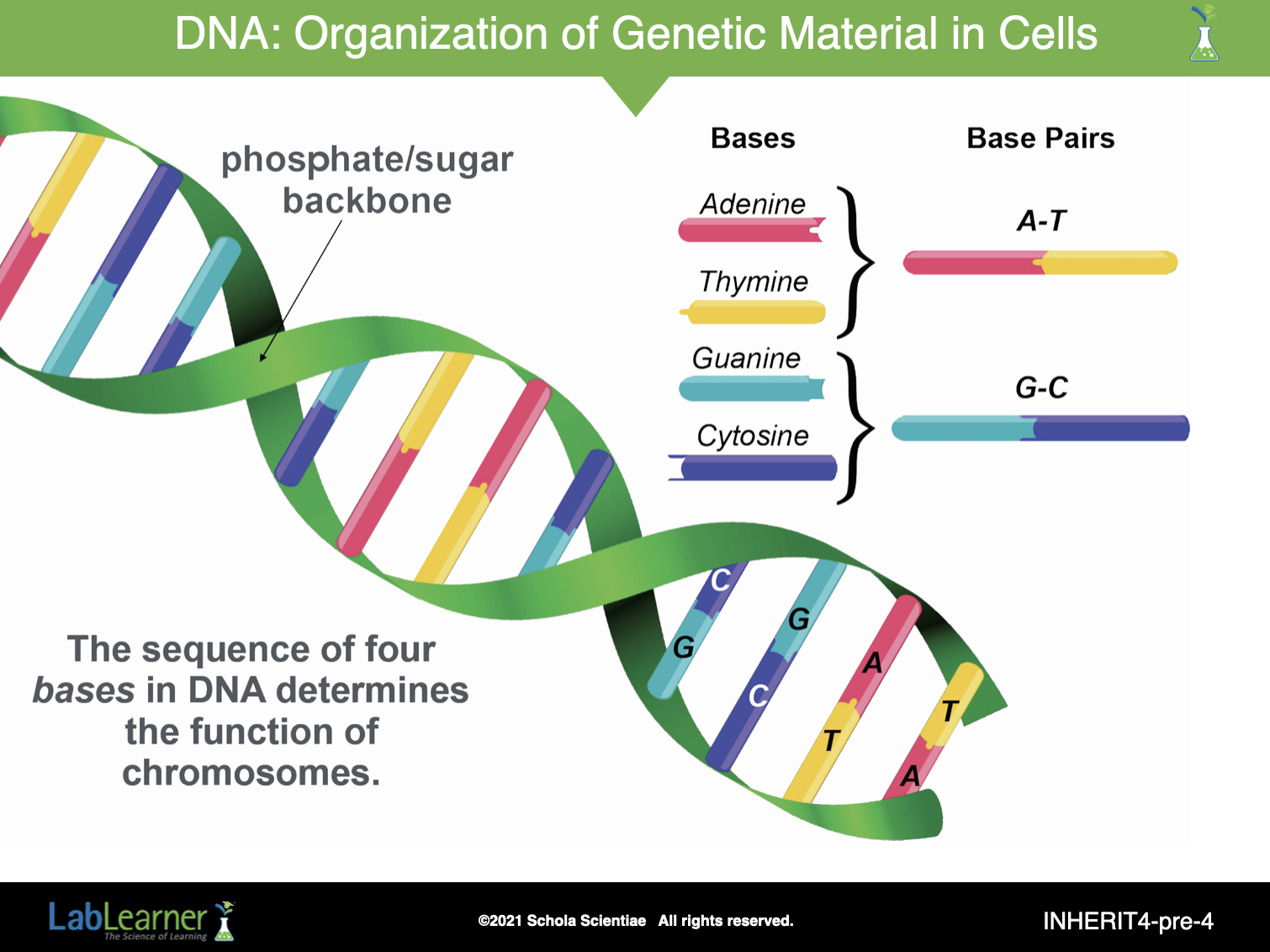
Encourage students to realize that DNA is made up of small building blocks called nucleotides. Ask a student volunteer to read the definition of nucleotide from the Scientist’s Glossary:
Nucleotide: The “building block” of DNA
Explain to students that there are four different nucleotides that are found in DNA: adenosine (A), cytosine (C), guanosine (G), and thymidine (T). For the purpose of this investigation, the symbols A, C, G, and T are sufficient to represent the four nucleotides.
Inform students that DNA is composed of millions or billions of nucleotides. For example, there are 6 billion nucleotides in the DNA found in the nucleus of every human cell. The nucleotides are in a specific order or sequence in the DNA. The DNA sequence of each species is different and the sequence of each gene in the DNA of a species is different.
______________________________________________
SLIDE INHERIT4-pre-5
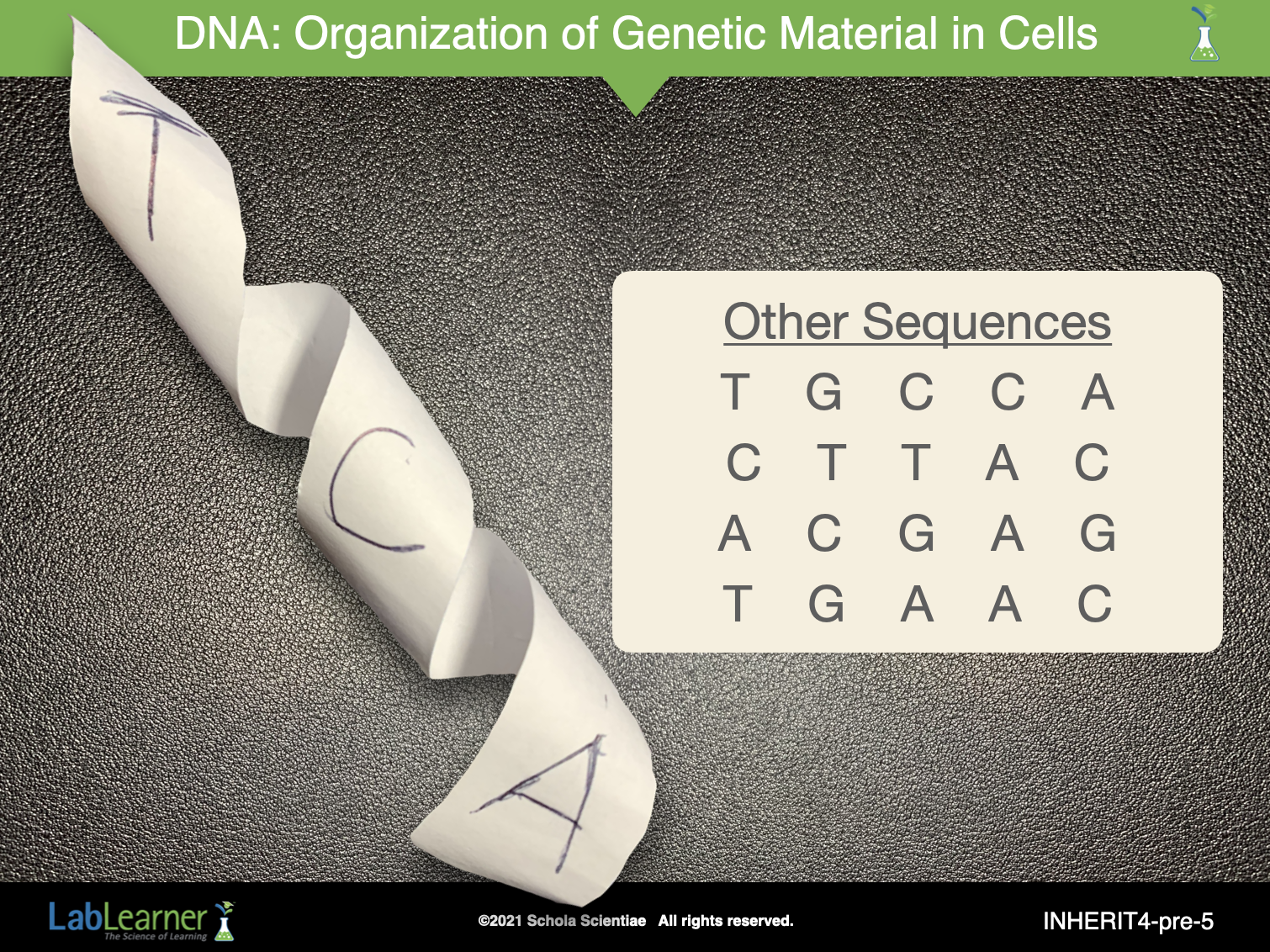
Direct students to create a sequence of DNA:
-
- Instruct students to stretch out one of their strips of paper.
- Tell students that the paper is going to model one strand of DNA that contains a sequence of five nucleotides. Ask students to write a sequence of five nucleotides on their strip of paper.
- Encourage students to realize that their sequence can have any order. Some sample sequences include: ATTCG, CGCGC, AAAAA, or CGTAA.
Ask several student volunteers to share their sequence with the class. Copy the sequences onto the board.
Ask students: Are any of the sequences on the board the same? Different? Students should indicate that all of the sequences are different.
Ask students: Do you think that the variation of DNA sequences of people in this room is high or low? Why? Students should indicate that the variation of DNA sequences is extremely high. This is because there are many different combinations that can be created by the four nucleotides. For example there are over 1,000 different sequences of the four nucleotides in a five nucleotide sequence (4 x 4 x 4 x 4 x 4 = 1,024)!
Explain to students that these sequences of nucleotides make up the genetic code.
Ask students: Have you ever heard the word “code” before? Give an example. Students should indicate that they have heard of the word code before. Examples include: Morse Code, ATM code, or zip code.
Point to some examples of nucleotide sequences on the board.
Ask students: Does this code make sense to you? Can you read it? Can you tell what color a person’s eyes will be from looking at this code? Student answers may vary. Students should indicate that the code does not make sense to them and they cannot interpret which traits are being coded for by the sequence of letters.
______________________________________________
SLIDE INHERIT4-pre-6
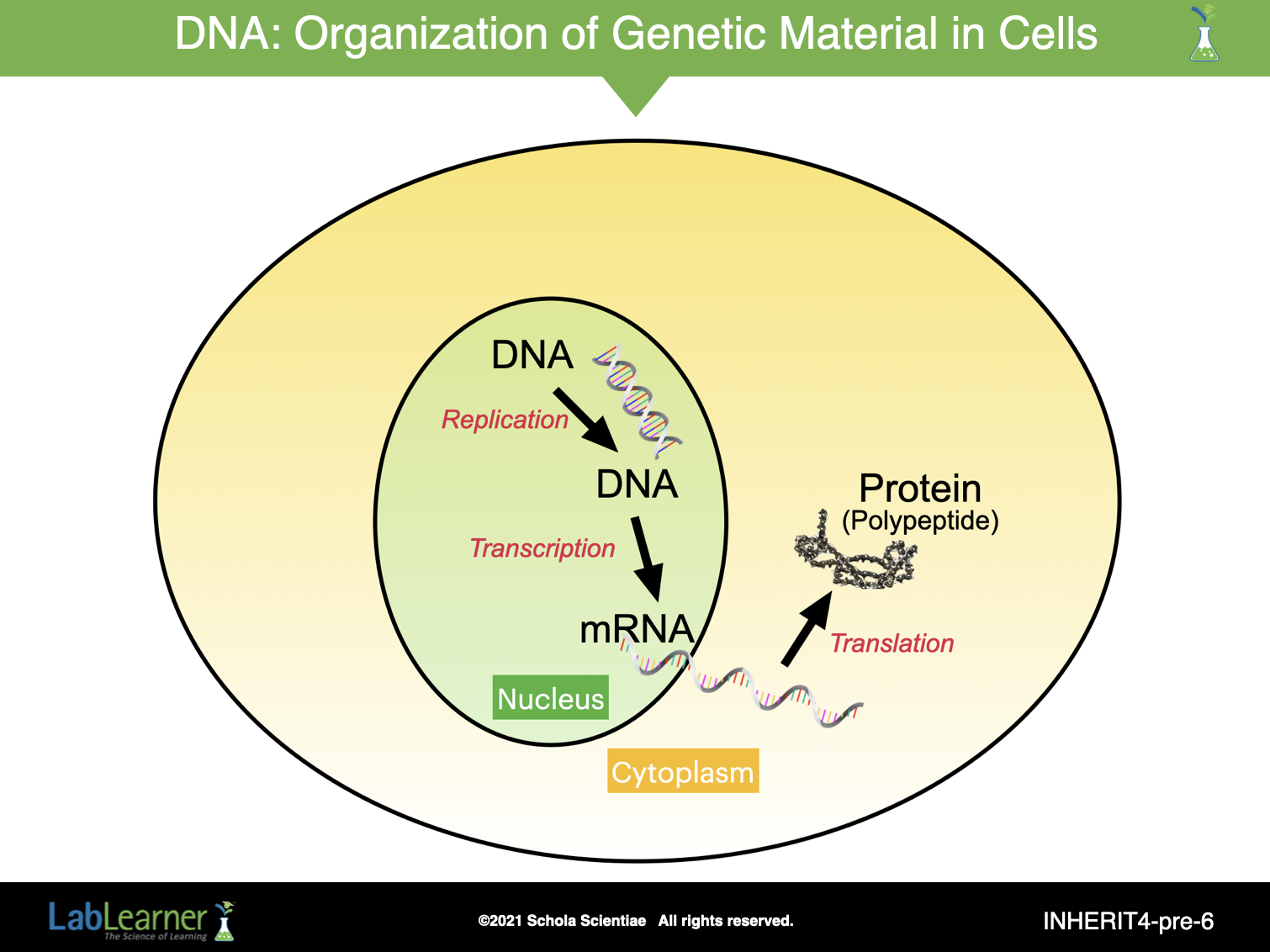
Inform students that the second concept they will discuss in this Investigation is the function of DNA, RNA, and proteins. Students will learn about proteins in this Investigation given that nucleotides are grouped together and used to create proteins.
Ask students: What is a protein? Student answers may vary.
Encourage students to realize that proteins control all of the functions of a cell and all of the traits of an organism. For example, proteins determine traits such as eye and hair color. Some proteins transport nutrients, while others provide structure and support for cells and tissues. Some proteins also enable muscles to contract, allowing movement.
Proteins are able to carry out these functions because of specific nucleotide sequences. Cells use the sequence of nucleotides to make proteins outside of the nucleus in the cytoplasm. All of the genetic information found on DNA must first be transferred from the nucleus to the cytoplasm.
Ask students: How do you think the information gets out of the nucleus? Student answers may vary.
Encourage students to realize that a messenger is needed to take the information from the nucleus and move it out to the proteins.
Ask students: Have you ever heard of information being passed this way? Student answers may vary. Students may indicate that information from a teacher may be sent to the school office via a messenger.
Tell students that the cell’s messenger is called RNA (ribonucleic acid). Ask a student volunteer to read the definition of RNA from the Scientist’s Glossary.
“RNA is a group of nucleic acids that copy and translate the genetic code.”
______________________________________________
SLIDE INHERIT4-pre-7
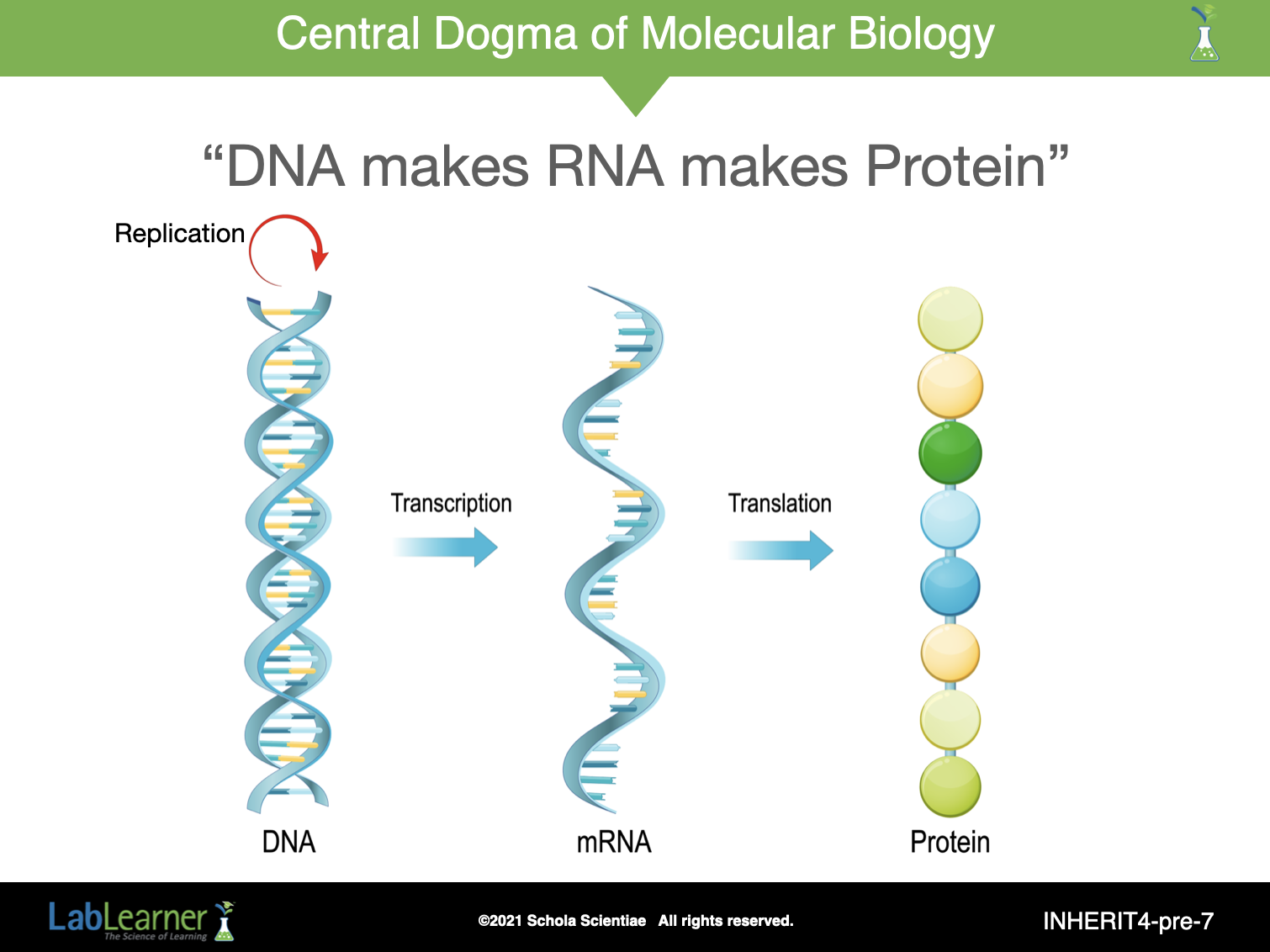
The central dogma of molecular biology is “DNA makes RNA makes Protein”. Notice that the doubling, or replication, of DNA, is indicated as well.
Replication: One DNA molecule makes two DNA molecules. Replication occurs in the nucleus.
Transcription: Double-stranded DNA molecule directs the synthesis of a single-stranded messenger RNA (mRNA) molecule. Transcription occurs in the nucleus.
Translation: mRNA serves as a template to make protein. Translation offers in the cytoplasm.
______________________________________________
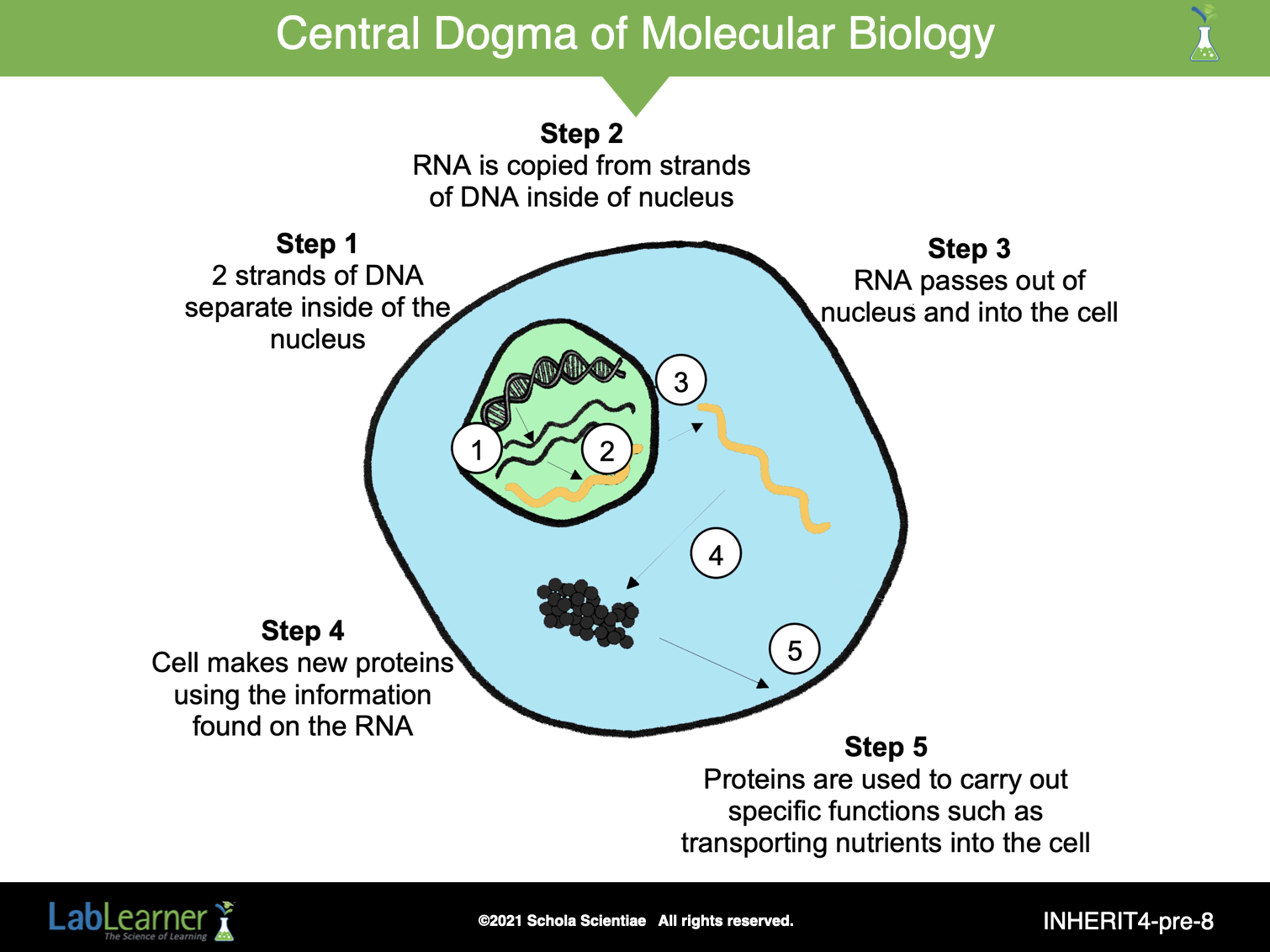
SLIDE INHERIT4-pre-8
Review the steps from transcription to protein synthesis:
1. DNA strands in the nucleus separate for replication, or copying.
2. RNA is formed by creating a copy of the DNA sequence of nucleotides inside of the nucleus.
3. The RNA is passed out of the nucleus into the cell.
4. The cell uses the information on the RNA to make new proteins.
5. The proteins are used by the cell to carry out its specific functions.
______________________________________________
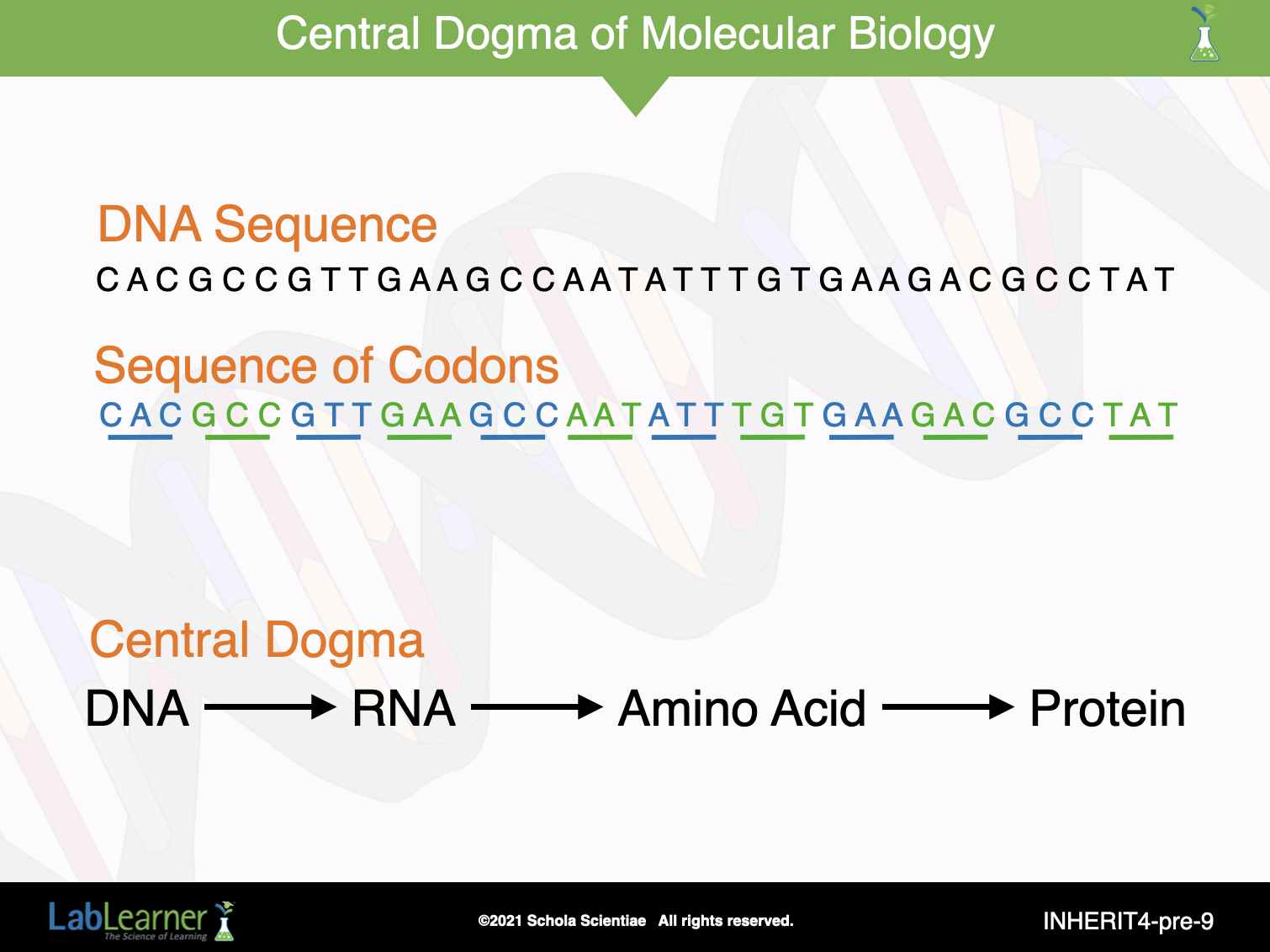
SLIDE INHERIT4-pre-9
Explain to students that the genetic information found on DNA and RNA must be translated by the cell so that proteins can be made. Over the years, scientists have determined how to interpret this code.
Ask students: What are some ways that you could speak to someone who does not speak English? Student answers may vary. Some students may indicate that they could communicate through gestures, some may indicate that they would use an interpreter or translator, others may indicate that they cannot communicate with someone who does not speak their language.
Inform students that, like a language interpreter, the genetic code can also be interpreted by cells using a key. That is, cells can translate the information found on DNA and RNA and use that information to make proteins.
Ask students to locate Problem 1 of their Student Data Record. Write the sequence found in Problem 1 on the board:
C A C G C C G T T G A A G C C A A T A T T T G T G A A G A C G C C T A T
-
- Tell students that when a cell is translating a sequence of nucleotides, the sequence is read from left to right.
- The sequence is also read by the cell in groups of three.
- Each group of three nucleotides is called a codon.
______________________________________________
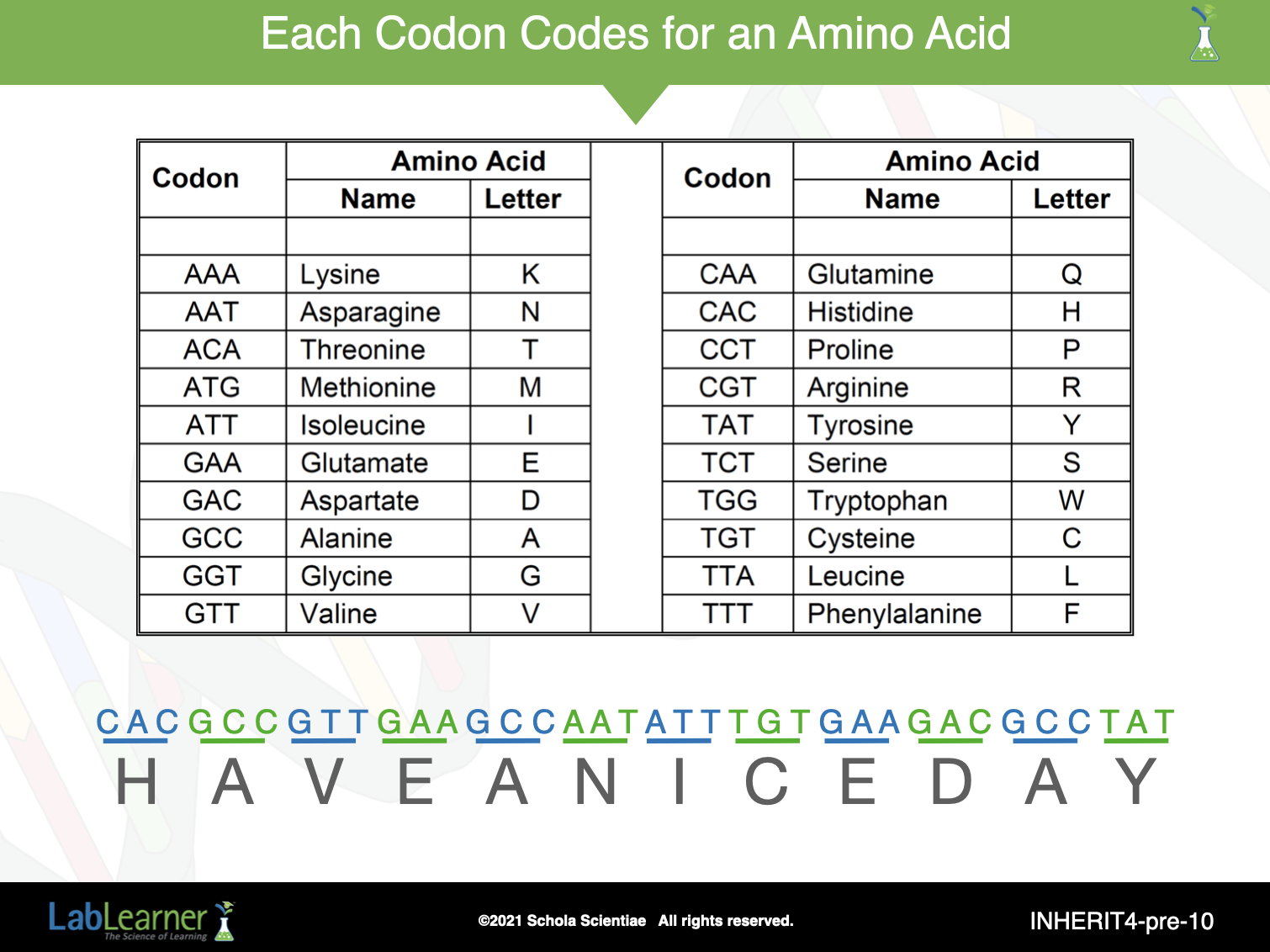
SLIDE INHERIT4-pre-10
This slide shows how you can use the genetic code to determine the amino acid sequence of a new protein directly from the DNA sequence. To do this, each triplet of nucleotides (each codon) is first found on the codon table and then the amino acid it codes for is found included in the protein sequence, in the correct order.
______________________________________________
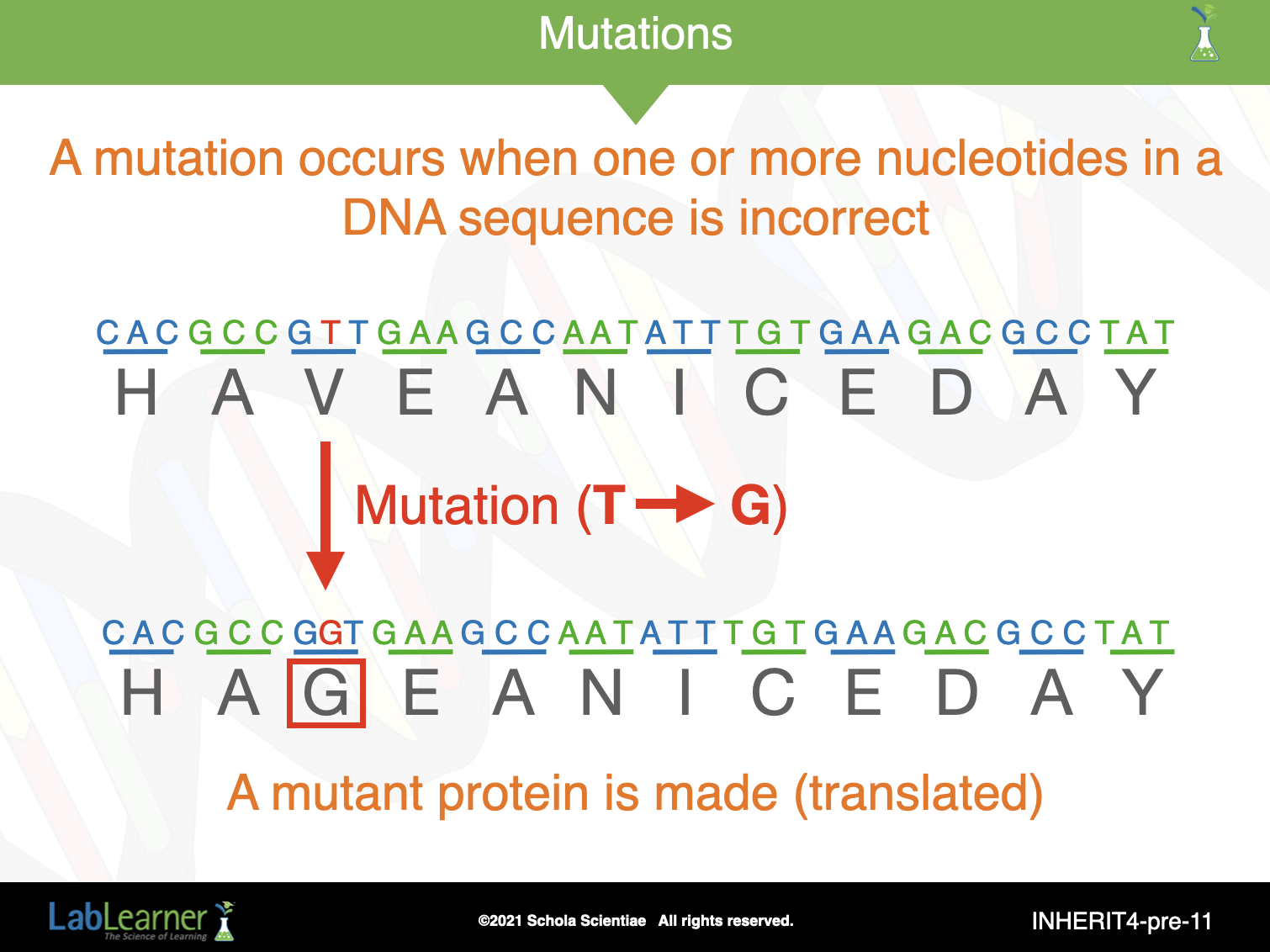
SLIDE INHERIT4-pre-11
Explain to students that sometimes a mistake is made in a genetic code. This results in a mutation. Ask a student volunteer to read the definition of mutation from the Scientist’s Glossary.
Mutation: A change in the DNA sequence of a gene.
This slide shows how a mutation in the DNA sequence (GGT to ACA) results in an altered protein with the wrong amino acid (T instead of V). The mutation is shown in the red box on the slide.
Ask students: Did one mistake of a nucleotide change the translation? Students should indicate that one mistake changed the word “have” to the word “hage.”
Ask students: Do all of the letters of the translation still group to make words? Students should indicate that all of the letters of the translation make words.
Ask students: Does the entire translated sentence still make sense? Students should indicate that the new sentence does not make any sense.
______________________________________________
SLIDE INHERIT4-pre-12
In the Lab, students will be translating the genetic code of a sequence of nucleotides and building protein models. Students should consider the following questions as they conduct their experiments:
• How is the genetic code interpreted by cells?
• How can a mutation affect the function of a protein?
• Do all mutations have a negative affect on a protein?
______________________________________________
VIEW IT
Play the following student video to the class and/or assign it as homework for students to prepare for Investigation Four lab.