Teacher Portal:
Inheritance and Adaptations
Investigation 4 – PostLab
 PRINT IT
Use your browser to download a printable PDF as help during the slide presentation and to make additional notes. In your browser, go to File > Print and then choose to save as PDF.
NAVIGATE IT
Once the slide presentation is launched
- use your left and right arrows to advance or go back in the slide presentation, and
- hover your mouse over the left edge of the presentation to get a view of the thumbnails for all the slides so that you can quickly move anywhere in the presentation.
- Click HERE to launch the slide presentation for the CELL.
SHARE IT
SLIDE INHERIT4-post-1
Ask students how to Summarize what they did in the Lab. Remind students that when creating a summary, the first thing to do is recall the main questions that were investigated. This will help them remember what they did, and will help direct the summary so that it answers the questions.
Remind students that the second thing to do is to think about the main steps involved in what they did and what each step was designed to represent. Small details that may signal differences in how a group conducted the Lab can be omitted.
What were the questions we wanted to investigate in the Lab? The main questions investigated in this lab were: How is the genetic code interpreted by cells? How can a mutation affect the function of a protein? Do all mutations have a negative affect on a protein?
How would you summarize the types of experiments that you performed to investigate these questions? In Trial 1, students used a set of RNA instructions to create two proteins using gram cubes. Students then tested whether or not each protein could perform its function. The cubes that represented the mutation could not do their job. In Trial 2, students used a key to translate three sequences of nucleotides. Students then analyzed each sequence to determine if a mutation had occurred. One mutation did not affect whether or not the translation was meaningful, and the other one did.
______________________________________________
SLIDE INHERIT4-post-2
Begin analyzing the Lab by directing students’ attention to the results of Trial 1. Refer students to the Student Data Record to support the discussion.
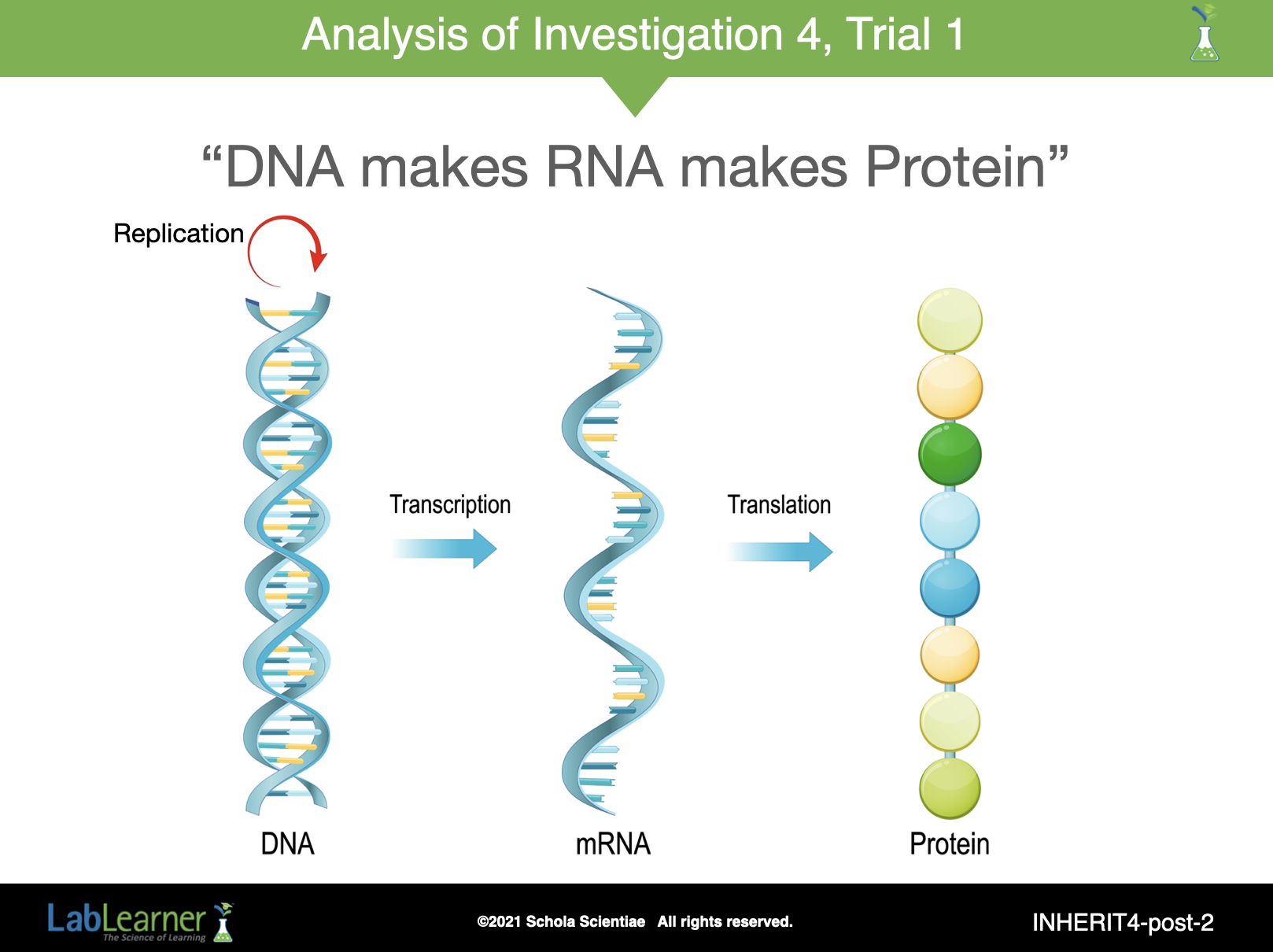
Ask students: What process was modeled in Trial 1? Students should indicate that the process of DNA being copied to RNA, then being translated into the creation of a protein was modeled in Trial 1.
Ask students: How was this process modeled? Students should indicate that they were the RNA following written instructions (DNA). The individual gram cubes represented amino acids and the chains of gram cubes represented completed proteins.
Ask students: What does a cell use to build its proteins? Students should indicate that amino acids are used to build proteins. The amino acids are determined by the codons found in the sequence of nucleotides in the DNA.
Ask students: In protein B, what do you think was represented by the different colored gram cube? Students should indicate that the different colored gram cube modeled a mutation in the protein that was encoded by allele B.
Ask students: What was the function of each protein in this Trial? Students should indicate that each protein had to fit through a small opening.
Ask students: Was each protein able to perform its function? Why or why not? Students should indicate that protein A was able to perform its function because its structure was a straight line of amino acids. Protein B was unable to perform its function because its structure was bent.
Ask students: If each of the proteins you built were found in the human body, do you think problems could occur as those proteins tried to perform their functions? Students should indicate that protein B would not be able to fit through small openings therefore it would not be able to perform its function in the human body.
______________________________________________
SLIDE INHERIT4-post-3
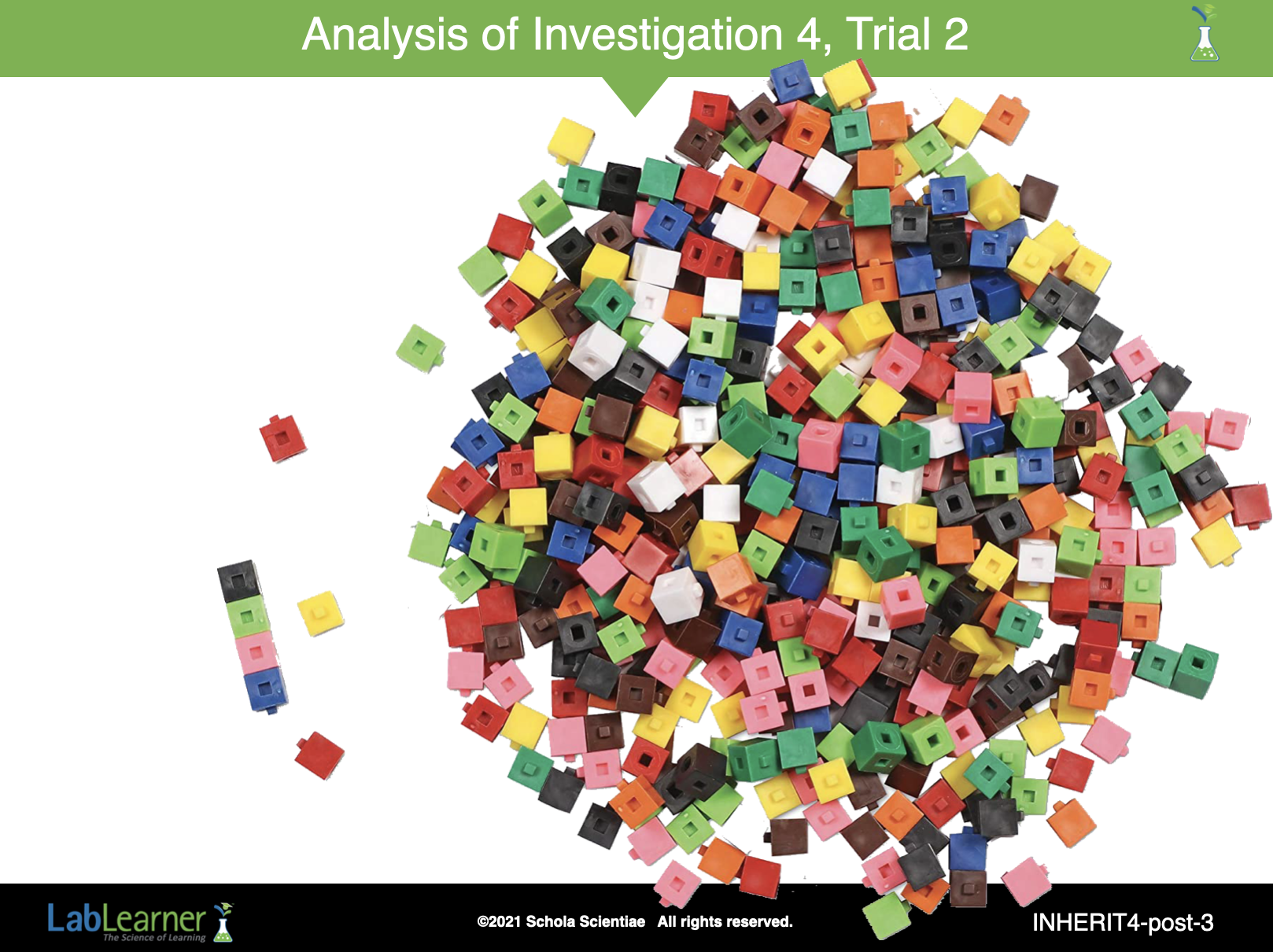
Continue the analysis by focusing on Trial 2. Ask students to recall Trial 2.
Ask students: Were the three sequences of nucleotides exactly the same? The sequences were slightly different.
Ask students: What was the function of these sequences? Student answers may vary. Encourage students to realize that these sequences encoded a specific sequence of amino acids. If the sentence made sense the sequence of amino acids was able to perform its function.
Ask students: Do you think sequence 1 was able to perform its function? Why or why not? Students should indicate that sequence 1 was able to perform its function because the sentence that was translated made sense.
Ask students: Do you think sequence 2 was able to perform its function? Why or why not? Students should indicate that sequence 2 was able to perform its function because the sentence that was translated made sense.
Ask students: Do you think sequence 3 was able to perform its function? Why or why not? Students should indicate that sequence 3 was not able to perform its function because the sentence that was translated did not make sense.
Ask students: How do you think the protein from sequence 2 was affected by its mutation? Students should indicate that the protein from sequence 2 was not affected by its mutation. The sentence was different than that of sequence 1, but it was still able to perform its function because the sentence made sense.
Ask students: How do you think the protein from sequence 3 was affected by its mutation? Students should indicate that the protein from sequence 3 was negatively affected by its mutation. The sentence was different than that of sequences 1 and 2, and it was not able to perform its function because the sentence did not make sense.
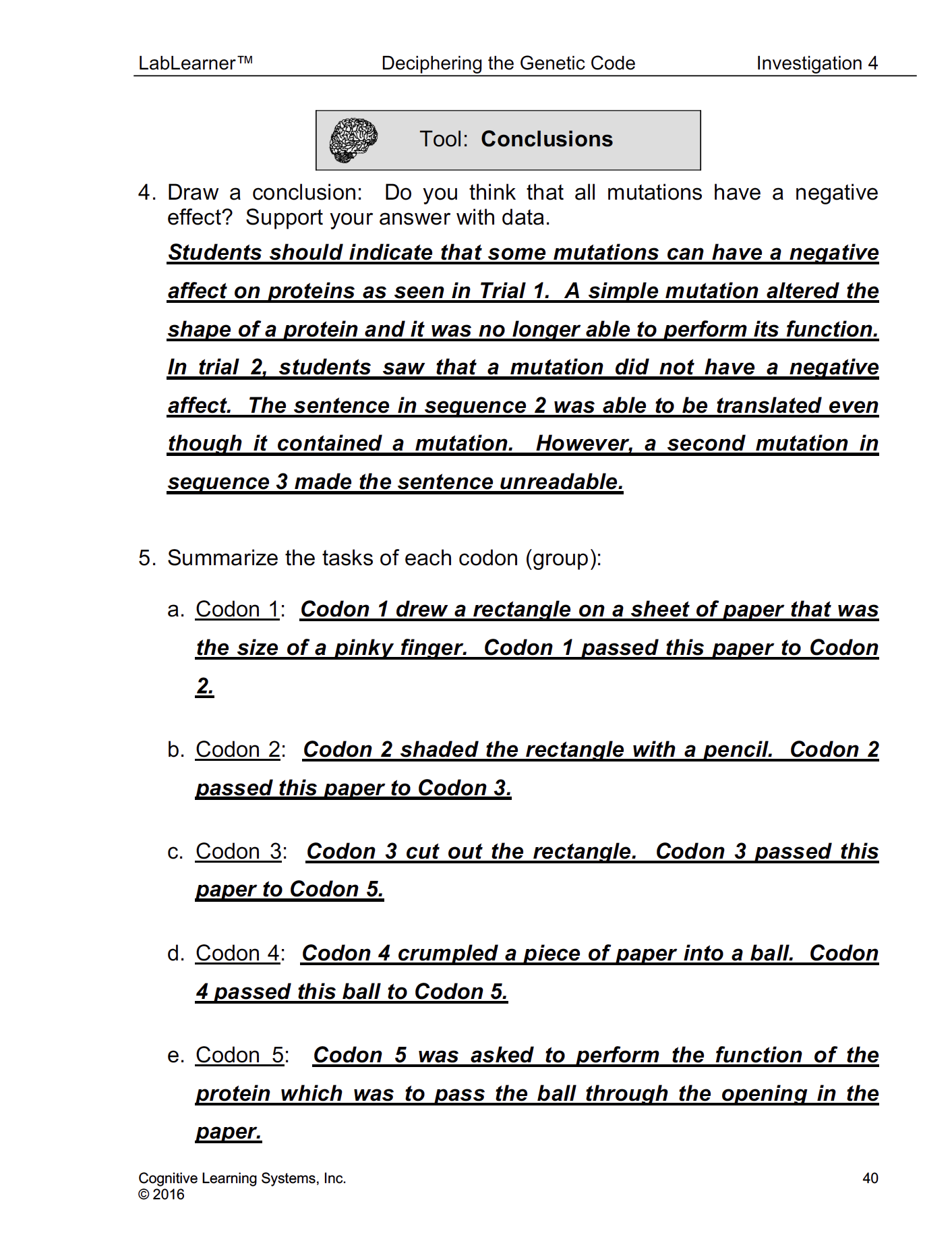
- Direct students to locate problem 4 of their Scientist Data Record. Encourage students to draw a conclusion based on the results of their experiment. Allow sufficient time for students to complete the problem. Once complete, discuss student answers as a class.
______________________________________________
SLIDE INHERIT4-post-4
Ask students how to use their findings to draw a Conclusion. If necessary, remind students to ask themselves the question presented in Problem 4 for each trial in turn.
Do you think that all mutations have a negative effect?
Remind students that they may write a sentence to summarize each trial and then write a conclusion statement thereafter, or may choose to write a position statement first, followed by evidence from their findings.
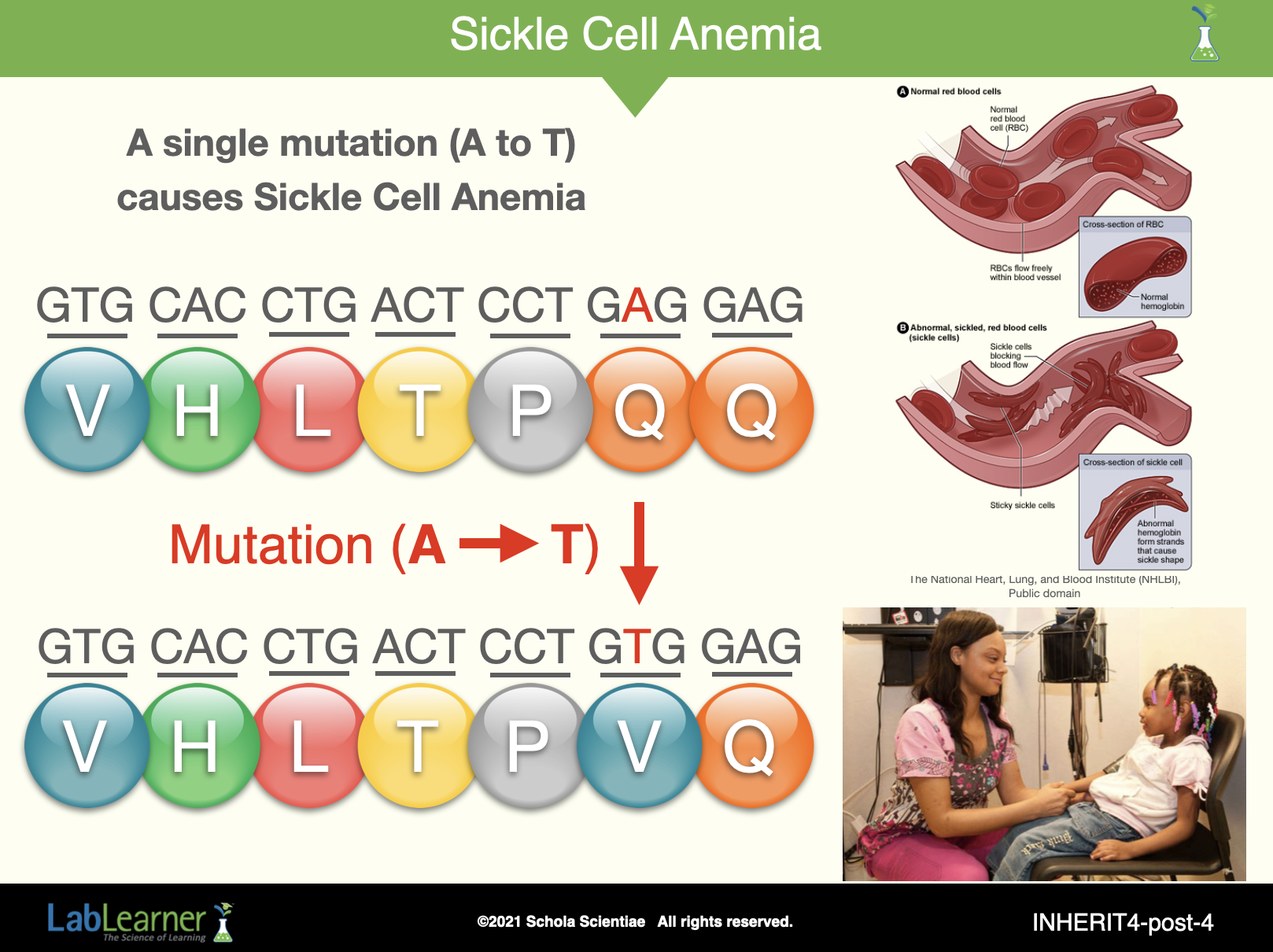
NOTE: This slide looks at the single mutation that causes Sickle Cell Anemia. Importantly, this mutation (an A in the DNA sequence is changed to a T) can be inherited from one generation to the next. Sickle Cell Anemia can deprive the body of oxygen and cause further complications by damaging the kidneys, liver, and spleen.
______________________________________________
POSTLAB EXERCISE
Continue the discussion of nucleotide mutations by engaging students in the following activity:
1. Divide the class into five groups, Codon 1 through Codon 5.
2. Explain that each group represents one codon in a nucleotide sequence. Each codon of this sequence must perform a task that will result in the protein performing its function.
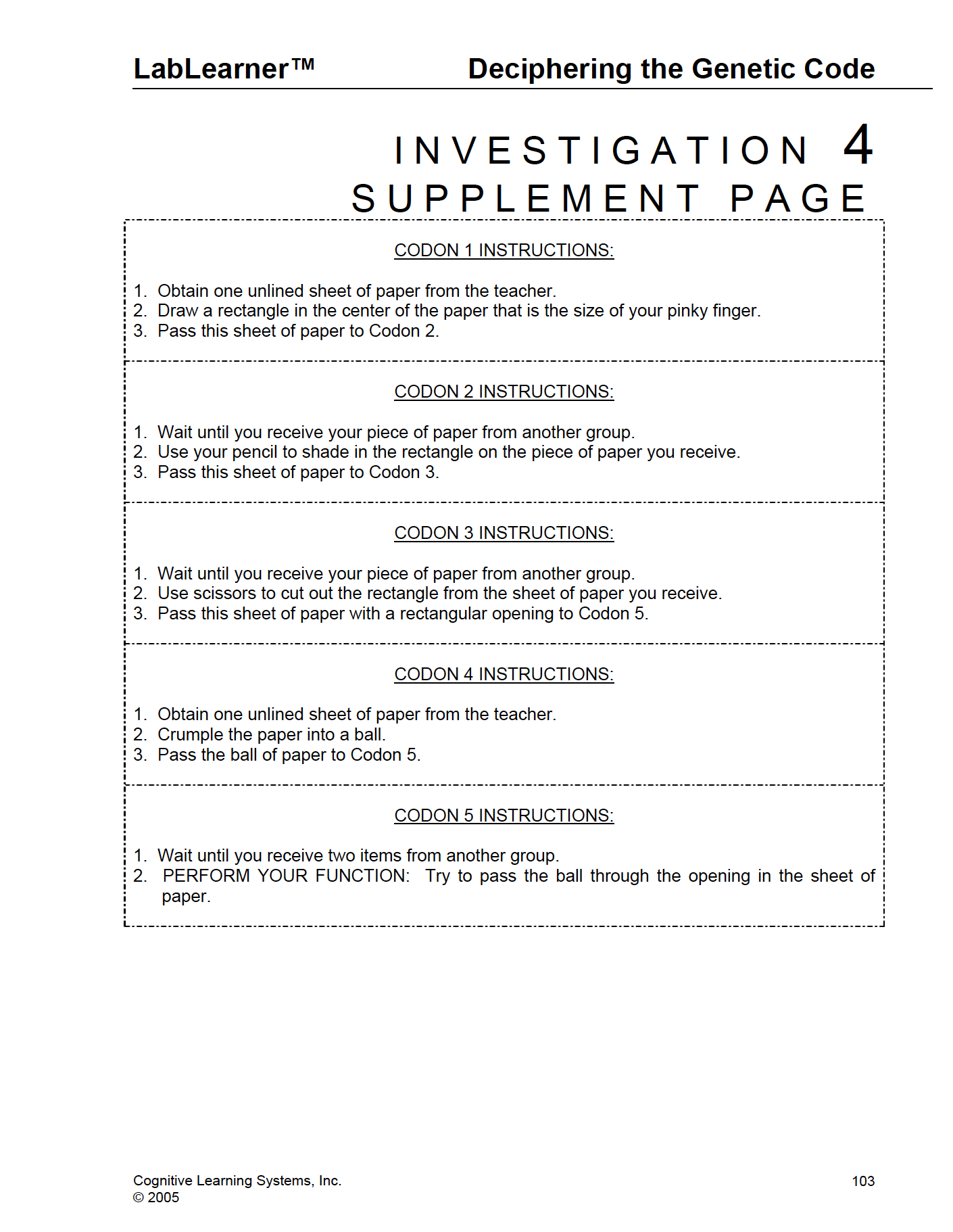
3. Distribute the prepared instructions from the Investigation One Supplement Page to the appropriate group. These are listed in Step 5 below for instructor reference.
4. Direct student groups to quietly read their instructions. Encourage students not to share their instructions with any other group.
5. Instruct students to follow their instructions and begin their tasks. The instructions for each student group are summarized below:
Codon 1: Obtain one unlined sheet of paper from the teacher. Draw a rectangle in the center of the paper that is the size of your pinky finger. Pass this sheet of paper to Codon 2.
Codon 2: Wait until you receive your piece of paper from the Codon 1 group. Use your pencil to shade in the rectangle on the piece of paper you receive. Pass this sheet of paper to Codon 3.
Codon 3: Wait until you receive your piece of paper from the Codon 2 group. Use scissors to cut out the rectangle from the sheet of paper you receive. Pass this sheet of paper with a rectangular opening to Codon 5.
Codon 4: Obtain one unlined sheet of paper from the teacher. Crumple the paper into a ball. Pass the ball of paper to Codon 5.
Codon 5: Wait until you have one item from the Codon 2 group and one item from the Codon 3 group. PERFORM YOUR FUNCTION: Try to pass the ball through the opening in the sheet of paper.
6. After all groups have performed their tasks, ask Group 5 to read their instructions aloud.
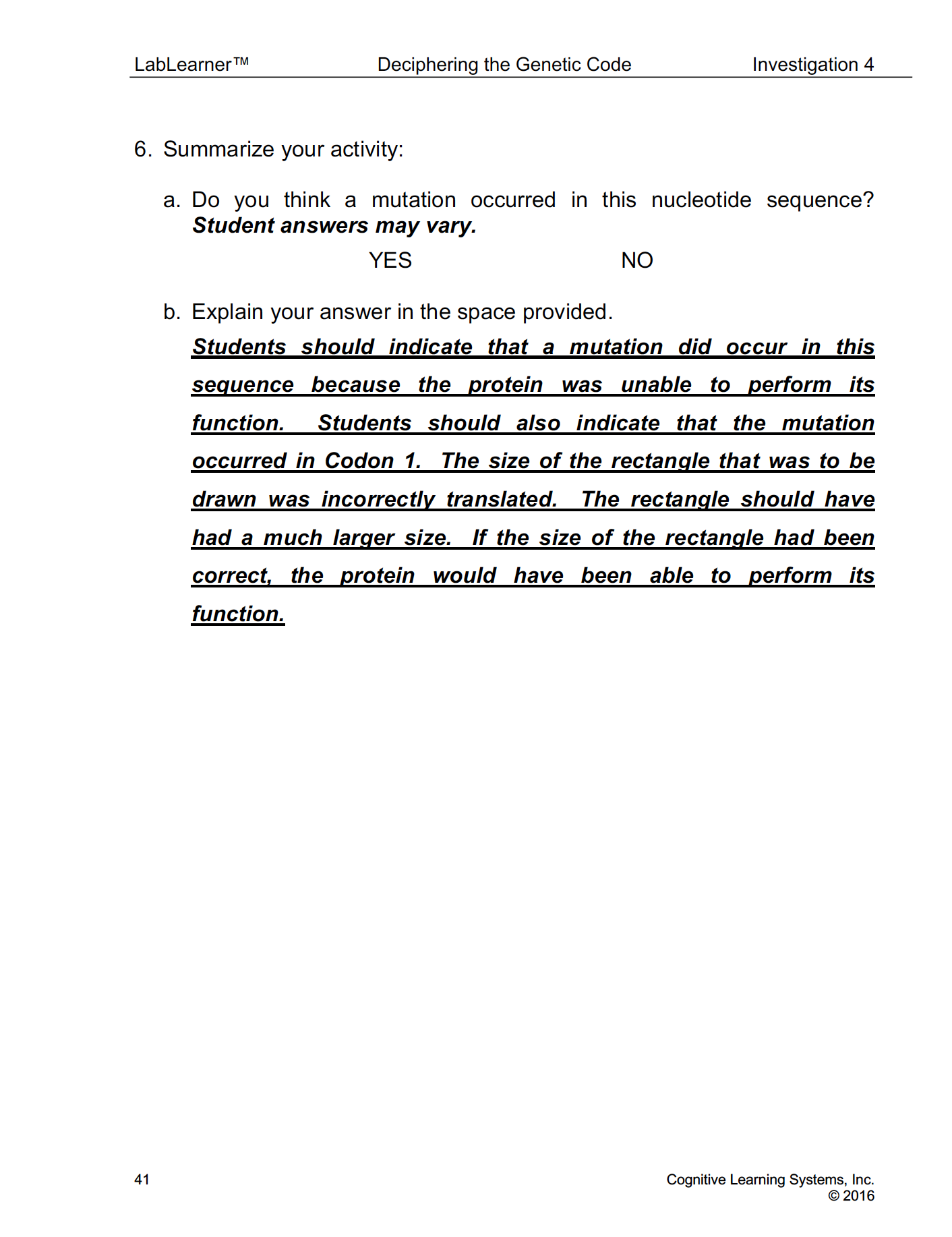
7. Ask students: Was this protein able to perform its function? Students should indicate that the protein was unable to perform its function.
8. Ask students to locate Problem 5 on their Student Data Record. Students are asked to summarize the tasks of each group. Ask one student from each group to read their instructions aloud. Allow sufficient time for students to summarize each step before reading the next set of instructions.
9. Encourage student groups to answer Problem 6 of their Student Data Record.
10. Ask several student volunteers to share their answers with the class.
KEYS: POSTLAB EXERCISE