
Teacher Portal:
Inheritance and Adaptations
Investigation 3 – PreLab
 MINDSET
This Investigation is designed to:
- reinforce the concept that genetic information is expressed in the form of traits.
- demonstrate to students that some traits are controlled by the inheritance of many genes (polygenic traits).
- encourage students to realize that inherited traits can be expressed as dominant, recessive, co-dominant, or incomplete dominance.
- provide students with the opportunity to randomly select alleles and complete a model using those alleles.
SCIENTIST’S GLOSSARY
1. Allele: Different form of the same gene containing slightly different genetic information that encodes a slight difference in a trait.
2. Biological variation: Slight differences in an organism’s traits compared to those of other members of the species that are considered normal.
3. Gene: A small portion of DNA that carries specific genetic information.
4. Incomplete dominance: A type of inheritance in which both alleles of a gene are expressed. This results in a trait that is intermediate in appearance between what each allele determines.
5. Co-dominance: A type of inheritance in which both alleles of a gene are expressed. This results in a trait whose appearance results from the expression of both alleles independently with no mixing.
6. Population: A large group of the same species that live in the same area.
7. Polygenic: When a trait arises from the expression of multiple genes. An example is eye color.
8. Ratio: A group of numbers that compares the amounts or quantities of two different things.
BE PREPARED
Watch the Investigation 3 Teacher Video and Student Video below to prepare for the PreLab.
SET FOR SUCCESS
- Tell students that they are going to continue learning about Inheritance and Adaptation.
- Ask students to share the kinds of things they might learn in these Investigations.
Begin the PreLab Concept Slides to start students on their learning journey. Then watch the Pre-Lab Student Video as a class.
NAVIGATE IT
Once the slide presentation is launched
- use your left and right arrows to advance or go back in the slide presentation, and
- hover your mouse over the left edge of the presentation to get a view of the thumbnails for all the slides so that you can quickly move anywhere in the presentation.
- Click HERE to launch the slide presentation for the CELL.
SHARE IT
SLIDE INHERIT3-pre-1
Begin the investigation by reviewing the differences in the expression of traits that students listed in Problem 11 of their Investigation One Scientist Data Record and by asking students to recall what they previously knew about the concepts of variation and population.
Ask students: What types of differences do you see among the members of your family? Student answers may vary depending on the lists they created in Investigation One.
Ask students: Can you think of a word that means the same thing as differences? Encourage students to use their Scientist’s Glossary to find the answer. Students should indicate that variation means the same thing as differences.
Ask students: How would you describe biologic variation? Can you give an example? Student answers may vary. A sample answer includes: Biological variation is differences of the characteristics found in organisms. An example would be different breeds of dogs or different types of trees.
Ask students: What is a population? Can you give an example? Student answers may vary. A sample answer includes: A population is a large number of the same organism living in the same place. An example would be the human population.
Ask students: How would you describe population variation? Can you give an example? Student answers may vary. A sample answer includes: Population variation is the difference in characteristics found in one population of organisms. An example would be the number of leaves found on maple trees or the thickness of fur of polar bears.
Ask students: Think about the human population. Do all members of this population have a heart? A brain? Skin? Students should indicate that all members of the human population have a heart, a brain, and skin.
Ask students: Do all members of this population have cells? What makes each member of this population different? Students should indicate that all members of the human population have cells. Each member of the human population is different based upon the differences found in their DNA.
Ask students: Do you think that the biological variation found in the human population is high or low? Why? Student answers may vary.
______________________________________________
SLIDE INHERIT3-pre-2
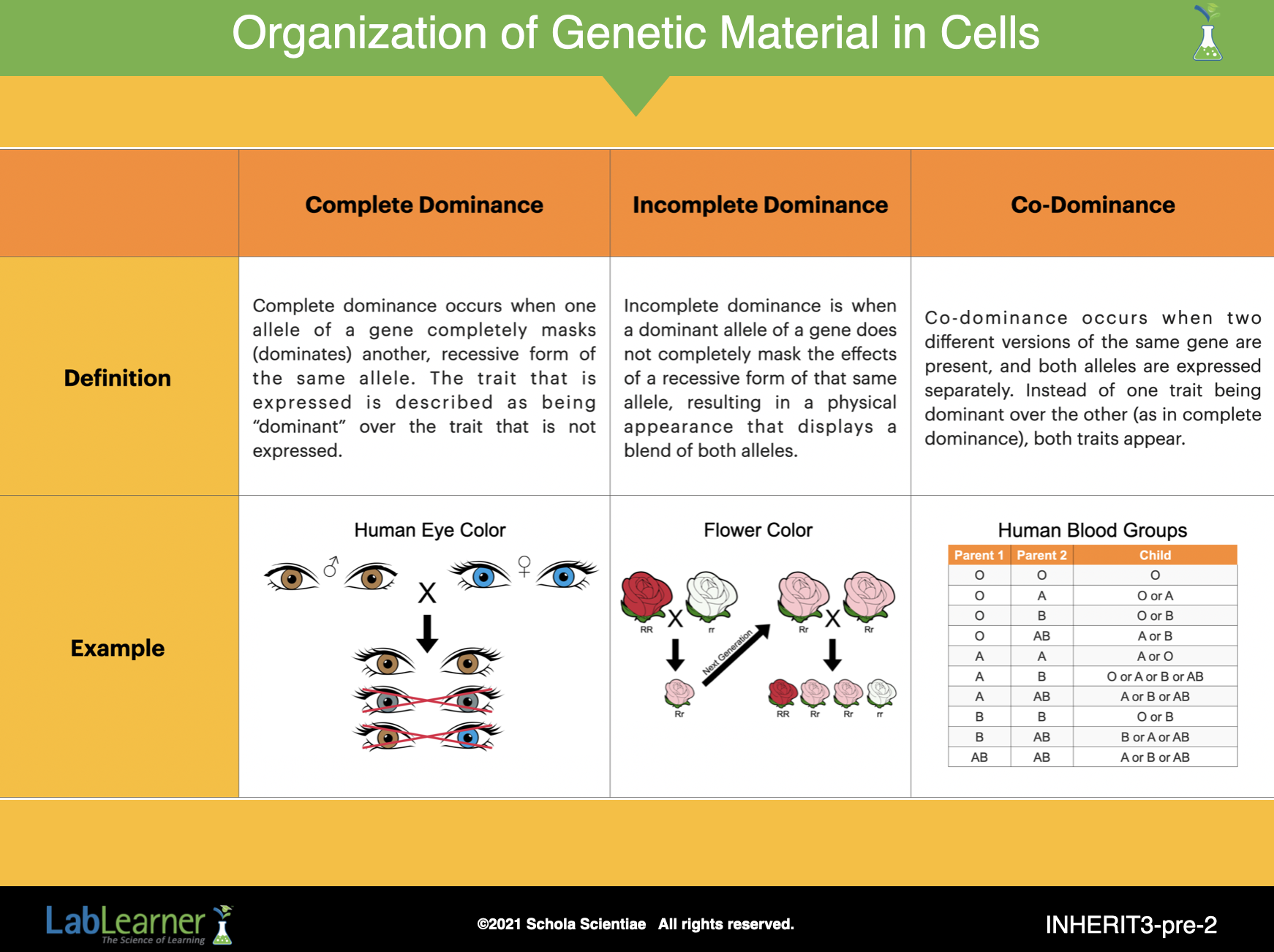
This slide quickly summarizes the three types of genetic inheritance that we will consider in Investigation Three Lab. Simply point out the three types of inheritance at this point as we will discuss each in further detail in subsequent slides.
______________________________________________
SLIDE INHERIT3-pre-3
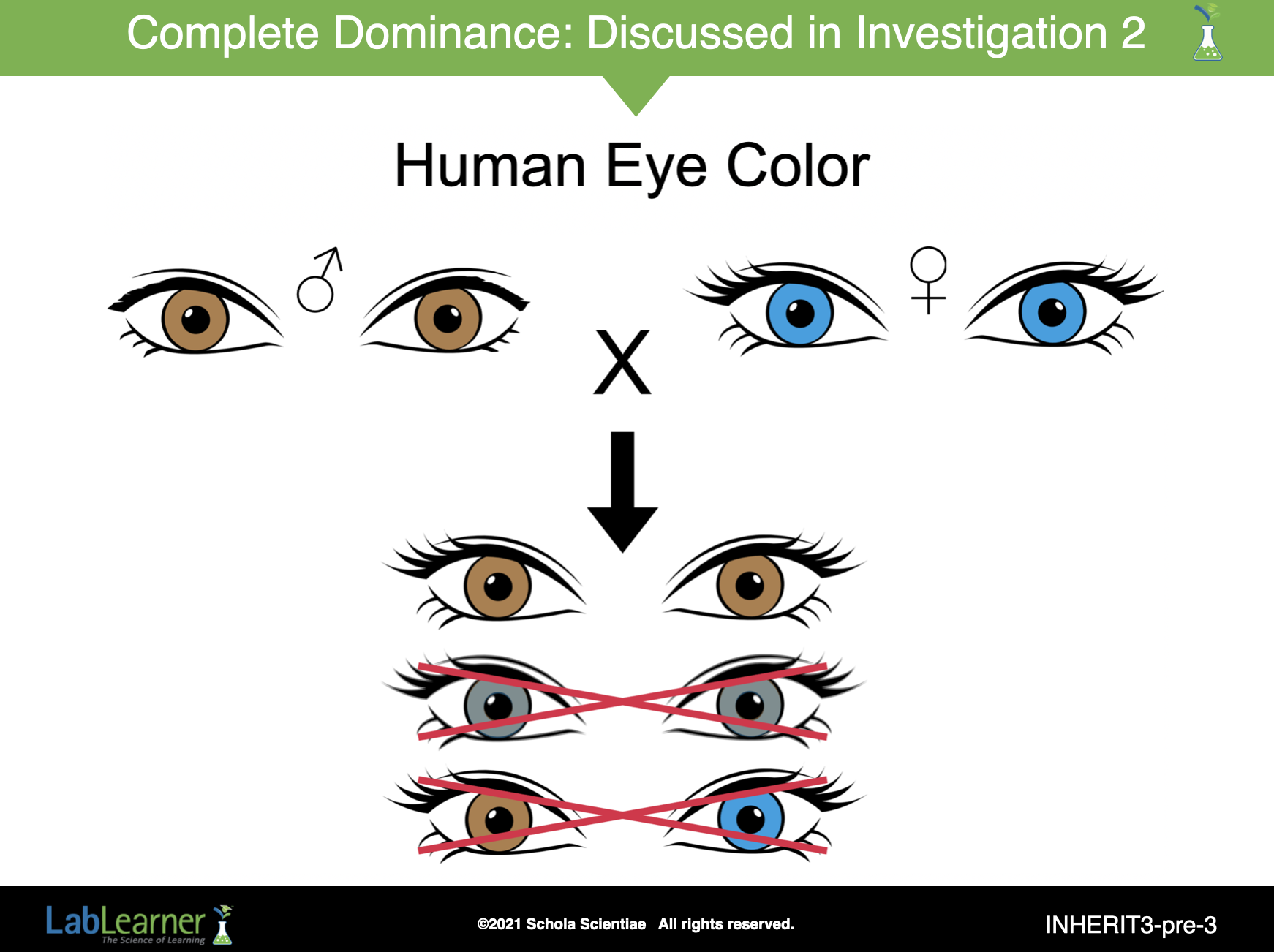
Begin a discussion of dominant and recessive alleles as was illustrated in Investigation Two.
Ask students, How are two alleles expressed if one is dominant and the other is recessive? Both alleles are inherited but the dominant allele is expressed and the recessive allele is not.
Remind students that any combination of a cross between parents that have a brown-eye color allele, will be expressed in the offspring as brown eyes. The brown-eye alley will “mask” or dominate the recessive allele even if it is present.
Thus, if upper case B indicates the dominant brown-eye allele, and lower case b represents the recessive blue-eye alley, there are two ways for brown-eye offspring to occur, but only one combination of B and b that will result in a blue-eye offspring:
Brown eyes: BB (two dominant alleles) or Br (one dominant and one recessive allele)
Blue eyes: bb (two recessive alleles, no dominant B allele)
______________________________________________
SLIDE INHERIT3-pre-4
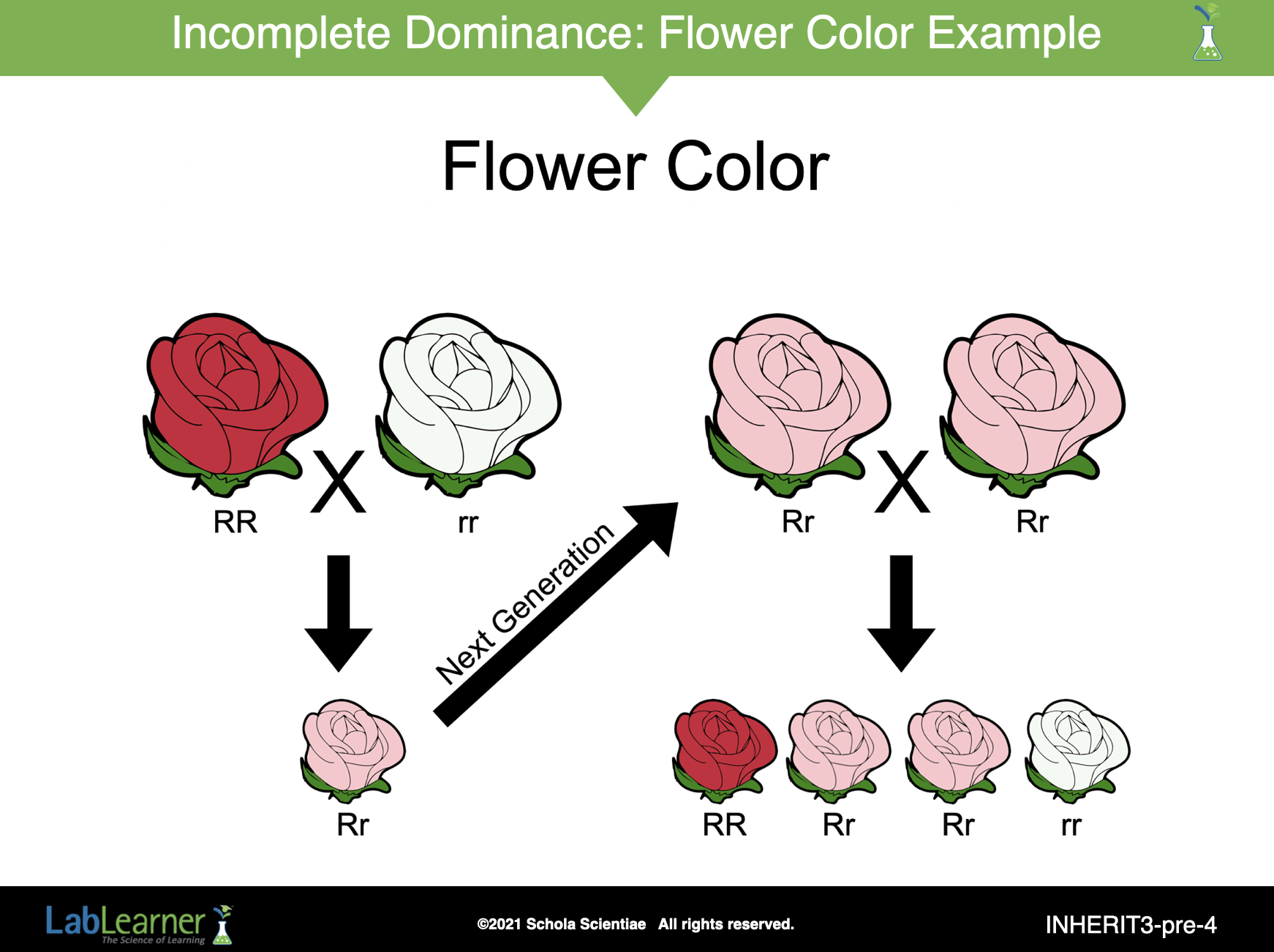
Ask students, What is the definition of incomplete dominance? Incomplete dominance is a type of inheritance in which both alleles of a gene are expressed. This results in a trait that is intermediate in appearance between what each allele determines.
Explain to students that in incomplete dominance, the expression of both alleles leads to a trait that shows a “blending” of the two traits. For example, in snapdragon flowers, when a red and a white parent are crossed, the offspring flower appears pink.
Notice that all flowers from a RR and rr cross are pink and have an allele combination of Rr (dominant/recessive). Therefore, if these flowers are crossed, they will produce three different allele combinations (shown on the right side of this slide):
RR (red flower)
Rr (pink flower)
Rr (pink flower)
rr (white flower)
Thus, only the rr (double recessive) allele combination can produce a white flower. The RR allele combination, of course, produces the red flower, and the Rf mixed allele combination gives the incomplete dominant pink flower.
______________________________________________
SLIDE INHERIT3-pre-5
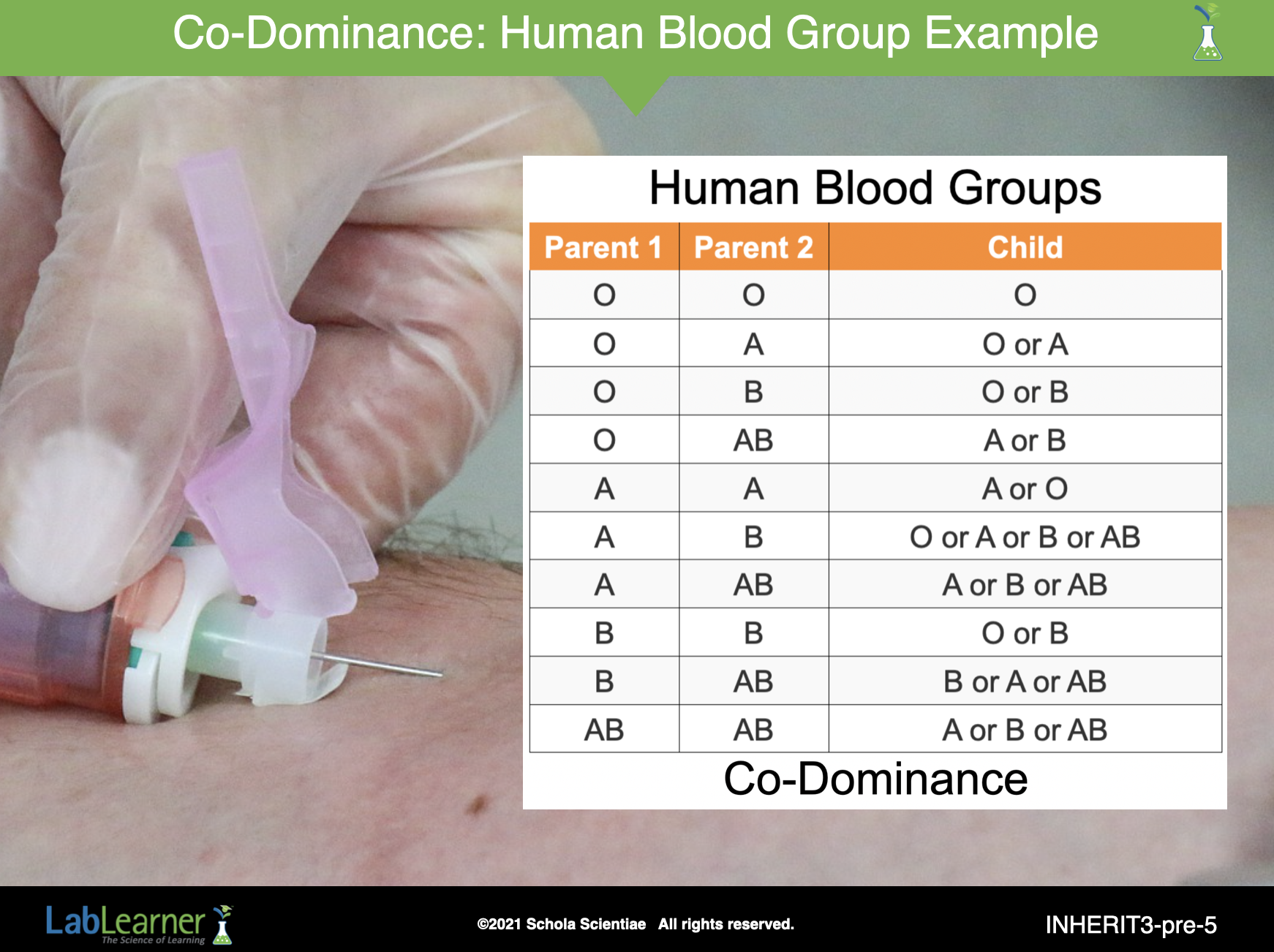
Ask students, What is the definition of co-dominance? Co-dominance is a type of inheritance in which both alleles of a gene are expressed. This results in a trait whose appearance results from the expression of both alleles independently with no mixing.
Explain to students that in co-dominance, the trait determined by each allele is clearly visible as an individual trait. For example, the blood type AB results from the expression of both the A allele and the B allele to produce both the A and the B trait.
______________________________________________
PRELAB EXERCISE
To demonstrate how the three different mechanisms of expression of pairs of alleles contribute to biologic variation, engage students in the following activity.
1. Divide students into pairs and ask each pair to select a pair of differently colored crayons or colored pencils.
2. Inform students that they will use the two different colors to represent the expression of two traits produced by two alleles of the same gene.
3. Students will first demonstrate dominance and recessiveness, then co-dominance, and then incomplete dominance.
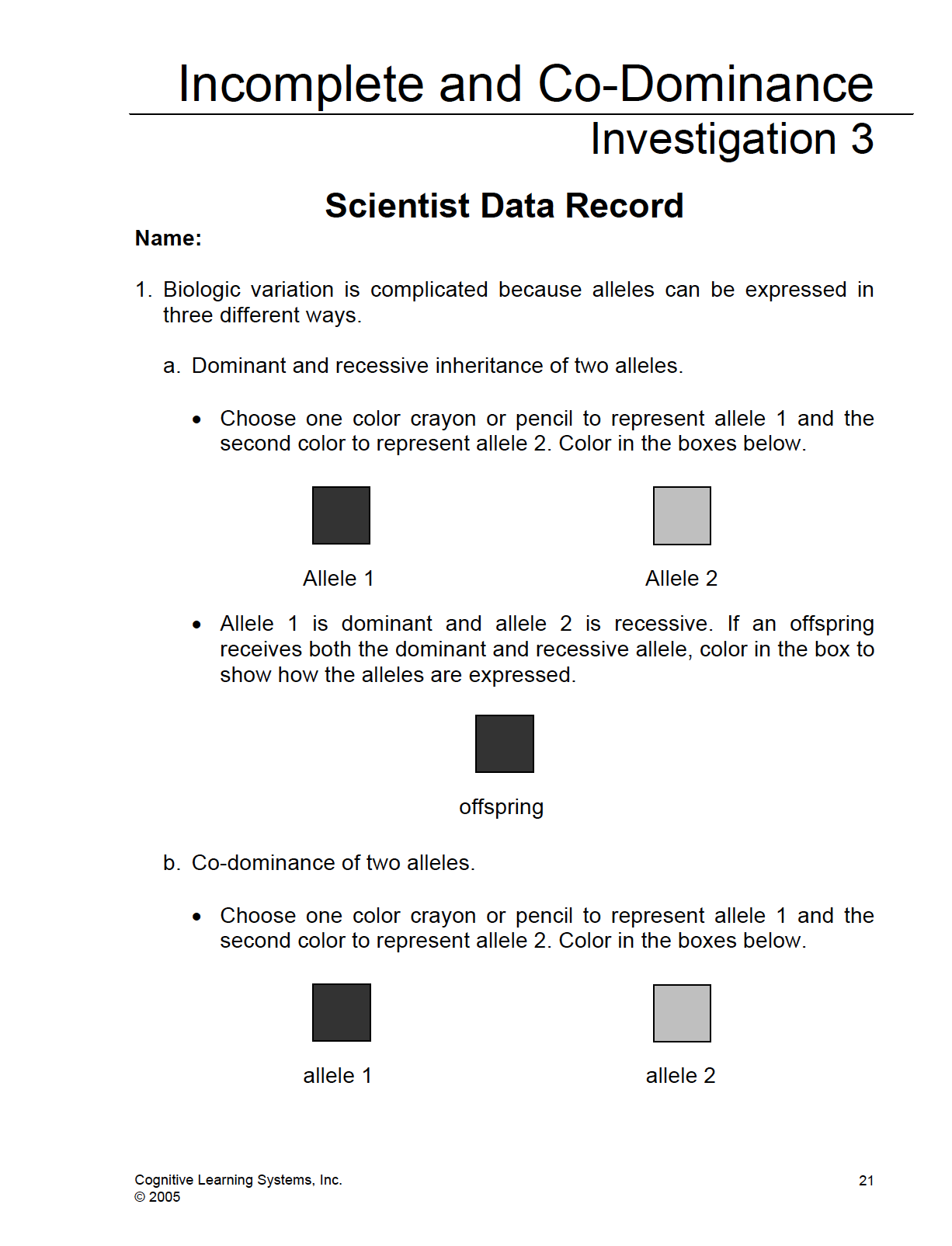
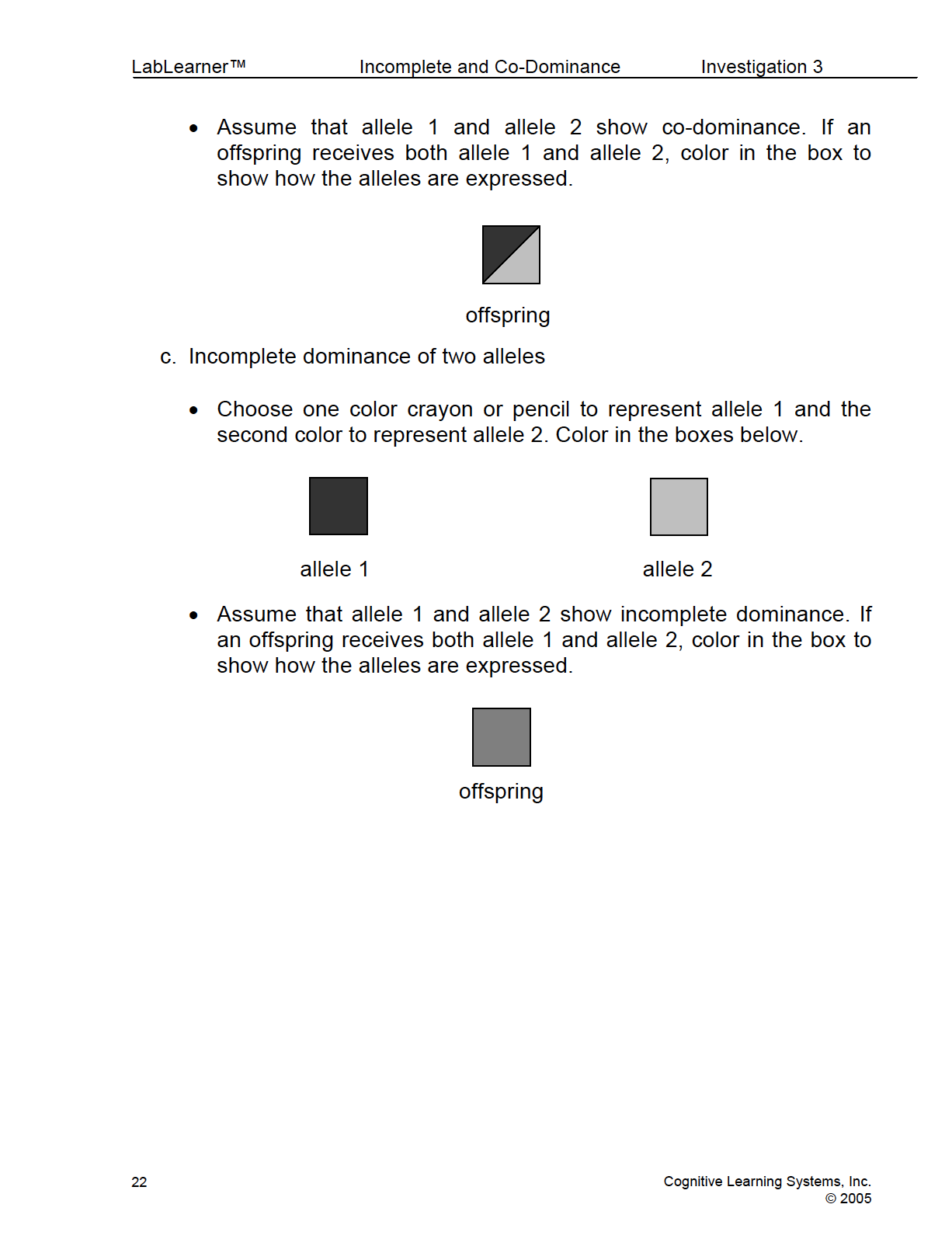
4. Work as a class. Ask students to follow the directions in Problems 1a through 1c and record their answers in their Scientist Data Record.
a. Ask a student volunteer to read Problem 1a in their Scientist’s Data Record aloud. Encourage students to color the offspring the same color that they had colored allele 1.
b. Ask a student volunteer to read Problem 1b in their Scientist’s Data Record aloud. Encourage students to color offspring half the color of allele 1 and half the color of allele 2.
c. Ask a student volunteer to read Problem 1c in their Scientist’s Data Record aloud. Encourage students to color offspring with both the color of allele 1 and allele 2.
Allow sufficient time for student pairs to complete this activity. When complete, ask students: How could these three ways for two different alleles lead to biologic variation in a population? Student answers will vary.
Biological Variation
Inform students that inheritance of chromosomes and of alleles also results in a tremendous amount of biological variation.
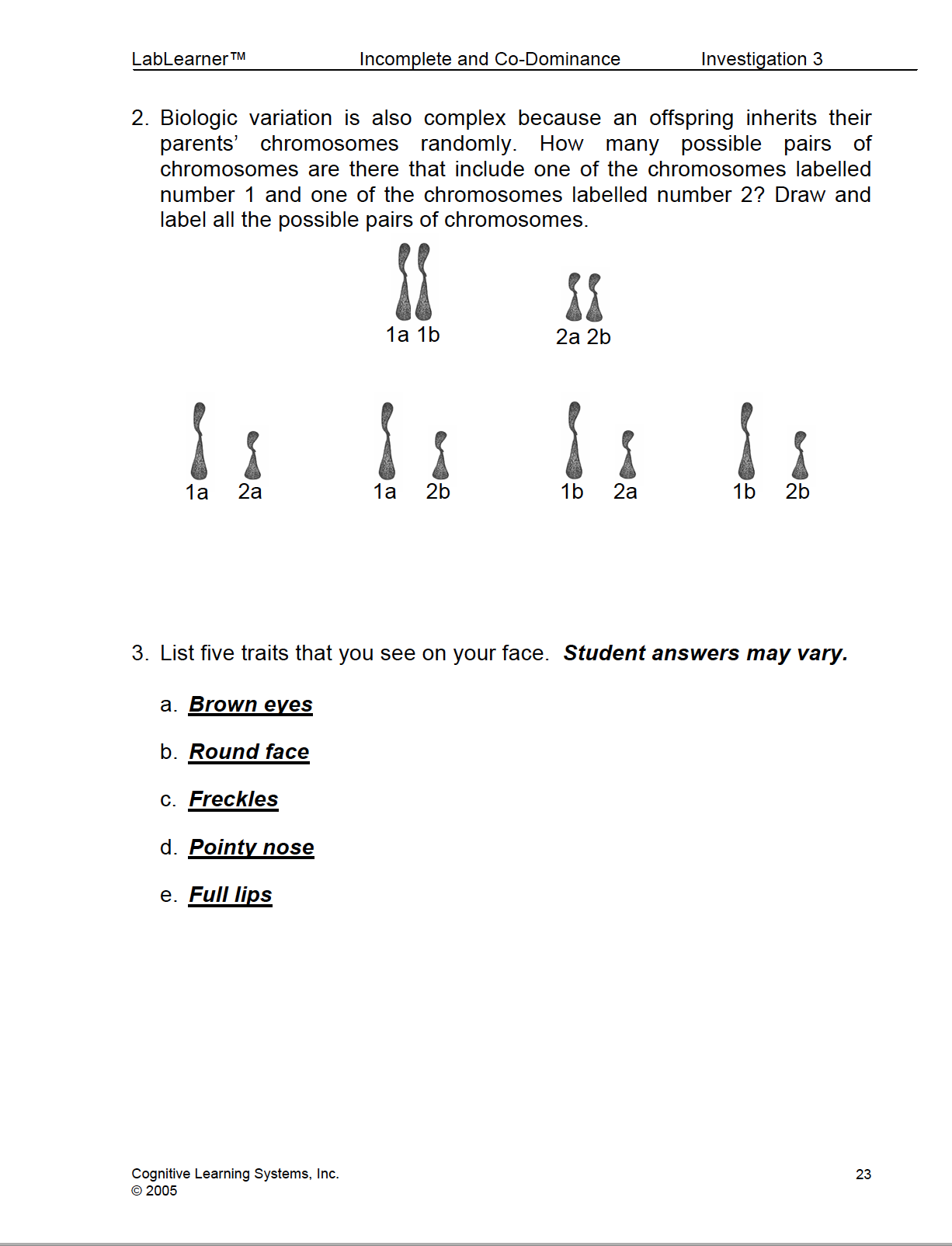
1. Inform students that an offspring could receive one or the other chromosome of each pair of chromosomes from their father and mother. This random association of parental chromosomes results in a staggering number of possible combinations of chromosomes resulting in the great variation among humans.
2. Ask students to follow the directions in Problem 2 in their Scientist Data Record and record their answer in the space provided.
3. Encourage students to realize that with only two pairs of chromosomes, a total of 4 different combinations are possible.
4. Inform students that a human offspring can randomly inherit one chromosome of each of their parents’ 23 pairs. The random association of parental chromosomes results in a staggering number of possible combinations. This results in great variation among humans. There are approximately 8 million different combinations of parental chromosomes that an offspring can inherit.
5. Inform students that biological variation is also increased if the number of genes and their alleles are considered. Inform students that there are some 50,000 genes found on human chromosomes.
a. Ask students: Think about a gene found on a human chromosome. How many alleles of the gene does a person have? Students should indicate that a person has two alleles for each gene.
b. Ask students: If every gene has two alleles, how many total alleles are found on human chromosomes? Students should indicate that there are approximately 100,000 alleles found on human chromosomes.
c. Ask students: How many combinations of alleles are possible for a person to inherit if there are 50,000 genes and 2 alleles for each gene? Student answers will vary.
Considering that there are two alleles of the 50,000 human genes, there are approximately 70 trillion different combinations of alleles that an offspring can inherit. This high potential for biological variation in the human population results in the unique characteristics of every individual.
d. Where are the alleles found in the cell? Students should indicate that the alleles are found on chromosomes.
Sexual Reproduction
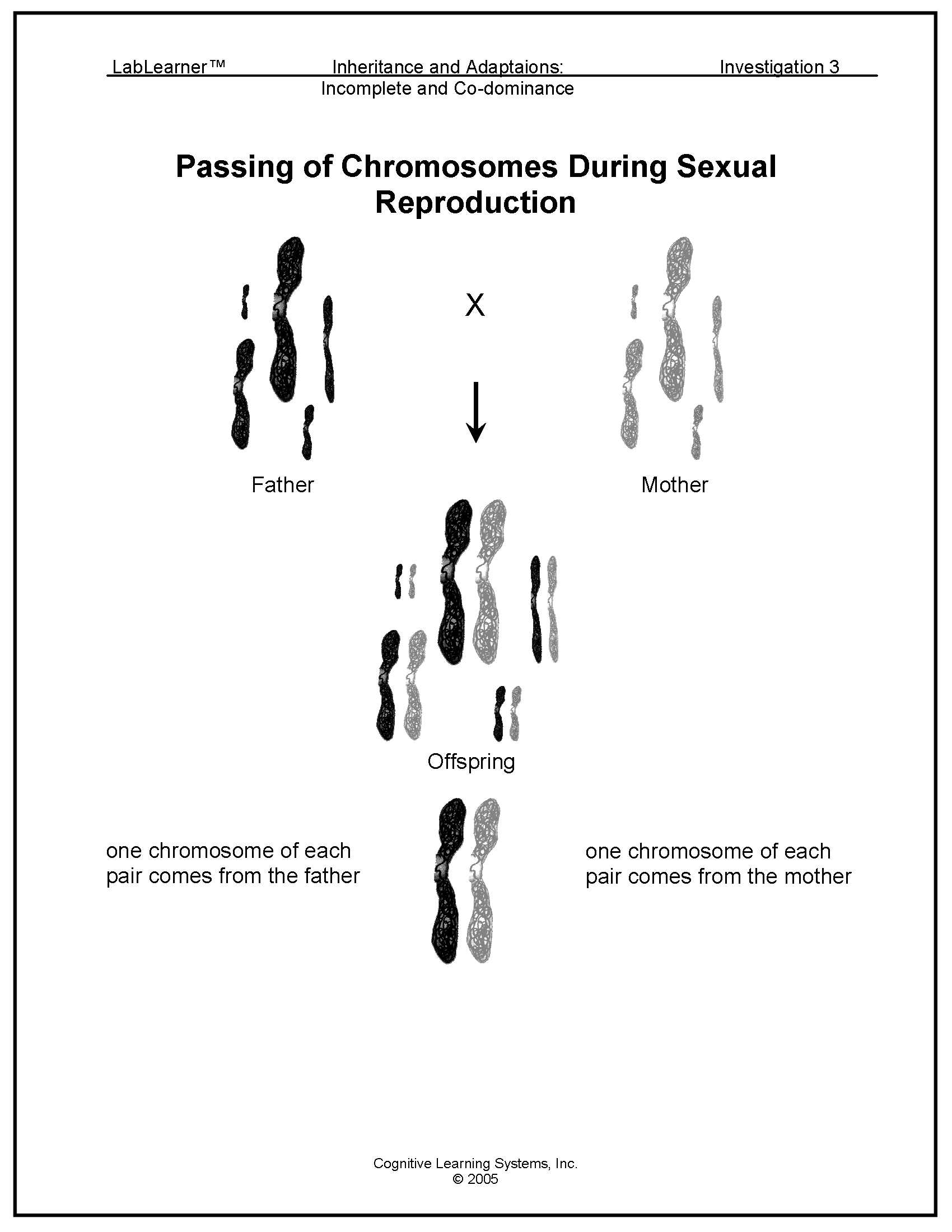
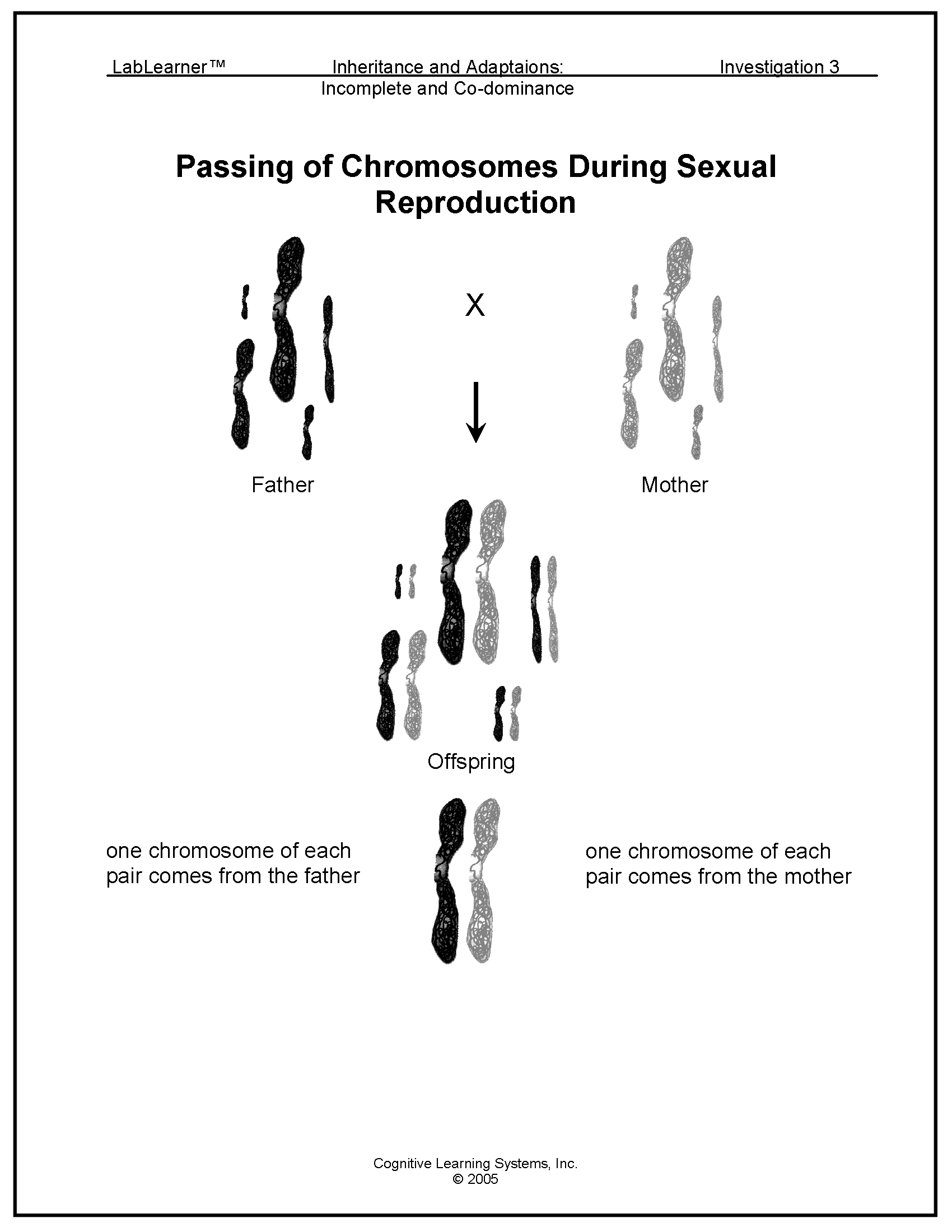 Begin a discussion of sexual reproduction using the Passing of Chromosomes During Sexual Reproduction page shown here:
1. Explain to students that during sexual reproduction, half of the father’s chromosomes and half of the mother’s chromosomes are passed to the offspring. In humans, that means that 23 chromosomes come from the father and 23 chromosomes come from the mother. This results in offspring with 46 individual chromosomes or 23 chromosome pairs.
2. Tell students that the copy of chromosomes that is passed to the offspring is random. That is, the mother and father do not choose which chromosome is passed. Ask students: How many different combinations of chromosomes do you think can be passed from parents to offspring? Student answers may vary.
Explain to students that approximately 70 trillion (70 million million) different combinations of chromosomes can be passed from parents to offspring.
3. Repeat a previous question by asking students: Do you think that the biologic variation found in the human population is high or low? Why? Students should indicate that the biologic variation found in the human population is very high due to the large number of chromosome combinations that can be inherited by offspring. Encourage students to realize that this is the reason that each human being is unique from every other human being.
The Complexity of Human Traits
Begin a discussion with students about the complexity of human traits.
1. Ask students to write down five traits that they see on their face in problem 3 of their Scientist Data Record.
2. Allow several student volunteers to share their lists with the class. Write the traits on the board as students read their lists.
3. Ask students: Look at the list on the board. Which of these facial features are genetic traits? Students should indicate that all facial features are genetic traits. It should be noted that any scar or cut found on the face is not a result of genetics. These are things that cannot be inherited by offspring.
4. Ask students: How many traits are found on the human face? Student answers may vary depending on the number of traits listed on the board.
Encourage students to realize that the human face is made up of many different traits.
Conclude this portion of the investigation by asking the following questions:
• Can two faces look exactly the same?
• How much variation in facial appearance would there be if facial traits were inherited through dominance/recessiveness, co-dominance, and incomplete dominance?
KEYS: PRELAB EXERCISE
VIEW IT
Play the following student video to the class and/or assign it as homework for students to prepare for Investigation Three lab.