Teacher Portal:
Inheritance and Adaptations
Investigation 3 – PostLab
 PRINT IT
Use your browser to download a printable PDF as help during the slide presentation and to make additional notes. In your browser, go to File > Print and then choose to save as PDF.
NAVIGATE IT
Once the slide presentation is launched
- use your left and right arrows to advance or go back in the slide presentation, and
- hover your mouse over the left edge of the presentation to get a view of the thumbnails for all the slides so that you can quickly move anywhere in the presentation.
- Click HERE to launch the slide presentation for the CELL.
SHARE IT
SLIDE INHERIT3-post-1
Begin this part of the Investigation by asking students to summarize the experiments they conducted during the Lab portion of the Investigation.
Ask students: What were the questions that you investigated during the experiments in the Lab? The questions investigated were: Are two humans exactly the same? What would a face look like if some traits are expressed through dominant and recessive alleles, co-dominance of alleles and incomplete dominance?
Remind students that before they begin an analysis of the investigation performed in the Lab, they should first Summarize what they did. This will help them recall what they did, and connect important aspects of their experiment to the concepts in genetics. As a class, review the following questions:
Ask students: How were alleles represented? Students should indicate that alleles were represented by colored gram cubes.
Ask students: How were alleles selected? Students should indicate that alleles were selected at random.
Ask students: Were all traits equally likely to be expressed? Students should indicate that traits were represented by whether they were dominant or recessive or whether they were expressed through incomplete dominance or co-dominance.
Ask students: Can you summarize the experiment using words that we have learned from our study of genetics? Students should indicate that they randomly chose pairs of alleles for each trait. For seven of the traits, they chose two dominant alleles, two recessive alleles, or one dominant and one recessive allele. For seven other traits, they also randomly chose pairs of alleles that are expressed through incomplete dominance. For one additional trait determined by co-dominance, students determined the inheritance of blood type alleles. Students then drew a picture of the face containing all chosen allele pairs and determined the blood type of the person.
______________________________________________
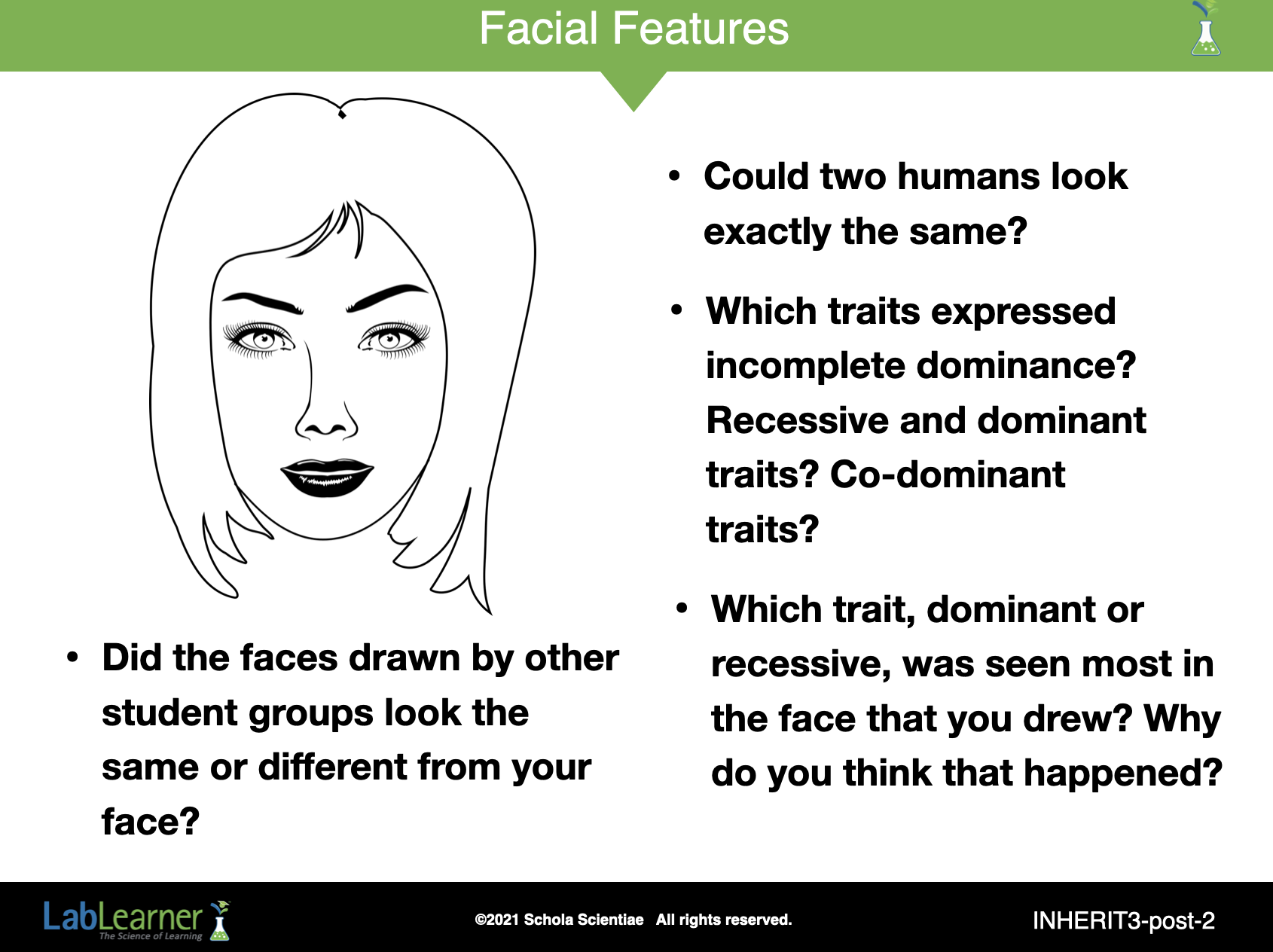
SLIDE INHERIT3-post-2
Continue analyzing the experiment by asking students to examine the different faces that were drawn.
Direct students to take a few minutes to look at some of the other faces that were drawn by student groups in the lab.
Ask students: Did the faces drawn by other student groups look the same or different from your face? Students should indicate that each face is different from group to group.
Ask students: Why do you think that each face looked different? Students should indicate that each face looked different because the alleles were randomly selected. Students may or may not realize that although two humans might appear similar (or identical in the case of identical twins); the probability of two humans looking exactly the same is virtually nonexistent.
Ask students: Look at the tables in Problem 4 of your Scientist Data Record. Which traits expressed incomplete dominance? Recessive and dominant traits? Co-dominant traits? Students should indicate that length of neck, size of ears, spacing of eyes, size of eyes, hair type, size of the mouth, and nose size were traits that expressed incomplete dominance. The shape of the face, the shape of the chin, attachment of earlobes, thickness of lips, the shape of eyebrows, length of eyelashes, and eye shape were traits that expressed recessive and dominant characteristics. Blood type was expressed through the co-dominance of the two traits.
Ask students: How did you represent the traits that expressed complete dominance in your drawings? Give an example. Students should indicate that they drew a trait that was dominant if two dominant alleles or one dominant and one recessive allele were selected. If two recessive alleles were selected, then they drew the recessive trait. For example, if students chose one dominant and one recessive allele or two dominant alleles for earlobe attachment, they would have drawn ears that were unattached. If students chose two recessive alleles, they would have draw ears that were attached.
Ask students: Which trait, dominant or recessive, was seen most in the face that you drew? Why do you think that happened? Student answers may vary.
Ask students to raise their hand if more dominant traits were seen in their face. Ask students to raise their hand if more recessive traits were seen in their face. Students should realize that more dominant traits were seen in the faces in their drawings.
______________________________________________
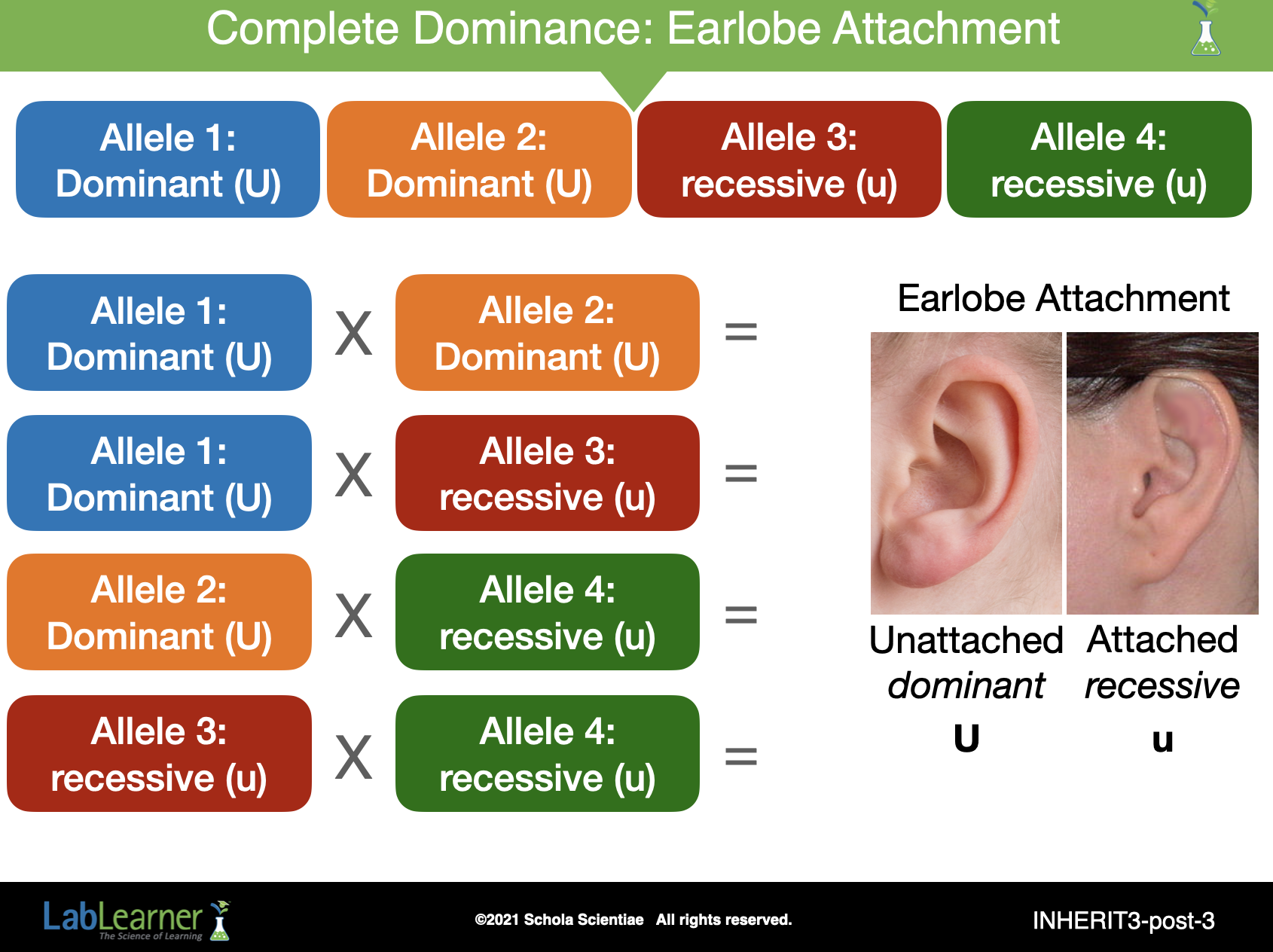
SLIDE INHERIT3-post-3
This slide should assist students’ thinking and explain this result.
Explain to students that this diagram shows the four different alleles that could have been combined to determine the attachment of earlobes.
Ask students: What allele combinations could have occurred during sexual reproduction? Which trait would have been inherited? Students should indicate that the allele combinations would be UU (unattached earlobes), Uu (unattached earlobes), and uu (attached earlobes).
Ask students: How many combinations will show the dominant trait? Recessive trait? Students should indicate that three combinations will show the dominant trait and one combination will show the recessive trait.
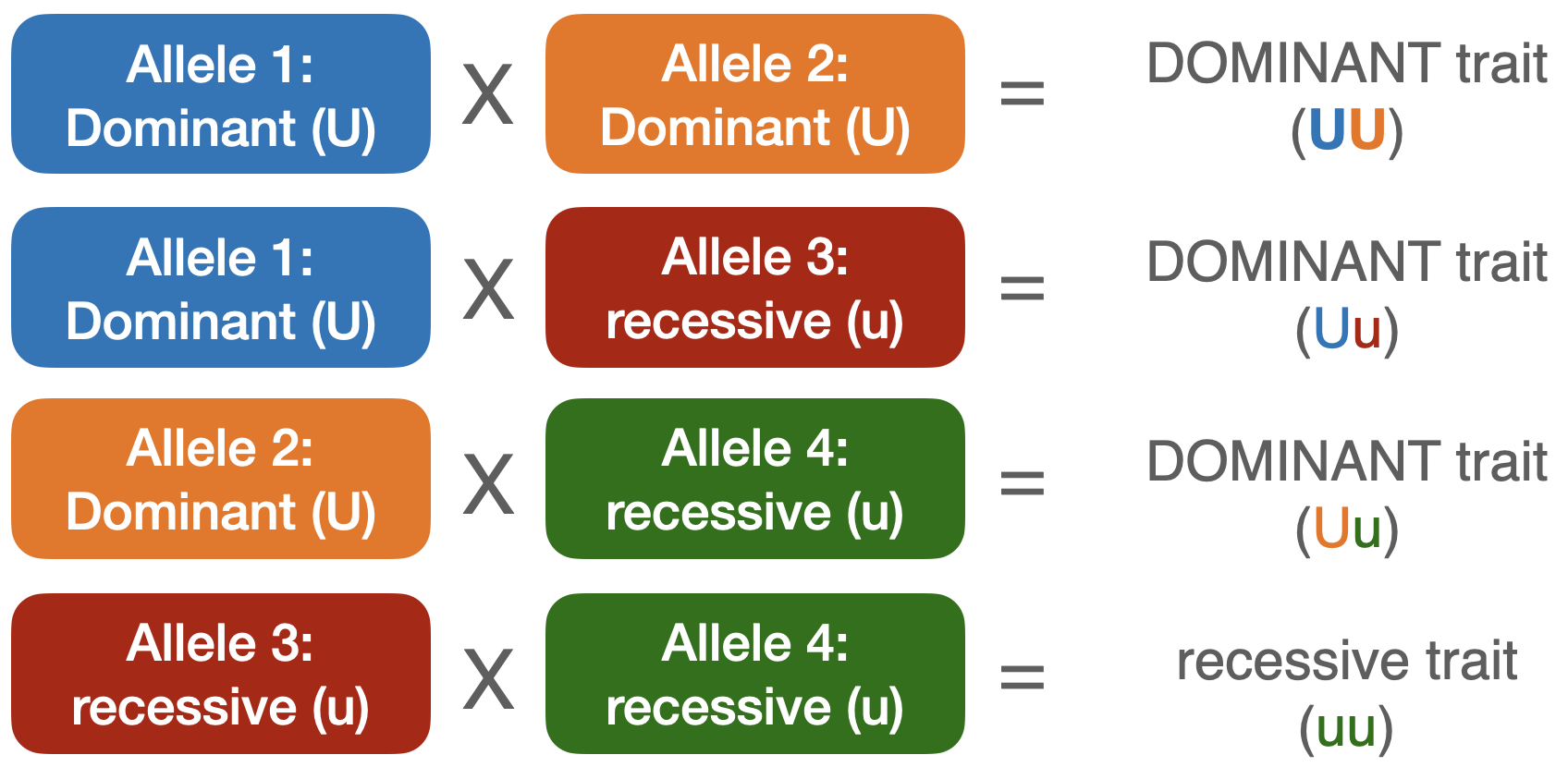
Explain to students that 3 out of 4, or 75%, of a population, will receive the dominant trait and that only 1 out of 4, or 25%, of a population, will receive the recessive trait. These numbers are called ratios. A ratio compares the amounts or quantities of two different things. It can also be written as 3:1. Students should realize that more dominant traits were seen in the faces in their drawings because the dominant trait is more likely (has a higher ratio) to occur.
Ask students: Do you think that other dominant and recessive alleles would show the same ratio? Students should indicate that other dominant and recessive alleles would show the same ratio.
______________________________________________
SLIDE INHERIT3-post-4
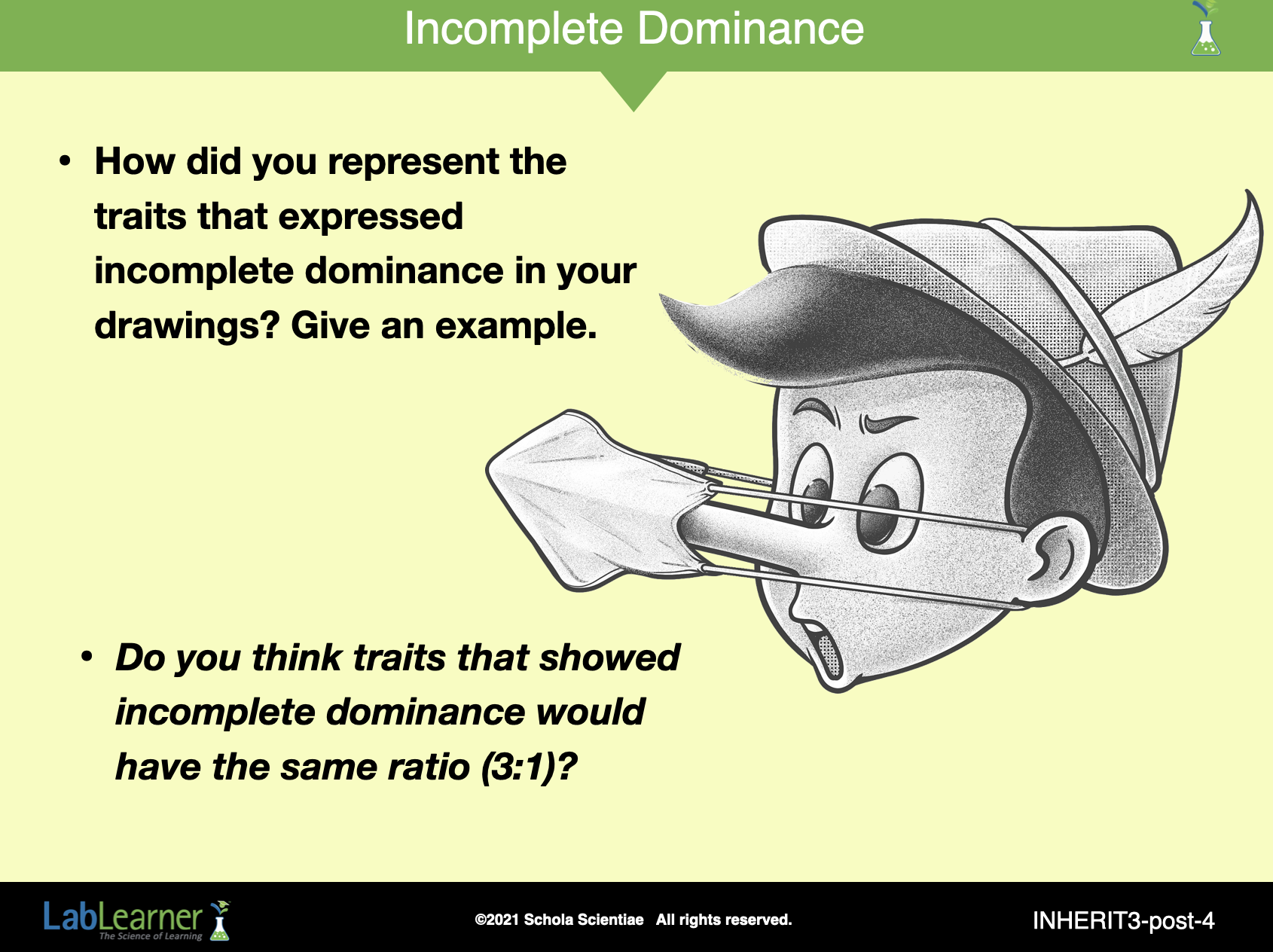
Ask students: How did you represent the traits that expressed incomplete dominance in your drawings? Give an example. Students should indicate that they drew a trait in between the traits that each allele alone determined if one of each allele were selected. For example, if students chose one large allele and one small allele for eye size, they would have drawn eyes that were of medium size. If students chose two alleles of the same type, they would have drawn eyes determined by that allele type. For example, if students chose two large alleles, the eye size drawn would have been large. If students chose two small alleles, the eye size drawn would have been small.
Ask students: Do you think traits that showed incomplete dominance would have the same ratio (3:1)? Student answers may vary.
Encourage students to raise their hand if their face showed the medium trait for nose size. Encourage students to raise their hand if their face showed the long trait for nose size. Encourage students to raise their hand if their face showed the short trait for nose size. Students should realize that the intermediate trait (medium size nose) was more prevalent than either the long trait or the short trait.
______________________________________________
SLIDE INHERIT3-post-5
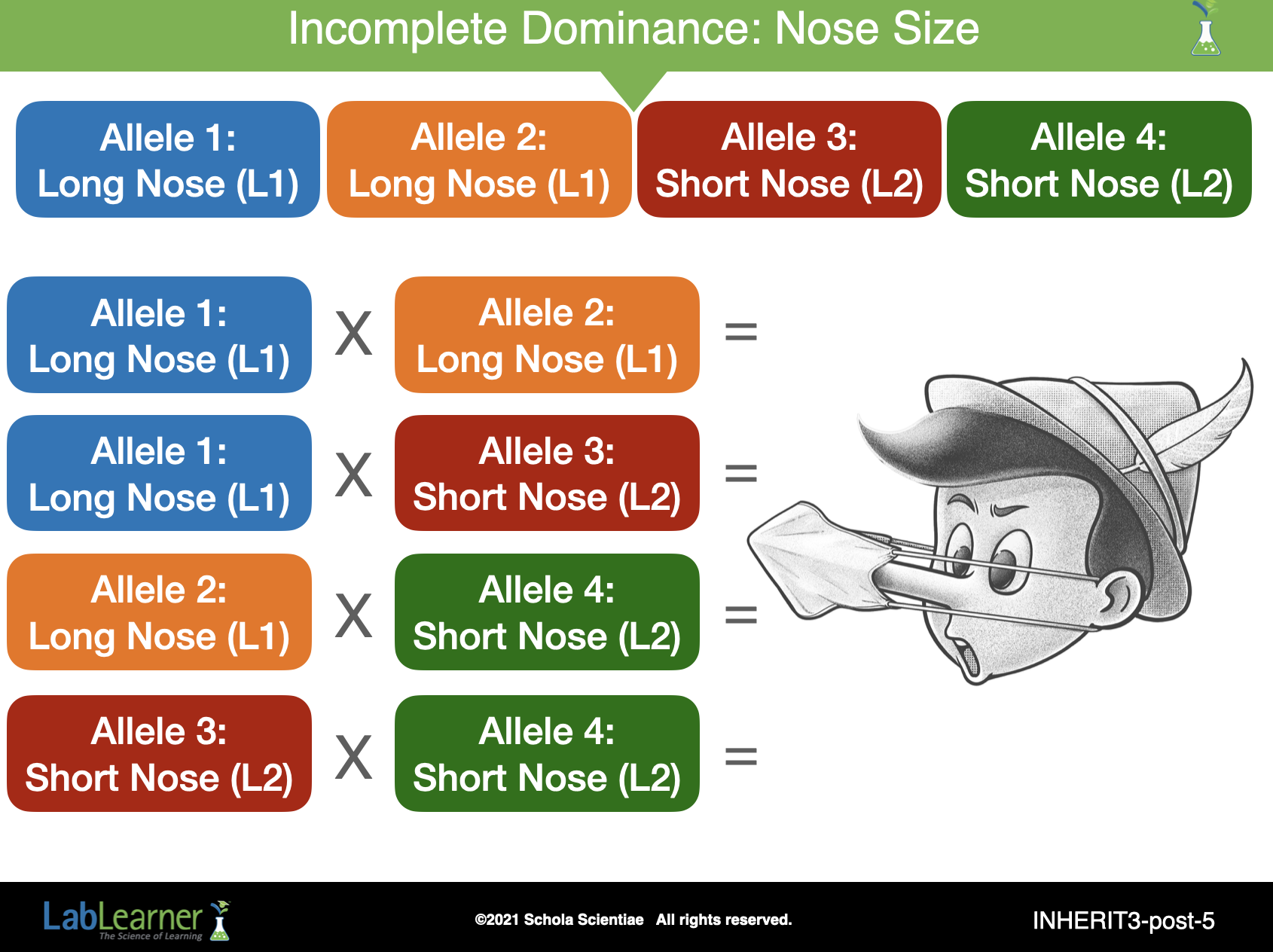
This slide should assist students’ thinking and explain incomplete dominance results.
Explain to students that this diagram shows the four different alleles that could have been combined to determine nose size.
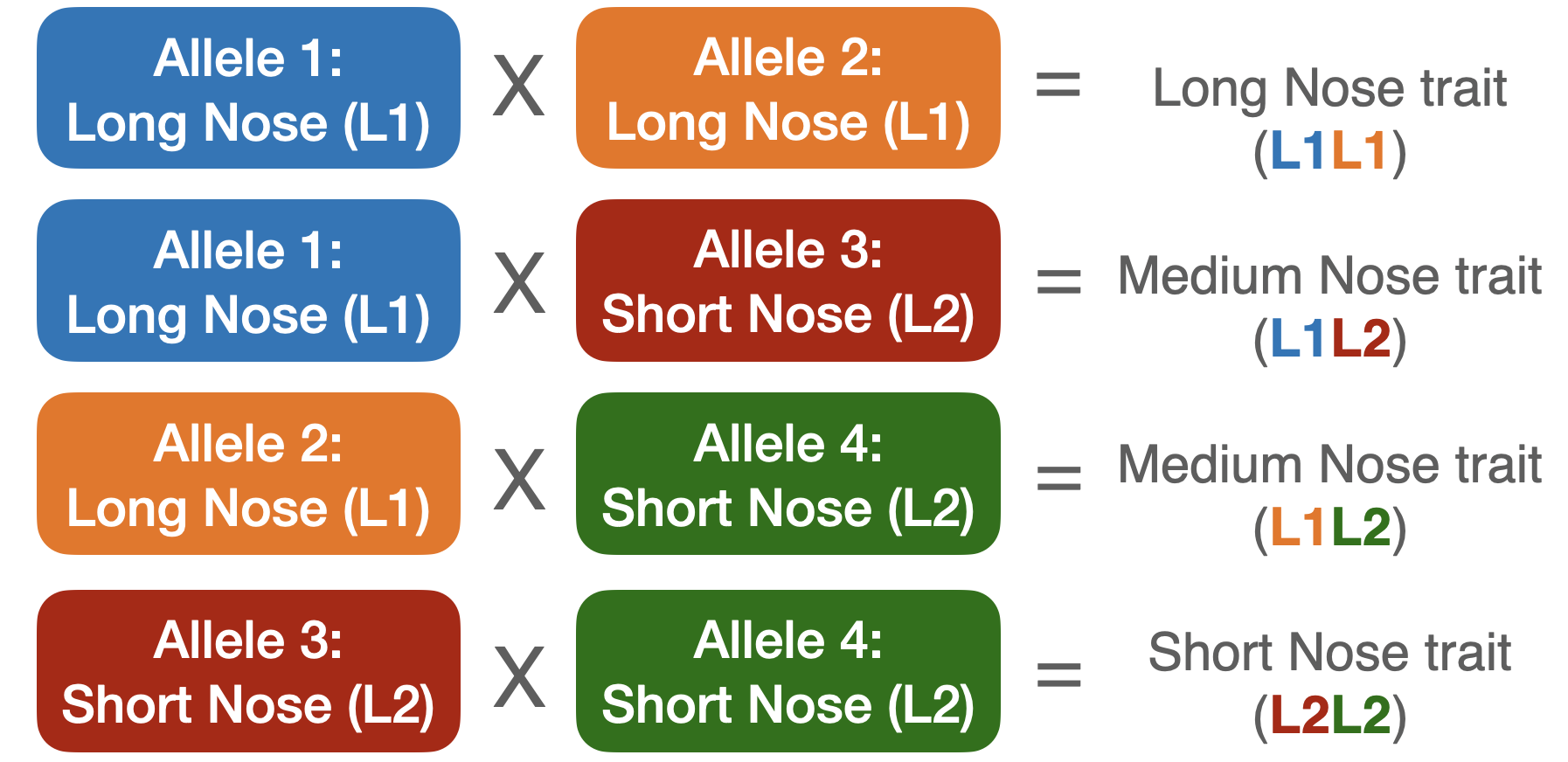
Ask students: What allele combinations could have occurred during sexual reproduction? Which trait would have been inherited? Students should indicate that the allele combinations would be L1L1 (long nose), L1L2 (intermediate or medium size nose), and L2L2 (short nose).
Ask students: How many combinations will show the long nose trait? Short nose trait? Intermediate (medium-length nose) trait? Students should indicate that one combination will show the long nose trait, one combination will show the short nose trait, and two combinations will show the intermediate or medium length nose trait.
Explain to students that 1 out of 4, or 25%, of a population, will receive the long nose trait; 2 out 4, or 50%, of a population, will receive the intermediate or medium length nose trait; and 1 out of 4, or 25%, of a population, will receive the short nose trait. This can also be written as 1:2:1.
Encourage students to realize that for traits inherited by incomplete dominance, the intermediate trait is more often seen in the faces because it is more likely (has a higher ratio) to occur.
______________________________________________
SLIDE INHERIT3-post-6
Encourage students to use and apply the knowledge they have gained during this CELL to work through a genetics problem.
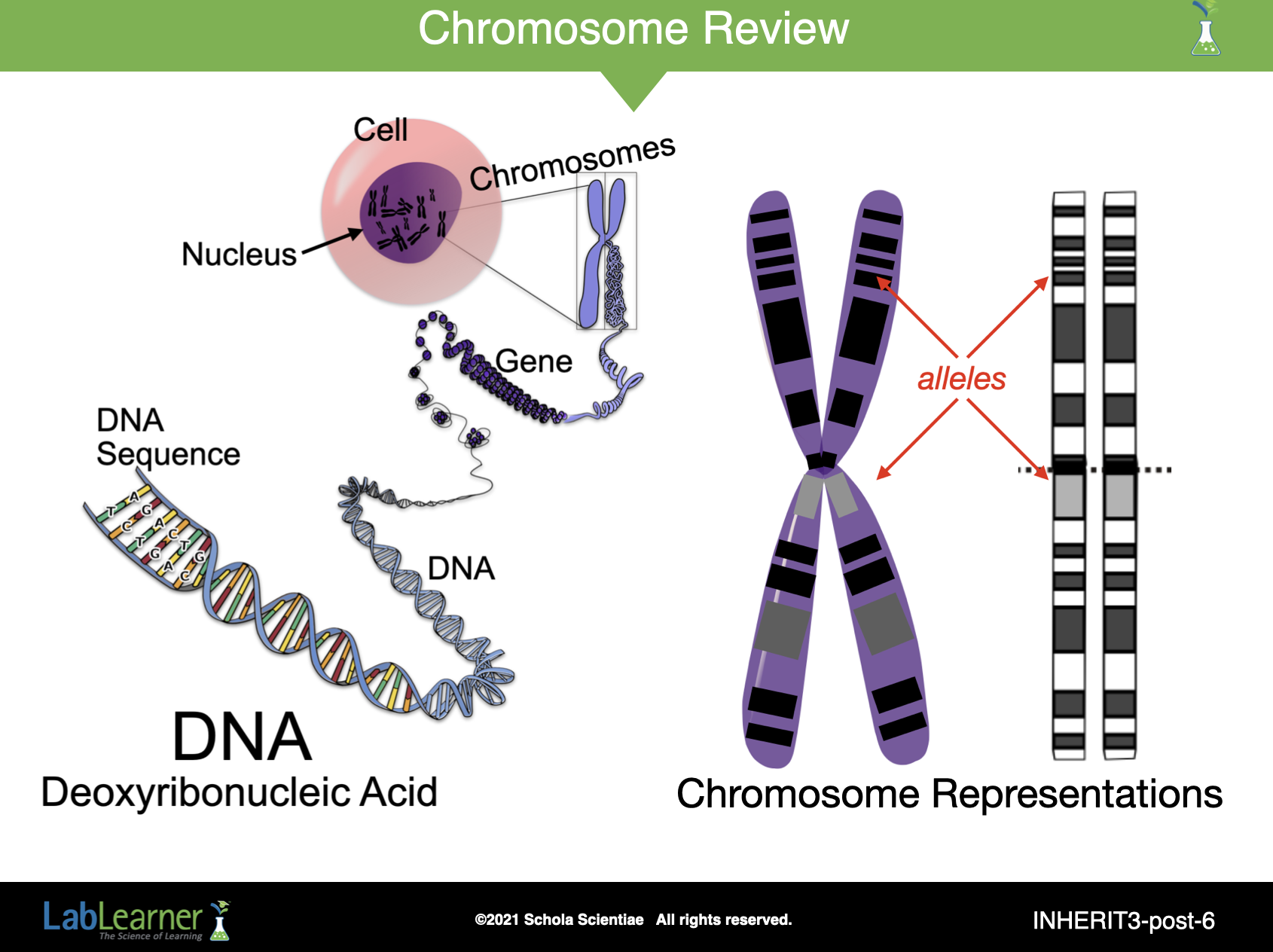
First, ensure recall of the important features of a chromosome, particularly how alleles are distributed along the length of the “arms”. In reviewing this slide, be sure to notice the location of the DNA molecule. This concept is important because when we say a gene or allele has been inherited, we are really saying that a part of a particular length of the DNA molecule was inherited.
Ask students: Can you describe a chromosome? Students should indicate that a chromosome is made up of DNA that is tightly wound around proteins and itself to form the shape of a chromosome. A chromosome contains several genes. Each chromosome has a copy that contains the same genes that have slightly different information. The pair of genes found on a chromosome pair are called alleles.
______________________________________________
POSTLAB EXERCISE
Inform students that they are going to use a Cognitive Tool that involves using what they have learned in another situation in order to solve a problem. If necessary, remind students that this means that they will Apply what they have learned.
1. Divide students into groups of three.
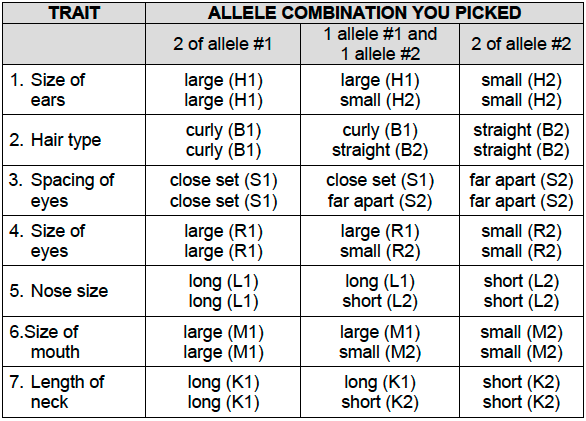 2. Ask student groups to locate Problem 5 of their Scientist Data Record. Encourage students to use the Table in Problem 4b to assist them as they work through the problem.
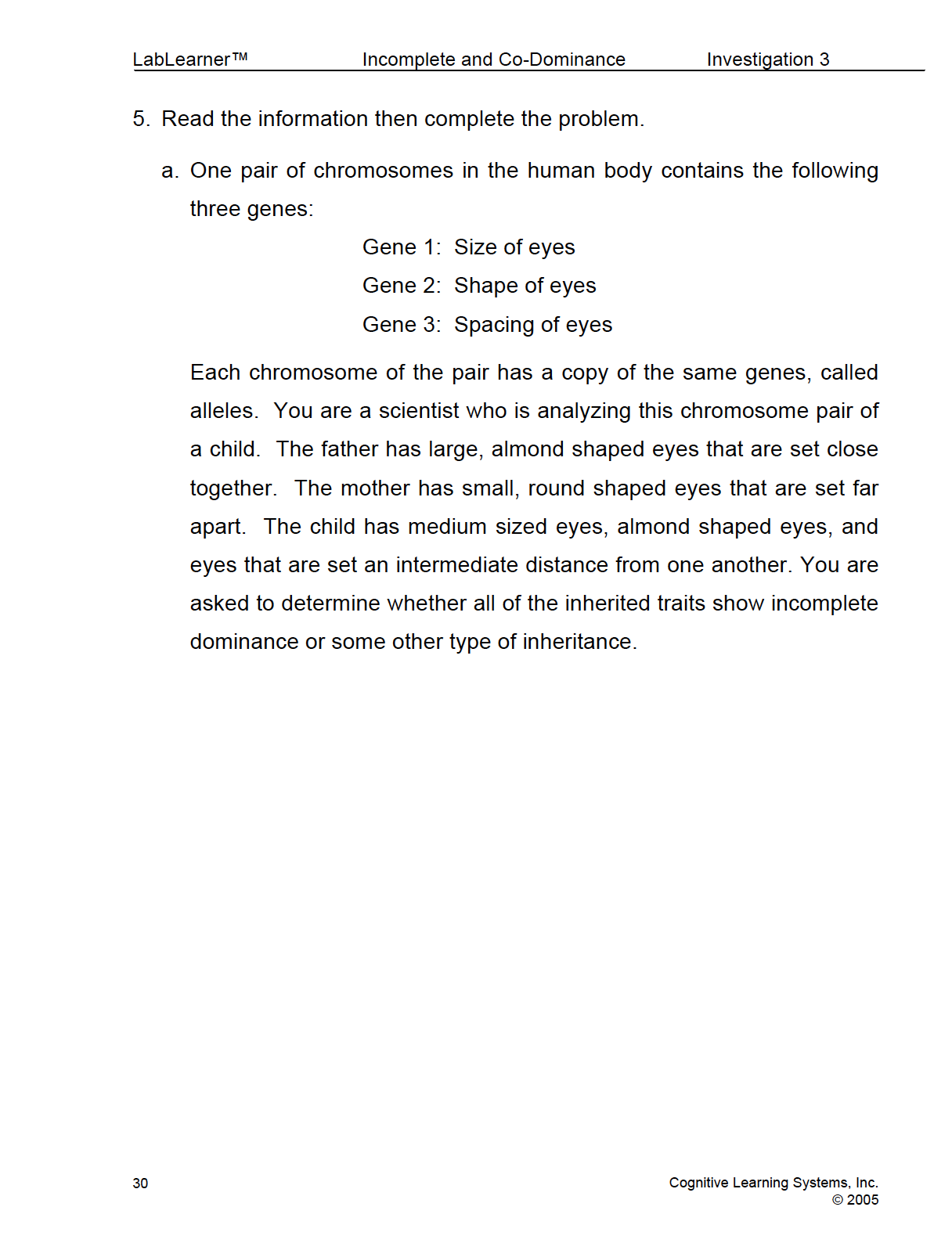
3. Explain to students that problem 5a contains a paragraph that provides information about a particular pair of chromosomes. The paragraph can be read individually, as a group, or as a class.
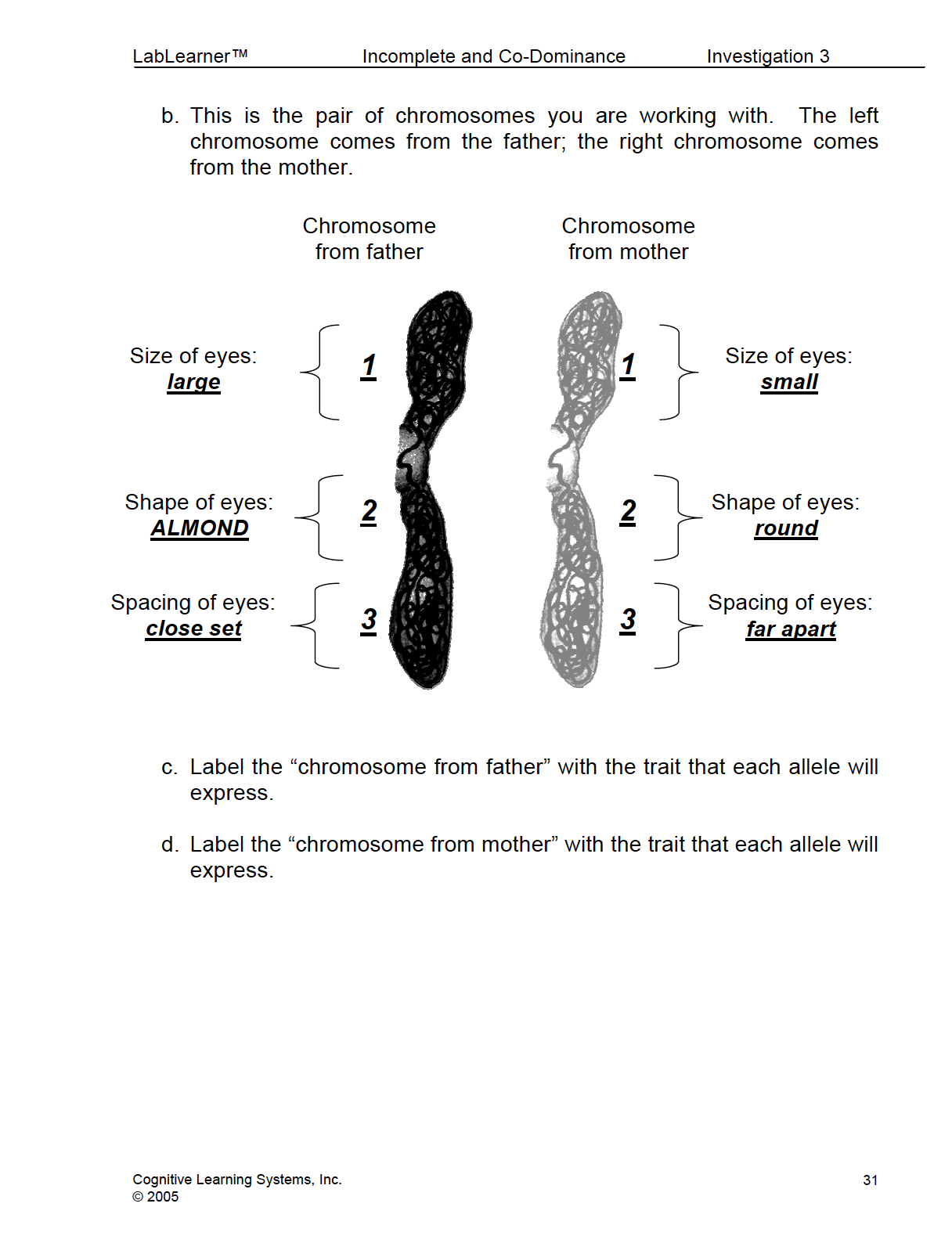
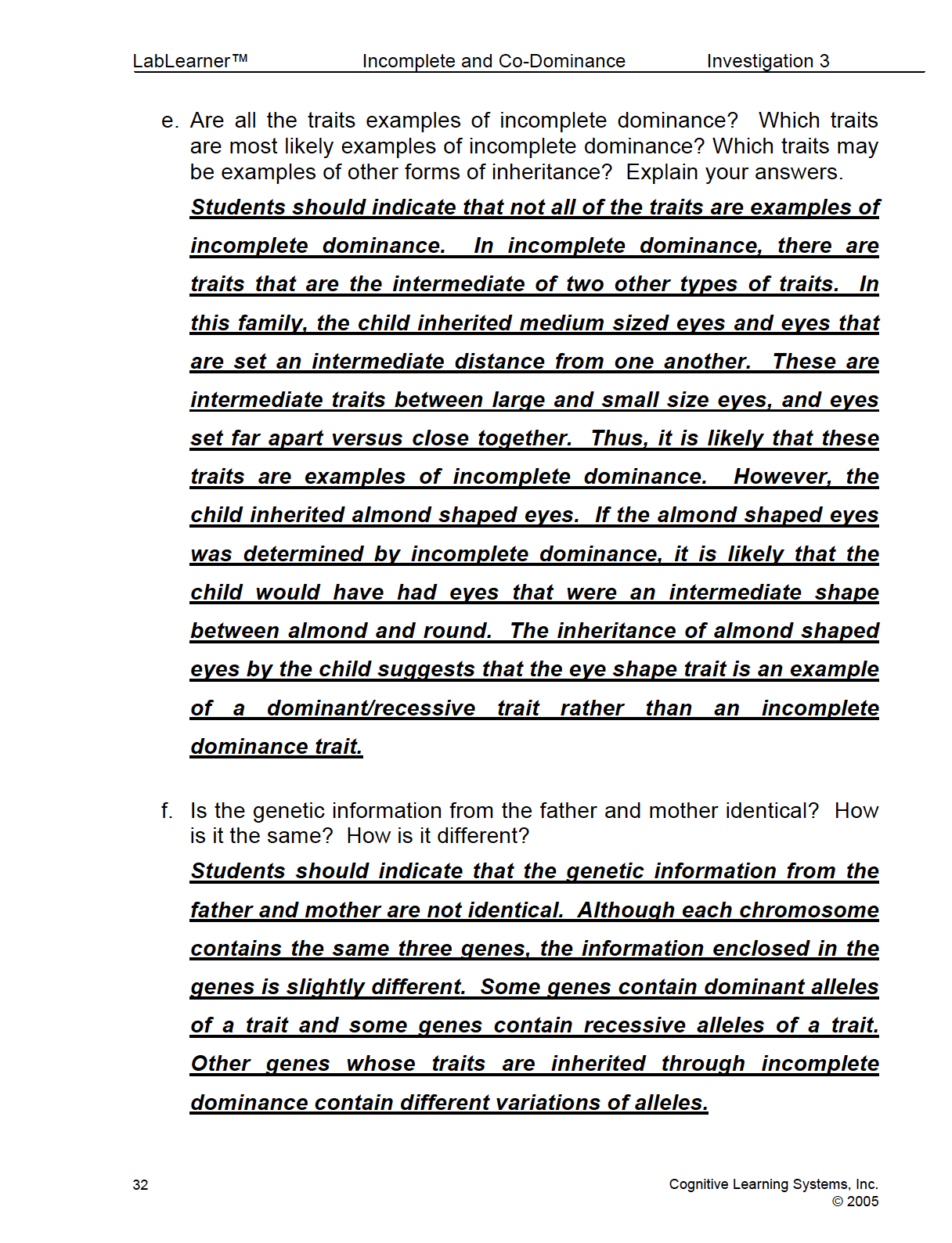
4. After the paragraph has been read, direct student groups to complete the chromosome pair found in Problem 5b. Students should then answer Problems 5e and 5f of their Scientist Data Record.
5. Allow sufficient time for students to complete this activity. After it is complete, ask several student volunteers to share their answers with the class. It may be helpful to draw a diagram of the chromosomes on the board as students share their answers.
Note: Explain to students that each of the three sections of the chromosomes represents a gene on each chromosome.
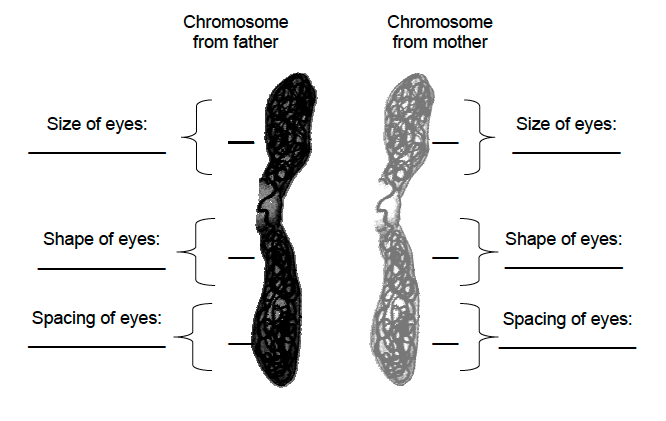
Conclude this portion of the investigation by explaining to students that the chromosomes found in a cell contain an enormous amount of information about the structure and function of an organism.
Ask students:
• How do you think genetic information is read by the cells?
• What do you think would happen if there was a mistake in the genetic information that is passed from parents to offspring?
KEYS: POSTLAB EXERCISE